


You know what's worse than clients missing sessions? Watching your automated session reminders fail spectacularly because they were built wrong from the start.
A career coach I know runs a solid $12K monthly practice. Beautiful website, clients love the work, genuine results. But her show-up rate sits around 68%. That's roughly one in three sessions getting rescheduled or forgotten entirely. The kicker? She has reminders set up. They just don't work.
This is more common than coaches want to admit. The assumption is that technology alone fixes attendance problems. It doesn't. The gap between reminders that move the needle and ones that become background noise comes down to behavioral engineering, not just setting up a drip sequence.
The Real Numbers Behind Missed Sessions
Most coaches underestimate how far the damage spreads. It's not just the lost session fee.
When a client misses their Tuesday 2pm slot, you lose:
-
The session revenue (obvious)
-
The momentum they had from last week's breakthrough
-
The homework they would have completed knowing they'd review it
-
The referral energy from someone making consistent progress
-
Your own mental energy switching from prepared coaching mode to admin scramble
A coach with 25 active clients typically sees somewhere between 4-7 no-shows monthly without decent reminder sequences. At $150 per session, that's $600-1,050 in direct revenue loss. But the indirect costs hurt more. Clients who miss sessions regularly have significantly higher dropout rates. They complete maybe 40% of assigned work between sessions versus closer to 75% for consistent attendees.
The frustrating part? Most coaches already send reminders. They're just sending them wrong.
Why Standard Reminders Fail
Standard reminder templates create notification blindness within weeks.
Never miss a session or detail again.
Guidyly helps you book, manage, and track every coaching session efficiently.
- Centralized session scheduling
- Automated client reminders
- Progress tracking & notes
No credit card required
Your practice management software sends the same "Don't forget your appointment tomorrow at 3pm" email 24 hours before every session. Maybe a text goes out too. Same message, same timing, every single time.
By session four, clients stop seeing these. Their brain filters them out as repetitive, low-value noise. It's the same psychological pattern that makes us scroll past banner ads without registering them.
The behavioral science is clear: humans respond to variable reinforcement and contextual relevance, not predictable patterns. Most automated session reminders coaches use follow the exact opposite approach.
Building Sequences That Actually Work
Effective reminder sequences run on three core principles:
Timing variability keeps messages from becoming invisible. Instead of always sending at 24 hours, you rotate between 48-hour prep reminders, 24-hour confirmations, and 2-hour final nudges. The unpredictability maintains attention.
Channel mixing reaches people where they're actually paying attention. Email works for homework reminders a few days out. Text catches last-minute confirmations. Voice notes create personal connection for clients who are slipping.
Contextual personalization makes each reminder feel relevant. The reminder for session two should be completely different from session ten. A client who missed last week needs different messaging than someone with perfect attendance.
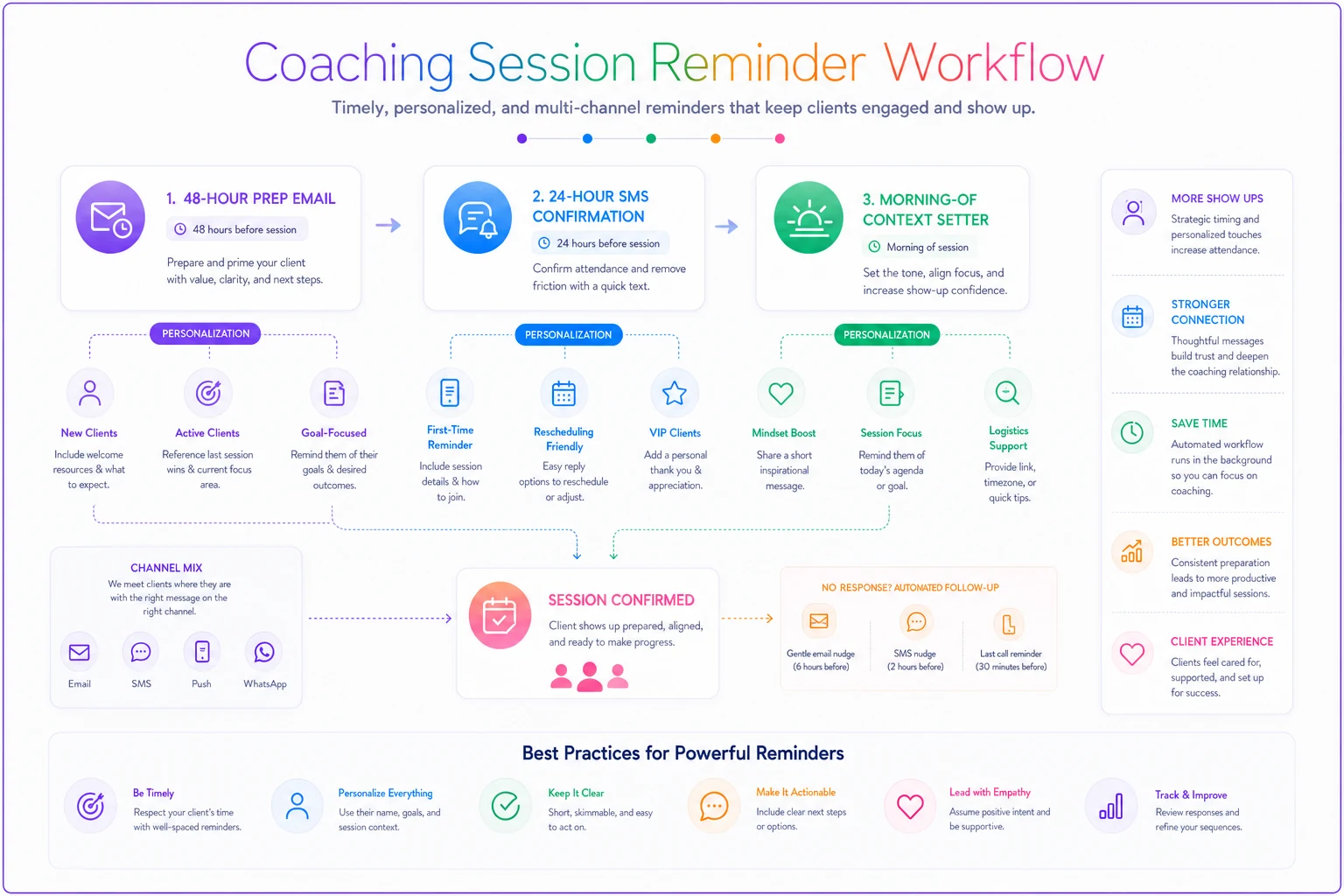
This diagram maps the sequence flow and where personalization branches should occur.
Here's what this looks like in practice:
The 48-Hour Prep Reminder
Two days before the session, send an email that frames preparation, not just attendance:
"Thursday's session will focus on the networking strategy we outlined. Before we meet:"
-
Review your three target companies list
-
Draft one outreach message using the template
-
Note any concerns about the approach
"This prep will help us use our full 45 minutes on refinement rather than review."
Notice how this reminder assumes attendance while creating accountability for homework. It's not asking if they'll show up. It's helping them prepare to make the session valuable.
The 24-Hour Confirmation
"Confirming tomorrow 2pm for our session. Reply YES to confirm or RESCHEDULE if you need to move it. Looking forward to reviewing your outreach drafts."
This creates a micro-commitment through the reply requirement while maintaining flexibility for real conflicts.
The Morning-Of Context Setter
"This afternoon we're tackling your LinkedIn outreach resistance. Bring your laptop so we can draft messages together in real-time. If you haven't done the prep work, no judgment - we'll work with where you are."
That last line matters more than it looks. Fear of showing up unprepared causes more no-shows than actual scheduling conflicts.
The Channel Mix That Maximizes Response
Different channels serve different psychological functions in a reminder sequence:
Email works for content-heavy reminders. Homework instructions, session agendas, resource links — anything requiring reference or review. Response rates hover around 22% for well-crafted reminder emails.
SMS drives immediate action. Confirmation requests, last-minute logistics, quick accountability checks. SMS sees response rates closer to 45% but only when used sparingly. More than 3-4 texts weekly and people start opting out.
Voice messages create personal connection for at-risk clients. A 30-second voice note — "Hey Sarah, looking forward to continuing our momentum tomorrow" — can rescue a session that seemed headed for cancellation. Use these selectively, maybe one in five sessions for clients showing warning signs.
Calendar invites provide persistent visibility. The appointment sitting in their calendar app is a passive reminder every time they check their schedule. Always include the Zoom link and a one-line agenda in the invite description.
Push notifications from coaching apps reach the always-online client. These work better for homework nudges between sessions, not appointment reminders. "Time to complete your weekly reflection" at 7pm Sunday tends to land better than yet another appointment reminder.
| Channel | Function |
|---|---|
| works for content-heavy reminders. Homework instructions, session agendas, resource links — anything requiring reference or review. Response rates hover around 22% for well-crafted reminder emails. | |
| SMS | drives immediate action. Confirmation requests, last-minute logistics, quick accountability checks. SMS sees response rates closer to 45% but only when used sparingly. More than 3-4 texts weekly and people start opting out. |
| Voice messages | create personal connection for at-risk clients. A 30-second voice note — "Hey Sarah, looking forward to continuing our momentum tomorrow" — can rescue a session that seemed headed for cancellation. Use these selectively, maybe one in five sessions for clients showing warning signs. |
| Calendar invites | provide persistent visibility. The appointment sitting in their calendar app is a passive reminder every time they check their schedule. Always include the Zoom link and a one-line agenda in the invite description. |
| Push notifications | from coaching apps reach the always-online client. These work better for homework nudges between sessions, not appointment reminders. "Time to complete your weekly reflection" at 7pm Sunday tends to land better than yet another appointment reminder. |
Calendar invites provide persistent visibility. The appointment sitting in their calendar app is a passive reminder every time they check their schedule. Always include the Zoom link and a one-line agenda in the invite description.
Personalization Rules That Drive Engagement
Generic reminders get ignored. Personalized ones get results. But personalization doesn't mean manually crafting every message.
Attendance History Segmentation
Clients with perfect attendance need minimal reminding. A simple confirmation text 24 hours out maintains the pattern without overselling.
Clients who've missed once in the last month get the full sequence: prep reminder, confirmation, morning-of context setter. You're rebuilding the habit.
Chronic cancelers need something different entirely. Direct, not punitive: "I've noticed we've rescheduled three times this month. Tomorrow's session will focus on identifying what's making consistency difficult. This is important work — please prioritize attending."
Progress Momentum Messaging
Clients making rapid progress get reminders that reinforce their momentum: "You crushed last week's goals. Tomorrow we're building on that foundation with advanced strategies."
Struggling clients need encouragement-based reminders: "Tomorrow's session is a reset opportunity. Come as you are — we'll find a path forward together."
Session Number Targeting
First-month clients need extra hand-holding. Include logistics in every reminder: Zoom link, what to prepare, how long sessions run, your cancellation policy.
Month 2-3 clients benefit from homework accountability in reminders: "Bring your completed worksheets from last session."
Veteran clients (4+ months) respond to variety and challenge: "Tomorrow we're trying something different — a role-play exercise for your upcoming difficult conversation."
Copy Templates That Convert
The Anticipation Builder (48 hours out, email)
Subject: Prep for Thursday's breakthrough session
Hi [Name],
-
Thursday's session targets the exact challenge you mentioned last week
[specific issue].
-
Before we meet
-
- [Specific prep task 1]
-
- [Specific prep task 2]
-
Jot down what success looks like for you
This prep ensures we spend our time solving, not explaining.
See you Thursday at [time], [Your name]
---
The Gentle Accountability (24 hours out, SMS)
Tomorrow at [time] we're reviewing your [specific homework]. Reply YES to confirm you'll be there or RESCHEDULE if needed. Either way, let me know!
---
The No-Judgment Reset (for chronic cancelers, email)
Subject: Tomorrow's session is especially important
[Name],
I know showing up has been challenging lately. Tomorrow, let's talk about why and adjust our approach.
No preparation needed. Just show up. We'll work with wherever you are right now.
This session could be the turning point.
[Your name]
---
The Progress Celebration (for consistent attendees, SMS)
Can't wait to hear about your wins tomorrow at [time]! Bring your success stories — we're celebrating progress before diving into next steps.
Homework Completion Sequences
Getting clients to do the work between sessions requires different behavioral triggers than appointment reminders. You're not fighting scheduling conflicts — you're fighting procrastination and overwhelm.
The most effective approach breaks homework into micro-commitments throughout the week:
-
Day of session Email summary with homework clearly outlined and linked resources
-
Day 2 SMS check-in: "Quick check — did you schedule time for this week's exercises?"
-
Day 4 Email with partial completion option: "If you only do one thing before our next session, make it the values clarification exercise. 15 minutes max."
-
Day 6 Final nudge with permission to be imperfect: "Tomorrow we review your homework. Whatever you've completed is enough. Partial progress counts."
This sequence acknowledges real life while maintaining accountability. Clients who receive structured homework reminders tend to complete around 70% of assignments versus roughly 35% with no follow-up.
Common Mistakes to Avoid
Over-reminding kills engagement faster than under-reminding. More than five touchpoints per week and clients start associating your name with nagging rather than support.
Apologetic language undermines your authority. Never write "Sorry to bother you but..." or "I know you're busy but..." These phrases train clients to see sessions as optional inconveniences.
Rigid timing ignores client reality. An executive coach working with CEOs shouldn't be sending 2pm reminders when clients are buried in back-to-back meetings. A life coach serving parents needs to avoid school pickup hours. Know your audience's actual rhythm.
Missing the human touch even inside automation. Templates should feel like they came from you. Include specific references to previous conversations, use their actual goals in messaging, acknowledge their real challenges.
Measuring What Works
Track these metrics monthly to figure out what's actually worth keeping:
-
Show-up rate by reminder type
-
Response rate to confirmation requests
-
Homework completion percentage
-
Client retention correlation with attendance
Most coaches discover surprising patterns when they actually look at the data. Maybe Tuesday reminders get better responses than Thursday ones. Perhaps voice notes work for introverted clients but annoy extraverts. You won't know without tracking it.
A simple spreadsheet — sends, responses, attendance — reveals optimization opportunities within 6-8 weeks. One coach found that adding emoji to SMS confirmations improved response rates by 15%. Another learned that homework reminders sent Sunday evening got three times better completion than Monday morning sends.
The Operational Reality
Setting up behavioral reminder sequences manually is genuinely painful. You're tracking multiple timings, channels, and personalization rules across dozens of clients. Managing the reminders becomes a part-time job on top of actually coaching.
This is where AI-powered operational software changes the picture. Instead of manually scheduling each reminder, you build the behavioral rules once and let the system handle execution — timing variations, channel selection, personalization based on client history. When certain clients consistently respond better to morning reminders, the system learns that and adjusts. When homework completion drops, it can trigger alternative messaging. You focus on coaching; the platform handles the behavioral engineering side.
That said, the principles matter more than the tools. Whether you're using sophisticated software or a basic calendar system, variable timing beats predictable patterns, mixed channels outperform single touchpoints, and personalized context will always outperform generic reminders.
Making It Sustainable
The best reminder system is one you'll actually maintain. Start simple:
-
Week 1-2 Implement just the 24-hour confirmation text. Track show-up rates.
-
Week 3-4 Add the 48-hour prep email. Monitor homework completion.
-
Week 5-6 Layer in attendance-based personalization. Measure the difference.
-
Week 7-8 Introduce channel mixing based on what's working.
Build complexity gradually as you see results. A basic but consistent system beats an elaborate one you abandon after three weeks.
Begin by implementing the 24-hour confirmation text and tracking show-up rates.
Most coaches see meaningful improvement within the first month. One executive coach went from 71% to 86% show-up rate just by adding variation to her reminder timing. A wellness coach nearly doubled homework completion by breaking assignments into smaller midweek check-ins.
The Bigger Picture
Automated session reminders aren't really about the technology. They're about understanding the psychology of commitment and designing systems that work with human behavior rather than against it.
Every missed session represents a gap between intention and action. Your reminder sequences bridge that gap. When built thoughtfully, they stop being reminders and start being part of how you maintain momentum, accountability, and connection between sessions.
Coaches who get this right don't just see better attendance. They see more engaged clients, better outcomes, and more referrals from clients who actually complete their programs and get results.
Start with one improved reminder this week. Test it. Refine it. Build from there. Your clients want to show up and do the work. Sometimes they just need the right nudge, at the right time, in the right way.
Ready to elevate your coaching business?
Join hundreds of coaches using Guidyly to save time, enhance client engagement, and grow their practice.