



A business coach showed me her pricing spreadsheet last month. She was charging $297/month for unlimited group calls, proud of her "accessible" pricing. Six months later, she was down to 12 active clients from an initial 47. Her coaching wasn't the problem—the remaining clients raved about her expertise. The issue was structural: her pricing actively encouraged people to leave.
This pattern repeats constantly. Executive coaches underpricing their expertise. Health coaches creating complex tiers that confuse buyers. Leadership consultants using subscription models that train clients to cancel after quick wins.
Retention drives 70% of long-term revenue, but coaches obsess over acquisition. Getting new clients feels urgent. Keeping existing ones feels like a problem for later. But a 5% retention improvement can mean the difference between a $120k year and a $180k year.
The Three Pricing Archetypes (And Why Each One Breaks Differently)
Subscription Model: The Slow Bleed
Subscription pricing looks clean. Monthly recurring revenue, predictable cash flow, simple to explain. But subscriptions in coaching create psychological patterns that kill retention.
Monthly payments mean monthly re-evaluations. Every invoice becomes a decision point. Did I get enough value this month? Can I afford this next month? Should I pause and restart later?
A career coach charged $497/month for weekly group calls and Slack access. Her average client lifetime: 2.8 months. The subscription model trained clients to treat coaching like Netflix—easy to cancel, easy to restart later (except they never came back).
-
Average client value
$497 × 2.8 = $1,391
-
Acquisition cost
$300-400 per client (ads, sales calls, content)
-
Net profit per client
~$900
-
Clients needed for $10k/month
11-12 new clients monthly
Compare that to her colleague's approach:
-
6-month package at $2,997
-
Average completion rate
78%
-
Average client value
$2,997
-
Same acquisition cost
$300-400
-
Net profit per client
~$2,500
-
Clients needed for $10k/month
4 new clients monthly
The subscription model created 3x more work for less profit.
Tiered Pricing: The Confusion Tax
Tiered pricing seems logical. Different packages for different budgets. Bronze, Silver, Gold. Basic, Professional, Premium. But in coaching, tiers create analysis paralysis and buyer's remorse.
Bronze tier clients feel like second-class citizens. They see what Gold members get and feel excluded. This resentment builds until they either upgrade (rare) or quit (common).
Gold tier clients feel pressure to extract maximum value. They dominate group calls, flood your inbox, burn you out. When they don't see instant results proportional to their investment, they blame the price point.
Silver tier clients constantly wonder if they chose wrong. Should they upgrade for better results? Downgrade to save money? This uncertainty erodes trust and increases churn.
-
Bronze ($197/month)
67% churn by month 3
-
Silver ($497/month)
52% churn by month 3
-
Gold ($997/month)
71% churn by month 3
Gold had the worst retention. High-paying clients expected miracles and left when coaching required actual work.
Cohort Pricing: The Hidden Winner
Cohort-based pricing structures your coaching around defined groups with clear start and end dates. Like a semester system rather than ongoing subscription.
Fixed timelines reduce decision fatigue. Clients commit to a 12-week program knowing exactly when it ends. No monthly "should I continue?" conversations.
Group dynamics improve dramatically. When everyone starts together, accountability increases. Nobody wants to be the person who drops out of their cohort.
Operations become manageable. Instead of juggling clients at different stages constantly, you handle cohorts in phases. Week 1 content for January cohort. Week 7 content for November cohort.
-
12-week cohort at $1,997
-
Completion rate
81%
-
Upsell to next cohort
34%
-
Average client value
$1,997 + (34% × $1,997) = $2,676
-
Operational overhead
40% less than monthly model
The retention math changes:
The Retention Math Nobody Teaches You
Most coaches calculate pricing based on desired monthly income divided by expected clients. That's backwards. Retention-focused pricing starts with client lifetime value and works backward.
Never miss a session or detail again.
Guidyly helps you book, manage, and track every coaching session efficiently.
- Centralized session scheduling
- Automated client reminders
- Progress tracking & notes
No credit card required
Step 1: Calculate True Acquisition Cost
Include everything:
-
Ad spend per lead
-
Time on sales calls (your hourly rate × hours)
-
Content creation time
-
Email nurturing costs
-
Platform fees
Real example from a health coach:
-
Facebook ads
$12 per lead
-
Conversion rate
8%
-
Cost per client from ads
$150
-
Sales call time
2 hours average at $100/hour = $200
-
Total acquisition
$350
Step 2: Determine Minimum Viable Lifetime Value
Your pricing must generate at least 3x your acquisition cost to be sustainable.
-
Acquisition cost
$350
-
Minimum lifetime value
$1,050
-
Target lifetime value
$1,750+ (5x for growth)
Step 3: Structure for Natural Retention
Short commitments increase churn. Long commitments scare buyers. The sweet spot for coaches sits between 8-16 weeks.
-
Long enough for real transformation
-
Short enough to feel achievable
-
Creates natural momentum checkpoints
-
Allows for seasonal planning
Step 4: Build in Expansion Revenue
Retention includes upgrades, not just renewals.
-
Foundation Program
8 weeks at $1,497
-
Implementation Intensive
4 weeks at $997 (38% take rate)
-
Mastermind
Ongoing at $397/month (22% convert)
Average client journey value: $2,832 over 7 months vs $1,497 one-time.
Sample Spreadsheet Models That Actually Predict Churn
Here's a simple workflow you can follow to analyze retention in your spreadsheets.
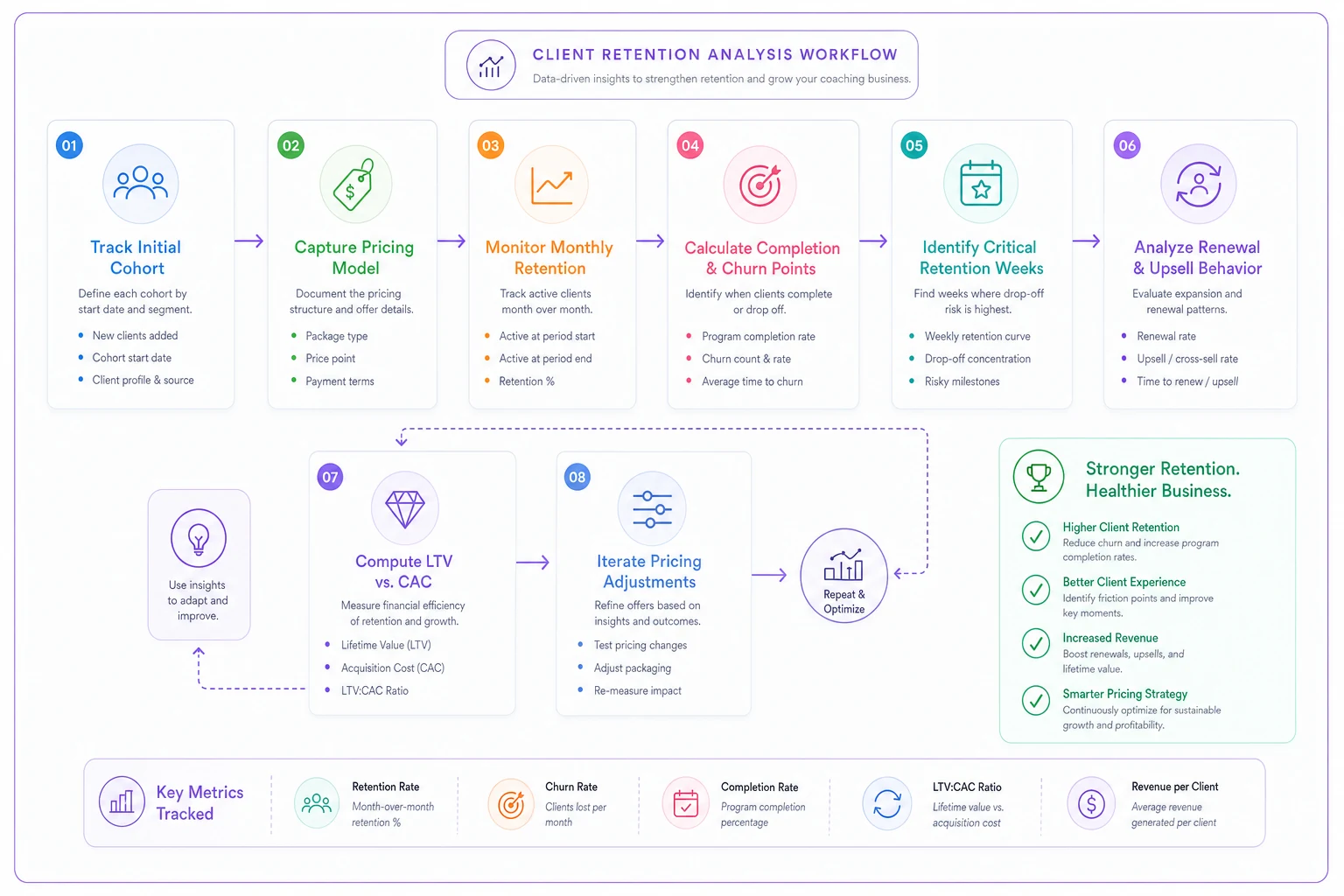
Model 1: Subscription Decay Calculator
| Month Started | Initial Clients | Month 1 | Month 2 | Month 3 | Month 6 |
|---|---|---|---|---|---|
| January | 15 | 15 | 12 | 9 | 4 |
| February | 12 | 12 | 10 | 8 | 3 |
| March | 18 | 18 | 13 | 10 | 5 |
Churn rate by month:
-
Month 1→2
20% average
-
Month 2→3
25% average
-
Month 3→6
55% average
This reveals the cliff. Most subscription coaches lose 50% by month 3.
Model 2: Cohort Completion Tracking
| Cohort Name | Start Date | Initial | Week 4 | Week 8 | Week 12 | Completed | Renewed |
|---|---|---|---|---|---|---|---|
| Spring Alpha | March 1 | 12 | 11 | 10 | 10 | 10 (83%) | 4 (33%) |
| Spring Beta | March 15 | 8 | 8 | 7 | 6 | 6 (75%) | 3 (38%) |
| Summer Alpha | June 1 | 15 | 14 | 13 | 12 | 12 (80%) | 5 (33%) |
Patterns emerge:
-
Smaller cohorts (8-12) have better completion rates
-
Week 4 is the critical retention point
-
Renewal rates stabilize around 35%
Model 3: Tiered Migration Analysis
| Starting Tier | Stay Same | Upgrade | Downgrade | Cancel | Avg Months |
|---|---|---|---|---|---|
| Bronze | 22% | 18% | N/A | 60% | 2.3 |
| Silver | 41% | 8% | 12% | 39% | 3.7 |
| Gold | 38% | N/A | 23% | 39% | 2.9 |
This data reveals that Silver is your most stable tier, not Gold.
Onboarding Sequences That Predict Success or Failure
The first 14 days determine 80% of retention outcomes. What happens during onboarding either locks in commitment or plants seeds of doubt.
Subscription Model Onboarding
Week 1 must deliver a quick win. Not a mindset shift or framework introduction—an actual tangible result they can point to.
-
Day 1
Personal productivity audit (not a sales call)
-
Day 3
One specific system implemented
-
Day 7
First milestone checked
-
Day 14
Clear 30-day roadmap created
Result: Month 2 retention jumped from 72% to 89%.
Removing ambiguity was key. Subscription clients need to know exactly what they're working toward next month, not just "ongoing support."
Tiered System Onboarding
Different tiers need different onboarding intensity, but most coaches deliver the same experience regardless of tier.
-
Automated welcome sequence
-
Group onboarding call
-
Clear boundaries set immediately
-
Self-service resources emphasized
Gold tier needs concierge treatment: Personal onboarding call, custom roadmap creation, direct access channel established, first quick win within 72 hours.
The mistake: Treating Bronze like Gold (burnout) or Gold like Bronze (resentment).
Cohort Onboarding as Retention Tool
Cohort onboarding becomes an event, not a process. This creates psychological commitment through social proof.
-
Pre-launch week
Cohort meets each other
-
Launch day
Virtual kickoff event (make it feel special)
-
Week 1
Aggressive engagement requirements
-
Week 2
First peer accountability partnerships formed
A career transition coach ran two parallel cohorts:
Cohort A: 68% completion Cohort B: 91% completion Same content, same coach, different onboarding energy.
When Each Model Actually Makes Sense (And When It Destroys Your Business)
Use Subscription When:
-
Your coaching delivers ongoing operational support rather than transformation. Think fractional CMO services, ongoing business advisory, or continuous performance coaching for athletes.
-
The client's problem regenerates monthly. Sales coaching makes sense as subscription because new sales challenges emerge constantly.
-
You have systems for preventing subscription fatigue. Regular value injection points, surprise bonuses, community events that make canceling feel like a loss.
Avoid Subscription When:
-
Your coaching promises specific transformation. Weight loss, career change, business launch—these have endpoints.
-
Your market has high price sensitivity. Subscription models amplify price concerns because the cost feels endless.
-
You can't sustain constant value delivery. Most coaches can't maintain the energy subscription models demand.
Use Tiered Pricing When:
-
You serve radically different market segments. A corporate consultant working with both Fortune 500 and small businesses needs tiers.
-
Your operational capacity varies. Different tiers let you manage time allocation explicitly.
-
The value difference is crystal clear. Executive coaching at $500/hour vs. group coaching at $50/hour makes intuitive sense.
Avoid Tiered Pricing When:
-
Your expertise applies equally to all clients. Most coaches deliver the same core value regardless of tier.
-
You're still establishing authority. Tiers dilute positioning when you're building reputation.
-
Your market is narrow. Specialized coaches serving one specific niche shouldn't fragment that focus.
Use Cohort Pricing When:
-
Your coaching follows a journey. Any transformation with clear phases works as cohorts.
-
Group dynamics amplify results. Peer accountability, shared experiences, and community support matter.
-
You want predictable operations. Cohorts let you batch content creation, calls, and support.
Avoid Cohort Pricing When:
-
Clients need immediate help. Crisis coaching or urgent problem-solving can't wait for next cohort.
-
Your market values exclusivity. Some executive coaches thrive on being "booked solid" with individual clients.
-
You can't fill cohorts consistently. Empty cohorts kill momentum and social proof.
Choose your pricing model based on where you want to be in five years, not next month.
The Operational Software Layer Most Coaches Miss
What breaks as coaching businesses scale: the manual systems that worked for 5 clients collapse at 20. The spreadsheets, email sequences, and calendar juggling become a full-time job.
This operational chaos directly impacts retention. When you're drowning in admin work, client experience suffers. Response times slow. Personalization disappears. The energy you should spend coaching gets absorbed by operations.
AI-powered operational software changes this dynamic. Not by replacing the coach, but by eliminating the friction between coaching sessions.
A client check-in that took 15 minutes manually becomes automated. Progress tracking shifts from spreadsheets to real-time dashboards. Payment processing, cohort management, and content delivery run without constant attention.
Automate weekly check-ins to flag engagement drops before week 4—the typical critical retention point.
What this means for retention:
Consistent client experience regardless of your workload. Automated check-ins happen whether you remember or not.
Faster intervention on at-risk clients. AI automation flags engagement drops before they become cancellations.
More capacity for actual coaching. When operations run automatically, you focus on transformation, not administration.
The math is straightforward. If operational overhead consumes 40% of your time, and AI automation reduces that to 10%, you've gained 30% more capacity for revenue-generating activities. That's either more clients at the same quality or same clients with dramatically better experience.
Testing Your Way to the Right Model
Don't overhaul your entire pricing model at once. Test with small groups first.
Start with your hypothesis about which model fits your coaching style. Run a 3-month pilot with 5-10 clients. Track everything: enrollment rate, engagement patterns, completion rate, renewal behavior.
A mindset coach tested all three models simultaneously:
-
Group A
$397/month subscription (10 clients)
-
Group B
Three tiers from $197-$597 (15 clients)
-
Group C
8-week cohort at $1,597 (8 clients)
Results after 6 months:
-
Group A
3 active clients, $1,191 monthly revenue
-
Group B
7 active clients, $2,318 monthly revenue
-
Group C
Second cohort running, $3,194 monthly revenue equivalent
The cohort model generated 2.5x more revenue with fewer total clients.
Your testing framework:
-
Define success metrics before starting (not just revenue)
-
Run for at least one full cycle (3 months minimum)
-
Track qualitative feedback, not just numbers
-
Consider operational burden, not just profit
Don't test forever—set a decision point and iterate.
The Five-Year View Nobody Talks About
Most pricing advice focuses on immediate revenue. But coaching businesses that survive think in 5-year cycles.
Year 1-2: Establishing model and operations Year 3-4: Optimizing retention and expansion Year 5+: Scaling through systems, not effort
Your pricing model determines which trajectory you follow.
Subscription models often plateau around year 2. The constant churn battle exhausts coaches. Revenue stabilizes but never truly scales.
Tiered models fragment over time. You end up running three different businesses poorly instead of one business well.
Cohort models compound. Each successful cohort makes the next one easier to fill. Alumni become referral sources. Operations get refined with each cycle.
The Retention Reality Check
Retention isn't about keeping every client forever. It's about structuring your business so the right clients stay for the right duration at the right price point.
The coaches crushing it aren't necessarily better coaches. They've figured out that pricing structure determines business health more than marketing tactics or coaching methodology.
Take your current model and run the real numbers. Include acquisition costs, operational overhead, and opportunity cost. Calculate what happens if you improve retention by just 10%.
Then test a new model with your next 5 clients. Not a complete overhaul—just a controlled experiment. Track what changes beyond the revenue. Notice your energy levels, client satisfaction, and operational stress.
The best pricing model for your coaching business already exists. You just need the courage to test it and the discipline to measure what actually matters: sustainable growth through retention, not just flashy acquisition metrics.
Most coaches won't do this work. They'll keep chasing new clients while hemorrhaging existing ones.
That's your opportunity
Ready to elevate your coaching business?
Join hundreds of coaches using Guidyly to save time, enhance client engagement, and grow their practice.