


Every coaching practice bleeds revenue from no-shows. You block the time, prep the materials, maybe even review their progress notes beforehand. Then nothing. Maybe a text three hours later apologizing. Maybe silence.
The standard response most coaches use is to send more reminders. Email the day before. Text the morning of. Call if they're late. But this shotgun approach misses the actual psychology driving cancellation behavior. After building operational systems for coaching practices ranging from executive coaches billing $800/session to health coaches running group programs at $47/month, one pattern becomes clear: no-shows aren't random. They follow predictable behavioral triggers you can interrupt with the right message at the right moment.
Why Traditional Reminder Systems Fail Coaches
Most coaches treat all clients the same. New client who just signed up yesterday? Gets the same generic "See you tomorrow at 2pm!" as your three-year veteran who never misses. First-time rescheduler? Same follow-up as someone who's canceled four times this month.
This one-size-fits-all approach ignores what behavioral economists call "commitment decay"—the psychological distance between making an appointment and actually showing up for it. A client booking a session feels motivated, committed, ready to change. That same client 72 hours later? Different mental state entirely. Work stress piles up. The commitment feels abstract. The session becomes "something on the calendar" rather than "the thing that will help me solve this problem."
Standard reminder systems also trigger what researchers call "reactance"—the knee-jerk resistance to being told what to do. Too many reminders and clients feel nagged. Too few and they genuinely forget. Wrong tone and they feel like a number in your system.
Different client segments need completely different approaches. Your reliable regulars need minimal touch. Your at-risk clients need behavioral nudges. Your chronic cancelers need accountability structures. Treating them all the same guarantees you'll keep losing money on empty slots.
The Real Cost of Ignoring Segmentation
A life coach I worked with in Austin had what looked like a healthy practice. Forty-two active clients, $225 per session, consistent bookings. But when we pulled her actual attendance data, the picture shifted. Her no-show rate averaged 14%, concentrated in about eight clients who canceled or no-showed at least once monthly.
Never miss a session or detail again.
Guidyly helps you book, manage, and track every coaching session efficiently.
- Centralized session scheduling
- Automated client reminders
- Progress tracking & notes
No credit card required
Do the math. Eight problem clients, averaging roughly 1.5 missed sessions monthly, at $225 each. That's around $2,700 in monthly lost revenue just from the repeat offenders. Annual impact? Over $32,000. From eight people.
Revenue loss only tells part of the story though. Those empty slots create operational chaos. You can't fill them last-minute. Your other clients who wanted that time can't get in. The uncertainty makes it impossible to plan properly.
The segmentation approach changes this. Instead of treating all 42 clients identically, you create three tiers based on actual behavior—not intentions, not how much they pay. Real attendance patterns.
Building Your Three-Tier System
Tier 1: Reliable Attendees These clients show up 95%+ of the time. They've been with you at least three months. When they do cancel, it's with proper notice.
For this group, less is more. One confirmation 48 hours before. Maybe a light reminder the morning of for virtual sessions. That's it. Over-communicating with reliable clients actually creates friction—they start feeling like you don't trust them, or worse, that your practice is disorganized if you need to remind them constantly.
Tier 2: Occasional Flakes This middle group cancels or reschedules maybe once every six to eight sessions. Not problematic yet, but patterns are emerging. Maybe they consistently reschedule Monday sessions, or they bail whenever work projects heat up.
These clients need strategic nudges—not more reminders, but different ones. A 72-hour confirmation that requires a response. A 24-hour message that references their specific goals. Morning-of communication that creates some urgency without pressure.
Tier 3: Chronic Cancelers The 20% causing 80% of your headaches. They've canceled or no-showed at least twice in the last eight weeks. Their attendance rate drops below 75%. Every booking feels uncertain.
This group needs structure, not reminders. Deposit requirements. Cancellation fees that actually get enforced. Pre-session check-ins that surface problems before they become no-shows. The messaging here isn't about reminding—it's about creating accountability.
Pre-Session Communication Cadence
The timing of your messages matters as much as the content. Most coaches cluster communication too close to the session—day before, morning of, maybe an hour before. But by then, the client has already mentally decided whether they're showing up.
Initial Booking Confirmation (Immediate) Right after they book, send a confirmation that does three things: locks in the commitment, sets expectations, and creates anticipation. Not just "Session booked for Tuesday 3pm" but something like: "Perfect, locked in your Tuesday 3pm spot. I'll send over the prep questions Monday morning so you can think through what you want to focus on. Looking forward to diving into your project launch plan."
This does subtle psychological work. It assumes they're showing up. It gives them something to do before the session. It makes the session about their specific situation, not generic coaching time.
72-Hour Commitment Check Three days out, you're not reminding them about the time—you're re-engaging them with the work. For Tier 2 and 3 clients, this needs a response: "Hey Sarah, Tuesday's session is coming up. Quick question: what's the ONE thing you want to walk away with clarity on? I'll prep accordingly. Hit reply with your focus area."
Notice what this does. It forces engagement, makes them think about value, creates personal investment. If they don't respond, you've identified a risk factor 72 hours out, not two hours out.
24-Hour Prep Message The day before, shift from logistics to substance. Especially for at-risk clients: "Tomorrow we're tackling your pricing structure concerns. Bring your current pricing sheet and last month's revenue breakdown. We'll build the new model together. See you at 3pm."
Specific. Actionable. Valuable. They'd feel bad missing this.
Morning-Of Reminder (Selective) Only for Tier 2 and 3, and only if virtual: "Session link for 3pm today: [link]. We're working on your pricing model—have your numbers ready!"
Short. Direct. Assumes attendance.
Here's a visual workflow for the pre-session communication cadence.
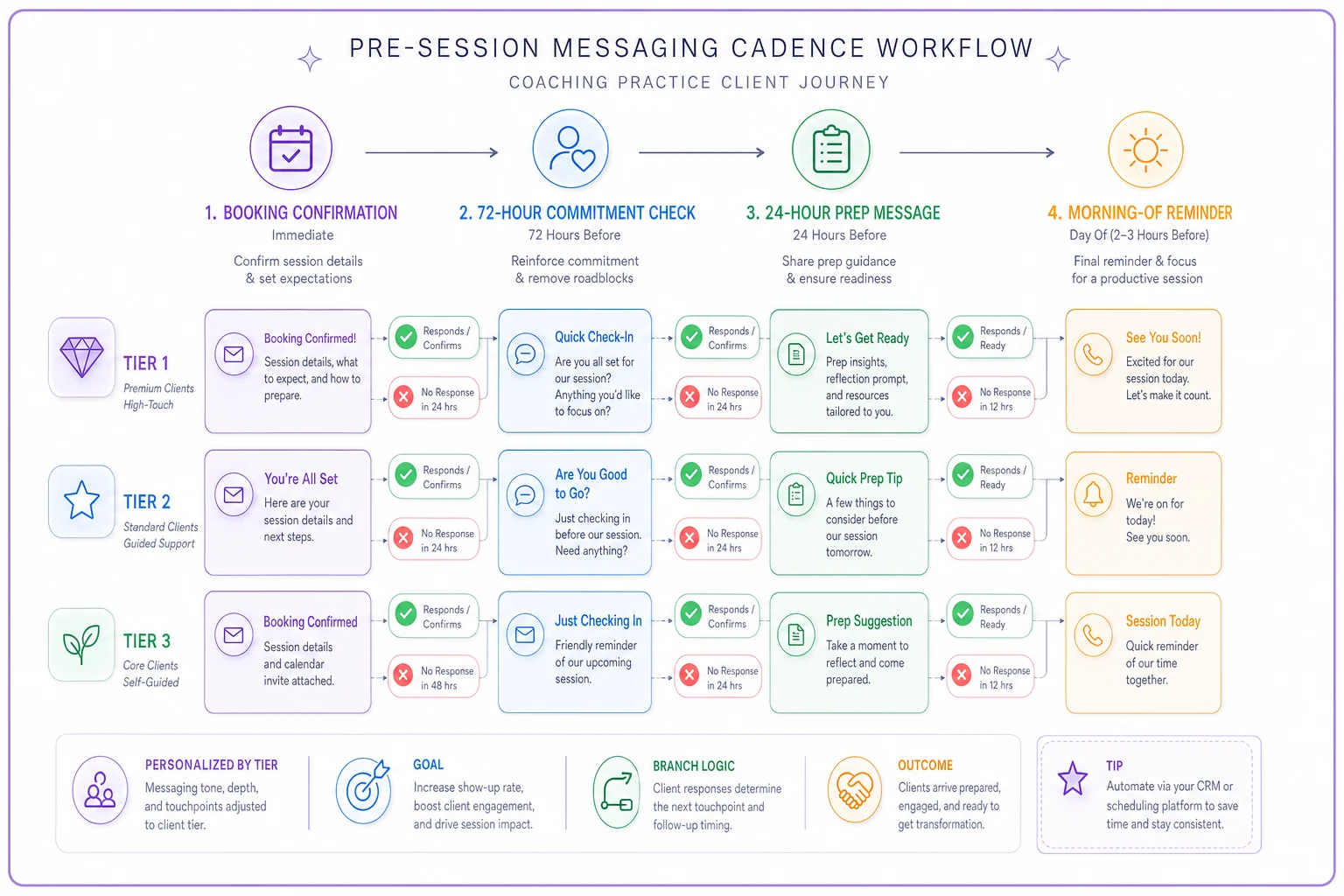
The visual shows how engagement at each stage changes the subsequent message sequence and flags clients for escalation if they don't respond.
The Email vs SMS Decision Matrix
Channel selection isn't about preference—it's about behavior patterns and message urgency.
| Situation | Best Channel |
|---|---|
| Prep materials or homework | |
| Confirmations 48+ hours out | |
| Detailed session recaps | |
| Tier 1 clients who prefer email | |
| Corporate coaching clients | |
| 24 hours or less until session | SMS |
| Previous email went unread | SMS |
| Tier 3 clients with poor email engagement | SMS |
| Urgent reschedule notifications | SMS |
| Quick confirmations needing a response | SMS |
The behavioral data here is hard to argue with: SMS gets around 98% open rates within minutes. Email hovers around 20%, often hours or days later. But SMS also feels more invasive if overdone. Use it strategically, not constantly.
Some coaches worry about bothering clients with texts. But clients who no-show cost $200+ per incident. Clients annoyed by a text? They tell you, and you adjust. The financial math is pretty clear.
Penalty and Incentive Structures That Actually Work
Behavioral economics shows that loss aversion drives behavior more reliably than gain-seeking. People hate losing something they already have more than they enjoy gaining something new. That principle shapes what actually works for accountability.
The Deposit Model Tier 3 clients put down a $50 deposit that rolls forward each session they attend. Miss without 24-hour notice? Deposit gets applied to the missed session, and they need a new one next time. This isn't punitive—it's protective. It protects your time and their commitment.
A career coach in Phoenix implemented this with her chronic cancelers—six clients averaging around 35% no-show rates. After requiring deposits, that dropped to under 10% within a month. Not because the $50 mattered financially, but because it created psychological commitment.
Progressive Consequences
-
First cancellation
No penalty, life happens
-
Second within 30 days
50% session fee
-
Third within 30 days
Full session fee plus a conversation about fit
The key is communicating this upfront, not surprising them with it. Include it in your agreement. Reference it during onboarding. Make it about mutual respect, not punishment.
Positive Reinforcement Structures
-
"Great consistency this month—your progress shows it"
-
Offer a bonus mini-session after eight consecutive attended sessions
-
Priority booking access for high-demand time slots
These don't need to cost money. Recognition and flexibility often matter more than discounts.
Message Templates That Convert
The language you use shapes behavior. Corporate-speak triggers detachment. Over-friendly feels fake.
Tier 1 Simple Confirmation "Tuesday 3pm confirmed. Looking forward to hearing about the product launch. -Mark"
Tier 2 Engagement Check "Hey David, Thursday's session is in 2 days. What's the biggest challenge you're facing this week that we should focus on? Reply with your top priority."
Tier 3 Accountability Message "Sarah, confirming tomorrow 2pm. As discussed, this is prepaid via your deposit. The worksheet I sent Tuesday will guide our conversation—please complete sections 1-2 minimum."
Cancellation Response "Got it, thanks for letting me know. I'm holding your deposit for next week's session. Let's lock in Tuesday 2pm or Thursday 3pm—which works?"
Acknowledges. Doesn't shame. Reschedules immediately. References deposit naturally.
A/B Testing Your Messages
Most coaches write something once and use it forever. But small wording changes can shift behavior meaningfully.
Elements worth testing:
-
Timing
48 vs 72-hour confirmations
-
Subject lines
"Tomorrow's session" vs "Your 2pm with me"
-
CTA placement
Beginning vs end of message
-
Tone
Professional vs conversational
-
Length
Two sentences vs a paragraph
-
Personalization
Generic vs specific to their situation
Track opens, responses, and actual attendance by version. One executive coach found that adding the client's main goal to reminders ("Tomorrow we're finalizing your board presentation strategy") increased show rates by around 22% compared to generic time reminders.
Don't test everything at once though. Change one element, run it for 20 to 30 sessions, then measure. Real data beats gut feelings.
Post-No-Show Recovery Sequences
What happens after someone no-shows determines whether it becomes a pattern. Most coaches either say nothing, send a guilt-laden message, or immediately go to penalties. None of those work long-term.
Hour 1: Information Gathering "Hey Mike, missed you at 3pm today. Everything okay?"
Hour 4: Re-engagement "When you're able, let's reschedule. I have Thursday 2pm or Friday 10am available. Also wanted to check—is something about our sessions not working for you?"
Day 2: Structure Setting "Mike, got you rescheduled for Thursday 2pm. Since this is our second cancellation this month, the session will draw from your deposit per our agreement. A new deposit will be needed for future bookings. Looking forward to getting back on track."
Week 2: Pattern Recognition If they no-show the rescheduled session: "Mike, we've had difficulty connecting a few times now. Before scheduling again, can we have a quick call about whether the timing or format is working for you? I want to make sure you're getting value. Free to chat Tuesday or Wednesday afternoon?"
This converts a potential termination into a retention conversation.
Automation Without Losing the Human Touch
This is where operational software genuinely changes things. But automation doesn't mean robotic. The best systems feel personal while running automatically in the background.
AI-powered operational platforms can handle the predictable, repetitive parts of client communication—segmenting clients based on attendance patterns, triggering different message sequences by tier, tracking response rates, escalating based on behavior changes, and managing deposit tracking. A client who starts showing risk factors—delayed responses, last-minute reschedules—gets moved to a more intensive communication track without you manually monitoring every account.
Route Tier 3 escalations to a human reviewer so accountability conversations keep necessary judgment and empathy.
But certain touchpoints need to stay human. Responding to a personal crisis no-show. Tier 3 accountability conversations. Pattern-breaking discussions. Genuine recognition of progress. These moments require judgment that no system should replace.
The real operational win is automating the predictable so you have actual capacity for the personal. When you're not manually sending 40 reminder emails a week, you can have meaningful check-ins with the clients who actually need them.
Results You Can Actually Expect
A health coaching practice in Denver implemented this tiered system across 67 active clients. Starting no-show rate: 18%. After 90 days:
-
Tier 1 clients (38 people)
2% no-show rate, required minimal communication
-
Tier 2 clients (19 people)
Dropped from 15% to 7% no-show rate
-
Tier 3 clients (10 people)
6 voluntarily opted into the deposit system, 3 left the practice, 1 improved to Tier 2
Overall no-show rate landed at 6.5%. Revenue recovery: roughly $3,400 monthly.
But the operational gains went beyond revenue. The coach stopped dreading Monday mornings wondering who would cancel. Admin time dropped by around 5 hours weekly. Client relationships actually improved because communication matched their actual needs rather than a blanket policy applied to everyone.
Conclusion
The difference between a 15% no-show rate and a 5% no-show rate isn't more reminders—it's recognizing that different clients need different systems. Your reliable clients need you to respect their consistency. Your occasional flakes need strategic engagement. Your chronic cancelers need structure and some accountability baked in.
Start by pulling your last 60 days of attendance data. Categorize every client into the three tiers. Build your message templates. Set up a testing framework. Then run it consistently for 30 days before adjusting anything.
Coaches who actually reduce no-shows stop treating it as a client problem to solve and start treating it as an operational system to build. The system does the heavy lifting. You focus on coaching.
Reducing no-shows isn't about forcing compliance. It's about creating the right conditions for commitment. When clients feel appropriately supported—not over-communicated with, not ignored—they show up. The messaging is just the mechanism. The real work is building a practice where missing a session feels like missing something genuinely valuable.
Every empty slot is lost revenue, yes. But it's also lost impact. The client who no-shows doesn't get the breakthrough they needed. The client who wanted that slot doesn't get served. Fix the no-show problem and most everything else gets a little easier.
Ready to elevate your coaching business?
Join hundreds of coaches using Guidyly to save time, enhance client engagement, and grow their practice.