


Most coaches obsess over their discovery calls, refine their sales scripts, then basically wing it the moment someone signs up. The intake form sits there. The first session gets scheduled "whenever works." Welcome emails feel like afterthoughts. Then three weeks later, that excited new client has already mentally checked out.
The gap between "yes, I want coaching" and "I'm fully engaged in this process" kills more coaching relationships than pricing, personality mismatches, or competition ever will. You're losing clients in those first 30 days—not because your coaching isn't valuable, but because your activation sequence doesn't exist.
Day 0-3: The commitment crystallization window
Right after someone pays, their brain starts second-guessing. Did I really need this? Can I afford it? Will this actually work? Every hour you wait to engage them, that doubt compounds.
Send your intake form within 2 hours of payment. Not tomorrow. Not "when you get a chance." Set up automation if you have to, but get that form in their inbox while they're still riding the decision high. Track your intake completion rate—anything below 85% within 48 hours usually means your form is too long, too vague, or arriving too late.
The intake form itself is a micro-commitment device. Instead of 47 questions about their life history and business goals, ask 8-10 targeted questions that take under 12 minutes to complete. Each answer they give psychologically reinforces their decision to work with you.
What most coaches miss: include one "quick win" question that delivers value immediately. Something like "What's one specific situation happening this week where you need guidance?" Then actually respond to that answer within 24 hours—a voice note, a quick framework, something real. You've now delivered value before the first official session even happens.
Day 4-7: The scheduling momentum phase
The biggest activation killer is the dead zone between signup and first session. If someone waits two weeks for their first call, they've already emotionally moved on. They're filling that mental space with YouTube videos, free resources, or just defaulting back to old patterns.
Never miss a session or detail again.
Guidyly helps you book, manage, and track every coaching session efficiently.
- Centralized session scheduling
- Automated client reminders
- Progress tracking & notes
No credit card required
Your scheduling link should arrive with the intake form—not after they complete it. Let them book while motivation is still high. Track your "time to first session" metric closely. Anything over 7 days from payment drops engagement by roughly 40%.
Send a pre-session primer on day 5 regardless of when they've scheduled. This isn't homework—it's activation. Include:
-
Three specific outcomes from session one
-
A 5-minute reflection exercise (not 30 minutes of journaling)
-
Permission to "come messy" (removes perfection paralysis)
If they haven't scheduled by day 6, your automated SMS says: "Quick check—noticed you haven't grabbed your first session slot yet. Here's my calendar for this week: [link]. Even 30 minutes gets us momentum."
The scheduling link should arrive with the intake form—not after they complete it.
Not "whenever you're ready." Not "at your convenience." Gentle urgency without desperation.
Day 8-14: The engagement thermometer check
By now you've either had your first session or you're about to. This window determines whether they become an active client or a ghost who technically paid but never really showed up.
Post-session automation kicks in within 3 hours. Not a survey. Not a homework dump. Send one specific action step from your discussion—something they can complete in under 10 minutes that creates visible progress.
"Based on what we discussed about your pricing anxiety, text three past clients tonight asking for a quick testimonial using this template: [template]"
Track completion. If they don't confirm within 48 hours, your follow-up isn't "Did you do it?" It's: "Hit any snags with reaching out to those three clients? Sometimes the first message is the hardest."
Your day 10 check-in introduces the idea of between-session support. Most coaches mention this during onboarding and never actually model it. Send a voice note or Loom addressing something specific from session one. Make it valuable—not "just thinking of you!" filler.
Day 15-21: The habit formation sprint
Week three is where coaching relationships either become habits or start feeling like obligations. You need three completed sessions by day 21 to lock in the routine. Two sessions don't create patterns—three do.
If they've only completed one session by day 15, your activation sequence shifts to recovery mode:
"Hey [name], noticed we've only connected once so far. Sometimes the second session is harder to prioritize than the first. Want to try a 20-minute momentum call this week instead of a full session? Here's my calendar: [link]"
You're removing friction, not chasing. The "momentum call" reframe makes it feel like a different, easier commitment.
For engaged clients, day 18 introduces your first piece of framework content. Not generic coaching philosophy—specific tools tied to their actual goals. If they mentioned imposter syndrome, send your "expertise evidence inventory" worksheet. Time management issues get your "energy audit tracker."
This content does two things: it shows the depth of your system while creating touchpoints between sessions. Track whether they engage with these resources. Under 50% open rate means your content titles need work or the timing is off.
Day 22-30: The integration checkpoint
Most coaches consider clients "onboarded" after a couple of sessions. That's not onboarding—that's just showing up twice. Real activation means they're integrating coaching into their weekly routine, not just responding when reminded.
Day 25 brings your first real feedback request—but not about your coaching. Ask about their experience with the process:
-
Is our session time still working for your schedule?
-
Are you preferring video, phone, or mixing it up?
-
What's one thing about our rhythm that's clicking well?
These aren't satisfaction surveys. You're getting them to articulate what's working, which reinforces the value they're already receiving.
Your day 28 message introduces the idea of "coaching seasons." Frame their first 30 days as "foundation season" and preview what "momentum season" (days 31-60) will focus on. This prevents the vague drift that quietly kills month two retention.
The micro-metrics that actually matter
Forget session attendance rates. Track these instead:
| Metric | Description |
|---|---|
| Response velocity | How quickly do they reply to between-session check-ins? Under 24 hours means highly activated. Over 72 hours means at risk. |
| Voluntary shares | Count unprompted messages they send you—wins, questions, random updates. Zero voluntary shares by day 20 means you're just another calendar appointment. |
| Resource interaction | Not opens—actions. Did they complete the worksheet? Reference your framework in session? Passive consumption isn't activation. |
| Schedule stability | How many times do they reschedule in month one? One reschedule is life. Three reschedules means coaching isn't a priority yet. |
| Referral mentions | If they mention you to someone else in the first 30 days—even casually, not a formal referral—they're fully activated. Track this through conversation, not surveys. |
Track this through conversation, not surveys.
Ready-to-deploy message sequences
Stop writing activation emails from scratch. Here's exactly what to send and when:
Hour 2 post-payment: "Welcome! Your intake form is here: [link]. Takes about 10 minutes. Also grabbed you a session slot for this week—claim it here: [calendar link]. Quick question while it's fresh: what made today the day you decided to invest in coaching?"
Day 3 (if no intake submission): "Noticed the intake form might have gotten buried. No stress—here's the link again: [link]. If any questions feel unclear, just put 'let's discuss' and we'll cover it live."
Day 6 SMS: "First session prep: bring one specific situation you're facing this week. Messier the better. We'll workshop it live."
Day 10 post-first-session: "Been thinking about your [specific issue discussed]. Recorded a quick thought for you: [Loom link]. No response needed, just wanted you to have this."
Day 18 framework delivery: "Mentioned this would help with [their specific challenge]. My [framework name] template: [link]. Takes 15 min to complete. Let me know what surfaces for you."
Day 25 checkpoint: "Quick pulse check: Our Tuesday 2pm slots working with your rhythm? Rather do mornings? Also—what's one thing about our process that's clicking well for you?"
The operational reality of activation
What typically happens: coaches invest enormous energy into marketing and sales, then abandon new clients to essentially self-onboard. You assume that because someone paid, they're committed. But payment is just permission to begin activation—it's not activation itself.
Without a systematic sequence, you're depending entirely on the client's motivation to carry things forward. And motivation without structure evaporates within two weeks. Every ghosted client, every awkward "are we still meeting?" message, every refund request in month one—those are activation failures, not coaching failures.
Automated sequences handle the heavy lifting, but they need to feel human. Use their actual name, reference specific things they've shared, and vary your sending times. Nothing signals "automated sequence" faster than five emails arriving at exactly 9:00 AM.
Your activation sequence is also your first coaching deliverable. When clients experience a thoughtful, systematic onboarding, they unconsciously assume your actual coaching will be equally well-structured. Sloppy activation creates expectation debt you'll spend months trying to overcome.
Software infrastructure for activation tracking
Most coaches track this stuff in their heads, or maybe a spreadsheet they check inconsistently. By the time you notice someone's disengaged, it's usually already too late to recover them cleanly.
You need triggered alerts based on behavior, not just calendar reminders. When an intake form sits uncompleted for 72 hours, you should know. When someone cancels their second session, an automatic recovery sequence should already be moving. When engagement metrics drop, the system catches it before it becomes a departure.
Here's a visual of the activation tracking workflow.
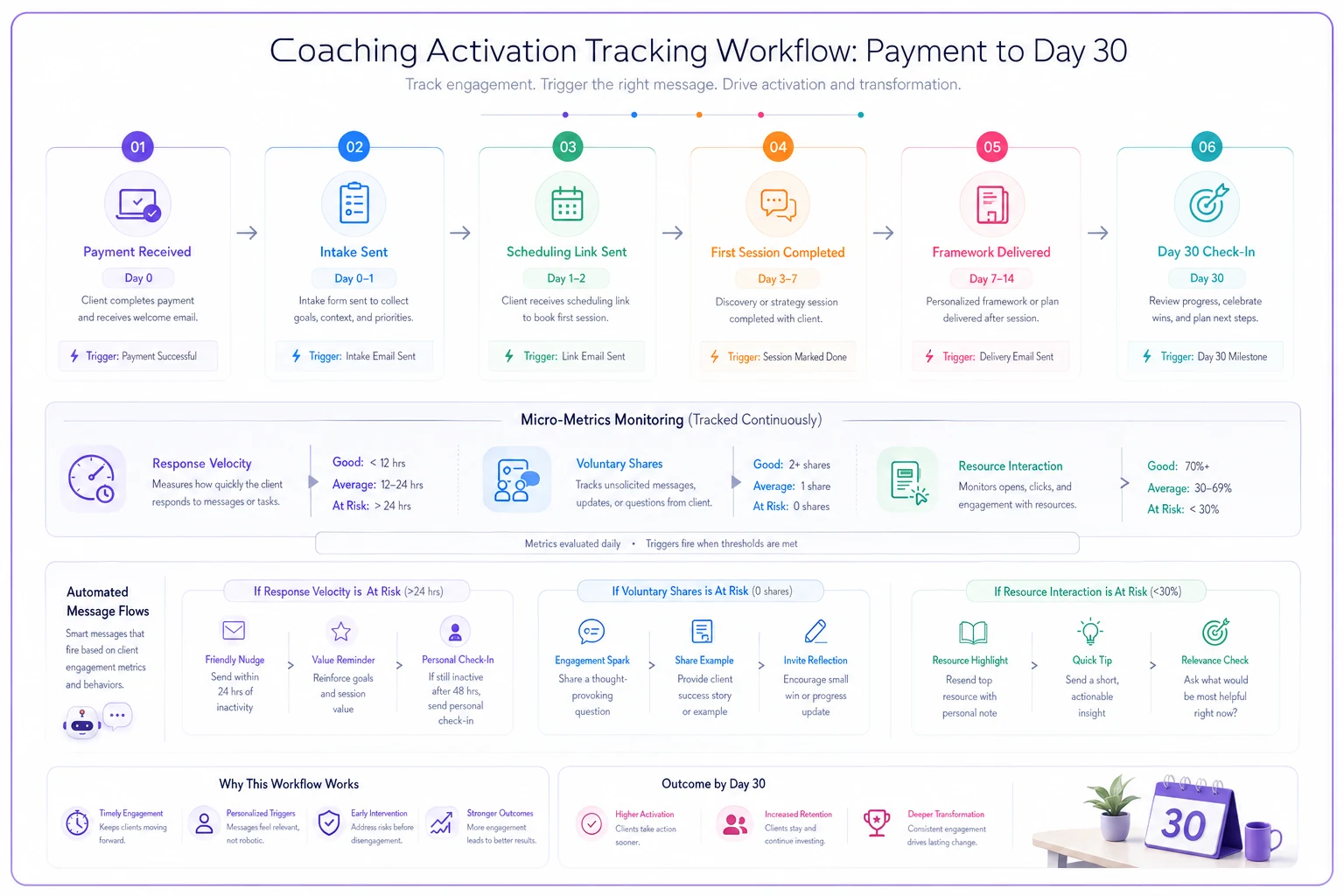
AI-powered operational software built for coaching businesses can handle exactly this—monitoring micro-metrics automatically, triggering the right message at the right moment, and flagging at-risk clients before they disappear. Your focus stays on actual coaching. The platform manages the activation layer running underneath it.
Every coach thinks their dropout problem is about session quality or pricing or niche clarity. Run these activation sequences for 90 days and watch your retention numbers shift. Not because you became a better coach overnight, but because more clients actually make it to the point where they can experience your coaching.
The first 30 days aren't about breakthroughs. They're about creating enough small wins and consistent touchpoints that showing up for session four feels as natural as checking email. Get the activation right, and retention mostly takes care of itself.
Ready to elevate your coaching business?
Join hundreds of coaches using Guidyly to save time, enhance client engagement, and grow their practice.