


You know that feeling when a client mentions they "told their friend about you" and then nothing happens? Or when that business owner you met at a networking event promised to "send people your way" but never follows through?
Most coaches treat referrals like lottery tickets—hoping they'll come through but never building real systems around them. After helping dozens of coaching businesses map their partnership channels, the difference between coaches pulling 2-3 referrals monthly versus those hitting 15+ isn't luck. It's having a proper referral playbook for coaches with real qualification criteria, structured outreach, and actual tracking.
The frustrating part? Most coaches already have solid potential partners sitting right there—past clients who love them, complementary service providers they know, professional contacts who serve the same audience. Without a systematic approach to activating those relationships, they just stay dormant.
Why Most Coach Partnership Programs Generate Nothing
Traditional referral strategies fail coaches because they ignore how trust actually flows in professional services. Asking for referrals feels awkward. Following up feels pushy. And without clear incentives or simple processes, even willing partners forget to actually make introductions.
The typical coach partnership attempt goes something like this: You meet someone at an event who serves your target market. You exchange cards, maybe grab coffee. They say they'll "keep you in mind." You add them to your newsletter. Six months later, zero referrals.
Or worse—you launch a formal referral program with complicated commission structures and tracking links. Partners need to register, learn your platform, remember to use special codes. The friction kills momentum before anything starts. Meanwhile, that executive coach down the street who simply texts you when she meets someone needing career transition support? She's sent you eight clients this year.
What actually works is building high-trust, low-friction channels where referring feels natural rather than transactional. Where partners know exactly who to send and feel confident doing it. Where you can predict referral flow based on partner type and relationship depth, not random chance.
Mapping Your Partner Ecosystem (And Why Order Matters)
Before creating any outreach sequences or incentive structures, you need to understand your partnership landscape. Not all referral sources are equal—some require months of nurturing for minimal return, while others can reshape your pipeline with a single conversation.
Never miss a session or detail again.
Guidyly helps you book, manage, and track every coaching session efficiently.
- Centralized session scheduling
- Automated client reminders
- Progress tracking & notes
No credit card required
Tier 1: Current Client Advocates Clients who've experienced real transformation and naturally talk about it. They don't need incentives—they need easy ways to share. A life coach working with executives noticed her clients frequently mentioned colleagues facing similar challenges. Instead of hoping they'd connect the dots, she created a simple introduction template clients could forward. Her referrals went from sporadic to 4-5 monthly.
Tier 2: Complementary Service Providers Therapists referring to business coaches, nutritionists referring to wellness coaches, financial advisors referring to career coaches. These partners already have trust with your ideal clients but serve different needs. The key is mapping exactly where your services intersect without competing.
Tier 3: Professional Network Multipliers HR directors, conference organizers, corporate trainers—people who regularly encounter coaching candidates but don't provide coaching themselves. A leadership coach built relationships with three HR consultants who collectively manage talent development for 40+ companies. Those three relationships now generate 35% of her corporate contracts.
Tier 4: Past Clients (Dormant) Former clients who had great experiences but haven't referred recently. They need reactivation, not cold outreach. Often a simple check-in where you mention your current focus areas is enough to trigger a "oh, I actually know someone who needs exactly that" response.
Tier 5: Industry Peers Other coaches in different niches or using different modalities. A coach specializing in new manager training partners with one focused on senior leadership. They cross-refer based on where clients are in their career stage.
The mistake most coaches make is treating all five tiers the same—same outreach, same asks, same follow-up. A current client advocate needs completely different activation than a professional network multiplier.
Building Your Qualification Framework
Not every potential partner deserves your time. Harsh, maybe. But spending months nurturing someone who'll never actually refer wastes energy you could put toward people who will.
Alignment Check:
-
Do they regularly interact with your ideal client profile?
-
Is there a natural conversation flow where your services would come up?
-
Can they describe who you help and how in under 30 seconds?
Trust Indicators:
-
Have they experienced or witnessed your work firsthand?
-
Do they have credibility with your target audience?
-
Would their endorsement actually carry weight?
Capability Assessment:
-
How many potential referrals do they encounter monthly?
-
Do they have a track record of making professional introductions?
-
Is referring part of their normal behavior, or would it require a real habit change?
Friction Analysis:
-
How easy is it for them to identify good fits?
-
Can they make introductions without complicated processes?
-
Will referring make them look good to their network?
A business strategist tracked her referral sources for eighteen months and found something counterintuitive. Her highest-referring partners weren't the ones with the biggest networks—they were the ones who could instantly recognize ideal client situations. Quality of fit beats volume of contacts.
One simple test: Can this person accurately describe your ideal client's situation without prompting? If they need constant reminders about who you serve, they won't refer consistently no matter what incentives you offer.
The Outreach Cadence That Actually Gets Responses
Generic "just checking in" messages kill partnership potential. Effective partner outreach follows specific rhythms based on relationship stage and partner type.
Initial Activation Sequence (New Partners)
-
Week 1
Context-setting message Not asking for anything—just establishing relevance. "Noticed you work with startup founders going through scaling challenges. Been developing some frameworks specifically for that 10-to-50 employee transition phase that your clients might find useful."
-
Week 2
Value-first share Send something genuinely helpful related to their work, not yours. An article, a resource, or an introduction to someone in your network who could help them.
-
Week 3
Soft exploration "Had a thought about how we might be able to support each other's clients. Would you be open to a brief call to explore if there's natural synergy?"
Prioritize value-first touches before any referral ask.
Maintenance Cadence (Active Partners)
-
Monthly
Status update Brief note about the type of clients you're currently helping and specific outcomes. Keeps you top-of-mind without being repetitive or pushy.
-
Quarterly
Value injection Share something substantial—a workshop invite for their clients, a useful template, an industry insight. Keep the relationship alive beyond just referrals.
-
Bi-annually
Relationship refresh Coffee, lunch, or a call to reconnect. Discuss how their business is evolving, update them on your current focus areas.
Reactivation Sequence (Dormant Partners)
-
Touch 1
Acknowledgment "Realized it's been too long since we connected. Saw your recent [specific achievement/post/update]—impressive work on [specific detail]."
-
Touch 2
Update catalyst "Quick update: I've shifted focus to help [specific client type] with [specific challenge]. A bit different from when we last spoke. Thought you should know in case you come across anyone dealing with this."
-
Touch 3
Direct value "Have a spot in my [program/workshop/session] that would be perfect for someone in your network dealing with [specific situation]. Anyone come to mind?"
Cadence matters less than consistency and relevance. An executive coach tested bi-weekly generic check-ins against monthly specific updates about client wins. The monthly messages generated roughly 3x more referral conversations.
Incentive Structures That Don't Feel Slimy
Money isn't always the answer. For many professional referral relationships, cash incentives actually reduce referral quality and frequency over time. The key is matching incentive type to partner motivation.
For Client Advocates:
-
Enhanced service access (bonus session, priority scheduling)
-
Exclusive content or tools
-
First access to new programs
-
Simple thank-you gifts that feel personal, not transactional
For Complementary Service Providers:
-
Reciprocal referral commitment
-
Co-created content that positions them as an expert
-
Joint workshop or event opportunities
-
Cross-promotion to your audience
For Professional Network Multipliers:
-
Educational resources they can share with their network
-
Guest expert opportunities at their events
-
Bulk session packages for their organization
-
Strategic introductions to other professionals
For Past Clients:
-
Alumni program benefits
-
Refresh sessions at a meaningful discount
-
Invitation to exclusive gatherings
-
Feature opportunities (case study, testimonial, speaker)
For Industry Peers:
-
Formal referral exchange agreement
-
Overflow client management
-
Joint ventures on larger contracts
-
Skill exchange or professional development trade
A career coach tested different incentive models over two years. Financial incentives in the 10-20% commission range generated fewer, more transactional referrals. Value-based incentives—exclusive workshop access, joint ventures—created deeper partnerships with noticeably higher lifetime referral value.
The psychological component matters more than the economic one. Partners need to feel that referring enhances their relationship with their own network, not puts it at risk.
Tracking What Actually Matters
Most coaches track referrals wrong—counting total numbers without understanding source quality, conversion patterns, or actual ROI per partner type. Here's the tracking framework that shows what's working:
| Partner Type | Avg Referrals/Month | Conversion Rate | Client LTV | Time Investment | ROI Multiple |
|---|---|---|---|---|---|
| Client Advocates | 4-6 | 68% | $8,200 | 2 hrs/month | 14x |
| Complementary Providers | 2-3 | 45% | $6,800 | 5 hrs/month | 6x |
| Network Multipliers | 1-2 | 72% | $12,400 | 8 hrs/month | 7x |
| Past Clients | 2-4 | 61% | $7,600 | 3 hrs/month | 9x |
| Industry Peers | 1-2 | 83% | $9,200 | 4 hrs/month | 11x |
These are aggregated from coaches who actually track this data. Notice how Network Multipliers have lower frequency but the highest client value? Or how Industry Peers have the best conversion rate because they pre-qualify so effectively?
Partner Information:
-
Name and contact
-
Partner type
-
Relationship stage
-
Last meaningful contact
-
Qualification score (1-5)
Activity Tracking:
-
Outreach dates and types
-
Response/engagement level
-
Referrals made (dated)
-
Conversion status
ROI Calculation:
-
Time invested (hours)
-
Direct costs (gifts, events, tools)
-
Revenue generated
-
Lifetime value realized
-
ROI multiple
Relationship Health Indicators:
-
Referral frequency trend
-
Response time to outreach
-
Engagement quality
-
Reciprocity balance
The spreadsheet isn't just measurement—it drives decisions. When you see Client Advocates generating 14x ROI with minimal time investment, you know where to focus. When Complementary Providers show declining referral quality, you know to refresh the qualification criteria you're sharing with them.
Creating Your 90-Day Implementation Plan
Starting from scratch, here's how to actually build this:
Here's a simple visual workflow to follow over 90 days.
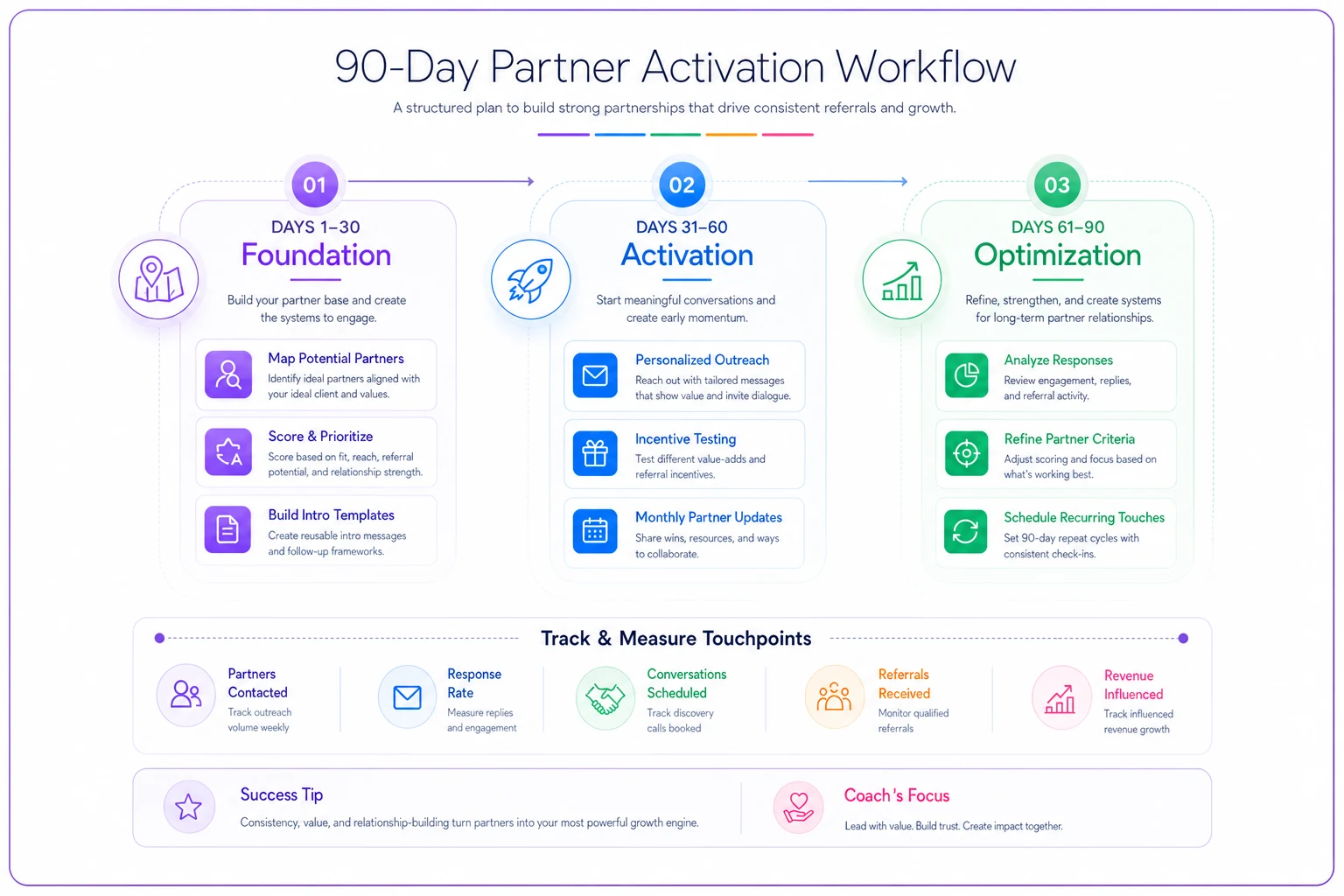
Days 1-30: Foundation Map your existing relationships into the five tiers. Don't overthink it—just categorize based on current state. Score each on the qualification criteria above. Identify your top ten high-potential partners across all tiers. Build three core tools: a one-paragraph description of your ideal client (so partners can recognize fits), an introduction template (for easy referrals), and a brief outcome story (for partners to share). Keep each under 100 words. Set up your tracking spreadsheet. Nothing fancy at this stage—partner info, contact dates, referrals. You can add complexity later once you understand what you actually need to track.
Days 31-60: Activation Launch outreach sequences for your top ten partners. Personalize based on tier and relationship depth. Focus on value-first touches before any referral asks. Test different incentive structures with two or three willing partners. See what resonates without overcommitting to any single approach. Create your monthly partner update template. Include: type of clients you're helping right now, specific challenge you're solving, a recent client win (anonymized), easy language for identifying fits.
Days 61-90: Optimization Analyze early response patterns. Which partner types engage most? Which outreach messages actually get replies? Where are referrals originating? Refine your qualification criteria based on what you're seeing. You'll likely find some assumed high-potential partners are duds while unexpected sources deliver. Build your sustainable rhythm. Put recurring partner touches, monthly updates, and quarterly value injections on the calendar. Make it systematic rather than dependent on memory or motivation.
Common Traps That Kill Referral Programs
Even with solid systems, certain mistakes consistently wreck coach referral programs.
The Assumption Trap Assuming partners know how to identify ideal clients without explicit guidance. Your perfect client profile lives in your head—partners need concrete indicators. "Executives who want more impact" is useless. "VP or C-suite leaders with 50+ direct reports feeling overwhelmed by people management" gives partners something they can actually recognize.
The Complexity Trap Building elaborate tracking systems, multi-tier incentives, and complicated referral processes. A health coach once created a 12-step referral program with different commission levels, tracking codes, and quarterly payouts. Zero participation. She simplified to text-based introductions with simple thank-you gifts. Referrals jumped 400%.
The Entitlement Trap Expecting referrals because you deliver good work. Excellence is table stakes, not a referral driver. Partners need clear mechanisms, regular reminders, and frictionless processes—even when they genuinely love what you do.
The Passivity Trap Waiting for partners to remember you exist. Without consistent, valuable touchpoints, even enthusiastic partners forget to refer. That monthly update email might feel repetitive to you, but it's often the trigger that makes a partner think "oh, that sounds exactly like my colleague's situation."
ROI Reality Check
A leadership coach serving tech companies spent roughly 20 hours monthly on partner development across 15 active relationships. Generated 12-14 referrals monthly, converting 8-10 into clients at around $4,500 average engagement value. Monthly time investment: 20 hours. Monthly revenue from referrals: $36,000-45,000.
A wellness coach focused entirely on building five deep partnerships with nutritionists and physical therapists in her area. Ten hours monthly maintaining those relationships. Generates 6-8 highly qualified referrals, converts 5-6 at $2,400 per client package.
The pattern holds across the coaches who actually track this: systematic referral playbooks generate 10-20x ROI on partnership time investment. Those without systems might get occasional referrals but can't predict or scale them.
Making It Sustainable
The difference between a referral program that dies after two months and one that drives consistent revenue for years is operational integration.
Building these systems manually—tracking partner touches, scheduling follow-ups, monitoring referral conversions, calculating ROI across partners—gets overwhelming fast. The administrative burden tends to kill momentum before results show up. Smart coaches are using AI-powered operational software to handle the tracking and reminder infrastructure while keeping the actual relationship building human.
The right platform handles the operational layer: automated partner touch reminders based on tier and cadence, referral source tracking linked to client records, ROI calculations that update as clients progress, and partnership health dashboards that flag when relationships need attention. That frees you up to focus on the high-value human side—building trust, creating genuine value, nurturing relationships—without things falling through the cracks.
The Two-Year View
Coaches who commit to systematic referral development see a pretty predictable arc:
-
Months 1-3
Foundation building, lots of effort, minimal results
-
Months 4-6
First consistent referrals, usually from 2-3 eager partners
-
Months 7-12
Rhythm established, 5-8 reliable referral sources
-
Year 2
Mature ecosystem, 10-15 active partners, predictable monthly flow
By year two, referral-driven coaches typically see 40-60% of new business coming from partnerships versus 10-15% for those relying on random referrals. Happy referred clients become referral sources themselves. The compounding is real.
Bottom Line
A proper referral playbook for coaches isn't about aggressive networking or complicated incentive schemes. It's about building high-trust, low-friction partner channels with clear qualification criteria, consistent outreach, and tracking that shows real ROI.
The coaches doing this well aren't necessarily more connected or more charismatic. They've just stopped treating partnerships like random events and started treating them like the operational system they are. They know which partners to pursue, how to activate them, what incentives actually work, and they track what matters so they can improve over time.
Your next step isn't to reach out to fifty potential partners. Map your existing relationships, qualify the top ten, and build simple systems that turn occasional referrals into predictable revenue. The partnerships are already there. You just need the playbook to activate them.
A proper referral playbook for coaches isn't about aggressive networking or complicated incentive schemes. It's about building high-trust, low-friction partner channels with clear qualification criteria, consistent outreach, and tracking that shows real ROI.
The coaches doing this well aren't necessarily more connected or more charismatic. They've just stopped treating partnerships like random events and started treating them like the operational system they are. They know which partners to pursue, how to activate them, what incentives actually work, and they track what matters so they can improve over time.
Your next step isn't to reach out to fifty potential partners. Map your existing relationships, qualify the top ten, and build simple systems that turn occasional referrals into predictable revenue. The partnerships are already there. You just need the playbook to activate them.
Ready to elevate your coaching business?
Join hundreds of coaches using Guidyly to save time, enhance client engagement, and grow their practice.