



If you've ever told a client "the payment should hit my account tomorrow morning" and then spent three days refreshing your bank app wondering where it went, the rule that took effect on September 18, 2026 is worth your attention. Nacha quietly rewired one of the assumptions most coaching practices have baked into their billing cadence without fully realizing it.
Short version: Nacha eliminated the old 5:00 p.m. receipt condition that let receiving banks delay when non-Same Day ACH credits became available. Under the new Nacha rules accelerating funds availability, those credits now have to be available by 9:00 a.m. local time on the settlement date. The rule also tightened how International ACH Transactions (IATs) get classified and handled — which matters if you invoice clients outside the US or pay an overseas contractor.
That's the news. But the news isn't really the point. Most solo and small-team coaches built their billing, refund, and reconciliation habits around old ACH timing, and faster money moving in doesn't automatically mean cleaner books. In some cases it just exposes reconciliation sloppiness you were able to hide when deposits were vague and slow.
First, understand what "faster" breaks before you celebrate it
Faster funds availability sounds like a pure win. More cash, sooner. And for cash flow, it mostly is.
But reconciliation isn't about how much money arrives — it's about matching what arrived to what you expected. When deposits were slow and batched unpredictably, a lot of coaches ran a loose system: wait a few days, let several payments clump together, then reconcile the lump against invoices at month-end. That worked, barely, because the delay gave you a natural buffer where everything "settled" before you looked at it.
Now deposits post earlier and more predictably. Which means the mismatch between when you recognize revenue and when the cash actually lands becomes visible almost immediately. If your bookkeeping was leaning on timing fog to paper over gaps, the fog just lifted.
The practices that feel this most are the ones running multiple payment rails — Stripe ACH for US clients, a direct bank ACH for a corporate account, and a cross-border method for an international client or two. Each of those now posts on a tighter schedule, and your reconciliation has to keep up with reality instead of lagging behind it.
The 9 moves
Below are the tactical adjustments worth making in the next few weeks. Some take ten minutes. A couple will force you to rethink a habit you've had for years.
Never miss a session or detail again.
Guidyly helps you book, manage, and track every coaching session efficiently.
- Centralized session scheduling
- Automated client reminders
- Progress tracking & notes
No credit card required
1. Re-baseline your "expected deposit" times in writing
Most coaches carry deposit timing in their head. "ACH takes a couple days." That mental model is now wrong in a useful direction — but still vague. Write down, per payment method, the actual expected availability window now that the 9:00 a.m. settlement-date rule applies. For standard (non-Same Day) ACH credits, your receiving bank must make funds available by 9:00 a.m. local time on settlement day. You can read the specifics of the funds-availability requirement straight from Nacha, but the operational takeaway is simple: build a one-row-per-processor table and stop guessing.
| Payment method | Old working assumption | New expected availability | Reconciliation trigger |
|---|---|---|---|
| Stripe/processor ACH (US) | "2–3 business days, whenever" | Settlement date, by 9 a.m. local | Same day as deposit posts |
| Direct bank ACH (corporate client) | "Next day-ish" | Settlement date, by 9 a.m. local | Same day |
| Same Day ACH | Same day, late | Same day (unchanged) | Same day |
| IAT / cross-border | "No idea, varies" | Varies by corridor; verify per bank | Hold until confirmed posted |
That IAT row staying fuzzy is intentional — more on that below.
2. Move reconciliation off a monthly cadence and onto a rolling one
This is the big mindset shift. When deposits were slow and clumpy, monthly reconciliation made sense. Now that credits post on a predictable settlement-date schedule, reconciling in smaller, more frequent passes is both possible and worth doing.
Month-end reconciliation becomes a dreaded multi-hour slog precisely because 30 days of transactions pile up and you can't remember which invoice a given deposit matched. Shift to a twice-weekly 15-minute pass and the memory problem mostly disappears — you're matching deposits while the context is still fresh.
A quick workflow for rolling reconciliation:
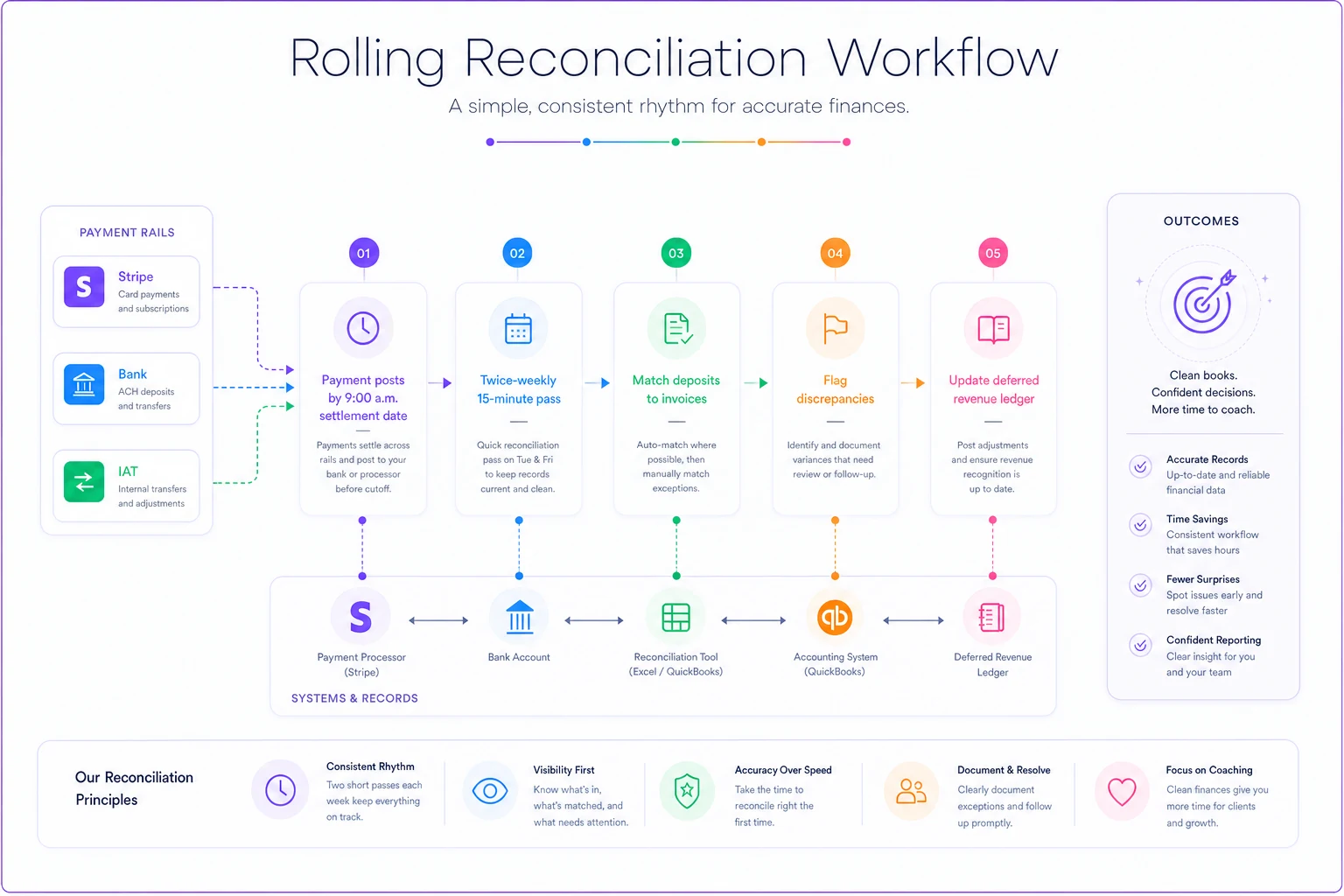
If you want the full framework for how rolling reconciliation, revenue recognition triggers, and multi-processor matching fit together, the deeper playbook in our billing and reconciliation guide for coaches walks through the month-end rules and revenue-recognition examples in detail. This rule change is a nudge to actually implement that system instead of just bookmarking it.
3. Separate "cash received" from "revenue earned" more rigorously
Faster cash tempts you to recognize revenue the moment money lands. Don't. A typical example: you sell a 12-session package for roughly $4,800, paid via ACH upfront. The cash hits your account the morning after the client pays. But you've earned that revenue across twelve sessions, not in one morning. Recognizing it all on deposit day inflates the month the payment arrives and guts the months you actually deliver the work.
The faster cash moves, the more disciplined your deferred-revenue tracking needs to be. Keep a simple ledger: cash received, revenue recognized this period, remaining deferred balance per client. The timing of the deposit should never drive the timing of recognition.
4. Rebuild your refund timing expectations and client scripts
Faster incoming ACH doesn't mean refunds and outgoing payments move on the same accelerated clock. Clients will absolutely assume they do. If a client cancels and you tell them "I'll refund you right away," they now expect next-morning money because that's what they experienced on the way in. Update your cancellation and refund language to state the realistic window for outgoing payments, which may differ from the deposit speed they saw on the receiving end. One mismatched expectation here turns a routine refund into three follow-up emails and a trust problem.
5. Re-time your dunning and failed-payment windows
A lot of coaches have failed-payment and retry logic tied to vague deposit timing — "if the payment doesn't show up in a few days, send the reminder." With clearer settlement-date posting, you can tighten those windows considerably.
A clean sequence to adopt:
-
Payment initiated — log the expected settlement date, not just "sent."
-
Settlement date, 9 a.m. — if the credit hasn't posted as expected, flag it same-day instead of waiting.
-
Same day, soft check — confirm it's a genuine failure vs. a timing quirk before messaging the client.
-
Day after confirmed failure — trigger your soft dunning message.
-
Defined escalation — move to your firmer sequence on your normal schedule.
The win here is that you stop sending awkward "where's my payment" nudges on transactions that were simply mid-transit. Tighter posting means fewer false alarms.
6. Treat IAT classification as a real task, not an afterthought
This is the part most coaches will skip and later regret. If you invoice international clients or pay overseas contractors through ACH, the updated IAT handling affects how those transactions must be classified. Misclassifying a cross-border payment as a domestic ACH isn't a cosmetic error — it can cause the transaction to be returned or flagged, and it muddies your reconciliation when the money doesn't behave like a domestic deposit.
Go through every recurring international payment relationship you have and confirm, with your processor or bank, that it's being classified correctly as an IAT where applicable. This is a "once, carefully" task that prevents a recurring mess. Don't assume your payment platform handles it silently and correctly — verify the actual classification on real transactions.
7. Reconcile international payments on a delayed trigger, not a same-day one
Domestic ACH now posts predictably. Cross-border does not follow the same 9 a.m. settlement-date logic — timing varies by corridor and intermediary bank. So if you reconcile everything on the same rolling same-day trigger, your international entries will constantly show as "missing" when they're just slower.
Split your reconciliation triggers: same-day matching for domestic ACH, a "hold and confirm posted" trigger for IATs. Forcing both onto one schedule is how practices end up chasing phantom gaps and mistrusting their own books.
8. Communicate the timing change to anyone who touches your numbers
If you have a bookkeeper, an accountant, or a part-time ops person, tell them the deposit timing assumptions changed. This sounds trivial. It isn't.
What tends to happen: your bookkeeper still assumes a 2–3 day float, keeps categorizing deposits against the wrong week, and your monthly reports drift from reality by a few days of transactions every cycle. By quarter-end, nobody trusts the numbers and you're doing a painful cleanup. A single two-paragraph email documenting the new expected posting behavior prevents that quiet drift.
9. Stress-test your payment integrations against the new posting behavior
If you use a scheduling-and-billing platform, a processor, and a bank that are supposed to talk to each other, don't assume they all updated their posting assumptions on the same day. Run a few live test transactions and watch when they actually post and how they appear in each system.
The failure mode to watch for: your software marks an invoice "paid" based on an old posting-delay assumption, while the bank already shows the money available. Small discrepancies like this are invisible until you're reconciling and the "paid" flags don't line up with the deposits. Catching it now, with deliberate test payments, beats discovering it in a month-end scramble.
A realistic before/after
Consider a two-coach practice billing roughly $18k–$22k a month across a mix of individual ACH payments and one corporate ACH account.
Before: Deposits arrived on a loose 2–4 day timeline. Reconciliation happened once, at month-end, as a single long session. Deferred revenue was tracked informally. Refunds were promised "right away" with no specifics. Two international clients paid through a method nobody had actually confirmed the classification on.
After re-baselining: Deposits confirmed posting by the morning of settlement date. Reconciliation moved to two short weekly passes, cutting the month-end session from a multi-hour grind to a quick review. Deferred revenue got its own simple ledger, so the month a big package landed stopped looking artificially inflated. Refund language got a realistic window attached. The two international payments were verified as properly classified IATs and put on a separate reconciliation trigger.
Nothing about revenue changed. But the books started matching reality, the month-end panic went away, and the practice stopped mistaking timing quirks for failed payments. That's the actual payoff — not faster money, cleaner money.
When this level of rework is overkill
If you run a small practice with one payment method, a handful of clients, and no international billing, you don't need nine moves. You need two: re-baseline your expected deposit timing (move 1), and reconcile a little more often since you now can (move 2). The rest is for practices with multiple rails, corporate accounts, or cross-border clients where mismatched assumptions compound.
And if you take only card payments and no ACH at all, this rule change doesn't touch you directly — though the habit of separating cash-received from revenue-earned is still worth borrowing regardless.
The underlying lesson
The real problem this rule exposes isn't timing. It's that a lot of coaching practices never built reconciliation as a system — they built it as a once-a-month act of faith, propped up by slow, vague deposits that gave everything time to settle before anyone looked closely.
Faster, more predictable ACH posting removes that cushion. It rewards practices with tight matching and clear revenue recognition, and quietly punishes the ones still running on timing fog. The accelerated funds availability isn't really the thing to react to — it's the prompt to finally run billing like infrastructure instead of a monthly chore. Predictable triggers, separated cash-and-revenue tracking, reconciliation that happens while the context is still fresh.
Spend an afternoon on moves 1 through 3 this week. The rest you can layer in as your mix of clients and payment methods demands.
Ready to elevate your coaching business?
Join hundreds of coaches using Guidyly to save time, enhance client engagement, and grow their practice.