



If you sell coaching through more than one channel — a Stripe checkout for 1:1 packages, PayPal for the occasional international client, maybe Kajabi or Teachable handling your group program — your month‑end close is quietly harder than it looks. Not because the numbers are big. Because the money moves through three or four systems that all report differently, settle on different days, and net out fees before you ever see a deposit.
Most coaches don't reconcile at all. They glance at the bank balance, feel okay, and move on. Then tax season arrives, or a bookkeeper asks a simple question — "why does your Stripe income not match your deposits?" — and there's no clean answer. This post is about closing that gap: matching processor reports to bank deposits, handling how refunds and failed payments distort recognized revenue, and building a reconciliation sheet that actually fits a coaching product mix.
This post is about closing that gap: matching processor reports to bank deposits, handling how refunds and failed payments distort recognized revenue, and building a reconciliation sheet that actually fits a coaching product mix.
The core problem: gross sales never equal what hits your bank
Your Stripe dashboard says you did roughly $12,400 in sales this month. Your bank shows deposits of about $11,700. Your accounting software, if you've connected it, might show a third number entirely.
-
Gross sales = what clients were charged
-
Net deposit = gross sales minus processor fees, minus refunds, minus chargebacks, held back by settlement timing
-
Recognized revenue = the portion of that money you've actually earned this month
For a coach selling a 3‑month package upfront, that last one is where it gets complicated. A client pays $3,000 in January for twelve sessions delivered through March. You have $3,000 in the bank in January. But you've only earned about $1,000 of it. The rest is a liability — money you owe in service.
When you skip reconciliation, all three numbers blur into one, and you end up either overstating income (paying tax on money you haven't earned) or losing track of what you owe clients if delivery stops.
Why multi‑processor setups make this worse
A single Stripe account is annoying but manageable. The trouble compounds when you're running parallel processors, which most coaches drift into without really deciding to.
Never miss a session or detail again.
Guidyly helps you book, manage, and track every coaching session efficiently.
- Centralized session scheduling
- Automated client reminders
- Progress tracking & notes
No credit card required
A typical situation: you started on PayPal because it was easy. Then you added Stripe when you built a real sales page. Then your group program went onto a course platform that has its own payment processing baked in. Now you have three sources of truth, three fee structures, and three deposit schedules.
-
Stripe settles on a rolling 2‑day delay, so a sale on the 30th lands in your bank in early next month. That single timing gap breaks naive month‑end matching.
-
PayPal lets money sit in a PayPal balance until you sweep it, so "sales" and "deposits" can be weeks apart.
-
Course platforms often report gross enrollment revenue while depositing net, and they bury their platform fee separately from the payment processing fee.
If you try to reconcile by eyeballing the bank, you'll never match these. The deposit amounts won't correspond to any single sale — they're batches, netted, delayed, and split across fee types.
The month‑end sequence that actually works
Reconciliation isn't hard once you do it in the right order. The mistake most people make is starting from the bank and working backward. Start from each processor instead.
-
Pull each processor's monthly report separately. In Stripe, use the Balance/Payouts report, not the Payments summary — you want the payout view because that's what maps to your bank. Do the same in PayPal (Activity export) and your course platform.
-
Reconcile each processor internally first. For each one, confirm: gross sales − fees − refunds − chargebacks = net payouts. Get each processor to tie out on its own before you touch the bank.
-
Match payouts to bank deposits. Take the net payout figures and find them in your bank statement. Because of settlement delay, a late‑month payout may land next month — flag it as "in transit" rather than forcing it.
-
Separate fees into their own expense line. Processor fees are a real business expense. Don't let them silently reduce your revenue figure. Book gross revenue and book fees separately, or you'll understate both your income and your costs.
-
Adjust for revenue recognition. For any upfront package or prepaid program, split what you earned this month from what's still deferred. This is the step almost every coach skips.
-
Handle refunds and dunning effects last, because they reverse earlier recognition and need their own treatment (below).
The order matters because a bank deposit is a batch — it never corresponds to one sale. Processor‑first reconciliation gives you the detail to explain each deposit.
Here's a simple workflow to visualize the processor‑first sequence before you map it to your bank.
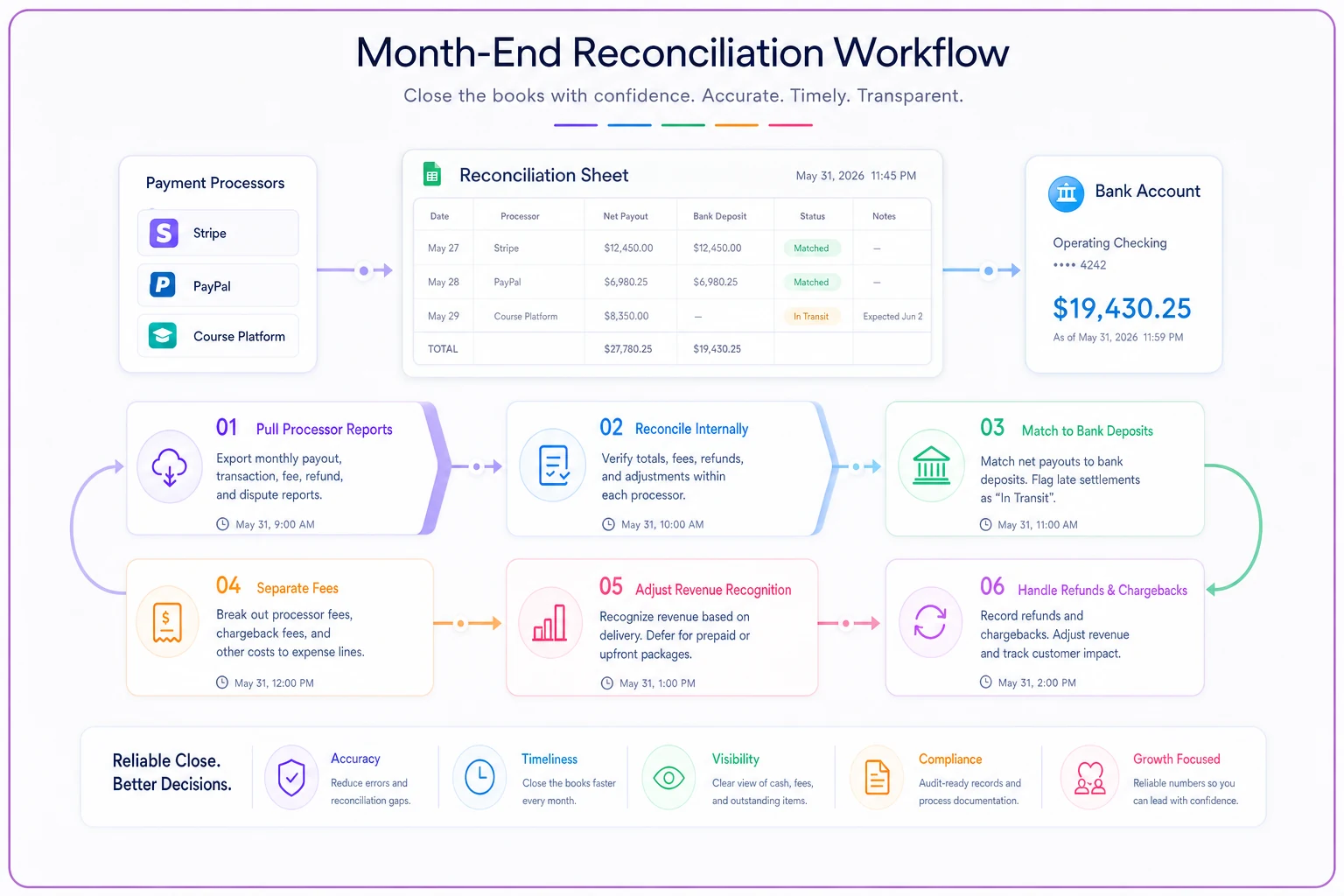
Keep the workflow close to your reconciliation sheet so each payout line ties to a bank line and a revenue recognition adjustment.
Refunds, chargebacks, and the recognition mess they create
Refunds are where coaching gets genuinely different from selling a physical product. When you refund a $250 single session before delivering it, that's clean — reverse the sale, done. But coaches usually refund partway through a program.
-
You'd already recognized roughly $1,000 as earned (four sessions).
-
You refund $2,000, which is the unearned, deferred portion.
-
Your deferred revenue liability drops by $2,000, and cash goes out.
-
The $1,000 you earned stays recognized — you delivered that work.
The common error is treating the whole $3,000 as a reversal, which wipes out legitimately earned income and throws your month off. Refunds should only claw back the deferred portion unless you're genuinely refunding earned work as goodwill.
Chargebacks are nastier because they're involuntary and come with a fee. A $500 chargeback typically costs you the $500 plus a $15–$25 dispute fee, and the money gets pulled from your next payout — so it shows up as a reduction in a future deposit, not a clean line item. When your bank deposit is $80 short one week, a silent chargeback is often why.
Dunning effects tie in here too. When a subscription payment fails and your dunning sequence retries it, revenue you may have already recognized can flip to unpaid. If you recognized a monthly retainer on the 1st and the payment failed and never recovered, you've booked revenue that never arrived. Your close needs to catch these. This is one reason a structured recovery process matters — the mechanics of running those retries without torching client relationships are covered in our breakdown of soft, moderate, and firm dunning sequences that recover cash without ruining relationships.
A reconciliation spreadsheet built for a coaching product mix
Generic reconciliation templates assume one revenue stream. Coaching usually has three or four with different recognition rules. Here's a structure that handles the mix.
Set up one row per revenue type, not per transaction, and track recognition separately:
| Product Type | Billing | Recognition Rule | Example: Gross Collected | Recognized This Month | Deferred |
|---|---|---|---|---|---|
| 1:1 single session | Pay‑per‑session | Recognize on delivery | $1,250 | $1,000 | $250 |
| 3‑month package | Upfront lump | Split evenly over 3 months | $6,000 | $2,000 | $4,000 |
| Monthly retainer | Recurring | Recognize in the month billed | $3,200 | $3,200 | $0 |
| Group program | Upfront cohort | Split over program length | $4,800 | $1,600 | $3,200 |
| Digital course | One‑time | Recognize on purchase (delivered instantly) | $900 | $900 | $0 |
Treat the Deferred column as your delivery backlog indicator — if it keeps rising, you're carrying more owed service than you've delivered.
The deferred column is the one that keeps you honest. That total deferred figure is your liability — money you're holding that you still owe in service. If it keeps growing, you've sold a lot of upfront programs you haven't delivered yet. That's a cash cushion, but it's also a delivery obligation sitting on your books.
Alongside this, keep a second tab that reconciles cash: processor gross → fees → refunds/chargebacks → net payout → bank deposit, with an "in transit" flag for settlement delay. The two tabs answer two different questions — "how much did I earn" and "where's the cash" — and you need both to close cleanly.
Sample journal entries coaches actually use
If you're on accrual accounting (which you should be the moment you sell upfront packages), the entries look like this. Using the 3‑month package as an example:
When the client pays $3,000 upfront:
-
Debit Cash (or Accounts Receivable pre‑settlement) $3,000
-
Credit Deferred Revenue $3,000
At each month‑end, recognizing one month:
-
Debit Deferred Revenue $1,000
-
Credit Coaching Revenue $1,000
When Stripe takes its fee on that transaction (~2.9% + 30¢ ≈ $87):
-
Debit Processor Fees (expense) $87
-
Credit Cash $87
When you refund the deferred $2,000 mid‑program:
-
Debit Deferred Revenue $2,000
-
Credit Cash $2,000
Notice the refund never touches the Revenue account, because you're only reversing money you hadn't earned yet. That single discipline prevents most of the month‑end distortion coaches run into.
Real scenario: a two‑processor practice cleaning up its close
A solo leadership coach was running Stripe for 1:1 work and Teachable for a group cohort, doing roughly $9k–$11k a month combined. Her "reconciliation" was checking that the bank felt about right. At year‑end, her bookkeeper flagged a mismatch of around $6,800 between reported income and deposits that nobody could explain.
The gap turned out to be three things stacked: settlement timing on late‑month Stripe sales, Teachable's platform fee being netted invisibly, and two mid‑program refunds that had been booked as full reversals. None of them were huge on their own. Together they made the books untrustworthy.
Rebuilding it processor‑first — reconciling Stripe and Teachable separately, then matching to the bank with an in‑transit flag — closed the gap to under $200, which was just rounding and one pending payout. More usefully, she discovered she was carrying about $7,400 in deferred group‑program revenue she'd been treating as spendable cash. Knowing that number changed how she managed her runway.
When this level of rigor makes sense — and when it doesn't
If you sell only pay‑per‑session work through a single processor and recognize revenue on delivery, you genuinely don't need deferred‑revenue accounting. Cash basis is fine. Reconciliation for you is just matching deposits to sessions, and monthly is plenty.
The rigor above earns its keep when:
-
You sell upfront packages or prepaid programs (deferred revenue becomes real)
-
You run two or more processors
-
You have recurring billing with failed payments flowing through dunning
-
Your revenue is past roughly $60k–$80k a year, where tax timing and clean books start to matter financially
Who should not over‑engineer this: a coach doing a handful of sessions a month on one Stripe account. Building a five‑tab reconciliation model for that is procrastination dressed up as diligence.
Making the monthly close a habit, not a scramble
Coaches who close cleanly treat it as a fixed 45‑minute task on the first business day of each month. A workable checklist:
-
Export payout reports from every processor, not just the main one
-
Reconcile each processor internally before touching the bank
-
Match net payouts to deposits; flag anything in transit
-
Book processor fees as their own expense line
-
Update the recognition tab — move earned amounts from deferred to revenue
-
Reverse only the deferred portion of any mid‑program refunds
-
Check for silent deposit reductions from chargebacks
-
Reconcile failed/recovered subscription payments against recognized revenue
-
Note your total deferred revenue balance — that's what you still owe in service
If you already track your numbers in a KPI system, recognized revenue and deferred balance belong right alongside your other operating metrics — the way we lay out data sources in the coaching KPI dashboard guide applies directly here.
The whole point of billing and reconciliation for coaches isn't to satisfy an accountant. It's to know, at any moment, how much money you've actually earned, how much you're holding on behalf of clients you still need to serve, and where every deposit came from. Once those three questions have clean answers, everything downstream — pricing, runway, tax planning — gets easier. The month‑end close stops being the thing you avoid and becomes the 45 minutes that tells you the truth about your practice.
Ready to elevate your coaching business?
Join hundreds of coaches using Guidyly to save time, enhance client engagement, and grow their practice.