

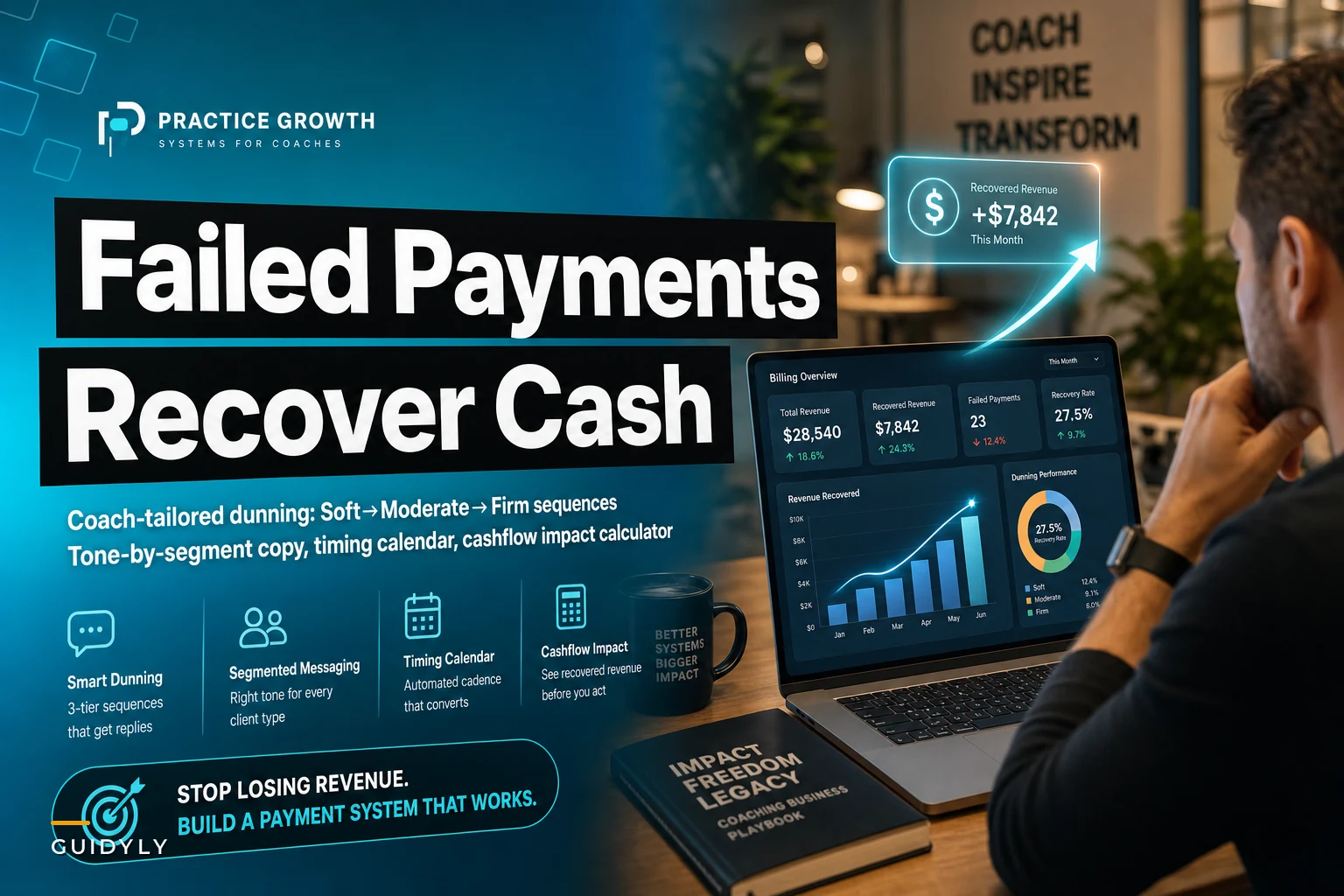

Payment failures hit coaching businesses harder than most people realize. A $500 monthly package that fails means instant negative cashflow while you're still showing up to sessions. Unlike products you can stop shipping, coaching creates this awkward situation where you're face-to-face with someone whose payment just bounced.
Most coaches handle it one of two ways: ignore it until it gets painfully uncomfortable, or send something that sounds vaguely threatening and destroys years of trust. Neither works.
What actually moves the needle is a tiered dunning workflow you can adjust based on the client. Not every failed payment deserves the same response. Your long-term executive client whose corporate card expired needs completely different messaging than a new client who might be quietly testing how seriously you take this stuff.
Breaking down the three-tier approach
The hard part of dunning isn't writing the emails—it's knowing which tone fits which situation. Most payment recovery systems treat every failure the same way, which is probably why recovery rates stay low while client churn quietly climbs.
A working tiered system looks like this:
Soft Touch (Days 1-3) Catches genuine mistakes without creating friction. Card expirations, timing-related insufficient funds, new cards that weren't updated—these account for roughly 65% of failures across coaching practices. The messaging stays helpful, not accusatory.
Moderate Push (Days 4-7) When soft touches don't work, something else is going on. Maybe cashflow issues, maybe the client's quietly questioning the value, maybe they keep forgetting. This tier acknowledges the situation while staying professional.
Firm Collection (Days 8-14) At this point you're dealing with serious financial issues or intentional avoidance. The tone shifts toward consequences while still leaving room for resolution.
The key insight operationally? Each tier needs different copy for different client segments. Corporate clients respond to completely different triggers than solopreneur clients.
Segment-specific copy that actually converts
Corporate executive clients respond to efficiency and discretion. A message for a failed $2,000/month executive coaching payment might look like:
Never miss a session or detail again.
Guidyly helps you book, manage, and track every coaching session efficiently.
- Centralized session scheduling
- Automated client reminders
- Progress tracking & notes
No credit card required
"Quick heads up - your payment method declined yesterday for our October coaching. I know these things happen with corporate cards. Here's a quick link to update it: [link]. Takes 30 seconds and we're back on track for Thursday's session."
Compare that to a life coaching client at $400/month:
"Hey Sarah, noticed your payment didn't go through yesterday - probably just a card issue. No stress, happens all the time. Can you hop into your account when you get a chance? Here's the direct link: [link]. Looking forward to our session tomorrow!"
The difference seems subtle, but it drives noticeably different response rates. Corporate clients want efficiency and discretion. Personal development clients want understanding and some flexibility.
Career transition clients need a different approach altogether. They're often between jobs, dealing with real cashflow uncertainty. Your moderate push might sound like:
"Hi Michael, following up on the payment from earlier this week. I know you're in transition right now - if we need to adjust the schedule or payment plan temporarily, let's talk. Otherwise, updating your card here [link] gets us sorted. Either way, let me know."
The timing calendar that maximizes recovery without burning bridges
Most coaches either move too fast or wait too long. Moving fast looks desperate. Waiting too long trains clients that payment is basically optional.
| Day | Action | Channel | Tone | Recovery Target |
|---|---|---|---|---|
| 0 | Payment fails | System notification | None | 0% |
| 1 | First soft touch | Helpful | 25-30% | |
| 2 | Second soft touch | Email + SMS | Friendly | 40-45% |
| 3 | Final soft touch | Concerned | 50-55% | |
| 4 | First moderate | Direct | 60-65% | |
| 5 | Pause | None | None | 65% |
| 6 | Second moderate | Email + Call | Serious | 70-75% |
| 7 | Final moderate | Warning | 75-80% | |
| 8 | First firm | Consequences | 80-82% | |
| 10 | Second firm | Email + Letter | Final notice | 82-85% |
| 14 | Service pause | System | Automatic | 85% |
The pause on Day 5 matters more than it looks. It prevents message fatigue and gives procrastinators a natural deadline from the Day 4 message. Skipping it is usually a mistake.
Legal requirements coaches routinely miss
Dunning isn't just about recovery—it's about compliance. Coaches operating across state lines need to understand varying requirements for collection communications.
California requires specific disclosures in collection messages. New York limits contact frequency. Texas has different rules for business versus consumer accounts. Most coaches have zero documentation showing client consent for payment retry attempts or collection communications.
-
Authorization for payment retries after failures
-
Communication preferences for payment issues
-
Service suspension terms for non-payment
-
Collection process escalation timeline
Without these, you're exposed even if you recover the payment. One client complaint to a state attorney general creates months of headaches.
The consent tracking gets messier with international clients. GDPR requirements mean EU clients need different handling than US clients, and payment recovery messages can fall under commercial communication rules depending on how they're interpreted.
Calculating real recovery impact versus relationship damage
Here's the math most coaches never actually run: what's the ROI of aggressive dunning once you factor in relationship damage?
A coaching practice with 40 clients at $750/month average, with a 5% monthly failure rate, has around 2 failed payments monthly—roughly $1,500 at risk.
Soft-only approach:
-
45% recovery rate
-
$675 recovered monthly
-
95% client retention
-
Net value
$675 + (38 clients × $750 × 0.95) = $27,825/month
Aggressive approach:
-
85% recovery rate
-
$1,275 recovered monthly
-
75% client retention
-
Net value
$1,275 + (30 clients × $750 × 0.75) = $18,150/month
The aggressive approach recovers $600 more per month but costs nearly $10,000 in retained revenue. That's why the tiered system matters—it maximizes recovery where appropriate while protecting long-term relationships where they count.
For your own numbers: Recovery Revenue = (Failed Payments × Recovery Rate × Average Payment) Relationship Risk = (Client Base × Churn Increase × Average LTV)
When Relationship Risk exceeds Recovery Revenue by more than 3x, you're destroying value by chasing payments too hard.
Warning signs your dunning is causing more damage than it fixes
Coaches rarely connect these patterns back to their payment recovery workflow, but they're worth paying attention to:
Immediate cancellations after payment recovery When clients pay then cancel the next week, your dunning worked tactically but failed strategically. They paid to exit cleanly, not to stay.
Radio silence after resolved failures Clients who stop scheduling sessions after payment issues are technically active but practically gone. The trust is already damaged.
Increasing initial failure rates over time When failures keep climbing with the same client base, some clients may be testing your response. Weak dunning encourages strategic non-payment.
Support ticket spikes around payment dates Clients creating unrelated issues around billing time are often using them as leverage or exit cover.
The operational automation that removes the awkwardness
Manual dunning creates three problems coaches don't usually anticipate. First, the emotional drain of chasing payments while trying to maintain a coaching relationship. Second, inconsistent timing when you're buried in client work. Third, the tendency to either over-communicate or avoid entirely depending on your mood that day.
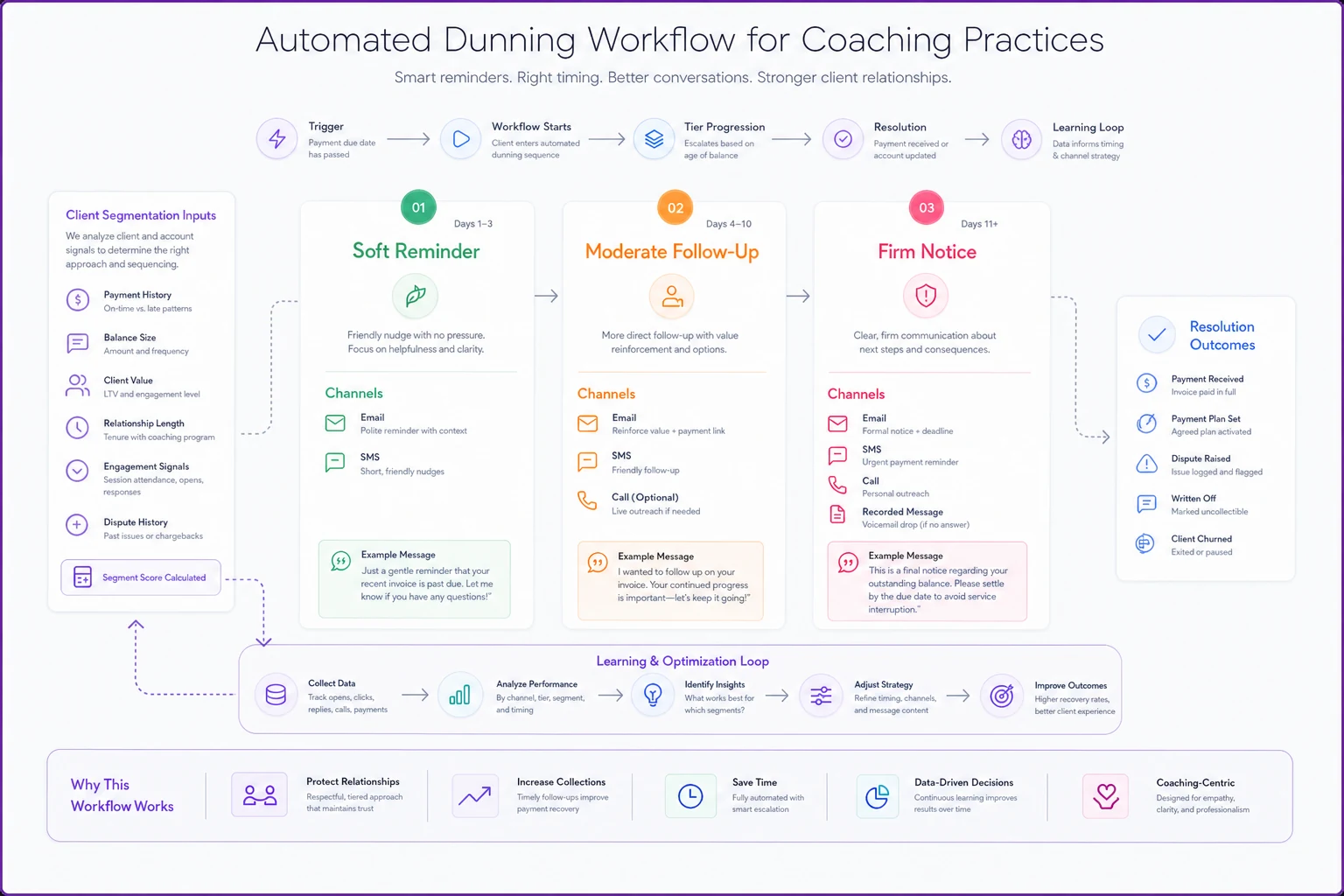
AI-powered operational software changes the dynamic here. Instead of manually tracking failures, writing individual messages, and managing follow-up schedules, the system handles the entire sequence automatically based on rules you set up once.
The automation tracks which tier each client falls into based on payment history, engagement level, and response patterns. Long-term clients with clean records get softer touches with longer gaps. New clients with immediate issues get faster escalation. It's not magic—it's just consistent execution that most coaches genuinely can't manage manually across a full client roster.
The system also learns from recovery patterns over time. If SMS outperforms email for certain client types, it adjusts. If morning messages get better response rates than evening sends, timing shifts accordingly. That optimization happens without you running a single report.
Below is a simple visualization of that workflow.
The less obvious benefit is emotional. Coaches can focus on actual coaching while the payment recovery runs in the background. No more avoiding the conversation until it's too late. No more sending something too aggressive because you're frustrated. You can read more about pricing and retention mistakes that compound these issues if you want the fuller picture on where coaching revenue actually leaks.
Building your segment-specific message library
High-ticket executive clients ($2,000+/month):
Soft: "Payment processing hiccup on our end - mind updating your card when convenient?"
Moderate: "Following up on the payment situation from earlier this week. Need to get this sorted before Thursday's strategy session."
Firm: "We need to resolve the outstanding balance of $2,000 before continuing our engagement. Please handle this today to avoid service interruption."
Mid-tier professional clients ($500-1,500/month):
Soft: "Quick note - your card was declined for this month's coaching fee. Here's the update link [link]"
Moderate: "Hey [Name], checking in about the payment from a few days ago. Everything okay on your end?"
Firm: "This is the final notice regarding your outstanding balance. Service will pause Monday unless resolved."
Entry-level clients (under $500/month):
Soft: "Heads up - your payment didn't process. New card maybe? Update here [link]"
Moderate: "Still showing an open balance from earlier this week. Can we get this sorted today?"
Firm: "Unable to continue sessions with the outstanding balance. Please resolve immediately or reply to discuss options."
Having this library built before the next failure matters more than having it perfect. You'll refine the copy based on what actually works with your specific clients.
When aggressive dunning makes sense (and when it doesn't)
Not every coaching practice should use the same dunning intensity.
When firm dunning works:
-
High-volume, low-touch group coaching
-
Course-based programs with defined endpoints
-
Corporate contracts with procurement departments
-
Clients with a history of payment games
When it backfires:
-
High-touch, transformational coaching
-
Long-term relationships (12+ months)
-
Referral-dependent practices
-
Vulnerable population coaching
Relationship-focused practices consistently lose more lifetime value from aggressive dunning than they gain in immediate recovery—usually by a factor of 3 to 4.
The hidden costs of broken payment recovery
Beyond lost revenue, failed dunning creates cascading operational drag that's easy to underestimate.
Administrative burden multiplies fast. You're tracking who owes what, sending manual reminders, updating spreadsheets, and having uncomfortable conversations. A single payment failure realistically costs 45-60 minutes of administrative time across its lifecycle.
Session scheduling gets messy too. Do you cancel the session for non-payment? Keep coaching and hope they pay? Every decision sets a precedent other clients quietly notice.
In group practices, team morale takes a hit. Coaches hate discussing money with clients. Admin staff hate chasing payments. Everyone avoids the responsibility and gaps form in the process.
Cash flow forecasting becomes unreliable when 5-10% of monthly revenue stays uncertain. You can't confidently invest in growth or plan ahead with any accuracy.
Your next steps for implementing tiered dunning
Start with segmentation. List your current clients and sort them by:
-
Payment history (clean, occasional issues, chronic problems)
-
Engagement level (highly engaged, normal, minimal)
-
Revenue tier (high, medium, entry)
-
Relationship length (new, established, long-term)
This drives your messaging strategy more than anything else.
Next, draft your three-tier messages for each segment. Don't overthink it—you'll refine based on what actually works. The goal is having something ready before the next payment failure, not having something perfect.
Set up your timing calendar. Most email systems can schedule sequences even if manually managed. Block 15 minutes every Monday to handle the previous week's failures systematically.
Block 15 minutes every Monday to handle the previous week's failures systematically.
Document the process with a simple checklist:
-
Payment fails → automatic notification
-
Day 1
Send soft touch #1
-
Day 2
Send soft touch #2 (email + SMS)
-
Day 3
Send soft touch #3
-
Day 4
Evaluate situation, send moderate #1 if needed
-
Continue through timeline
Track your results. Note recovery rates at each stage, client responses, and any relationship impacts. That data is what actually drives optimization over time.
The difference between coaches sitting at 95% collection rates and those stuck around 70% usually isn't aggressive tactics—it's having a systematic approach at all. The right dunning workflow protects both revenue and relationships without requiring you to become a collections agent.
Payment recovery handled well isn't confrontational. It's just a clear, consistent process that works for both sides. When clients know what to expect and you execute reliably, payment failures become operational hiccups rather than relationship crises. The best dunning system is one you rarely have to think about—it runs, recovers payments professionally, and lets you get back to the part of the business you actually built it for.
Payment recovery handled well isn't confrontational. It's just a clear, consistent process that works for both sides. When clients know what to expect and you execute reliably, payment failures become operational hiccups rather than relationship crises. The best dunning system is one you rarely have to think about—it runs, recovers payments professionally, and lets you get back to the part of the business you actually built it for.
Ready to elevate your coaching business?
Join hundreds of coaches using Guidyly to save time, enhance client engagement, and grow their practice.