



Yesterday's Fed announcement caught nobody off guard. The Federal Reserve held rates at 3.50%-3.75% and basically confirmed what most people already suspected — inflation's still sticky, and another hike before year-end isn't off the table.
For coaches and consultants running solo or small practices, this isn't abstract economic news. It's about to show up in your Stripe dashboard, your discovery calls, and your monthly P&L.
The pattern is predictable but still brutal every time. When rates stay elevated, potential clients start doing that thing where they "need to think about it" for three weeks instead of one. Current clients discover payment issues right around the time their credit card statement arrives showing a 24% APR. Corporate clients freeze L&D budgets. And that working capital line you were considering? The bank just quoted you 11% instead of the 7% you expected six months ago.
I watched this play out in late 2022. A career coach in Austin went from closing 4 out of 10 discovery calls to barely 2 out of 10 within eight weeks of the first major rate hike. Nothing changed about her program. Nothing changed about her marketing. But everything changed about how prospects viewed a $3,500 coaching package when their mortgage payment had just jumped $400 a month.
The delayed reaction hitting coaching businesses right now
Most coaches miss this about Fed policy: the damage doesn't happen immediately. According to recent CNBC coverage, market participants are already pricing in continued tightness through Q3. But for service businesses, the real impact rolls out over 60-90 days as existing contracts expire, payment plans complete, and new prospects start reevaluating discretionary spending.
A leadership coach in Phoenix walked me through her revenue breakdown last month. Pretty standard operation — 1:1 executive coaching at $2,000/month, a group program at $500/month, and occasional corporate workshops. Her trailing 90-day revenue was down about 18% compared to the previous quarter. Not because she lost a major client. Not because she took time off. Death by a thousand cuts:
-
Three exec clients dropped from twice-monthly to once-monthly sessions
-
Her group cohort filled to 8 instead of the usual 12
-
Two payment plans that should have auto-renewed got "paused for budget review"
-
A corporate client pushed a Q3 workshop to "maybe Q4, maybe next year"
Nobody said "interest rates are destroying my budget." They said things like "refocusing priorities" and "reevaluating investments." But the pattern was unmistakable.
Move 1: Restructure payment terms without touching headline prices
Revisiting your coaching pricing strategy doesn't necessarily mean changing your prices — sometimes it means changing how people pay them.
Never miss a session or detail again.
Guidyly helps you book, manage, and track every coaching session efficiently.
- Centralized session scheduling
- Automated client reminders
- Progress tracking & notes
No credit card required
When cash gets tight, the psychology around large upfront payments shifts hard. A $5,000 six-month coaching package feels impossible to someone reviewing their credit card statements. But $950 per month with a 5% discount for ACH? That same person finds a way to make it work.
The math is worth thinking through. Say you typically charge $6,000 for a 12-week intensive, paid upfront. In a high-rate environment, offering multiple payment options might look like:
| Payment Option |
|---|
| Option A: $6,000 upfront (original pricing) |
| Option B: $2,200 x 3 monthly payments = $6,600 total |
| Option C: $1,150 x 6 monthly payments = $6,900 total |
You're essentially becoming the lender, but at rates way below what clients would pay on a credit card. They save money, you get the sale, and you maintain your headline price point. Nobody needs to know payment plans exist until they're already sold on the value.
The operational challenge is actually managing these schedules. You need clear terms, automated billing, and a failed payment recovery process that doesn't burn relationships. Too many coaches learn this the hard way when month three arrives and half their payment plans are suddenly failing.
Move 2: Create a "bridge offer" for hesitant prospects
During the 2018 rate cycle, a business coach in Denver did something worth stealing. She normally sold a $10,000 six-month program. When leads started ghosting after discovery calls, she didn't chase them with discounts. She created a "Quick Win Sprint" — three sessions for $750 focused on solving one specific, named problem.
The lower price point wasn't the genius part. Around 60% of Quick Win clients upgraded to her full program within 45 days. They got results, built trust, and mentally adjusted to investing in coaching before committing to the bigger package.
-
Specific, measurable outcome Not "explore your leadership style" but "create your 90-day leadership development plan"
-
Compressed timeline 2-4 weeks maximum, urgency without commitment fear
-
Natural upgrade path The bridge offer surfaces a problem your main program solves
A sales coach could offer a "Pipeline Audit Package" — two sessions diagnosing why deals are stalling, naturally transitioning to ongoing coaching to fix what they find. An executive coach might do a "360 Feedback Debrief" that reveals development gaps requiring longer-term work.
Position it as a strategic response to market conditions, not desperation. You're helping clients get value quickly when longer commitments aren't feasible — not discounting because you're hungry.
Move 3: Add corporate payment pathways for individual clients
Most coaches never consider this: individual clients often have access to professional development budgets they're not using. When personal cash flow tightens, that $2,500 annual L&D allocation their employer provides suddenly looks attractive.
But most coaches make it unnecessarily hard to access those funds. No proper invoices. Can't accept purchase orders. No idea how to position coaching as professional development rather than personal growth.
-
Professional services agreements instead of coaching contracts
-
Detailed invoices with learning objectives and outcomes
-
Net-30 payment terms for corporate accounts
-
A one-page document clients could submit directly to HR
Within four months, roughly 40% of her "individual" clients were actually being paid by their employers. Same coaching, same price, different payment source. Cash flow improved because companies pay eventually — slower than individuals, but they don't just disappear mid-program.
The operational lift is real. You need proper invoicing software, possibly a separate business entity, and definitely more patience with payment timing. But when personal discretionary spending drops, corporate budgets become a genuine lifeline.
Move 4: Implement value stacking that justifies premium positioning
When money gets tight, coaches reflexively discount. There's a counterintuitive approach that often works better: add enough value that your premium price starts feeling like a bargain.
A health coach in Miami faced exactly this. Instead of dropping her $500/month rate, she added:
-
Weekly group accountability calls (30 minutes, 8 people max)
-
A resource library she'd built over five years
-
Quarterly guest expert sessions she was already running anyway
-
Voxer access for quick questions between sessions
Her costs went up maybe $50/month per client. But she could now position the program as "$2,000 worth of value for $500/month" with actual line items backing it up. Close rates improved because prospects felt like they were getting a deal — without her ever touching the price.
The stack needs to feel substantial without creating operational chaos. Group calls scale. Digital resources have zero marginal cost. Async communication takes minutes with the right boundaries. But together, they shift value perception completely.
Coaches with organized systems have a serious advantage here. That worksheet you built three years ago for one client? It's now part of your "implementation toolkit." The Loom videos you recorded to avoid repeating yourself? They become your "quick-start video library." If the assets exist, packaging them costs you almost nothing.
Move 5: Tighten your dunning sequence before the payment failures spike
Payment failures are coming. Not because clients want to bail — because cards are getting maxed, banks are tightening limits, and people are juggling more bills than usual. Most coaches respond to a failed payment with one apologetic email and then either nothing or a deeply awkward follow-up call they've been dreading for two weeks.
A systematic approach recovers payments without destroying the relationship. In this environment, that sequence should look something like:
-
Day 0 (failure) Automated friendly notification — "Looks like your payment didn't go through"
-
Day 2 Personal email from you — "Hey, wanted to make sure you saw the payment notification"
-
Day 5 Text or call — "Quick check-in on the payment, want to make sure we keep momentum"
-
Day 7 Offer an alternative payment method or modified terms
-
Day 10 Pause access with a clear reactivation path
The key is assuming positive intent while creating urgency. Somewhere around 70% of failed payments recover within the first week if you actually follow up — but most coaches feel too awkward to have the conversation and leave a lot of money sitting there uncollected.
AI-powered operational platforms can automate this entire sequence while keeping the personal tone intact. The system handles the triggers and tracks responses, escalating to you only when something actually needs human attention. You stay focused on coaching.
Move 6: Shift acquisition strategy from paid ads to referral optimization
When discretionary spending drops, paid acquisition costs go up. A Facebook campaign generating leads at $50 per booking can drift to $150 without you changing anything. Google Ads become rough as coaches bid up the same keywords trying to maintain volume.
The smarter move is doubling down on referrals — not the passive "hope clients mention me" version, but an actual system with triggers, incentives, and tracking.
A consultant in Boston built something worth copying. Every client who hit 90 days got an automated email:
"You've made incredible progress in our first three months together. I have space for two new clients next month. If you know someone facing similar challenges, I'd love to help them too. As a thank you, both you and anyone you refer get a bonus strategy session."
Simple. Systematic. It generated 3-4 qualified referrals monthly. Her acquisition cost dropped from around $300 per client to essentially zero, and referred clients had meaningfully higher lifetime value because they came pre-sold.
-
Automated trigger emails based on client milestones
-
A simple referral tracking system
-
A clear incentive structure that doesn't feel cheap
-
Follow-up sequences for both referrer and new prospect
During tight money periods, warm referrals close at a much higher rate than cold leads because trust already exists. Price becomes less of an objection when someone they respect is vouching for the results.
Reading the room: Why these moves matter more than ever
The Fed's holding pattern isn't just about interest rates. It signals that cheap money is gone, and businesses need to operate differently. For coaches, that means shifting from growth-at-any-cost to operations that are actually sustainable.
Looking at revenue data from around 30 coaching businesses over the past 18 months, the ones doing well now share three things:
-
Multiple payment pathways — they make it easy to pay regardless of individual cash flow situations
-
Value density — their offers feel premium but worth it, not discounted to seem accessible
-
Operational efficiency — they've automated the repetitive administrative work so delivery stays strong
The coaches struggling are still operating like it's 2021. One payment option. Minimal follow-up on failed payments. Banking on one corporate contract to save the quarter.
The infrastructure reality check
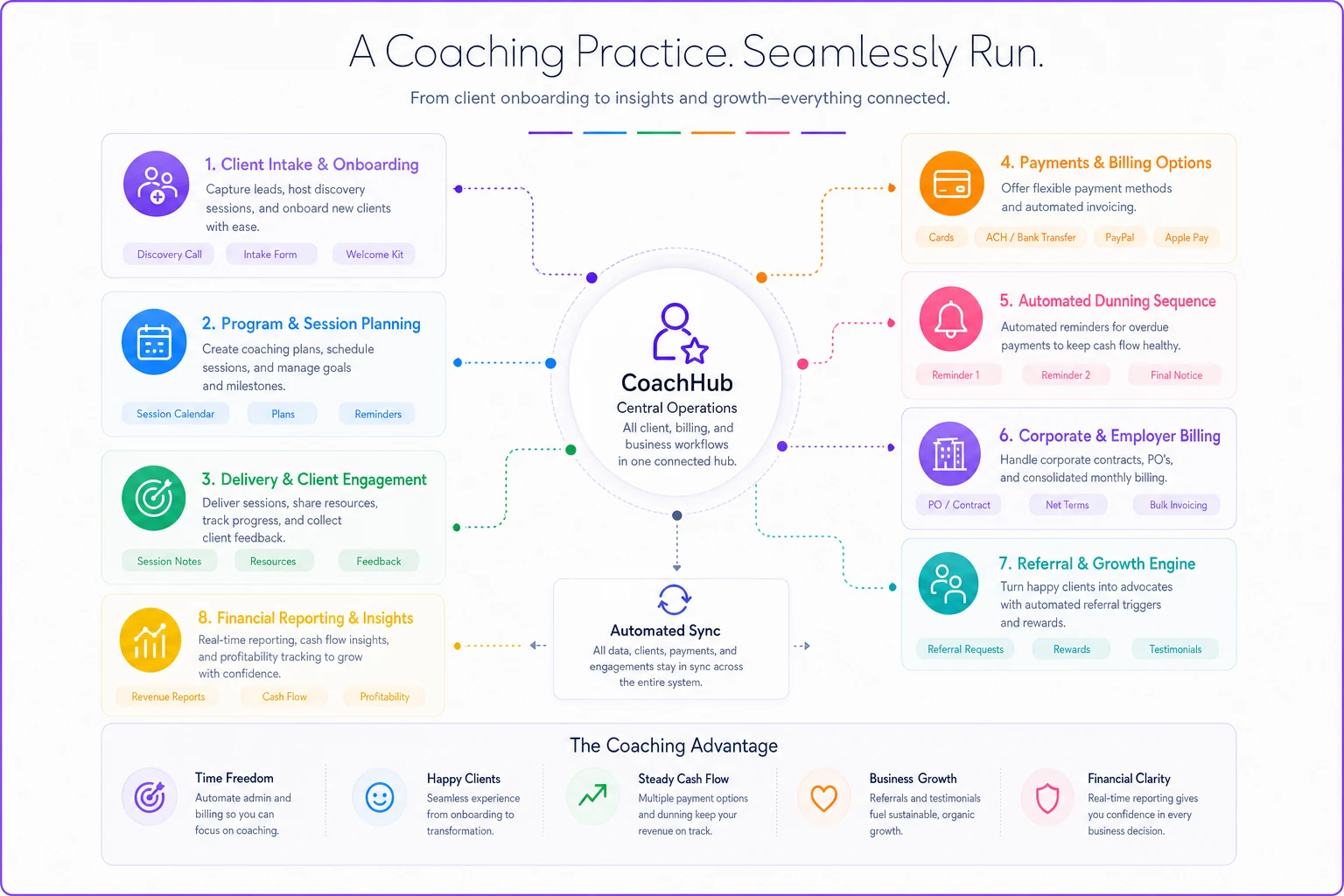
Implementing these moves requires operational infrastructure most coaches haven't built. Payment processing flexibility, automated email sequences, client tracking, referral management, financial reporting — it adds up fast.
Here's a simple visual of the workflow.
A coach in Austin spent three months trying to wire this together herself using Calendly, Stripe, ConvertKit, Airtable, and Zapier. It sort of worked until it didn't. Failed payments weren't triggering the right emails. Referrals weren't tracked. She was spending more time managing the system than coaching clients.
Purpose-built operational software solves this — instead of duct-taping five tools together, you get integrated payment management, dunning sequences, referral tracking, and financial dashboards in one place. The AI-assisted components handle repetitive follow-ups and routine communications while you focus on delivery.
Even without the software, the strategy is the same. Make it easier for clients to pay you. Make it harder for payments to fail silently. Make client acquisition cheaper. These aren't complicated ideas — they just matter a lot more when money is tight.
Your next 72 hours
Your competitors are still processing what yesterday's announcement means. There's a window to adjust before everyone else panics and starts cutting prices.
Start with payment flexibility. Look at your current packages and add at least two payment options by Friday. Don't overthink the structure — just give people ways to pay that don't require a massive upfront commitment.
Then audit your failed payment process. Pull up your last five failed payments and look at what actually happened. Did you follow up? How many times? Did any recover? If you're recovering less than half, you're leaving money on the table you can't afford right now.
Finally, identify three clients who've been with you 90+ days and had clear wins. Send them a personal note this week asking if they know anyone facing similar challenges. Don't build a formal program around it. Just start the conversation.
The coaches who come out of this period ahead won't be the ones with the best Instagram presence or the most polished website. They'll be the ones who saw the operational reality early and adjusted — premium prices with payment flexibility, strong value propositions with efficient delivery, systematic follow-up that preserves relationships rather than torching them.
The Fed is holding steady. Your coaching pricing strategy can't afford to do the same.
Ready to elevate your coaching business?
Join hundreds of coaches using Guidyly to save time, enhance client engagement, and grow their practice.