


You land a corporate pilot with a Fortune 500 company. Three months later, they thank you for your time and move on. Meanwhile, another coach just converted their 12-week pilot into a $180k annual contract with the same type of organization.
The difference? They had a systematic coaching corporate pilot playbook built specifically for converting skeptics into believers.
Most coaches treat corporate pilots like extended sales demos. They deliver great sessions, collect positive feedback, then get blindsided when procurement passes. The real problem isn't your coaching quality—it's that you're playing defense while other providers are running a conversion playbook from day one.
Why Corporate Pilots Actually Fail (And It's Not Your Coaching)
Corporate pilots fail for operational reasons, not coaching reasons. The HR buyer who championed you internally needs ammunition to justify the full contract. The CFO needs measurable ROI. The executive sponsor needs visible wins they can point to in leadership meetings.
Your pilot participants might love the sessions. HR might see engagement ticking up. But without the right operational framework, that positive sentiment rarely translates into a signed contract.
Around week 8 of a 90-day pilot, this is usually what happens: HR starts getting questions from finance about renewal decisions. They scramble to pull together feedback. You provide some testimonials and attendance data. HR presents this to leadership, who asks for "more concrete metrics." The pilot ends with everyone agreeing it was "valuable" but not quite ready to commit to a full program.
The coaching was fine. The operational structure failed.
The Three Stakeholder Groups You're Actually Selling To
During any corporate pilot, you're not selling to one buyer—you're selling to three distinct groups with completely different success criteria.
Never miss a session or detail again.
Guidyly helps you book, manage, and track every coaching session efficiently.
- Centralized session scheduling
- Automated client reminders
- Progress tracking & notes
No credit card required
The Economic Buyer sits in finance or procurement. They care about cost per employee, comparative vendor pricing, and measurable business outcomes. They're weighing your $45k pilot against hiring another full-time L&D person or upgrading their learning management system.
The User Buyer is your HR contact or L&D leader. They care about participant satisfaction, completion rates, and whether this makes their job easier or harder. Implementation effort, internal marketing needs, how it fits existing programs—that's what keeps them up at night.
The Executive Sponsor authorized the pilot budget. They want strategic alignment, visible culture change, and stories they can take to the board. They're thinking about talent retention OKRs, not session satisfaction scores.
Most coaches only plan for the User Buyer. That's why pilots die in procurement.
Building Your 90-Day Conversion Framework
A coaching corporate pilot playbook that actually converts needs four core components working together from day one.
Component 1: Pre-Pilot Success Criteria Alignment
Before the pilot starts, you need documented success criteria from all three stakeholder groups—not vague goals like "improve leadership skills," but specific, measurable targets.
Schedule a 45-minute alignment call with each stakeholder group separately. Don't combine them. You need honest answers about what success looks like from each perspective, and people talk differently when they're not sitting next to their CFO.
For the Economic Buyer, push for specifics:
-
Target cost per participant outcome
-
Comparison benchmarks they're using
-
Budget threshold for full program
-
ROI calculation method they prefer
For the User Buyer, document operational wins:
-
Current time spent on this problem weekly
-
Specific pain points this should eliminate
-
Integration requirements with existing systems
-
Internal resource requirements
For the Executive Sponsor, capture strategic goals:
-
Which company OKRs this supports
-
Competitive advantages they're seeking
-
Culture shifts they want to enable
-
Board-level metrics they track
Get stakeholders to sign the one-page success criteria within the first two weeks to lock alignment.
Get these in writing. A simple one-page success criteria document that all parties sign off on. This becomes your north star for the entire pilot.
Component 2: Weekly Measurement Cadence
Corporate buyers expect data density most coaches aren't prepared to deliver. You need three parallel measurement tracks running throughout the pilot.
Engagement Metrics (Weekly) Track participation rate, session completion, homework submission, and peer interaction frequency. Go deeper—track sentiment shifts week-over-week, topic resonance scores, and implementation commitments participants make.
Progress Metrics (Bi-weekly) Measure skill progression against the specific competencies outlined in your success criteria. Use pre/post assessments, 360 feedback snapshots, or manager observation forms. The goal is showing movement, not just activity.
Business Impact Metrics (Monthly) Connect coaching outcomes to business KPIs. If the pilot focuses on sales leadership, track pipeline velocity changes. For new manager development, track team engagement scores. For executive coaching, track decision speed or strategic initiative progress.
Most coaches wait until week 10 to compile this data. By then, it's too late to course-correct or amplify what's working.
Component 3: Strategic Reporting Rhythm
Collecting data is one thing. Knowing when and how to share it is what builds contract momentum.
Week 2: Early Wins Report Send a brief "early indicators" report to all stakeholders. Highlight initial engagement levels, participant feedback, and any immediate behavioral shifts. Two or three direct quotes from participants go a long way here.
Week 4: Engagement Deep Dive Provide detailed engagement analytics with comparison to industry benchmarks. Show that your pilot is outperforming typical corporate training. Include a "risk and mitigation" section addressing any participation challenges.
Week 6: Mid-Pilot Progress Review Schedule a 30-minute review with all stakeholders. Present progress against the original success criteria. Include participant testimonials, manager feedback, and early business impact indicators. If there are concerns about hitting pilot goals, surface them now and propose adjustments.
Week 9: Preliminary ROI Analysis Share initial ROI calculations based on the methodology the Economic Buyer specified. Include both quantitative metrics and qualitative value stories. Provide three scenarios for full program rollout: conservative, moderate, and aggressive expansion.
Week 11: Final Impact Report Deliver a comprehensive report showing full pilot results against original success criteria. Participant testimonials, manager endorsements, measured business impact, and a clear recommendation for next steps.
Week 12: Contract Transition Meeting Present the full business case for expanded engagement. Come prepared with multiple contract options, implementation timelines, and risk mitigation strategies.
Component 4: Contract Transition Mechanics
The biggest pilot killer? Procurement friction in weeks 10–12. Build these elements into your pilot agreement from the start.
Auto-Renewal Clause Include language that automatically converts the pilot to a full program unless the client provides written notice of non-renewal by week 10. This shifts the default from "no" to "yes" and creates real urgency.
Graduated Pricing Structure Offer pricing incentives for committing before pilot completion:
-
Week 8 commitment
15% discount on annual program
-
Week 10 commitment
10% discount
-
Post-pilot commitment
Standard pricing
Expansion Triggers Define specific metrics that automatically trigger contract expansion discussions:
-
90%+ participant satisfaction
-
80%+ session attendance
-
Measurable skill improvement in 70%+ of participants
-
Positive ROI by week 8
Risk Reversal Options Offer a performance guarantee for the full program:
-
First 30 days of full program fully refundable
-
Success metrics guarantee with fee reduction if not met
-
Pilot fee credited toward annual contract
Start procurement conversations early and bake in these mechanics so procurement isn't a last-minute blocker.
Below is a visual workflow of the pilot conversion process.
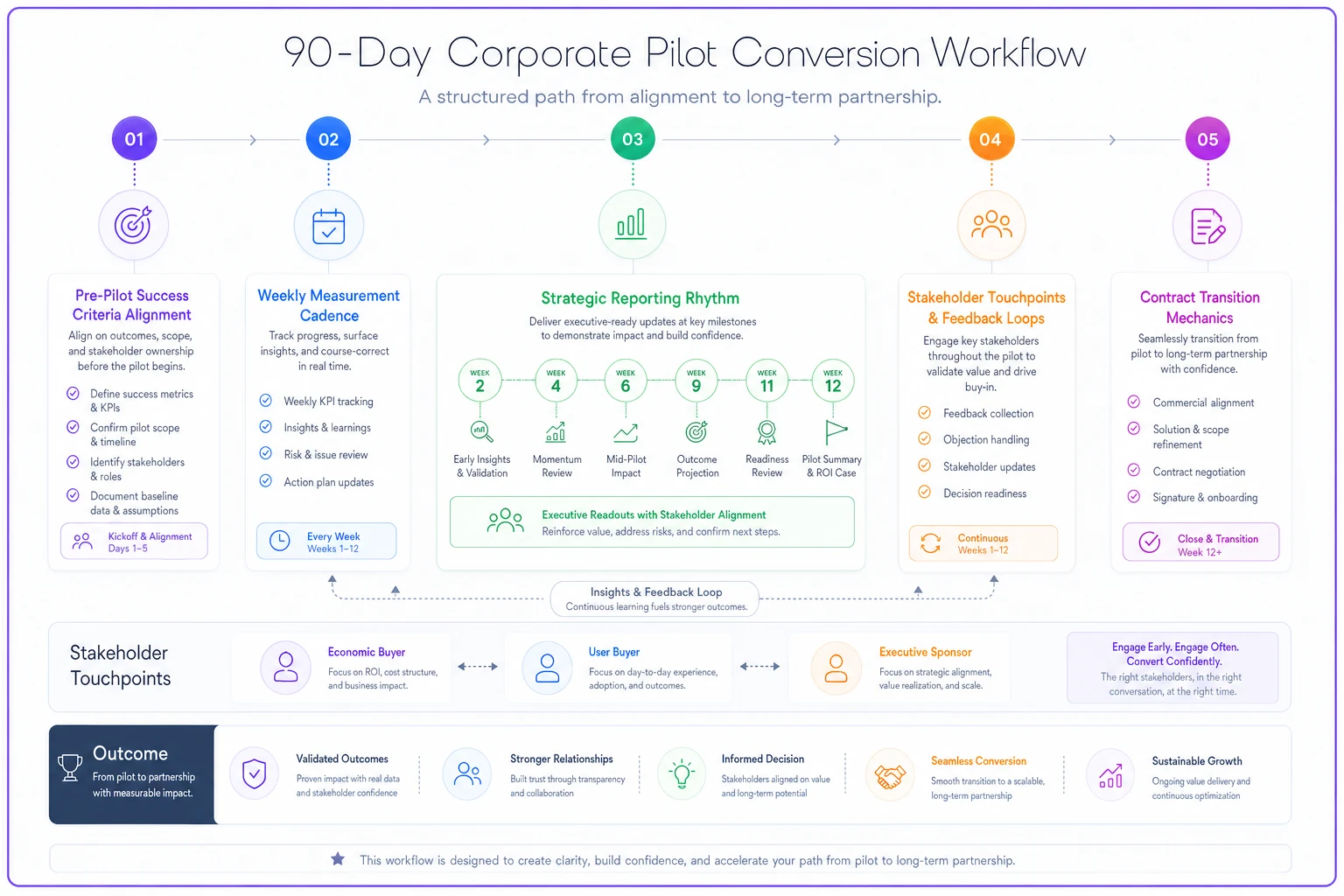
Place this workflow diagram in stakeholder-facing reports or the pilot command center to align expectations visually.
The Hidden Pilot Killers
Even with solid execution, a few things can quietly derail a conversion.
Internal Competition Other vendors are often running simultaneous pilots. Your contact won't tell you this, but procurement is comparing multiple options. Ask directly: "What other solutions are you evaluating?" Build comparison materials that show your specific value clearly.
Budget Timing Misalignment Corporate budget cycles don't care about your pilot timeline. If your pilot ends in October but budget planning happened in July, you've already lost the window. Map budget cycles early and time pilots accordingly.
Stakeholder Turnover Your champion leaves in week 7. The new person has different priorities. Build relationships with multiple stakeholders from day one. Document everything. Have a transition plan ready.
Integration Overwhelm IT needs a security review. Legal wants contract modifications. Procurement needs vendor onboarding. These processes can take 8–12 weeks on their own. Start them in week 2, not week 10.
Real Coaching Corporate Pilot Playbook Example
A leadership coaching firm ran a pilot with a 500-person tech company using this framework:
Week 0: Documented success criteria including "25% improvement in 360 leadership scores" and "15% increase in team engagement"
Weeks 2–8: Delivered bi-weekly progress reports showing sentiment improvements, skill development tracking, and early behavior changes
Week 6: Mid-pilot review surfaced concerns about senior leader participation—they adjusted to include executive-only sessions
Week 9: Preliminary ROI analysis showed $240k in projected retention savings based on improved manager effectiveness
Week 11: Final report demonstrated all success criteria met or exceeded
Week 12: Converted to $180k annual contract with expansion option for additional business units
The $45k pilot fee was credited toward the annual contract, making the effective pilot cost zero.
When Pilots Make Sense (And When They Don't)
Not every corporate opportunity needs a pilot. Sometimes they actually reduce your conversion probability.
Pilots make sense when:
-
The organization has been burned by previous coaching vendors
-
You're introducing a methodology they haven't tried before
-
Multiple stakeholders need convincing
-
Budget exceeds $100k annually
-
They want to test cultural fit
Skip the pilot when:
-
There's a strong internal champion with budget authority
-
An urgent business need requires immediate full rollout
-
The pilot group is too small to show meaningful impact
-
Timeline doesn't align with budget cycles
-
The organization already has a successful history with coaching
Pilots are about risk mitigation, not education. If the client already believes in coaching value, a pilot just delays the inevitable and gives competitors time to interfere.
Your 90-Day Pilot Conversion Checklist
Use this checklist to make sure your coaching corporate pilot playbook covers all the conversion elements:
Pre-Pilot Setup
-
Success criteria documented for all stakeholder groups
-
Measurement methodology agreed upon
-
Reporting cadence scheduled
-
Contract transition terms included in pilot agreement
-
Budget cycle timing confirmed
-
Competition landscape understood
Weekly Execution
-
Participation tracked and reported
-
Sentiment measured consistently
-
Early wins captured and shared
-
Stakeholder engagement maintained
-
Risk factors monitored
Mid-Pilot Checkpoints
-
Week 4 engagement report delivered
-
Week 6 review meeting conducted
-
Course corrections implemented
-
Procurement process initiated
-
IT/Legal reviews started
Final Sprint
-
Week 9 ROI analysis completed
-
Week 11 final report delivered
-
Contract options prepared
-
Success stories documented
-
Transition meeting scheduled
Use this checklist to make sure your coaching corporate pilot playbook covers all the conversion elements:
Technology That Accelerates Pilot Conversion
Manual pilot management burns time you should spend coaching. AI-powered operational software can handle the measurement, reporting, and stakeholder tracking that most coaches are doing manually—or skipping entirely.
Platforms built for this kind of work can automatically track engagement metrics, generate progress reports from session notes, and flag at-risk pilots before they quietly die. That frees you up to focus on actual coaching instead of spending weekends building PowerPoint decks for week-9 reviews.
Some coaching practices set up what you'd basically call a pilot command center—a shared dashboard where stakeholders can check in on participation, feedback, and business impact in real time. That kind of transparency shifts the conversation. Executives stop questioning value and start planning for expansion.
More advanced platforms can surface early warning signals when a pilot is trending toward non-renewal, giving you time to course-correct rather than scramble in week 11.
The Math Behind Pilot Economics
Understanding pilot economics helps you structure deals that actually convert. Here's the rough framework:
| Metric | Without Playbook | With Playbook |
|---|---|---|
| Average enterprise contract value | $150k–$200k | $150k–$200k |
| Typical pilot investment | $30k–$50k | $30k–$50k |
| Conversion rate | 25–35% | 65–75% |
| Contracts per 4 pilots | ~1 | ~3 |
The math is pretty straightforward—a structured approach converts roughly three times as many pilots. But there's a cost that doesn't show up on the spreadsheet: failed pilots burn references, create skepticism in your target market, and eat months of business development time. One well-run pilot that converts is worth more than five messy ones that don't.
Pilots Are Not Demos
The biggest mistake coaches make with corporate pilots is treating them like extended demonstrations rather than structured conversion programs.
Your coaching quality matters, but operational excellence is what wins contracts. The organizations evaluating you have procurement processes, budget constraints, and political dynamics you need to navigate. A coaching corporate pilot playbook gives you the framework to manage all of that while still delivering real coaching outcomes.
Stop hoping pilots convert. Start engineering conversions from day one. Document success criteria, measure consistently, report strategically, and build contract momentum throughout the pilot—not just at the end.
The coaches winning enterprise deals aren't necessarily better coaches. They're better at the operational side of pilot management. They understand that building strategic partnerships starts with proving value systematically, not just delivering it.
Your next corporate pilot is a chance to show potential clients you're not just a coach—you're a strategic partner who understands their business, measures what matters, and delivers predictable results. That's how pilots become contracts.
Ready to elevate your coaching business?
Join hundreds of coaches using Guidyly to save time, enhance client engagement, and grow their practice.