

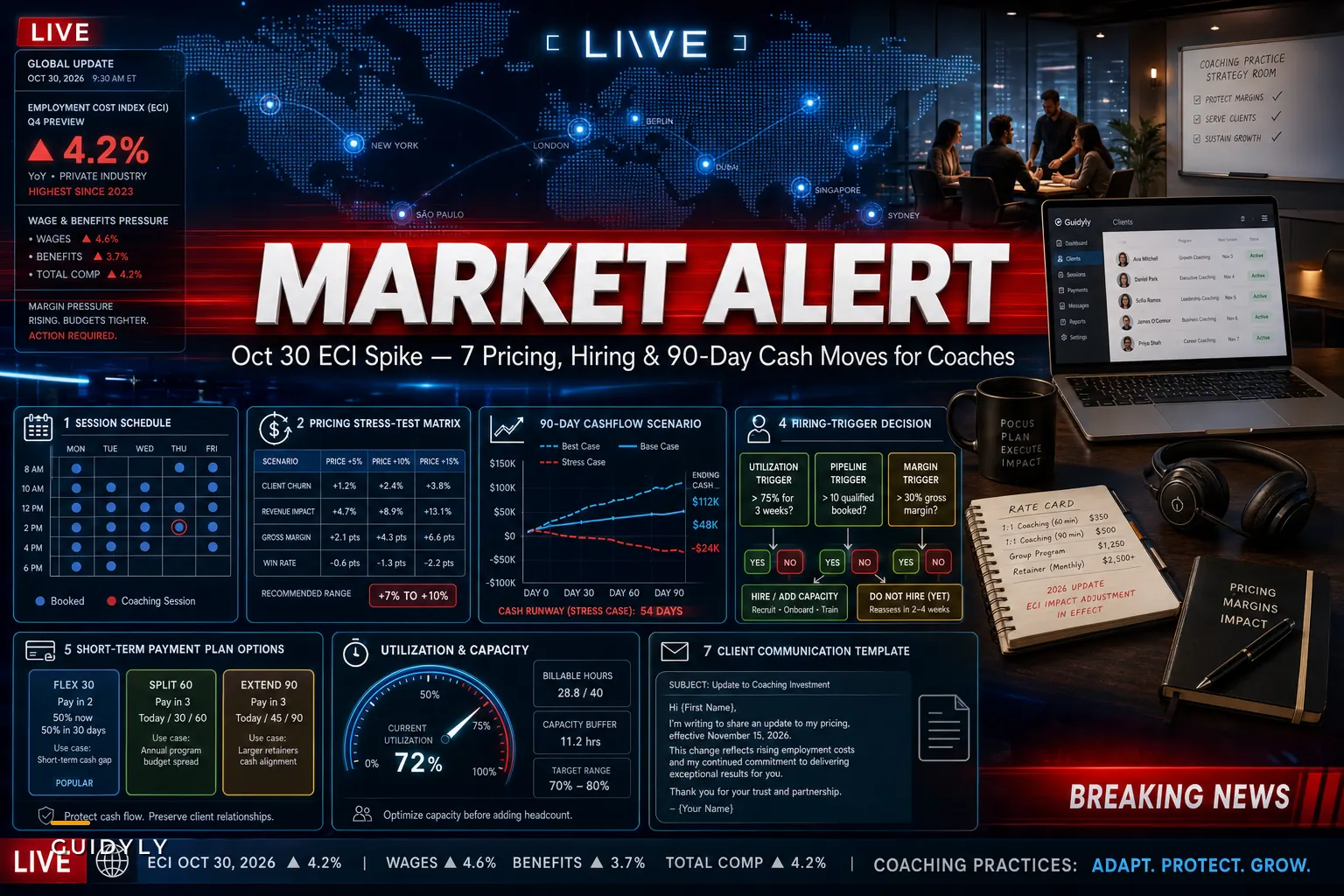

The Q3 2026 employment-cost data landed on October 30, and for once it's macro news that actually touches how a coaching practice runs. According to a Reuters report on third-quarter labor costs, wage growth eased and labor-cost increases came in below inflation. Bloomberg framed the same data as employment-cost growth holding steady while staying under the inflation line.
Fine. But a headline about the Employment Cost Index doesn't tell you what to do on Monday. What matters is the chain reaction: if wages are cooling, household purchasing power is shifting, your clients' employers are recalibrating raises, and your own compensation bands may be drifting out of sync with the market. For practices that pay other coaches, this is the moment to check whether you're overpaying, underpaying, or just guessing.
Skipping the economics lecture. Here are the operational decisions this actually forces.
The underlying problem this exposes: most practices price and pay on autopilot
Most coaching practices set their session rates and their coach pay once — usually at a moment of anxiety or optimism — and never revisit the logic. The rate was "what felt right in 2024." The contractor coach pay was "what we needed to offer to land her." Neither number is tied to anything that moves.
When labor costs were climbing fast, that passivity quietly hurt you — payroll crept up, rates didn't, margin thinned. Now the direction has flipped, and the same lack of a mechanism hurts you differently. If market wages are flattening and you don't notice, you might greenlight a raise or a new hire based on last year's panic. Or you hold rates flat while a competitor adjusts and quietly undercuts you.
The real issue isn't the direction of wages. It's that your pricing and compensation have no trigger logic. A shift in the Employment Cost Index should nudge a number somewhere in your business — and in most practices, it doesn't nudge anything.
Below are seven moves. Not all of them apply to every practice. A solo coach with no payroll can skip the compensation-band work and focus on pricing and cash-flow scenarios. A four-coach practice should read the hiring section twice.
1. Re-check your coach compensation bands against a softer market
If you pay other coaches — W-2 or contractor — you set those rates in a specific labor environment. When wages were hot, you probably stretched. Now that labor-cost growth has cooled below inflation, that stretch may no longer be necessary for new hires.
Never miss a session or detail again.
Guidyly helps you book, manage, and track every coaching session efficiently.
- Centralized session scheduling
- Automated client reminders
- Progress tracking & notes
No credit card required
This does not mean cutting what you pay existing coaches. That's a fast way to tank morale and retention. It means your next offer and your band ceilings can be more disciplined.
The move:
-
Pull your current comp bands for each coach tier
-
Note the market context in which each was set
-
Set a ceiling for new offers, not a floor
-
Leave existing coach pay untouched unless there's a performance reason
A typical example: a practice pays senior associate coaches a $95–$110/session contractor rate, set during a tight hiring stretch. The next hire doesn't automatically need to come in at $105 just because the last one did. In a softer market, you might open the search at $88–$95 and see what quality applies before escalating. Over roughly 600 sessions delivered by that coach across a year, the difference between $105 and $92 is close to $8k — real margin, not a rounding error.
2. Separate "cost-of-living" price increases from "value" price increases
A lot of coaches raise rates every year with a vague "costs went up" justification. When labor costs are running below inflation, that justification gets weaker — and sharp clients, especially corporate buyers, will notice.
Stop bundling two very different price moves:
| Price increase type | Justification | When it holds up now |
|---|---|---|
| Cost-of-living bump | "My expenses rose" | Weaker — labor costs are cooling |
| Value / outcome bump | "Results, demand, scarcity, new program depth" | Strong — unrelated to macro wages |
If your only story is "my costs went up," a procurement team can push back with public data. If your story is "our last cohort hit its outcome targets and we have a waitlist," the macro environment is basically irrelevant. Shift your pricing narrative toward the second column. It holds up in any economy.
3. Pressure-test your per-client margin before you assume you're fine
Softening wages sounds like good news for margin — payroll pressure eases. But there's a trap. If client spending tightens because household income growth is cooling too, your revenue side can soften at the same time. You can't assume the cost relief shows up at the bottom line.
Run a quick per-client margin check on your three largest program types. For each:
-
Fully-loaded delivery cost per client (coach pay + your time + platform/software + admin)
-
Current price per client
-
Contribution margin in dollars and percent
-
What happens to that margin if 1 in 10 clients downgrades to a cheaper package
Practices that skip this step often celebrate lower wage pressure, then get surprised three months later when a wave of package downgrades eats the savings. The margin math has to account for both sides moving.
4. Re-set your hiring triggers so they respond to data, not feelings
This one matters most for multi-coach owners. Most hiring decisions get made emotionally — you're drowning, you panic-hire, and six weeks later you're underutilized when a few clients churn.
Put these hiring thresholds in writing and check them monthly so decisions aren't made in the moment.
A labor-cost shift is a good excuse to replace the feeling with a rule. Tie your next hire to actual thresholds:
-
Utilization trigger hire when existing coaches have run above roughly 85% of target caseload for three consecutive months
-
Pipeline trigger hire when qualified-lead volume has exceeded current delivery capacity for two straight months
-
Margin trigger only hire if projected contribution margin on the incremental coach stays above your floor even in a conservative revenue case
A quick visual of these hiring triggers in sequence can make the rule clearer.
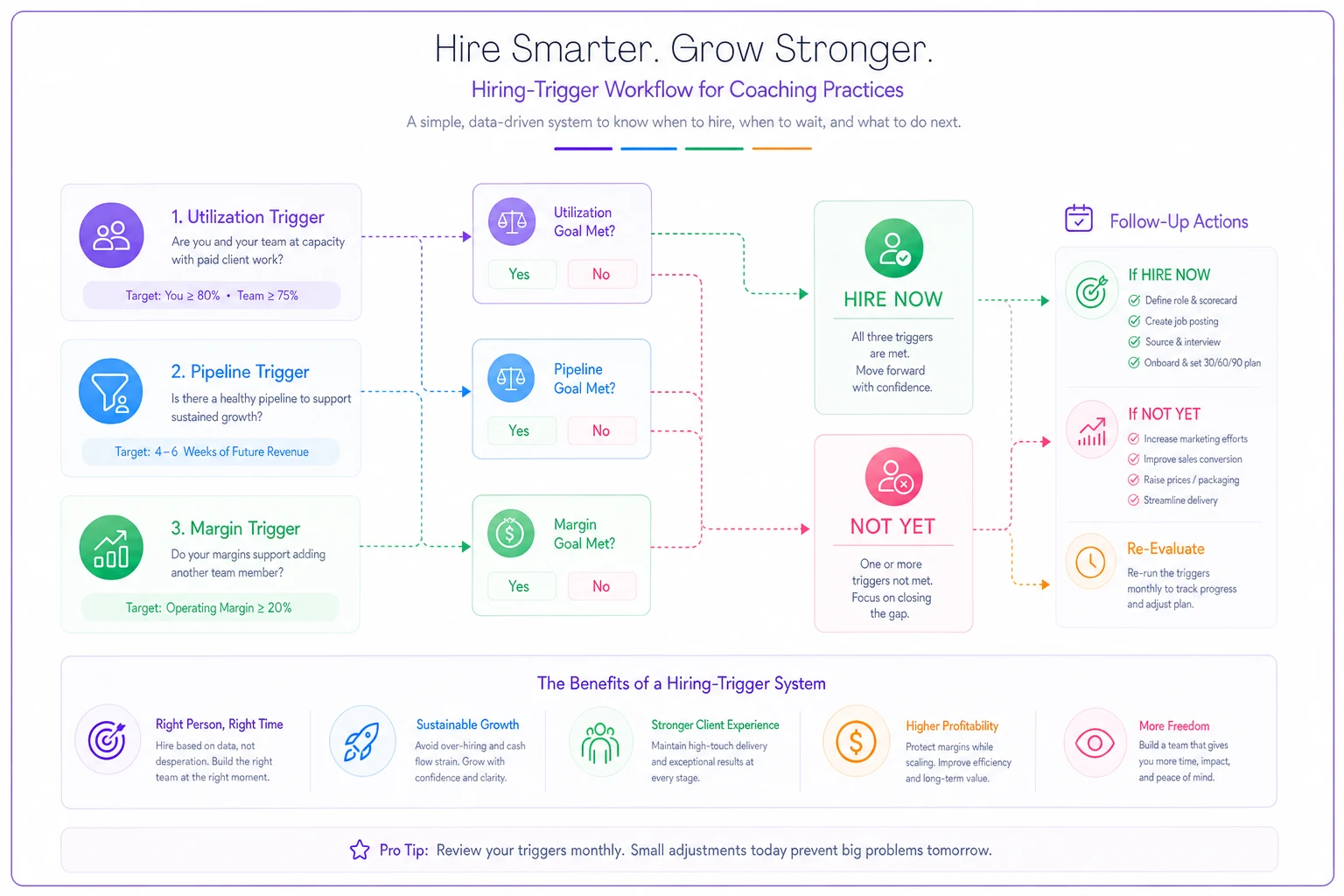
Cooling wages might make hiring cheaper, which is tempting. But cheaper isn't the same as justified. A hire that's affordable but under-utilized still bleeds you. The trigger logic protects you from "it's a good deal so let's do it."
If you don't already have these thresholds written down, that's exactly the kind of thing a practice financial operating system built around forecasting and hiring rules is meant to formalize — so the decision is made before the emotional moment, not during it.
5. Build two cash-flow scenarios, not one forecast
A single forecast is a guess dressed up as a plan. In a shifting labor environment, you want a range. Build a low case and a steady case and watch where they diverge.
A simplified setup for a three-coach practice:
-
Steady case retention holds, no package downgrades, one new mid-tier hire in Q2
-
Low case 8–12% of clients downgrade, lead volume dips, hire delayed to Q3
The point isn't precision. The point is to see your cash runway under both scenarios and find the decision points where they split. If the low case shows cash getting tight around month four, you now know exactly when to pull the hire-delay lever or push a retention campaign — before it's an emergency.
Most practices skip this because it feels like busywork when things are going well. Things are fine until they aren't, and by then the forecast is useless.
6. Use payment flexibility as a retention tool while spending is uncertain
If client household budgets are getting squeezed even as wages cool, retention risk isn't always about value — sometimes it's pure cash timing. A client who loves the work might still churn because the monthly charge lands at the wrong moment.
Cheap moves that protect retention without discounting:
-
Offer a quarterly-pay option alongside monthly (smooths their cash, locks your revenue longer)
-
Add a pause-instead-of-cancel path for clients hitting a rough month
-
Let annual-plan clients split into two payments instead of one
None of these drop your price. They change the timing of the cash, which is often the real objection. A client who would've canceled at month three but instead pauses for 30 days and comes back is worth far more than the discount you didn't give.
When this is a bad idea
Payment flexibility backfires if you don't track it. If you start offering pauses and splits with no system logging who's on what arrangement, your reconciliation turns into a mess and you lose visibility into actual revenue. Only offer flexibility you can track cleanly.
7. Audit whether your admin and delivery costs justify your current pricing
The quiet cost creep in most practices isn't coach pay — it's the stack of subscriptions, the hours of manual scheduling, the reconciliation that eats a weekend every month. When the macro environment tightens margins from both sides, the fat you can cut without hurting clients is usually operational.
A quick checklist for this quarter:
-
[ ] List every software subscription and the last time anyone actually used it
-
[ ] Estimate hours per week spent on scheduling, reminders, and billing reconciliation
-
[ ] Flag any task done manually more than 10 times a month that follows the same steps every time
-
[ ] Calculate what one admin hour costs you (your rate or a coordinator's) and multiply by weekly admin load
-
[ ] Decide which of those recurring tasks could be standardized or automated
Practices that run this audit usually find a few hundred dollars a month in dead tooling and a real chunk of time locked up in repetitive admin. Reclaiming even five hours a week changes your capacity math — which loops back into the hiring-trigger question in move #4. Sometimes you don't need another coach. You need your existing coaches to stop doing scheduling.
A short real scenario
A two-coach leadership practice — a sole owner plus one associate — was running about 320–340 billed sessions a month at roughly $180 each. The owner was about to hire a third coach going into the softer market because "labor's cheaper, let's grab someone."
Instead they ran the margin check (move #3) and the trigger logic (move #4). Utilization was sitting around 72%, not 85%. The "need" was really an admin problem — the owner was spending close to nine hours a week on scheduling and month-end reconciliation, which made it feel like being at capacity.
They cut two unused subscriptions (roughly $140/month), tightened their reconciliation process, and held off on the hire. Three months later, the low-case scenario they'd built partly materialized — a handful of clients downgraded — and because they hadn't added fixed cost, the quarter stayed in the black. The hire got revisited in Q3 against real utilization numbers, not a gut feeling.
Nothing dramatic. Just decisions made against thresholds instead of nerves.
Who should skip most of this
If you're a solo coach with no payroll, one program, and healthy cash in the bank, you don't need scenario-planning gymnastics. Focus on moves #2 and #6 and move on. The compensation-band and hiring-trigger work is overhead you don't need yet.
The practices that genuinely benefit from the full list are the ones paying two or more coaches, where a single misread on hiring or comp bands compounds across a whole year of sessions. That's where a cooling labor market is both an opportunity and a trap.
The real takeaway
The employment-cost shift itself isn't the story. Most coaching practices have no mechanism for any macro signal to change any internal number. Wages rose for two years and most rate cards didn't move. Now wages are cooling and most hiring plans won't adjust either.
You don't need to react to every data release. You need pricing, comp, and hiring logic that can respond when it matters — written down, tied to thresholds, and checked on a schedule rather than in a panic. Build that once, and the next shift becomes a quick adjustment instead of a scramble.
Ready to elevate your coaching business?
Join hundreds of coaches using Guidyly to save time, enhance client engagement, and grow their practice.