



Most coaching practices don't fail because the owner is bad with money. They fail because the owner is reactive with money. Cash looks fine until payroll hits, a slow month turns into a quiet panic, and the decision to hire or raise prices gets made emotionally — usually too late, occasionally too early, almost never on schedule.
The fix isn't a better spreadsheet. It's a connected set of financial habits that run on a cadence and fire off clear signals when something needs a decision. That's what a practice financial operating system actually is: forecasting that feeds triggers, triggers that feed hiring and pricing decisions, and a review rhythm that forces you to look before the ground shifts.
This isn't theory. Below is how the pieces connect, where they break as you grow, and how to build something that holds up past six figures.
The three layers most practices are missing
Think of your finances in three stacked layers. Most solo and early-stage practices only operate the bottom one.
-
Layer 1 — Recording. You know what came in and went out. Invoices, Stripe payouts, expenses. This is backward-looking.
-
Layer 2 — Forecasting. You project forward
expected revenue, known costs, cash position in 60–90 days.
-
Layer 3 — Decision triggers. Pre-set thresholds that tell you when to hire, raise prices, or kill an offer — before the pressure hits.
The gap between Layer 1 and Layer 3 is where practices quietly bleed. A coach doing roughly $18k–$22k a month can run on gut feel for a while. Past that, the delay between "something's off" and "I noticed" gets expensive fast — because now there's a contractor's pay, a software stack, and maybe an assistant riding on your timing.
The whole point of an operating system is to shrink that delay to near zero. You're not trying to predict the future perfectly. You're trying to build a machine that nudges you at the right moment.
Why reactive finance is the default (and why it survives longer than it should)
In real operations, this usually happens because the early years reward it. When you're solo, your "forecast" is your calendar. You can see next month's sessions, you know your costs are low, and the margin is forgiving enough that mistakes don't compound.
Never miss a session or detail again.
Guidyly helps you book, manage, and track every coaching session efficiently.
- Centralized session scheduling
- Automated client reminders
- Progress tracking & notes
No credit card required
So you never build the muscle. Then you add a second coach, or launch a group program, or sign a corporate pilot with net-30 terms, and suddenly revenue and cash stop lining up. You're profitable on paper and short on money in the account — a classic timing mismatch that no amount of enthusiasm solves.
A pattern worth noticing: the practices that struggle most with this aren't the ones with bad margins. They're the ones with lumpy revenue and no system to smooth their expectations around it. A single churned retainer client or a delayed corporate invoice can swing a month by 15–20%, and without a forecast, every swing feels like an emergency.
Understanding your real per-client economics is the foundation here. If you haven't mapped out your unit economics including CAC, LTV and per-client profitability, the forecasting layer will sit on sand — you'll be projecting revenue without knowing which revenue is actually worth keeping.
The forecasting workbook: what actually belongs in it
Forget elaborate models. A working forecast for a coaching practice needs four tabs and nothing fancier.
-
Committed revenue. Signed retainers, active program cohorts, confirmed corporate contracts. Money you can reasonably count on with a known end date.
-
Pipeline-weighted revenue. Deals in progress, discounted by probability. A corporate pilot at 60% likely for $12k shows up as $7.2k. Be honest with the percentages or the whole thing lies to you.
-
Fixed and variable costs. Software, contractor pay, your own draw, processing fees, anything recurring. Separate the fixed from the per-client variable so you can see what happens as volume moves.
-
Cash timing. Not revenue — cash. When does the money actually land? Net-30 corporate clients and monthly consumer subscriptions behave completely differently, and your bank account only cares about timing.
Be honest with the percentages or the whole thing lies to you.
That last tab is where most coaches get surprised. You can have a great revenue month and a terrible cash month if three invoices are sitting unpaid. The reconciliation side of this matters more than people expect — getting your month-end rules and revenue recognition right is what keeps your forecast honest instead of optimistic.
A typical example of how the tabs connect: your committed tab shows $16k, pipeline-weighted adds $5k, costs run $11k, and the cash tab warns that $6k of that revenue doesn't land until week six. So on paper you're making $10k this month — but you'll be functionally short until the delayed cash arrives. That's the kind of thing a forecast catches and a bank balance never will.
TCO: the costs that don't show up until they hurt
Total cost of ownership gets ignored in service businesses because coaches think of themselves as low-overhead. And compared to a restaurant, they are. But the hidden costs stack up as you add people and tools.
Here's a rough breakdown of where TCO actually lives in a growing practice:
| Cost category | Solo practice | 3-coach practice | Often forgotten? |
|---|---|---|---|
| Software stack | $150–$300/mo | $500–$900/mo | Per-seat pricing scales faster than you expect |
| Payment processing | 2.9% + fees | 2.9% + fees + failed-payment recovery | Yes — failed payments quietly eat margin |
| Contractor/coach pay | — | 40–55% of their revenue | No, but the margin math gets missed |
| Admin/ops time | your unpaid hours | part-time assistant | Yes — your time has a real cost |
| Onboarding new coaches | — | $2k–$4k per hire in ramp | Almost always |
| Client acquisition | variable | variable | Tracked, rarely tied to LTV |
The TCO checklist isn't about cutting costs. It's about knowing your true cost per delivered client hour so your pricing and hiring decisions rest on real numbers. A practice that thinks it nets 70% but actually nets 48% after honest TCO accounting will hire too aggressively and price too cheaply — both at once.
Decision gates: the part that makes it an operating system
This is the core. A forecast that nobody acts on is just anxiety with charts. The triggers turn numbers into decisions, and the trick is defining them before you're emotional about them.
Hiring / capacity trigger
> When committed revenue sustains above 80% of current delivery capacity for two consecutive months, AND pipeline-weighted revenue projects continued demand, begin the hiring process.
The reason for the two-month rule is simple: one busy month is noise. Two is a trend. Hiring off a single spike is how practices end up paying a contractor to sit idle.
Capacity is the other half of this gate, and it's worth getting precise about how many clients you can actually hold before quality drops. The capacity-planning math and caseload model gives you the ceiling number that your hiring trigger references. Without it, "80% of capacity" is a guess.
Price-raise trigger
-
Close rate above ~70% for three months (you're priced too low — demand exceeds friction)
-
Waitlist forming consistently
-
Delivery costs rising faster than revenue per client
-
You haven't raised prices in 12+ months and your outcomes have measurably improved
Sunset-an-offer trigger
> If an offer runs below target margin for two consecutive quarters, OR contributes under ~10% of revenue while consuming disproportionate delivery time, flag it for sunset review.
Note the word review, not kill. The trigger forces a conversation, not an automatic execution. Sometimes the answer is to reprice or repackage rather than retire.
The review cadence that holds it together
Triggers only work if someone looks at them on schedule. The cadence is the heartbeat.
Monthly (45 minutes):
-
Update the forecast workbook with actuals
-
Check cash timing for the next 60 days
-
Review each trigger
green, yellow, or firing?
-
Note any variance over ~10% between forecast and actual, and why
Quarterly (half day):
-
Full TCO recalculation
-
Offer-by-offer margin review (feeds the sunset gate)
-
Pricing review against the price-raise triggers
-
Capacity and hiring assessment
-
Reset forecast assumptions for the coming quarter
The monthly meeting is tactical — are we on track, is cash okay, is anything about to fire. The quarterly is strategic — should the structure itself change. Mixing them up is a common mistake; you end up doing neither well because you're trying to make big structural calls under monthly time pressure.
A real scenario: the practice that was "doing fine"
A two-coach leadership practice was running roughly $34k–$38k in monthly revenue and felt stable. No forecast beyond a mental estimate. The owner handled billing by checking the Stripe dashboard every few days.
The problem surfaced when a large corporate client on net-45 terms made up about a third of revenue. When that client paused for a quarterly budget review, the practice went from comfortable to scrambling in about three weeks — not because the money was gone, but because nothing had warned them how concentrated and delayed their cash actually was.
After building out the operating system — a four-tab forecast, a TCO checklist that revealed their true margin was closer to 52% than the 68% they assumed, and explicit triggers — the picture changed. Not overnight, and not dramatically on the revenue line. What changed was the timing of decisions. They caught a slow quarter early enough to hold off on a planned hire, repriced a group program that was quietly running at a loss, and renegotiated the corporate client to net-30 with partial upfront. Cash stopped feeling like a surprise.
Revenue climbed modestly over the following two quarters, but the bigger win was that the owner stopped making decisions in panic mode.
When this level of system makes sense — and when it doesn't
Build this when:
-
You've added, or are about to add, a second coach or contractor
-
A meaningful chunk of revenue comes from delayed-payment clients
-
You're making pricing or hiring decisions more than once a year
-
Your revenue is lumpy enough that single months mislead you
Don't over-engineer it when:
-
You're genuinely solo with simple monthly subscription revenue
-
Your costs are low and predictable and your calendar is your forecast
-
You're pre-product-market-fit and still figuring out what you even sell
A practice doing $6k a month with three recurring clients does not need a quarterly TCO recalculation. The system should match the complexity of the operation. Building a full financial OS too early is just procrastination dressed up as discipline.
Where the pieces connect
What makes this an operating system rather than a pile of spreadsheets is the wiring between the parts. Your unit economics define your targets. The forecast projects against those targets. The TCO checklist keeps your margin assumptions honest. The triggers convert gaps into decisions. The cadence makes sure someone actually looks.
Pull one piece out and the rest degrades. A forecast with no triggers is just worry. Triggers with no cadence never fire on time. A cadence reviewing bad numbers produces confident wrong decisions.
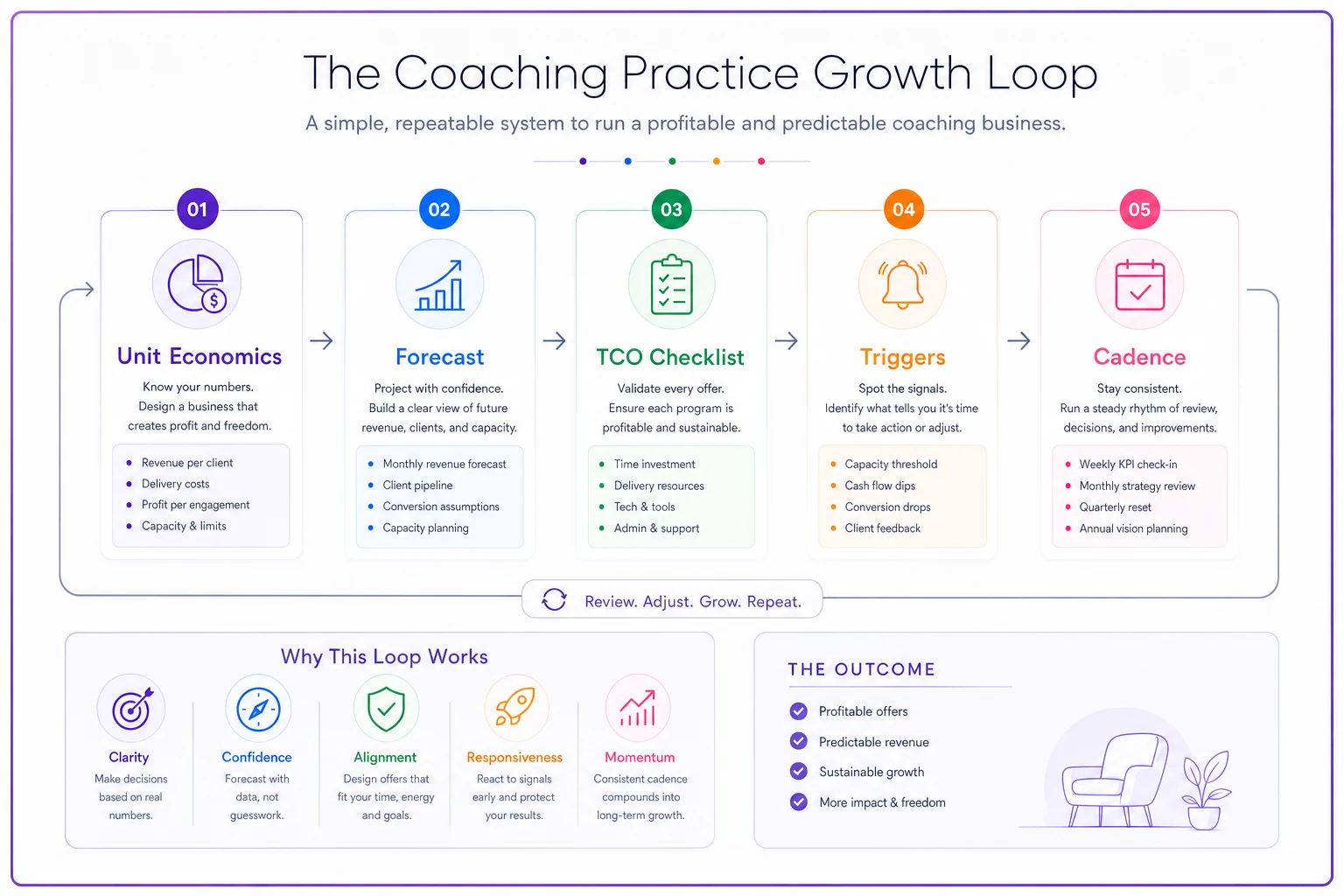
This simple loop visualization helps you see why the parts depend on each other.
The value is in the loop, not any single tool.
Bringing it together
The practices that scale cleanly aren't the ones with the most sophisticated models. They're the ones where financial decisions happen on a schedule, against pre-agreed thresholds, using numbers they trust. That removes the two worst features of reactive finance: the lag and the emotion.
Start smaller than you think. Get the four-tab forecast running. Do one honest TCO pass so you know your real margin. Write down your three triggers — hire, raise price, sunset — with actual numbers attached. Put a monthly check and a quarterly review on the calendar and treat them as non-negotiable as client sessions.
Six months of running that loop will teach you more about your practice than any amount of staring at your bank balance ever did. The money was never really the problem. The timing was.
Ready to elevate your coaching business?
Join hundreds of coaches using Guidyly to save time, enhance client engagement, and grow their practice.