



Most coaches can tell you their monthly revenue without thinking twice. Ask them what a single client actually costs to acquire and serve — including the free discovery call, the onboarding hours, the two reschedules, and the payment processing fees — and things get fuzzy fast.
That fuzziness is the problem. A coaching practice can look healthy on the top line and still be quietly bleeding margin on the exact package it sells most. And because coaching businesses run on the owner's time, the numbers that matter aren't just financial — they're operational. Your unit economics live at the intersection of pricing, capacity, retention, and hiring. Change one and the others move whether you planned for it or not.
This isn't a "10 metrics to track" list. The goal is to show you how the pieces connect, where the model breaks as you grow, and how to build forecasting tools that actually tell you something before the cash runs low.
Why unit economics for coaching practices is different from SaaS or e‑commerce
The startup version of unit economics is clean: you have a customer acquisition cost (CAC), a lifetime value (LTV), and you want LTV to comfortably exceed CAC. Coaching borrows the vocabulary but breaks most of the assumptions.
-
Your cost of delivery is your own time, and that time is capped. You can't serve more clients by spinning up another server. Every profitability calculation has an invisible ceiling baked into it.
-
CAC often looks near-zero because so many coaches get clients through referrals and word of mouth. That hides the real cost: the unpaid discovery calls, the proposals that go nowhere, the content you produce for months before anyone books.
-
LTV is wildly variable depending on whether someone buys a single package or renews into a year-long engagement. Two clients acquired the same way can differ 10x in value.
-
Contribution margin gets buried because most coaches only look at price minus obvious costs, ignoring the hours sunk into onboarding, admin, and rescheduling.
So when we talk about unit economics for a coaching practice, the real question isn't "what's my LTV/CAC ratio." It's: for each thing I sell, what's left over after I account for my time and my real costs — and how does that change when I get busier or hire someone?
The unit that actually matters: define it before you calculate anything
The first mistake is calculating economics for "a client" as if all clients are the same. They aren't. A better starting point is to define your unit around your offer, then layer client behavior on top.
Never miss a session or detail again.
Guidyly helps you book, manage, and track every coaching session efficiently.
- Centralized session scheduling
- Automated client reminders
- Progress tracking & notes
No credit card required
Most practices have a product mix that looks something like this:
| Offer | Typical price | Delivery hours (incl. admin) | Renewal likelihood |
|---|---|---|---|
| One-off intensive / VIP day | $1,200–$2,500 | 6–9 hrs | Low |
| 3-month 1:1 package | $3,500–$6,000 | 20–28 hrs | Medium |
| 6-month 1:1 package | $7,000–$12,000 | 40–55 hrs | High |
| Group program / cohort | $900–$2,500 per seat | 2–4 hrs per seat | Medium |
| Corporate engagement | $10,000–$40,000 | Highly variable | Depends on renewal |
The delivery-hours column is where most coaches under-count. A 3-month package isn't just 12 sessions. It's 12 sessions plus the intake, the prep, the notes, the between-session messages, the two reschedules, and the invoicing chase. In real operations, those "invisible" hours often run 30–50% on top of session time.
Once you have delivery hours per offer, you can calculate something far more useful than revenue: contribution margin per hour of your time. That single number reorders your entire product mix, and it's usually full of surprises. The VIP day that felt premium sometimes earns less per hour than the group program you've been underselling.
Building the contribution-margin model
Contribution margin, in a coaching context, is simply revenue from an offer minus the variable costs directly tied to delivering it. Fixed costs — your software stack, rent, insurance — sit above this line and get covered by total contribution across all your offers.
Variable costs coaches routinely forget:
-
Payment processing fees — typically 2.9% + $0.30 per transaction, higher if you offer payment plans that run multiple charges.
-
Refunds and partial refunds — averaged across a program, these quietly shave a point or two off margin.
-
Failed and recovered payments — every failed charge on a payment plan costs you admin time and sometimes lost revenue. If a meaningful share of your plans hiccup, it's a real line item. This is exactly why having structured dunning sequences that recover cash without ruining relationships matters — recovered revenue flows straight to contribution margin.
-
Onboarding materials, assessments, or licensed content you pay per client to use.
-
Contractor or VA time if anyone besides you touches delivery.
Compute margin per delivery hour for each offer to prioritize what to sell.
A clean contribution-margin template has one column per offer and rows for price, each variable cost, and the resulting margin in both dollars and percentage. The version worth building also computes margin per delivery hour, because that's the number that tells you what to sell more of.
A typical example: a 3-month package sells for $4,500. Processing on a 3-payment plan runs about $140. You budget a small refund reserve of $90 and $40 in assessment tools. That's $4,230 in contribution. If real delivery is 24 hours, you're earning roughly $176 per hour. Compare that to a group cohort at $1,500 a seat, 3 hours of your time per seat, $65 in variable costs — about $478 per hour. Same practice, nearly 3x difference in what your time actually earns.
CAC for coaches: counting the cost you pretend is free
Because referrals feel free, most coaches report a CAC near zero and move on. That's a trap. Referrals aren't free — they're deferred and diffuse. You earned them through months of unpaid work, and if referral flow ever slows, you'll suddenly need paid acquisition and won't have a model for it.
-
Direct spend — ads, tools, sponsorships, paid communities.
-
Sales time — discovery calls that don't convert. If you take 8 calls to close 3 clients, those 5 unpaid calls are a real acquisition cost measured in your hourly value.
-
Content and nurture — the podcast, the newsletter, the posts. Even a rough monthly allocation is better than pretending it's zero.
-
Onboarding admin — sometimes counted in delivery, but it lands somewhere.
You don't need surgical precision. A blended CAC that says "each new client costs me roughly $400–$700 in spend plus about 4 hours of unpaid sales time" is enormously more useful than "referrals, so basically free." Once you can see it, you can decide whether that acquisition channel is worth scaling.
Where the model breaks as you grow
Generic finance advice skips this part. Unit economics that work for a solo coach at 12 clients quietly fall apart around 20–25, and again when you add your first hire.
Bottleneck one: your calendar becomes the constraint, not your marketing. Early on, growth is a demand problem — you want more leads. But contribution margin per hour only matters up to the point where you run out of hours. Past that, adding a high-margin offer means removing something else. Your model has to shift from "what earns the most" to "what earns the most per slot on a fixed calendar." This is where capacity math becomes inseparable from unit economics, and why it's worth working through a proper caseload model instead of just overbooking yourself.
Bottleneck two: the hiring trigger nobody times correctly. Coaches tend to hire too late — burned out, capacity maxed, quality slipping — or too early, with a new coach and no clients to fill their time. The trigger should be a number, not a feeling. Something like: when my calendar hits 85% of deliverable capacity for two consecutive months, and my pipeline shows enough demand to fill a second coach to at least 40% within 90 days, I hire. That's a rule your forecast can watch for you.
Bottleneck three: margin dilution from delegated delivery. The moment someone else delivers, your contribution margin per client drops because you're paying for delivery. That's expected — the point of hiring is to sell your time back to yourself — but your model has to reflect it. A client that earned $176/hour of contribution when you delivered might earn $70–$90/hour of your margin once a contractor is paid. Multiply that across a full caseload and the picture changes considerably.
Bottleneck four: product mix drift. When you get busy, you tend to say yes to whatever's in front of you. Six months later your mix has quietly shifted toward lower-margin work because those were the easy yeses. Without a model tracking mix, this erosion is invisible until a slow month exposes it.
Connecting the pieces: the forecasting workbook
A forecasting workbook for a coaching practice should tie four things together so a change in one ripples through the others:
-
Product mix (how many of each offer you expect to sell)
-
Capacity (your available delivery hours, and any coach you've added)
-
Retention/renewal (how much revenue carries forward vs. needs replacing)
-
Cashflow (when money actually lands, especially on payment plans)
The workflow it should support, in plain terms:
You enter your expected sales by offer for the next few months. The workbook multiplies each by its delivery hours and checks the total against your available capacity — flagging any month where you've sold more hours than you have. It applies your contribution margins to project not just revenue but margin. It layers in renewal assumptions so recurring revenue shows up. Then it maps everything onto a cash timeline, because a $9,000 package paid over six months hits your bank very differently than one paid upfront.
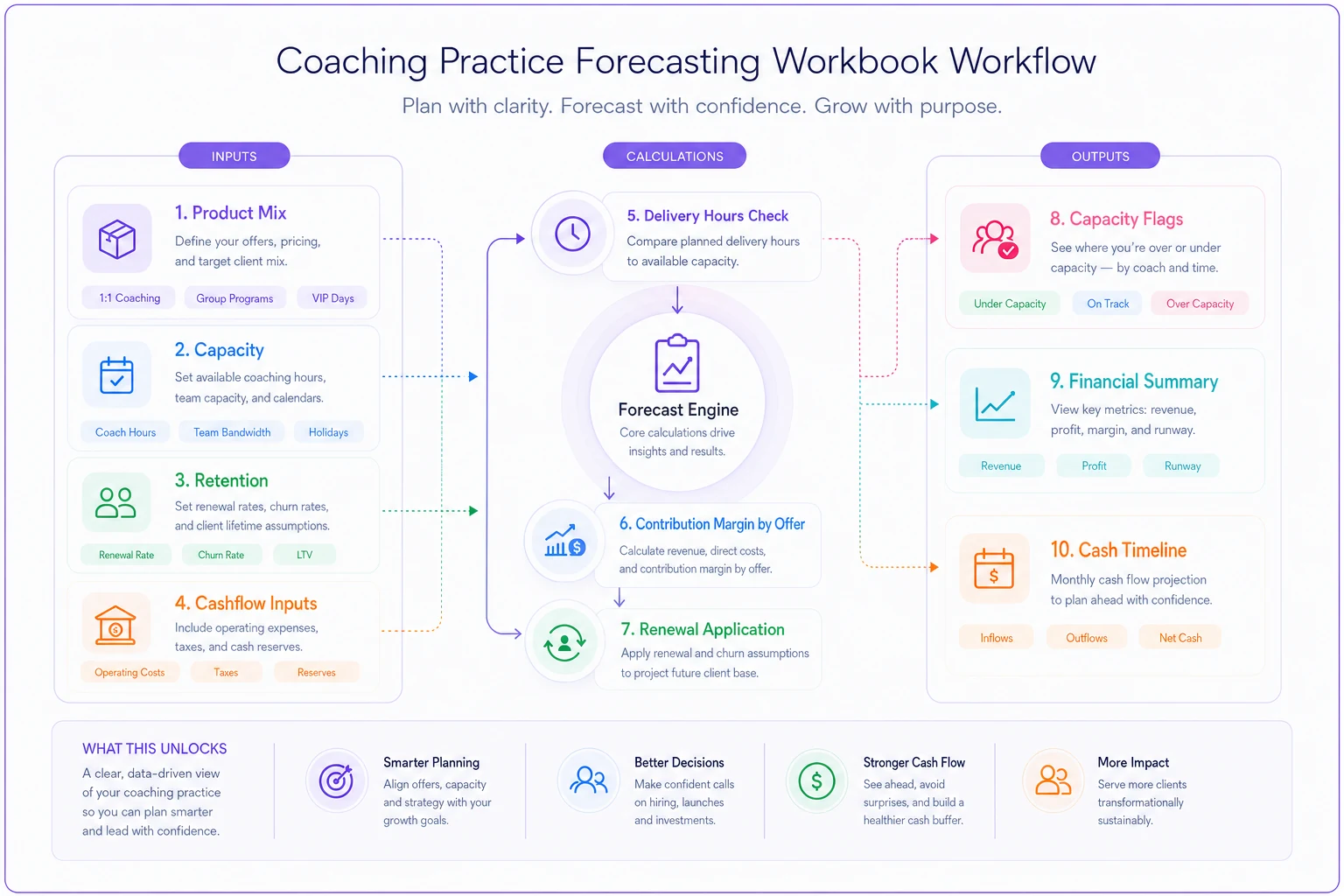
A simple diagram of this workflow helps you see where capacity and cash warnings appear.
The output you actually want is a single view that answers: In month four, given my expected mix and renewals, will I have the cash and the capacity — and if not, is the fix pricing, hiring, or changing what I sell?
Sensitivity scenarios: the part that earns its keep
A static forecast is a guess with false confidence. What makes the model genuinely useful is running scenarios against it. Build three at minimum:
-
The soft quarter. Sales drop 25%, one client refunds, two renewals don't happen. Does cash go negative? Which month? This tells you your real runway.
-
The capacity crunch. You sell 20% more than planned. Do you have the hours? At what point does quality — and retention — start to suffer? This tells you when to stop selling or start hiring.
-
The pricing shift. You raise the 3-month package 15% and lose one prospect in six to price sensitivity. Contribution usually rises even with the lost sale — but the workbook proves it instead of you hoping. If you haven't tightened your pricing logic, it's worth reviewing the pricing mistakes that quietly reduce retention before running this one.
Sensitivity scenarios turn the model from a bookkeeping exercise into a decision tool. You stop asking "what happened last month" and start asking "what breaks first if things go sideways, and what lever do I pull."
A real scenario: solo coach, stuck at a ceiling
A leadership coach running mostly 3-month 1:1 packages was doing roughly $9k–$11k a month and completely maxed on time. Felt successful, felt trapped, couldn't figure out where the money went.
Building out the per-offer contribution margin surfaced two things quickly. First, her signature VIP intensive — the offer she led with in marketing — earned about $130 per delivery hour once prep and follow-up she'd never counted were included. Her occasional small group cohort, which she treated as a side thing, earned closer to $400 per hour.
Second, roughly one in seven of her payment plans failed at least one charge, and she was recovering maybe half of those. That was a slow, quiet leak of a few hundred dollars a month straight off the bottom line.
The changes weren't dramatic. She shifted marketing emphasis toward the group cohort, kept the VIP day but repriced it upward, and put a structured recovery sequence on failed payments. Over the following two quarters, revenue moved to roughly $13k–$15k on fewer delivery hours, with meaningfully better margin per hour. Nothing exotic — she just stopped selling her cheapest hours the hardest.
When this level of modeling makes sense — and when it doesn't
When it's worth doing:
-
You're consistently near capacity and deciding whether to raise prices, change your mix, or hire.
-
You run payment plans or multi-month packages where cash timing genuinely differs from revenue.
-
You sell three or more distinct offers and can't confidently rank them by profitability.
-
You're planning a first hire and need a defensible trigger.
When it's overkill:
-
You're brand new with one offer and a handful of clients. Get to a repeatable model first; forecasting three scenarios on five clients is noise.
-
Your delivery is genuinely uniform and cash lands the same way every time. A simple margin calc beats a forecasting apparatus you won't maintain.
Who should be careful: coaches who love building spreadsheets more than serving clients. The model is a tool for decisions, not a hobby. If you're spending more time refining the workbook than acting on what it tells you, the model has become the distraction.
Making the numbers current instead of quarterly
The weakness in any workbook is that it goes stale. You build it in a burst of motivation, use it for a month, then it drifts from reality and you stop trusting it. The practices that actually run on their numbers are the ones where the inputs — bookings, payments, renewals, cancellations — flow in without manual re-entry.
That's the operational argument for keeping your scheduling, billing, and client records in a connected system rather than scattered across a calendar app, a payment processor, and a spreadsheet you update when you remember. When actuals are already captured, refreshing the forecast is a five-minute check, not an afternoon of data cleanup. The model stays honest because it's fed by what's really happening, and a well-designed platform can flag when you're crossing a capacity threshold or when payment failures are creeping past your assumed rate — the exact signals your unit economics depend on.
The tooling matters less than the habit. Whether it's a purpose-built coaching platform or a well-wired stack, the goal is the same: the numbers driving your biggest decisions shouldn't require archaeology to find.
The takeaway
Unit economics for a coaching practice isn't a finance topic bolted onto an operations business — it is the operations business, expressed in dollars. Your pricing, your calendar, your renewals, and your hiring plan are all the same system viewed from different angles. Model one without the others and you'll make locally smart, globally expensive decisions. Start with contribution margin per hour, get honest about CAC even when it feels free, and build the forecast so a change in your product mix, capacity, or renewals shows up in projected cash before it shows up in your bank account. Then run the ugly scenarios on purpose, while you still have time to react. Knowing where the model breaks before it breaks on you — that's the whole point.
Ready to elevate your coaching business?
Join hundreds of coaches using Guidyly to save time, enhance client engagement, and grow their practice.