



Every coach hits the same wall eventually. You're booking clients back-to-back, squeezing in "just one more" session, telling yourself you'll catch up on admin work this weekend. Then someone cancels last minute, you realize you haven't invoiced three clients from last month, and your best client mentions they're thinking about pausing because they feel rushed during sessions.
The problem isn't your coaching ability. It's that you're running on gut instinct instead of operational math.
Why Traditional Time-Blocking Fails for Coaching Practices
Traditional productivity advice tells you to time-block your calendar. Set aside chunks for deep work, batch similar tasks, protect your mornings. Fine advice for a lot of jobs, but coaching doesn't really fit into neat boxes.
An executive coaching session might run over by 20 minutes because you're working through a breakthrough. A life coaching client might need an emergency call between sessions. Your business coaching client sends you their P&L at 9pm asking for feedback before tomorrow's board meeting.
The standard time-blocking approach assumes predictable work with clear boundaries. Coaching is neither. You're dealing with human complexity, emotional labor, and constant context-switching between different client situations, coaching modalities, and whatever operational tasks have piled up.
What makes this worse is that coaches consistently underestimate the true time cost of each client relationship. You think a session takes an hour, but you're not counting:
-
The 15 minutes before to review notes and get into the right headspace
-
The 10 minutes after to capture insights while they're still fresh
-
The follow-up email with resources and action items
-
The occasional check-in text or quick call between sessions
-
The mental residue that lingers after intense sessions
Add all that up, and that one-hour session actually consumes closer to two hours of your real capacity. Multiply that across your entire caseload and the picture changes fast.
The Real Math Behind Sustainable Caseloads
Here's the actual capacity planning math that holds up in practice.
Never miss a session or detail again.
Guidyly helps you book, manage, and track every coaching session efficiently.
- Centralized session scheduling
- Automated client reminders
- Progress tracking & notes
No credit card required
Total Monthly Hours: 160
Deduct Non-Client Time:
-
Business admin (invoicing, scheduling, emails)
20 hours
-
Marketing and business development
16 hours
-
Professional development and supervision
8 hours
-
Buffer time and transitions
12 hours
Actual Client-Facing Capacity: 104 hours
But those 104 hours aren't all direct session time. For every hour of actual coaching, you need surrounding time:
Per Client Hour Breakdown:
-
Direct session time
1 hour
-
Prep and review
0.25 hours
-
Documentation
0.25 hours
-
Between-session support
0.25 hours
-
Total time per session hour
1.75 hours
That means your 104 hours of client-facing capacity translates to roughly 59 actual session hours per month. If you're doing hour-long sessions and your average client meets twice monthly, you can sustainably handle around 30 clients.
That number probably feels low. Most coaches are genuinely surprised when they do this math for the first time. They're trying to serve 40, 50, even 60 clients and wondering why everything feels chaotic.
Building Your Personal Capacity Model
The numbers above are a starting point. Your actual capacity depends on a few key variables.
Coaching Type Multipliers:
Executive coaching typically requires more prep and follow-up. A single executive client might need 2.5 hours of total time per session hour. Life coaching might run closer to 1.5 hours. Group coaching can be more efficient—maybe 1.25 hours per session hour—but demands different energy.
Experience Level Adjustments:
Newer coaches need more prep time. You're still developing your frameworks, second-guessing your approaches, spending extra time on session planning. Add roughly 25% more time per client for your first couple of years.
Experienced coaches develop efficiencies. Proven frameworks, faster pattern recognition, less prep needed. You might get down to 1.5 total hours per session hour.
Energy Management Factors:
-
High energy (motivated, clear goals, positive momentum)
0.8x capacity use
-
Medium energy (typical coaching challenges)
1.0x capacity use
-
Low energy (resistant, complex or draining situations)
1.5x capacity use
If a significant portion of your caseload falls into that last category, your sustainable capacity drops noticeably.
The Utilization Target Sweet Spot
Most coaches don't realize they shouldn't be aiming for 100% utilization. Honestly, not even 90%.
The sustainable target for a coaching practice is somewhere between 70–80%. That means if you have capacity for 30 clients, you should actually be serving 21–24.
Target 75% utilization in planning spreadsheets to protect buffer time.
The buffer isn't wasted space. It serves real functions:
Flexibility for Client Needs
When a client hits a rough patch and needs an extra session, you can accommodate them without blowing up your week. When someone wants to temporarily increase frequency, you have room.
Business Development
Those open slots become consultation calls, time to develop new programs, or space to think strategically about where your practice is going.
Recovery and Renewal
Coaching is emotional labor. You need processing time between intense sessions, space to reflect on your work, and room to actually improve your methods.
Quality Protection
When you're overbooked, quality is the first thing to go. You rush sessions. You skip documentation. You stop preparing properly. Clients notice, even if they don't say it directly.
Operating at 75% utilization might feel like leaving money on the table. It's not. It's protecting your reputation and your referral pipeline, which are the actual engines of long-term revenue.
Converting This Into Pricing Strategy
Once you know your true capacity, pricing becomes much clearer. If you can sustainably serve 24 clients and you want to make $120,000 per year, the math is fairly direct:
$120,000 ÷ 12 months = $10,000 per month $10,000 ÷ 24 clients = $417 per client per month
Meeting twice monthly, that's roughly $200 per session. Weekly, that's around $100 per session.
There are three variables you can adjust to increase revenue without increasing hours:
1. Reduce Low-Value Time
Every hour saved on admin is an hour you can reinvest in clients. Cut admin time by 25% through better systems and you gain roughly 5 hours monthly—enough capacity for a few more clients.
2. Increase Session Value
Specialized expertise commands higher rates. An executive coach at $400/session makes the same revenue as a generalist at $200/session with half the clients.
3. Optimize Client Mix
Group programs change the math entirely. Six participants each paying $150 for a 90-minute session is $900, which works out to $600 per hour versus $200 for individual sessions. The economics are hard to ignore.
This is also where the pricing models we covered earlier become directly relevant. Pricing strategy and capacity planning need to work together, not in isolation.
The Multi-Coach Scaling Model
When you're at capacity and demand is still there, the next move is bringing on additional coaches. But the math changes significantly.
As a solo coach, you keep 100% of revenue. With employed coaches, you might keep 40–50% after their compensation. With contractors, maybe 20–30%. The capacity gain needs to clearly offset the margin loss.
A realistic scaling scenario:
-
Solo Practice at Capacity
- 24 clients at $400/month = $9,600 revenue - Your time: 104 hours - Revenue per hour: $92
-
Adding One Associate Coach
- They handle 20 clients at $400/month = $8,000 revenue - You keep 30% margin = $2,400 - Your time managing them: ~10 hours monthly - Revenue per hour for those 10 hours: $240
The math looks compelling, but the hidden costs are real. Training time. Quality control. Client handoffs. Brand risk if they deliver inconsistent experiences. Most coaches underestimate how operationally complex it is to scale past themselves. You need documented processes, training systems, and actual infrastructure before this model works reliably.
Building Your Capacity Planning Spreadsheet
Here's a framework you can build into a spreadsheet and actually use.
| Variable | Your Numbers |
|---|---|
| Total weekly hours available | 40 |
| Weeks worked per year | 48 |
| Target utilization rate | 75% |
| Average session length | 60 minutes |
| Prep/follow-up multiplier | 1.75 |
| Monthly non-client hours | 56 |
Calculate your capacity in order:
-
Available annual hours = Weekly hours × Weeks worked = 1,920
-
Monthly available hours = Annual hours ÷ 12 = 160
-
Monthly client-facing hours = Total hours − Non-client hours = 104
-
Effective session capacity = Client hours ÷ Time multiplier = 59 sessions
-
Target sessions at utilization = Capacity × Utilization rate = 44 sessions
Add pricing scenarios:
| Sessions/Client | Max Clients | Revenue Needed | Price Per Client | Price Per Session |
|---|---|---|---|---|
| 2x monthly | 22 | $10,000/month | $455 | $227 |
| Weekly | 11 | $10,000/month | $909 | $227 |
| 2x weekly | 5.5 | $10,000/month | $1,818 | $227 |
Include buffer calculations:
-
Emergency session buffer
10% of capacity = 6 sessions
-
Cancellation/no-show allowance
5% = 3 sessions
-
Business development slots
10% = 6 sessions
-
Actual billable sessions
44 − 15 = 29 sessions
This model forces you to see the trade-offs clearly. Want to serve more clients? You need to reduce session frequency, raise prices, or get more efficient. Want to protect quality? You need to protect your buffers.
Scenario Planning for Different Practice Types
Three realistic scenarios to show how the model adapts:
Scenario 1: New Life Coach Building Practice
-
Available monthly hours
80
-
Non-client time (higher due to learning curve)
35 hours
-
Client-facing capacity
45 hours
-
With 2.0x multiplier (new coach)
22.5 session hours
-
At 70% utilization
15–16 sessions monthly
-
Sustainable caseload
8 clients at 2x monthly
-
Minimum price for $4,000/month target
$500/client
Sarah's constraint isn't demand—it's capacity. She needs to charge premium prices from day one or she'll never build something sustainable.
Scenario 2: Established Executive Coach
-
Available monthly hours
140 (35 hours/week)
-
Non-client time
40 hours
-
Client-facing capacity
100 hours
-
With 1.5x multiplier (experienced)
66 session hours
-
At 75% utilization
50 sessions monthly
-
Sustainable caseload
12–13 clients meeting weekly
-
Price for $20,000/month target
$1,600/client
Marcus can maintain high quality with fewer, higher-paying clients. His real constraint is finding executives willing to pay at that level.
Scenario 3: Group Program Hybrid
-
Available monthly hours
160
-
Non-client time
50 hours
-
Client-facing capacity
110 hours
-
Individual coaching
60 hours → 34 session hours → 17 clients
-
Group programs
50 hours → 8 group sessions → 48 participants
-
Combined capacity
17 individual + 48 group = 65 total clients
-
Revenue mix for $15,000/month
$400/individual + $150/group participant
Jennifer's model shows how group programs dramatically expand client reach without requiring more hours.
Warning Signs You're Over Capacity
Evening and weekend work is a red flag. You're consistently working evenings or weekends to catch up on documentation. This usually means your time multiplier is off and you need more buffer built in.
Clients mention feeling rushed, or that you seem distracted. Presence suffers before anything else when you're overbooked. You might physically be in sessions while mentally already thinking about the next one.
Your cancellation rate creeps up. Burned-out coaches unconsciously create reasons to cancel. If you find yourself secretly relieved when a client reschedules, that's worth sitting with.
Session notes become one-line summaries. You stop sending follow-up resources. You can't quite remember what you discussed with whom last week.
Business development stops entirely. When you're at capacity, marketing feels pointless because you can't take on more clients anyway. Then when clients churn, the revenue gap is hard to fill quickly.
You start resenting clients—especially the demanding ones. Every extra email feels like an imposition. This is burnout, and it compounds fast.
Making Buffer Time Non-Negotiable
The biggest mistake coaches make is treating buffer time as optional. A great client opportunity comes up, you squeeze them in. Revenue is tight, you add "just one more." It feels fine in the moment.
Buffer time isn't empty space—it's operational infrastructure. It's when you process intense sessions, spot patterns across your caseload, develop new frameworks, handle unexpected client needs, and maintain your own stability.
Think of it like insurance. You don't need it until you really need it—and then you need it badly.
A few practical ways to protect it:
-
Block buffer time as "Internal Client Work" in your calendar so it looks occupied to anyone trying to schedule.
-
Set clear rules for when you'll actually use buffer time. Emergency client session? Yes. Impromptu consultation call? No.
-
Track buffer usage monthly. If you're consistently burning through it, your capacity model needs to be adjusted.
And when demand starts exceeding supply, the right answer is usually a price increase—not more hours.
Technology and Capacity Optimization
The right operational systems can meaningfully improve capacity efficiency without touching the quality of your coaching. The goal isn't to automate coaching—it's to automate everything around it.
Here's how the typical time-savings flow works across a coaching practice once operational systems are in place:
Client books session ↓ Automated confirmation + intake form sent ↓ Reminder sequence fires automatically (48hr, 24hr) ↓ Session occurs → structured note template opened ↓ Follow-up email with resources sent automatically ↓ Payment processed without manual invoicing ↓ Coach reviews dashboard → next session prep
Scheduling automation saves a few hours monthly just from eliminating back-and-forth. Clients book directly into available slots, confirmations go out automatically, and reminders reduce no-shows.
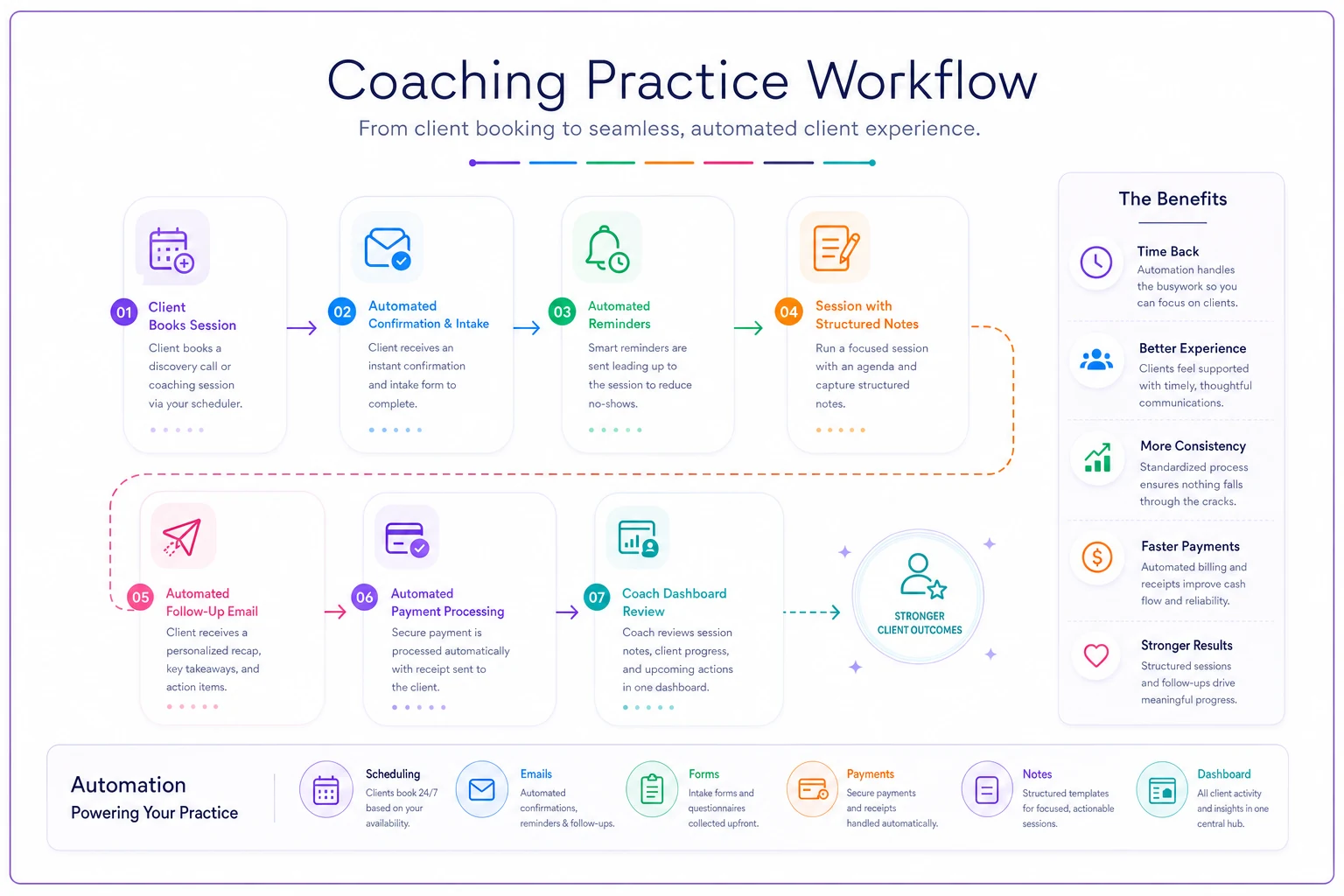
Documentation templates cut note-taking time noticeably. Instead of starting from scratch after every session, you're updating a structured format that captures what actually matters.
Automated follow-ups keep clients engaged between sessions without requiring your direct attention for every touchpoint. Session summaries, resource links, check-in messages—these can happen in the background.
Payment automation removes invoicing from your plate entirely. Charges go out automatically, failed payments retry without you chasing anyone, and your revenue picture is always current.
AI-powered operational platforms can pull a lot of this together—intake forms, scheduling, reminders, payment processing, and session note organization in one place. Not replacing the coaching relationship, just clearing the operational clutter so you can be fully present for it.
Coaches who implement this kind of operational infrastructure typically recover somewhere between 8–12 hours monthly. That's enough for a few additional sessions, or more realistically, actual breathing room in your practice.
The Profitable vs Sustainable Balance
There's always tension between maximizing revenue and maintaining sustainability. You could eliminate buffer time, pack your schedule, and generate more revenue for a while. But six months in, client quality has dropped, referrals have dried up, and you have no energy for anything other than getting through the week.
The sustainable model might generate less this month. But it compounds over time. Happy clients refer more. You have energy to develop new programs. You can actually take time off without the practice falling apart.
A sustainable practice running at 75% capacity will outlast and outperform a maxed-out practice almost every time. The math supports it, and your clients will feel the difference whether they articulate it or not.
Your Next Steps
Start with an honest capacity assessment. Run your actual numbers, not your optimistic ones. Track your time for a couple of weeks and see where it really goes—most coaches are surprised by the results.
Build your capacity model using the framework above. Be conservative with estimates. Overcommitting is a much more expensive mistake than leaving a little capacity on the table.
Then look at your current caseload against your sustainable number. If you're over, you need a reduction plan. If you're under, you can focus on growth with a clear picture of how much room you actually have.
Protect your buffer time like your practice depends on it—because it does. The difference between a thriving coaching practice and a burned-out one usually comes down to that 20% margin. Make sure you're on the right side of it.
Start with an honest capacity assessment. Run your actual numbers, not your optimistic ones. Track your time for a couple of weeks and see where it really goes—most coaches are surprised by the results.
Build your capacity model using the framework above. Be conservative with estimates. Overcommitting is a much more expensive mistake than leaving a little capacity on the table.
Then look at your current caseload against your sustainable number. If you're over, you need a reduction plan. If you're under, you can focus on growth with a clear picture of how much room you actually have.
Protect your buffer time like your practice depends on it—because it does. The difference between a thriving coaching practice and a burned-out one usually comes down to that 20% margin. Make sure you're on the right side of it.
Ready to elevate your coaching business?
Join hundreds of coaches using Guidyly to save time, enhance client engagement, and grow their practice.