



Google's August 2026 AI recap landed with two updates that matter more to coaches than the headlines suggested. One is Gemini 3.7 Flash, a lower-cost workhorse model. The other is Gemini 3.5 Transcribe — a speech-to-text engine that handles multi-speaker audio, cleans up filler words, and runs faster than what most coaching tools were quietly using under the hood.
If you record sessions, run transcripts through an AI summarizer, or send clients a post-session brief, you're sitting on a real decision. Not a dramatic one. But there's a short window before your clients start expecting better output that competitors will roll out first.
This isn't about chasing the newest model. It's about understanding what actually shifts operationally when transcription gets cheaper and cleaner — and where the new risks hide.
What actually changed under the hood
Most coaching platforms and note tools don't build their own transcription. They rent it. So when Ars Technica covered the Gemini 3.5 Transcribe release, the interesting part wasn't the demo accuracy numbers — it was that a lot of tools you already pay for will swap this in on the backend, sometimes without telling you.
Two things move at once:
-
Transcription gets more accurate on messy audio. Overlapping speakers, a client crying mid-session, someone on a bad connection — the stuff that used to produce garbled transcripts now comes through cleaner.
-
The per-token cost of processing that transcript drops. Flash-tier models mean the summarization step that turns a 60-minute transcript into a brief is now cheaper to run at scale.
The disfluency cleaning is the sneaky part. When the model removes "um," "you know," and false starts, the transcript reads smoother — but you've also lost signal. A client's hesitation before answering "how's the relationship going" is data. Sometimes the cleanup erases exactly the thing you'd want to notice later.
That tension — cleaner output versus lost nuance — runs through everything below.
Why this hits coaching harder than other service businesses
A law firm transcript is a record. A coaching transcript is a working document that feeds back into the relationship. You use it to prep the next session, track patterns across weeks, and sometimes hand the client a summary they'll actually act on.
Never miss a session or detail again.
Guidyly helps you book, manage, and track every coaching session efficiently.
- Centralized session scheduling
- Automated client reminders
- Progress tracking & notes
No credit card required
Accuracy failures don't just create typos in that context. They create wrong homework, misremembered commitments, and briefs that make a client feel unheard because the summary flattened what they said.
In practice, it tends to look like this: a coach runs six to eight sessions a day, relies on the auto-summary to remember what happened in each, and stops re-reading raw transcripts entirely. The summary becomes the memory. When the underlying transcription quietly changes — new model, different behavior — the coach's mental picture of clients shifts with it, and nobody notices for weeks.
So the upgrade is genuinely good news. But it also raises the stakes on a workflow most coaches never formalized in the first place.
The 7 moves
Below is the sequence I'd run through, roughly in priority order. You don't need all seven this month, but the first three are close to urgent.
1. Find out what your tools are actually running
Before evaluating anything, figure out what's already changing. Email your note tool, session platform, or CRM vendor and ask two direct questions:
-
What transcription model are you currently using, and are you migrating to Gemini 3.5 Transcribe?
-
Will disfluency removal and speaker cleanup be on by default, and can I turn it off?
You'd be surprised how many vendors can't answer question two cleanly. That's your first signal about how carefully they handle your client data.
2. Run a jargon and accuracy test on your own audio
Generic accuracy benchmarks don't tell you what happens with your vocabulary. A somatic coach, an executive coach, and an ADHD coach all have different specialized language — and transcription errors cluster around exactly those terms.
Pull three representative recordings. Use your messiest audio, not your cleanest. Then compare old versus new transcripts on:
| Test dimension | What to check | Why it matters |
|---|---|---|
| Domain terms | Are your frameworks, modalities, assessment names spelled right? | Errors here poison every downstream summary |
| Emotional moments | Does the transcript capture pauses, breaks, tone shifts? | This is often the most coaching-relevant signal |
| Multi-speaker | In group or couples sessions, is attribution correct? | Wrong speaker = wrong follow-up |
| Numbers and dates | Are commitments, deadlines, metrics accurate? | These become homework and accountability |
Score each transcript qualitatively. You're not looking for perfection — you're looking for whether the new model breaks in different places than the old one, because that changes what your human review needs to catch.
3. Update your consent and disclosure language
This is the one people skip, and it's the one with actual liability. If AI is now editing transcripts — removing words, restructuring, cleaning speech — your existing consent form probably says something vague like "sessions may be recorded and transcribed." That no longer describes what's happening.
Clients have a reasonable interest in knowing their words are being algorithmically altered before those words land in a summary or a shared brief. Your disclosure should now cover:
-
That recordings are transcribed and processed by AI
-
That the processing may remove filler words and edit for readability
-
Where transcripts are stored and how long
-
Who can access them
If you've already built a recording consent workflow, this is a patch, not a rebuild. If you haven't, now is the moment.
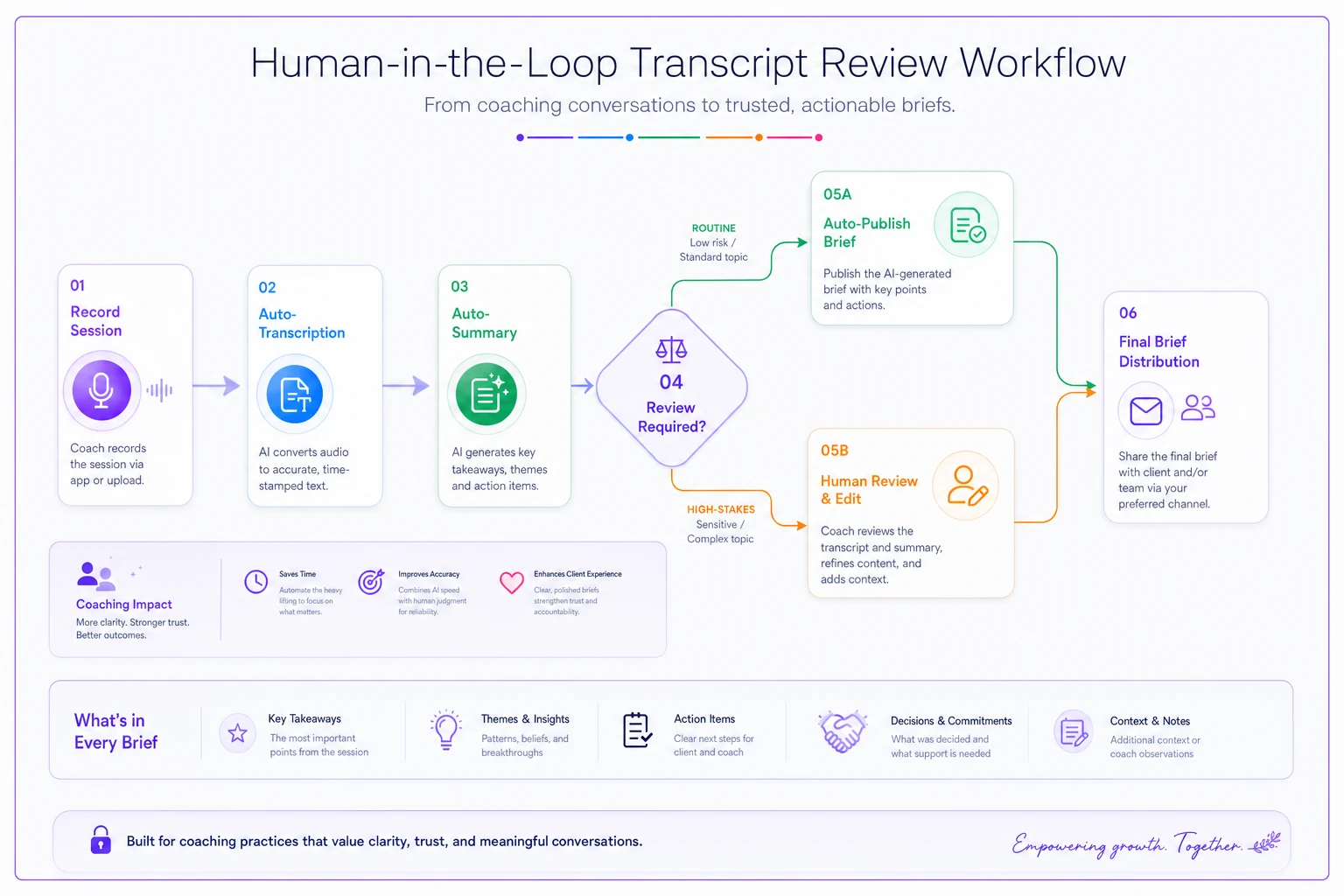
4. Add a human-in-the-loop step for sensitive transcripts
Not every session needs review. But some do, and the trick is defining "some" in advance rather than case by case.
A workflow that actually holds up:
-
Routine sessions → auto-transcribe, auto-summarize, coach skims the brief before next session. No extra review.
-
High-stakes sessions (a client disclosure, a conflict, a decision with real consequences, anything you might reference in a difficult conversation later) → flag for a full transcript read, not just the summary.
-
Anything you'd hand to a client or third party → always human-reviewed before it leaves your system.
The point isn't to review everything. It's to stop treating all transcripts as equally trustworthy when AI cleanup means they aren't.
Define concrete examples of "high-stakes" in your SOPs so reviewers apply the same standard across the team.
Below is a simple workflow visualization you can use when documenting who reviews what.
The point isn't to review everything. It's to stop treating all transcripts as equally trustworthy when AI cleanup means they aren't.
5. Reprice or re-tier if your AI costs shifted
Cheaper Flash-tier processing cuts your per-session cost if you're running summaries at volume. If you built pricing around the old cost of AI deliverables — automated homework summaries, post-session briefs, session recaps — your margins just moved.
A small practice with three coaches might have been spending somewhere in the $180–$220 range per month on transcription and summarization across a few hundred sessions. Lower model costs could push that down to $120–$150. Not life-changing, but enough to widen a tight margin or fund a better client-facing deliverable that competitors aren't offering yet.
The mistake is quietly pocketing the savings and doing nothing with them. The better question is: what AI-assisted deliverable was too expensive before that now actually pencils out?
6. Decide what real-time captions and briefs are worth to you
Lower latency makes live captioning and near-instant post-session briefs more viable. Some coaches will find real use here. Others shouldn't bother.
When real-time features make sense: accessibility needs (a hard-of-hearing client), group facilitation where a live transcript helps you track threads, or corporate engagements where the client expects a polished brief within minutes.
When it's a bad idea: one-on-one deep work where a live caption on screen pulls attention out of the room. The tech being available doesn't mean it belongs in every session. Presence is still the product.
Who should skip this entirely: solo coaches under roughly 20 clients who already read their own notes. The overhead of building and testing a real-time pipeline outweighs the benefit at that scale.
7. Re-train yourself (and staff) on the new failure modes
New model, new mistakes. Old transcription failed loudly — garbled words you could spot immediately. The new version fails quietly. A clean, confident, well-formatted summary that's subtly wrong is more dangerous than an obviously broken one, because nobody double-checks something that reads well.
If you have associate coaches or a VA handling notes, walk them through this specifically. The smoother the output looks, the more carefully you should sanity-check the high-stakes parts against the raw audio. That's not intuitive, and it needs to be said out loud.
A quick decision guide
Not sure how much of this applies to your practice? Rough sort:
-
Solo coach, low volume, reads own notes Do moves 1, 3, and 7. Skip the rest for now.
-
Solo coach, high volume, relies on summaries All seven matter, especially 2 and 4.
-
Multi-coach practice Treat this as an ops project. Standardize the consent update (3) and the review workflow (4) across everyone, or you'll end up with inconsistent client experiences across your team.
-
Selling to corporate clients Move 6 is a competitive lever. Fast, accurate briefs are something buyers notice.
Not sure how much of this applies to your practice? Rough sort:
The deeper problem this exposes
What the model upgrade really surfaces is this: most coaches never had a system for turning session records into something useful. They had a pile of transcripts and a habit of skimming summaries. When the transcription was mediocre, that limitation was obvious and everyone stayed appropriately cautious.
Now that the output looks polished, the temptation is to trust it completely — and that's exactly when a weak underlying process becomes a real problem. Better transcription doesn't fix a broken knowledge system. It just makes the cracks harder to see.
If your session notes mostly disappear into a folder and never feed back into how you actually coach, model quality is beside the point. The gap is structural. There's more on this in why session notes fail coaches and how a lightweight knowledge system turns them into curriculum improvements — and everything there matters more now, not less, because cleaner transcripts make it far too easy to assume the notes are handling themselves.
A short real scenario
A three-coach leadership practice was sending clients automated post-session briefs built on last-generation transcription. Their recurring headache: briefs occasionally attributed commitments to the wrong person in group sessions, and cleaning that up ate maybe two to three hours a week across the team.
After testing newer multi-speaker transcription on a handful of representative recordings, speaker attribution improved noticeably — most of the manual correction disappeared. But the test also caught something they'd have missed otherwise: the disfluency cleanup was smoothing over moments where a client audibly hesitated on a commitment, which was exactly the signal the coaches used to gauge follow-through.
So they made two changes. They adopted the better transcription for the accuracy win, and they added a rule: any session involving a commitment conversation gets a quick raw-audio check, not just a summary read. Less busywork and better coaching signal — which only happened because they tested instead of just trusting the upgrade.
Bottom line
The Gemini updates are worth adopting for most practices that lean on transcripts. The real work isn't the swap, though. It's tightening the workflow around it — consent, review tiers, and a clear-eyed understanding that a better-looking transcript is not automatically a more truthful one.
Move fast on the disclosure and testing pieces. Take your time on real-time features. And don't let a polished summary quietly become the only version of your client you remember.
The Gemini updates are worth adopting for most practices that lean on transcripts. The real work isn't the swap, though. It's tightening the workflow around it — consent, review tiers, and a clear-eyed understanding that a better-looking transcript is not automatically a more truthful one.
Move fast on the disclosure and testing pieces. Take your time on real-time features. And don't let a polished summary quietly become the only version of your client you remember.
Ready to elevate your coaching business?
Join hundreds of coaches using Guidyly to save time, enhance client engagement, and grow their practice.