



Every coaching session generates patterns. Client struggles that repeat across different people. Breakthrough moments that follow predictable triggers. Questions that seem to unlock progress in specific situations. But most of these insights stay buried in session notes that nobody looks at again.
The typical coach has notes scattered across notebooks, Google Docs, voice memos, and whatever app seemed like a good idea a few months back. Even the organized ones with everything in one place rarely go back through old notes. There's no system for surfacing patterns or turning observations into program improvements.
This isn't really an organization problem. It's a knowledge management problem — specifically, the absence of any feedback loop between what happens in sessions and how your programs actually evolve. That's what this post is about: building that loop in a way that doesn't require another afternoon of setting up a system you'll abandon in three weeks.
The Real Cost of Lost Session Intelligence
A busy coach running 15 to 20 clients a week will rack up close to a thousand sessions over a year. Each session probably has three or four observations worth keeping — what worked, what fell flat, what the client actually needed versus what they said they needed. That's a lot of signal disappearing into folders that never get opened again.
And the part that stings is it's not random noise getting lost. It's the good stuff. The moment a client finally understood why they kept undermining themselves. The reframe that worked when nothing else did. The question you stumbled into that opened up a conversation you didn't expect.
I've watched coaches with genuinely excellent instincts hit a ceiling in their practice — not because they stopped improving in sessions, but because nothing they learned ever made it back into their programs. They kept solving the same problems from scratch. New client, same challenge, same three sessions of circling around it.
Think about executive coaches working with first-time managers. The same delegation mistakes show up constantly — not sometimes, constantly. But without anything surfacing that pattern, coaches keep addressing it reactively, one client at a time, instead of building it into the curriculum where it belongs. Business coaches watch clients stall at the same revenue thresholds. Life coaches see the same relationship patterns emerge at specific career transition points. These things repeat because they're real patterns, not coincidences.
The opportunity cost compounds quietly:
-
Solving the same problems from scratch with each new client
-
Missing obvious curriculum improvement opportunities
-
Not recognizing which interventions are actually doing the work
-
Failing to notice which client types you serve best — and which ones quietly drain you
The problem is they're invisible when your notes live in 12 different places and you haven't opened most of them since last quarter.
Why Traditional Note-Taking Systems Break Down
The intention is usually good. Nice notebooks, elaborate Notion setups, color-coded systems that look like they were designed by someone with a lot of free time. For a few weeks, everything gets documented. Then reality hits.
Never miss a session or detail again.
Guidyly helps you book, manage, and track every coaching session efficiently.
- Centralized session scheduling
- Automated client reminders
- Progress tracking & notes
No credit card required
Session notes break down because they're designed for documentation, not synthesis. You write detailed narratives that feel important in the moment but are nearly impossible to review later. Full paragraphs, stream of consciousness, everything captured — and then completely useless for spotting patterns across 40 sessions.
Digital tools help with storage but not retrieval. You might remember a client had a significant breakthrough around boundaries six months ago, but finding those notes means scrolling through hundreds of entries hoping you used the same word you're searching for now. Search only works if you were consistent, and nobody is consistent.
The deeper structural problem is that session notes and program development exist in completely separate worlds. Notes live in one place, curriculum materials somewhere else, and nothing ever moves between them. Insights don't make it into program updates because there's no mechanism to move them there — just the hope that you'll remember something useful when you sit down to revise a module.
Taxonomy inconsistency makes it worse. One day you tag something "leadership," the next "management," the next "delegation issues." Without standardized categories, even genuinely useful insights become unfindable.
Building a Three-Layer Capture System
The reason most capture systems fail isn't the tool — it's trying to do too many things at once. Capturing, analyzing, and synthesizing in the same moment is cognitively exhausting, so people skip steps or stop entirely. Separating those functions into three distinct layers actually works.
Layer 1: Session Quick Capture
-
Client context (1 line)
-
Key challenge presented
-
Intervention used
-
Client response
-
Potential pattern flag
Under 2 minutes per session. The goal isn't comprehensive documentation, just enough to support pattern analysis later.
Layer 2: Weekly Pattern Logs
Every Friday, spend 20 minutes reviewing the week's quick captures. Look for repeated challenges across different clients, interventions that landed particularly well, questions that unlocked something, and resistance points that kept showing up. Document these in a separate pattern log with standardized categories. This is where consistent taxonomy actually matters.
Layer 3: Monthly Synthesis Reports
Once a month, review your pattern logs and identify curriculum opportunities. What challenges appeared repeatedly? Which interventions consistently delivered? What new frameworks might address recurring issues?
Separating capture from analysis makes both more effective. You're not trying to identify patterns in the moment or write comprehensive notes for future review. Each layer has one job.
Here's roughly how the flow moves from session to curriculum:
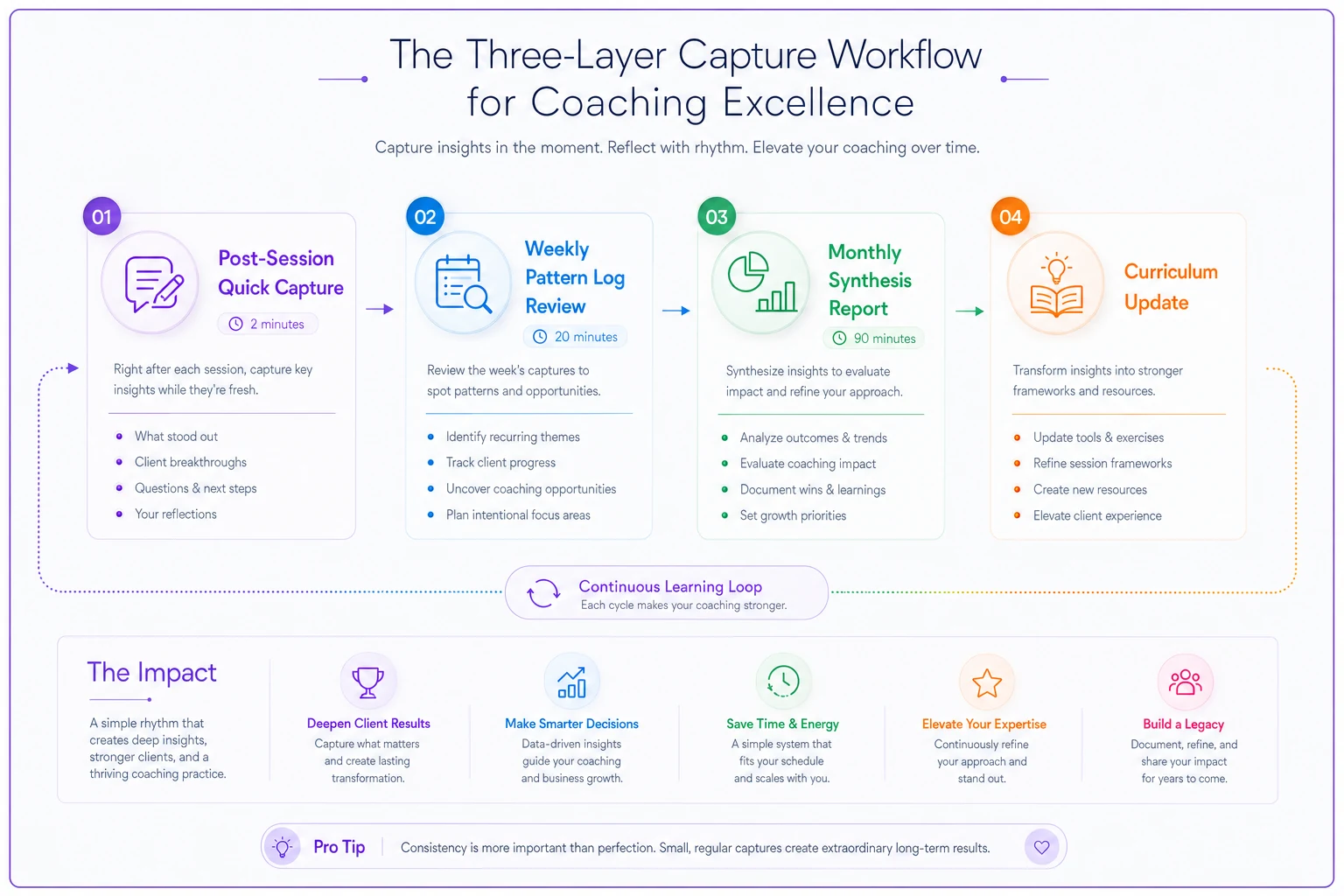
It's a simple loop, but most coaches are missing two or three steps entirely.
Start with Layer 1 consistently for a couple of weeks before adding Layer 2 so the weekly review has enough material to be useful.
Separating capture from analysis makes both more effective. You're not trying to identify patterns in the moment or write comprehensive notes for future review. Each layer has one job.
Creating a Taxonomy That Actually Works
Your tagging taxonomy determines whether insights become findable or just pile up. Most coaches either build overly complex systems with dozens of tags or stay so high-level that everything ends up under "personal" or "professional" and distinctions get lost.
Start with five core categories and keep each one tight — five to seven tags maximum. More than that and it gets unwieldy fast. The goal is consistency, not precision.
Challenge Types
-
Mindset blocks
-
Skill gaps
-
Resource constraints
-
Relationship dynamics
-
Systems/process issues
Intervention Methods
-
Reframing exercises
-
Accountability structures
-
Skill-building activities
-
Reflection prompts
-
Behavioral experiments
Client Stages
-
Early exploration
-
Active implementation
-
Plateau/resistance
-
Breakthrough moments
-
Integration phase
Outcome Indicators
-
Immediate insight
-
Gradual progress
-
Resistance/pushback
-
Breakthrough
-
Backsliding
Context Factors
-
Life transitions
-
Work dynamics
-
Health/energy
-
Support systems
-
External pressures
Pick your terms once and stick with them. Consistency matters far more than having perfect labels.
Templated Formats for Different Session Types
Different coaching conversations need different capture formats. A breakthrough session needs different documentation than a routine check-in or a crisis call. Templates speed up post-session capture while making sure you're actually recording what matters for each scenario.
Standard Progress Session Template
Date: [Date] Client: [Initials] Session Type: Progress Review Since Last Session:
-
[Key development 1]
-
[Key development 2]
Today's Focus: Challenge: [One sentence] Root Pattern: [Underlying issue] Intervention: [Approach used] Response: [Client reaction] Next Steps:
-
[Action 1]
-
[Action 2]
Pattern Flag: [If applicable]
Breakthrough Session Template
Date: [Date] Client: [Initials] Session Type: Breakthrough Trigger Context: [What preceded the breakthrough] Breakthrough Moment: Realization: [Core insight] Emotional Response: [Client's reaction] Previous Block: [What was preventing this] Enabling Factors:
-
[What made this possible now]
-
[Coaching technique that helped]
Integration Plan: [How to reinforce this breakthrough] Curriculum Note: [Lesson for other clients]
Crisis/Challenge Session Template
Date: [Date] Client: [Initials] Session Type: Crisis Support Immediate Situation: [Brief context] Client State: Emotional: [Current state] Capacity: [Available resources] Support: [What they have/need] Intervention: Stabilization: [What helped ground them] Perspective: [Reframing offered] Resources: [Tools/support activated] Follow-up Required:
-
[Immediate need]
-
[Next session focus]
Pattern Note: [Similar situations with others]
Templates don't constrain the session — they structure the capture afterward. That distinction matters. The conversation stays intuitive. The documentation gets consistent.
Monthly Review Process That Generates Curriculum Updates
The monthly review is where accumulated observations become actual program improvements. Block 90 minutes on the last Friday of each month and treat it like a client appointment — not a task you squeeze in between things.
Start by reviewing all pattern logs from the past month. Look specifically for insights that showed up three or more times across different clients. Recurring patterns indicate something systematic in your coaching population, not one person's quirk.
Group related patterns into potential curriculum modules. If several clients struggled with setting work boundaries, that's the outline of a workshop. If a particular reframing approach kept producing breakthroughs, it probably deserves more prominent placement in your methodology rather than staying in your back pocket.
For each identified pattern, work through a simple proposal:
-
Pattern observed (with rough frequency)
-
Current approach to addressing it
-
Proposed program enhancement
-
Implementation timeline
-
Success metrics
Don't try to implement everything at once. One or two updates per month is enough. This keeps improvements manageable while still ensuring the program keeps evolving.
Track which updates actually improve client outcomes. Not every pattern needs to become curriculum — some insights are valuable for individual coaching but don't generalize well to group programs or structured modules.
AI-Powered Synthesis for Pattern Recognition
Manual pattern review across hundreds of session notes is genuinely tedious, and most coaches either skip it or only do surface-level analysis. This is where operational software with AI automation changes what's actually possible.
Modern coaching platforms can analyze session notes to surface things like common phrases that precede breakthrough moments, challenge patterns by client demographics, intervention success rates across different contexts, and optimal session spacing for different coaching goals.
The client progress tracking systems you might already be using can integrate with knowledge management workflows. When AI analyzes both progress metrics and session notes together, it catches connections that manual review would likely miss — or catch only after hours of work.
A platform might surface that clients who raise imposter syndrome in the first few sessions show significantly less progress on leadership goals unless it's addressed directly early in the engagement. Or that breakthrough moments around work-life balance tend to cluster in a specific session range for corporate clients but much earlier for entrepreneurs. These are the kinds of things you'd eventually notice anecdotally, but systematic analysis gets you there faster and with more confidence.
This doesn't replace coach intuition. You still decide what patterns matter and how to act on them. But AI automation handles the detection work across data volumes that would take hours to review manually.
On privacy: reputable platforms either process data locally or extract patterns without storing raw session content. Worth verifying before you commit to any platform, but it's generally a solved problem at this point.
Converting Insights into Program Assets
Identifying patterns is only useful if something actually gets built from them. Each monthly review should produce at least one new program component — even a small one.
Worksheet Development
When multiple clients struggle with the same self-assessment, build a structured worksheet that guides them through it. If several clients need help clarifying values, design the exercise around what's actually worked in your sessions — not a generic values list lifted from a certification workbook.
Email Templates
Recurring coaching conversations often signal a need for reinforcement between sessions. If you're repeatedly explaining the same concept live, write an email template that walks through it clearly. Send it after the relevant session moment rather than re-explaining it every time.
Group Session Modules
Patterns that affect multiple clients at similar stages make natural group coaching topics. If several clients hit the same plateau at the same revenue level or career transition, that's a ready-made group session.
Assessment Tools
When you identify predictable stages or transition points, assessments help clients understand where they are in the process. They accelerate early sessions by providing context without a long intake conversation.
The key is making these assets actually accessible — not filing them somewhere you'll never look. Integrate them into your active session prep so relevant materials surface when you're preparing for a client facing a familiar challenge.
Measuring the Impact on Your Practice
After about three months of consistent knowledge management, the differences start showing up in measurable ways.
Session efficiency improves because you're not approaching familiar challenges without tested interventions. When a new client presents something you've seen repeatedly, you have a starting point. What used to take three sessions of circling around might take one.
Client outcomes sharpen as interventions become more targeted. Instead of general approaches, you're deploying specific techniques with a track record in similar situations. Your success rate with particular challenge types should improve noticeably.
Sometimes program enrollment picks up too, as curriculum becomes more precisely matched to what real clients actually need. When prospects see modules that directly address their specific challenges rather than generic coaching content, conversion tends to improve.
| Metric | Expected Improvement | Timeframe |
|---|---|---|
| Time to breakthrough (common challenges) | Measurable reduction | 60–90 days |
| Client satisfaction scores | Gradual improvement | 90 days |
| Program completion rates | Higher with targeted curriculum | 3–6 months |
| Referral frequency | Increases with better outcomes | 6+ months |
| Revenue per client | Improves with premium positioning | 6–12 months |
These numbers matter because they connect knowledge management to business outcomes, not just organizational hygiene.
Common Implementation Obstacles
Perfectionism is the most common roadblock. Coaches want comprehensive notes or nothing, then abandon the system entirely after missing a few sessions. A 70% capture rate beats zero. The whole point is pattern detection — imperfect data still reveals patterns.
Technology overwhelm stops others before they start. They spend weeks evaluating apps instead of capturing anything. A basic spreadsheet consistently used beats a sophisticated system you'll eventually stop opening. Start minimal.
Some coaches resist templates because they feel constraining. Worth repeating: templates happen after the session, not during. The structure is for capture, not conversation.
The time investment concern is understandable but usually misplaced. The system requires maybe three to four hours monthly. It saves more than that by eliminating redundant problem-solving and accelerating program development. Most coaches recoup the investment quickly through improved session efficiency.
The most dangerous obstacle is waiting for the right moment to start. There isn't one. Start with next week's sessions and adjust from there.
Quick Implementation Checklist
Getting started doesn't require a full setup day. Four days is enough to have something real in place.
Monday: Set Up Basic Infrastructure
-
Create three folders/documents
Session Notes, Pattern Logs, Curriculum Ideas
-
Design your initial taxonomy (5 categories, 5 tags each)
-
Copy the session templates into your note system
Tuesday–Thursday: Test Quick Capture
-
After each session, spend 2 minutes using the appropriate template
-
Don't aim for perfection — just capture core insights
-
Flag one potential pattern per day
Friday: First Pattern Review
-
Spend 20 minutes reviewing the week's captures
-
Identify 2–3 patterns across sessions
-
Write one paragraph about each
-
Note one potential curriculum improvement
Weekend: System Adjustment
-
Review what worked and what felt clunky
-
Adjust templates where needed
-
Simplify anything too heavy
-
Prepare for next week's full implementation
Don't overthink the initial setup. The system will adjust as you use it.
Making Knowledge Management Sustainable
Long-term success depends on integrating capture into your existing workflows rather than bolting on a separate process that has to survive on willpower.
Connect capture to things you already do. If you always make coffee after sessions, quick capture becomes part of that wind-down. If you review your calendar every Friday morning, pattern logging gets added to that block. Systems that attach to existing habits actually last.
Keep the process lightweight enough to maintain during busy periods. Fully booked weeks are exactly when you need knowledge management most — and when you have the least margin for anything extra. A system that breaks under pressure isn't sustainable, it's just aspirational.
Build in quarterly simplification reviews. Every few months, look honestly at what you're using versus what seemed good in theory. Cut what isn't providing clear value. A simple system you use beats a comprehensive one you've quietly abandoned.
Some coaches also find value in sharing sanitized pattern insights with their client community — not individual session details, but observations about common challenges and what tends to help. It creates additional value and gives clients a sense of being part of something larger than their individual engagement.
The Compound Effect of Systematic Learning
After a year of consistent knowledge management, the change in your practice becomes hard to ignore. Not just more organized — genuinely better at producing outcomes.
Your intake process gets sharper because you recognize client types and can anticipate their typical trajectory. You can tell prospective clients not just that you can help, but how their challenge usually unfolds and where the typical breakthrough points tend to fall.
Confidence in pricing improves because you have actual evidence of the value you deliver. When you can articulate specific patterns of transformation and the curriculum assets that reliably produce them, premium pricing has something real behind it.
Most importantly, your methodology starts to feel distinctly yours. Instead of borrowing frameworks from certification programs, you develop approaches validated against your actual client population. That differentiation is genuinely hard to replicate.
The coaches who build sustainable, profitable practices aren't always the most gifted in individual sessions. They're often the ones who learn systematically from every client interaction and keep converting those learnings into better programs. Knowledge management isn't really about documentation — it's about building a practice that improves on its own momentum.
Every session without systematic capture is a missed opportunity. But every pattern you identify and convert into curriculum makes all future coaching more effective. That compound effect, over time, is what separates coaches who plateau from coaches who keep getting better.
Ready to elevate your coaching business?
Join hundreds of coaches using Guidyly to save time, enhance client engagement, and grow their practice.