

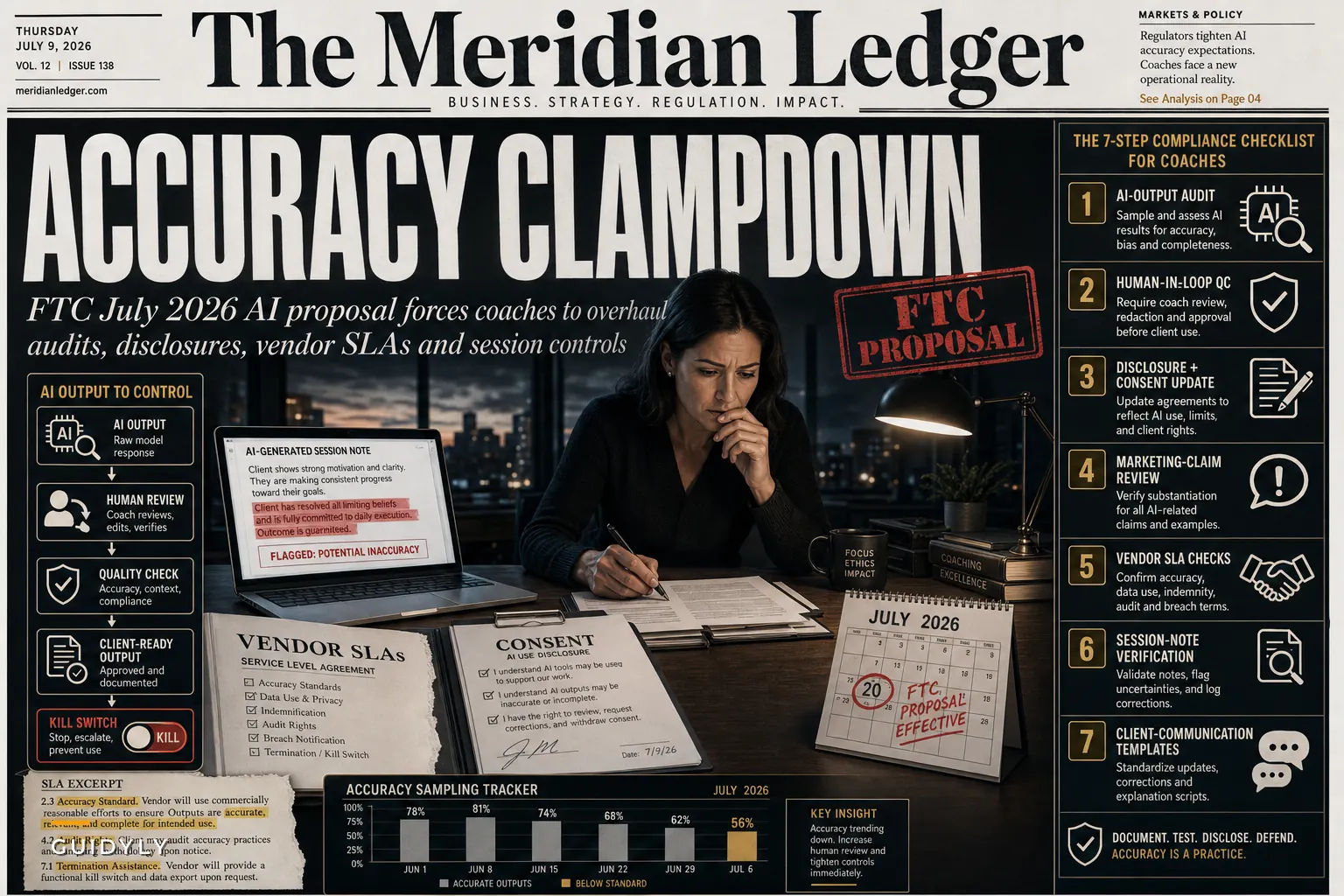

Last week's FTC policy statement on AI accuracy landed like a cold splash of water across my network of coaching practitioners. The message was clear: misleading or inaccurate AI-generated content could violate consumer protection laws, even when you didn't intend to deceive anyone.
The timing's rough. Most coaches I work with just finished integrating AI tools into their operations—ChatGPT for session summaries, automated email sequences for client follow-ups, that kind of thing. One executive coach in Denver had literally launched her AI-powered intake system three days before the announcement. She called me panicking about whether she needed to shut everything down.
She doesn't. But she does need to get compliant, fast.
The Hidden Liability Bomb in Your Current AI Setup
What makes AI compliance particularly tricky for coaches is that unlike most industries where AI handles backend processes, coaching puts AI directly in the path of sensitive client interactions. Your AI-generated session notes become part of client records. Your automated check-in messages influence client mental state. Your AI-drafted program descriptions set outcome expectations.
A life coach running a weight-loss program found this out the hard way last month. Her AI tool had been summarizing client sessions and generating "motivational insights" based on conversation patterns. Sounds fine, right? Except one client's summary incorrectly stated she'd "committed to eliminating all carbs" when she'd actually said she wanted to reduce processed foods. The client followed the AI's interpretation, ended up in the ER with severe hypoglycemia, and now there's a negligence claim sitting on the table.
This happened before the FTC guidance. The exposure now is a different conversation entirely.
The bigger operational problem isn't just liability—it's that most coaches have no real visibility into what their AI tools are actually outputting. They set up automations months ago, adjusted a few prompts, and let them run. Meanwhile, these systems are generating hundreds of client touchpoints weekly without anyone looking at them.
Why Traditional Compliance Approaches Will Sink Your Practice
The knee-jerk reaction I'm seeing everywhere right now: coaches scrambling to add disclaimers to everything. "This message was generated by AI." "AI-assisted summary, please verify." "Automated content, not personalized advice."
Never miss a session or detail again.
Guidyly helps you book, manage, and track every coaching session efficiently.
- Centralized session scheduling
- Automated client reminders
- Progress tracking & notes
No credit card required
Disclosure matters, sure. But plastering warnings on every message destroys the trust that makes coaching work in the first place. Picture receiving a vulnerable follow-up message after sharing something deeply personal, only to see "WARNING: AI-GENERATED CONTENT" at the bottom. The relationship takes a hit right there.
More importantly, disclaimers don't actually protect you if the content itself causes harm. The FTC's stance, according to Reuters' legal analysis, suggests that even well-intentioned bias safeguards could run afoul of consumer law if they produce inaccurate outputs. A disclaimer doesn't fix a false claim about treatment efficacy or a misrepresented client statement.
The compliance frameworks being pushed by legal consultants—lengthy audits, committee reviews, multi-stage approvals—might work for large healthcare systems. For a solo coach managing 40 clients while trying to grow their business? It's not realistic.
The 7-Step Compliance Checklist That Actually Works
After helping dozens of coaches navigate this over the past week, here's the practical version—the one that won't destroy your operations in the process.
Step 1: Map Your AI Touchpoints (2 hours max)
Build a simple spreadsheet with four columns: Tool Name, Use Case, Client-Facing (Y/N), Risk Level (1-5). Walk through your entire client journey from first inquiry to program completion.
| Tool Name | Use Case | Client-Facing (Y/N) | Risk Level (1-5) |
|---|---|---|---|
Most coaches find somewhere between 8 and 12 AI touchpoints they'd forgotten about. That scheduling assistant that sends confirmations? AI-powered. The worksheet generator for homework assignments? AI. The testimonial request email after program completion? Probably AI-templated.
Risk levels are pretty straightforward:
-
Level 5
Health/medical advice, financial guidance, legal interpretation
-
Level 4
Program promises, outcome predictions, progress assessments
-
Level 3
Session summaries, action plans, goal-setting
-
Level 2
Scheduling, reminders, general check-ins
-
Level 1
Administrative tasks, internal notes
Step 2: Implement Output Sampling (30 minutes weekly)
You can't review everything, but you have to review something. Every Monday, pull three random AI outputs from the previous week—one high-risk, two medium-risk. Read them as if you were the client. Does anything seem incorrect, misleading, or potentially harmful?
One business coach doing this found her AI was consistently overstating client revenue goals in summaries—turning "I'd like to reach $10k months" into "Client committed to achieving $10k monthly revenue." Small difference on paper, real expectation mismatch in practice.
Step 3: Create Kill Switches for High-Risk Content
Any AI output touching health claims, financial projections, or relationship advice needs a manual review gate before it reaches clients. Yes, this slows things down. That's the point.
Set up a simple holding queue—AI drafts go to a folder, you review and approve before sending. Takes maybe 10 extra minutes a day and prevents catastrophic errors. One ADHD coach caught her AI suggesting medication adjustments based on session notes. That could've ended her career.
Prioritize health-related and financial touchpoints in your weekly sampling and kill-switch checks.
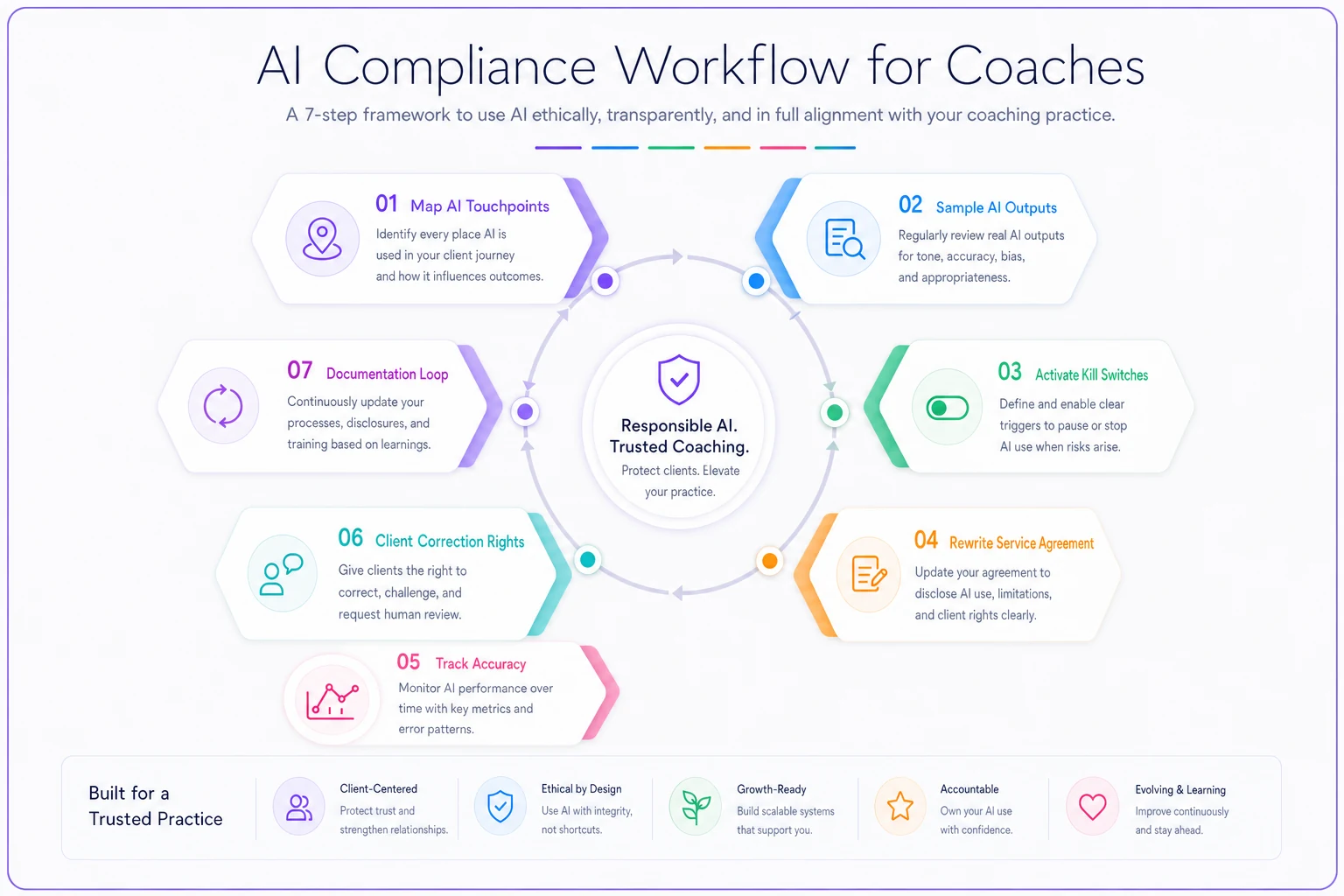
Here's a quick visual of the 7-step compliance workflow.
Step 4: Rewrite Your Service Agreement (Once, Done Right)
Don't bury AI disclosure in paragraph 47 of your terms. Create a clear, separate section covering:
-
Which processes use AI assistance
-
What human oversight you maintain
-
Client rights to request human-only interactions
-
How errors get corrected
Keep it under 200 words. Clients actually need to read and understand it, not skim past it.
Step 5: Build Your Accuracy Tracking System
This connects directly to the session notes system we covered previously—you need a feedback loop to catch errors before they compound into something worse.
Simple implementation: open each session with a quick check—"Anything in last week's summary or messages that didn't quite capture what you meant?"
Log corrections as they come in. Pattern recognition matters here more than perfection. If your AI consistently misreads discussions about family dynamics as relationship problems, you either need to fix your prompts or switch tools.
Step 6: Establish Client Correction Rights
Give clients an easy, low-pressure way to flag AI mistakes. Not a form—just a simple email template: "Hey, noticed something off in my session notes..."
One coach I work with added a standing agenda item to her monthly check-ins: "Any tech weirdness we should fix?" Clients started flagging small errors she never would've noticed, which prevented a few bigger problems from developing.
Step 7: Document Your Improvement Cycle
The FTC cares about good faith effort. Keep a simple log:
-
Date of AI output review
-
Issues identified
-
Corrections made
-
System improvements implemented
This isn't about building perfect documentation. It's about showing you're actively managing AI accuracy instead of just hoping for the best.
The Deeper Operational Shift Nobody's Discussing
Beyond compliance, this FTC guidance is exposing something uncomfortable: most coaches had no real quality control on their client communications before AI either. AI just made the gaps visible.
Before AI, how often did you review session notes for consistency? How frequently did you audit whether your email responses actually aligned with client goals? Probably not often. The operational sloppiness was hidden inside general inefficiency.
Now AI amplifies everything. A slightly-off interpretation that might've been a one-off mistake in a tired moment becomes a systematic error repeated across dozens of clients. The casual promise about expected outcomes gets baked into every program description.
The coaches who'll do well post-FTC-guidance aren't the ones who abandon AI. They're the ones who use this as a forcing function to build better operational foundations—proper session documentation, consistent communication standards, real outcome tracking.
Moving Forward Without Paranoia
A career coach in Austin called me this week ready to delete all her AI tools and go back to manual everything. That's not the answer.
AI-powered operational software is still genuinely transformative for coaching practices. Automated scheduling alone saves most coaches somewhere between 5 and 7 hours a week. Consistent follow-up means clients actually get timely responses instead of scattered attention when you're stretched thin.
The key is treating AI like any powerful tool: with some respect for what can go wrong. You wouldn't let an untrained assistant handle client communications without oversight. AI shouldn't be any different.
Start with your highest-risk areas, get those under control, then work through medium and lower-risk touchpoints. Build reviewing AI outputs into your weekly routine—not as a burden, but as quality control you probably should've had anyway.
And talk to your clients about it. Not in scary legal terms, just honestly: "I'm using some tools to serve you better and I want to make sure they're working right for you." Transparency builds trust. Hidden AI erodes it.
The FTC guidance isn't trying to kill AI in coaching. It's forcing the industry to grow up. The coaches who take that seriously—who build thoughtful, compliant, client-protective systems—are going to be in a much stronger position than those who slap disclaimers on everything and call it done.
Those who ignore it entirely? They're one client complaint away from something much worse.
The enforcement action that makes an example of our industry is coming eventually. Getting ahead of it now is a lot easier than scrambling after it lands.
Ready to elevate your coaching business?
Join hundreds of coaches using Guidyly to save time, enhance client engagement, and grow their practice.