



Most coaches build their business backwards. They start with custom work, create something genuinely good, then realize they're stuck recreating it from scratch every single time. The exhausting part isn't the coaching itself—it's rebuilding the same foundational pieces while pretending each engagement is completely unique.
A leadership coach I worked with nearly burned out after three years of bespoke programs. Incredible results, genuinely transformative outcomes—but every new client meant starting from zero. She'd spend 15-20 hours preparing for each engagement, recreating similar exercises with slight variations, rebuilding progression maps that followed nearly identical patterns. Around 70% of what she delivered was actually repeatable. She just hadn't figured out how to extract it.
The solution isn't to become a cookie-cutter program factory. It's building a modular curriculum system—a way to decompose your successful client work into reusable components while keeping enough flexibility to customize. Think of it like a professional kitchen where your base sauces, techniques, and plating styles are standardized, but every dish can still be unique.
Why Coaches Resist Creating Repeatable Programs (And Why That Resistance Costs Them)
The fear makes sense. You've built your reputation on personalized transformation. Your clients come to you specifically because you don't offer generic solutions. Standardizing feels like betraying that.
But when you resist systematization, you end up spending roughly 40% of your time recreating work you've already done. You cap yourself at maybe 8-12 clients a year because each one requires so much custom development. Income stays tied directly to available hours, and you can't bring on associate coaches because everything lives in your head.
Executive coaches who make this shift typically double their capacity within six months—not because they work more hours, but because they stop rebuilding from scratch. Program development drops from 15-20 hours per client to 3-4 hours of customization. That's 12-16 hours back for actual coaching, business development, or just living their life.
The key insight: repeatability doesn't mean rigidity. It means having a foundation to build on rather than starting from nothing.
Decomposing Client Outcomes into Reusable Modules
Every successful coaching engagement follows patterns, whether you've noticed them or not. The trick is identifying which elements are truly custom versus which ones just feel custom because you recreate them differently each time.
Never miss a session or detail again.
Guidyly helps you book, manage, and track every coaching session efficiently.
- Centralized session scheduling
- Automated client reminders
- Progress tracking & notes
No credit card required
Start by auditing your last five successful client engagements. Look for common threads in outcomes achieved, not just activities performed. A career coach might notice that every client who successfully transitions roles goes through similar stages: clarity on values, skill inventory, market positioning, network activation, and interview preparation. Those become your core modules.
Each module should be outcome-focused, not activity-focused. Instead of "Resume Writing Workshop," you have "Market Position Development." Instead of "Goal Setting Session," you have "Strategic Priority Alignment." This framing keeps you focused on results while allowing flexibility in how you actually deliver.
The modules should also be stackable and reorderable. Not every client needs every module, and the sequence might shift based on where they're starting from. A founder working with an executive coach might need "Leadership Style Assessment" before "Team Communication Frameworks," while a new manager might need the opposite. Document the dependencies between modules too—some are genuine prerequisites. You can't do "Stakeholder Influence Mapping" effectively before completing "Role Clarity Definition." These dependencies become your program architecture.
Building Your Module Template Library
A module template isn't a script. It's a framework that ensures consistency while leaving room for adaptation. Each template needs five core components.
First, the outcome statement. This defines what success looks like in clear, measurable terms. For a "Communication Style Optimization" module, the outcome might be: "Client can identify their default communication pattern, recognize triggers for ineffective communication, and deploy two alternative approaches in high-stakes conversations."
Second, the assessment criteria. How do you know when someone is ready for this module? What prerequisites must they have completed? This prevents you from forcing clients through modules they're not ready for or don't need.
Third, the core content framework. Your teaching methodology, key concepts, and essential exercises. Not a word-for-word script—more like a recipe. The essential ingredients and techniques, not exact measurements for every situation.
Fourth, the adaptation parameters. Where and how can this module flex based on client context? A "Strategic Planning" module might have variations for solopreneurs versus corporate executives versus nonprofit leaders. Document those variations so you're not recreating them each time.
Fifth, the completion indicators. How do you and the client both know the module is actually done? What deliverables or demonstrations indicate mastery? This prevents modules from dragging indefinitely or wrapping up too soon.
Creating Facilitator Notes That Actually Help
Most facilitator notes are either too vague ("discuss leadership challenges") or too rigid ("say exactly this"). Effective notes give you just enough structure to ensure quality while letting your actual expertise come through.
Include timing breakdowns that reflect real sessions, not ideal ones. If a module typically takes 90 minutes but stretches to two hours with analytical clients, document that. Note where conversations tend to run long and where you might need to cut short.
Document the common resistance points and how you navigate them. Every module has moments where clients typically struggle, deflect, or want to skip ahead. If clients resist the "Values Clarification" exercise by claiming they already know their values, you probably have a reliable reframe that surfaces the gap between stated and lived values. Write it down so you're not rediscovering it each time.
Include question banks rather than scripts. Having 15-20 tested questions per module section gives you flexibility while making sure you hit key points. Questions like "What would change if this was easy?" or "Where else in your life does this pattern show up?" become tools you deploy based on client responses rather than boxes to tick.
Keep your question bank in a searchable document so you can quickly pull questions during live sessions.
Add intervention protocols for common scenarios too—what do you do when a client hasn't done the pre-work, when someone intellectualizes instead of engaging, when someone wants to skip a module they actually need? These protocols stop you from problem-solving in the moment every single time.
Designing Progression Maps That Make Sense
A progression map isn't just a list of modules in order. It's a visual representation of the transformation journey that helps both you and your clients understand where they are and where they're headed. The best maps show multiple valid pathways rather than one rigid sequence.
Here's a workflow visualization to guide how you map entry points, dependencies, milestones, and outcome branches.
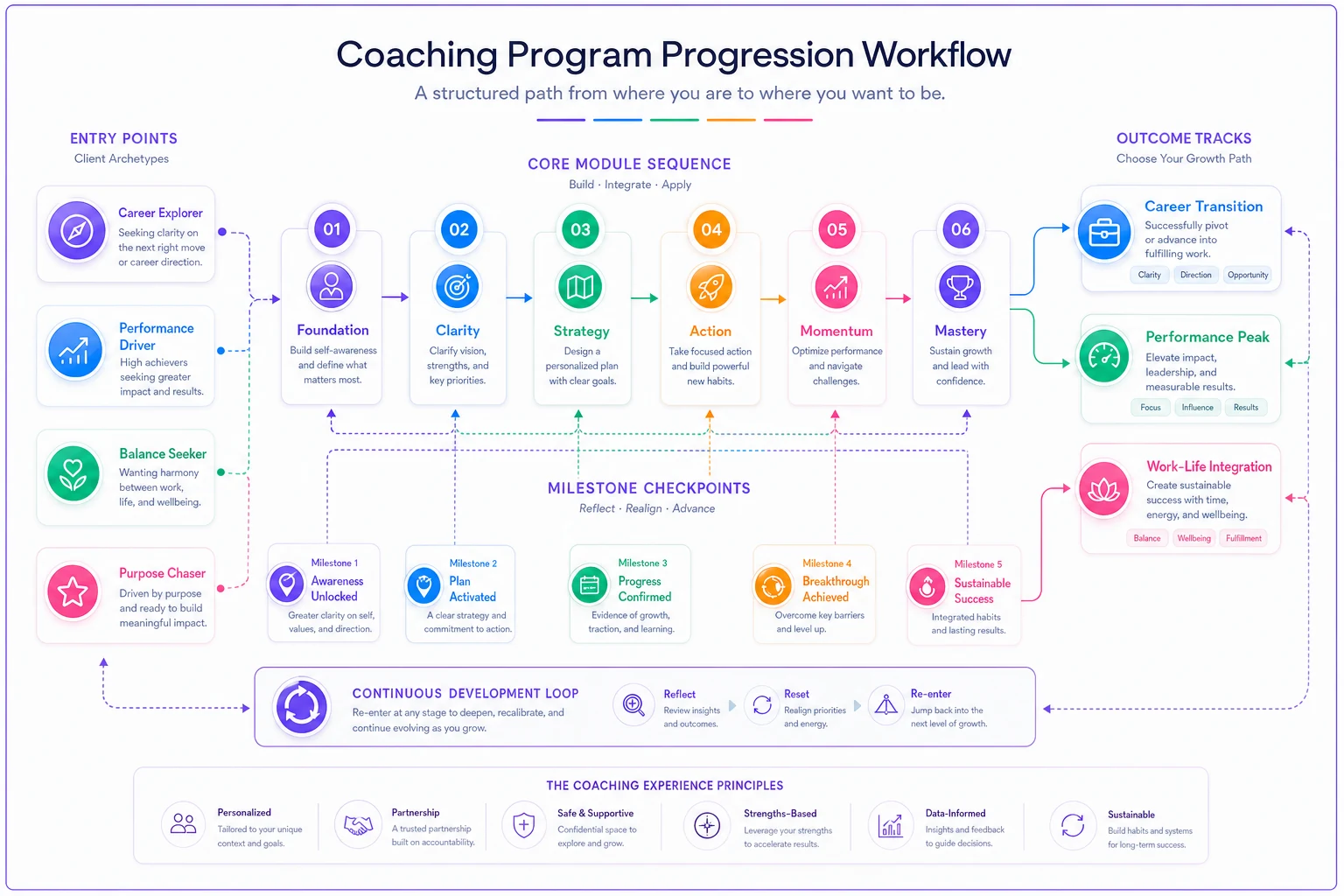
Start with entry points based on client archetypes. A new entrepreneur might enter at "Business Model Clarity" while a burned-out executive might start with "Energy Management Systems." Each entry point should have a diagnostic that determines the appropriate starting module. This stops you from forcing everyone through the same beginning when their needs are genuinely different.
Map the dependencies and prerequisites between modules explicitly. Some progressions are logical—you need "Vision Development" before "Strategic Planning." Others are contextual—"Team Leadership" modules only apply to clients who actually manage teams. Include milestone checkpoints every three or four modules to validate overall progress, not just individual module completion. These sometimes reveal the need to revisit earlier work with fresh understanding, or to skip planned modules that are no longer relevant.
Design branch points for different outcomes too. Not everyone who starts your program wants the same ending—some want career transition, others want performance improvement, still others want work-life integration. Your map should show how the path diverges based on desired outcomes. And consider re-entry loops for ongoing development. The best coaching relationships cycle rather than end cleanly, and your map should reflect that.
The Pre-Launch Testing Protocol
Before launching a newly systematized program, you need real people to break it in ways you didn't anticipate. This phase isn't about perfection—it's about finding gaps between theory and practice.
Run a pilot cohort at reduced pricing with an explicit testing agreement. Be transparent that they're helping you refine the program in exchange for a discount, typically 40-50% off eventual pricing. This sets expectations and turns participants into development partners rather than critics of imperfection.
Track time carefully during the pilot. How long does each module actually take? Where do you consistently run over? If your "Communication Assessment" module consistently takes 75 minutes instead of the planned 60, you need to know that before you've sold the program at full price.
Document every adaptation you make on the fly. When you modify an exercise, add a question that lands well, or cut something that falls flat, capture it immediately. Those adaptations often become the most valuable parts of the final program.
Collect feedback at three levels:
| Feedback Level | What It Reveals | When to Collect |
|---|---|---|
| Module | Specific component quality and timing | End of each module |
| Program | Flow, sequencing, and progression issues | Midpoint and end of program |
| Transformation | Whether outcomes were actually achieved | 30-60 days post-completion |
Each level requires different questions and different timing. Mixing them together usually means shallow answers at all three levels.
Building Your Launch Checklist
A solid launch checklist prevents scrambling at the last minute or discovering critical gaps after you've already sold the program.
Technical Infrastructure
-
Upload and organize all materials on your delivery platform—whether that's a course platform, shared drives, or a simple folder structure. Test access permissions with someone non-technical. If they can't find materials easily, neither will clients.
-
Set up your scheduling system with buffer time between sessions. Build in 15-30 minute gaps depending on module intensity. Packed back-to-back sessions are a fast track to poor delivery.
-
Establish communication protocols before the program starts. How will clients reach you between sessions? What's your response time? Where do they submit pre-work? These boundaries are much harder to set once things are already moving.
Program Materials
-
Finalize all module templates with version control. Use clear naming conventions like "Module3Valuesv2.1" so you always know which version is current. Sending an outdated worksheet mid-program undermines confidence fast.
-
Create a client-facing progression tracker. Whether it's a simple spreadsheet, a visual journey map, or a more structured client progress dashboard, clients need to see their advancement to stay engaged.
-
Prepare contingency materials for common scenarios—missed sessions, clients who are ahead or behind, sudden shifts in focus. Having these ready prevents reactive scrambling.
Business Operations
-
Set pricing and payment terms based on actual pilot data. You now know how much time each client genuinely requires. Price accordingly, including prep time, session time, and between-session support.
-
Build an intake process to assess fit and determine starting point. Not everyone is right for your program, and not everyone should start at Module 1. A solid intake protects both you and potential clients from mismatched expectations.
-
Document your terms and policies—cancellation, refunds, confidentiality—before you need them. Establishing boundaries retroactively is a mess.
A solid launch checklist prevents scrambling at the last minute or discovering critical gaps after you've already sold the program.
The Hidden Complexity of Customization Within Structure
The paradox of repeatable coaching programs is that the more structured your foundation, the more freely you can actually customize. When you're not worried about forgetting essential elements or recreating basic frameworks, you can focus on what's genuinely unique to each client.
This shows up in subtle ways. Because you're not scrambling to remember what comes next, you can listen more deeply. You notice patterns across clients that improve the program over time. You have the mental bandwidth to create truly custom interventions when standard approaches don't fit.
Coaches who resist this often say they don't want to become "formulaic." But formulas exist in every profession for good reason—they encode proven approaches while leaving room for artistry. A surgeon follows protocols while adapting to each patient's anatomy. A chef uses standard techniques while creating unique dishes. Coaching works the same way, whether coaches admit it or not.
Measuring What Matters: Program Metrics and Refinement
Once the program is running, you need metrics that tell you whether systematization is actually working—not just whether clients are happy.
Track program development time per client. This should drop significantly from your bespoke days. If you were spending 20 hours on custom development and now spend 4 hours on customization, that's real. If you're still spending 15 hours because you keep creating new materials anyway, something needs to change.
Monitor module completion rates and timing. Which modules do clients consistently finish? Which ones get skipped or drag on? If everyone takes twice as long on Module 4, it probably needs to be split. If Module 7 has a 50% completion rate, it might be poorly positioned in the sequence.
Measure outcome achievement by module and overall program. Are clients hitting the defined success criteria? Are they achieving the transformation the complete program promises? This data shows whether your modules are properly scoped—not just whether clients liked working with you.
Calculate capacity and revenue metrics too. How many clients can you now serve simultaneously? What's your revenue per client hour compared to before? These numbers tell you whether systematization is improving your business, not just organizing it.
The Ongoing Evolution of Your Program System
Your modular program system is never truly finished. It evolves based on client needs, market shifts, and your own growing expertise. The difference is that evolution happens intentionally rather than chaotically.
Every client engagement generates refinement data. That question you asked in Tuesday's session that unlocked something gets added to the question bank. The exercise that finally worked with a resistant client becomes a standard alternative approach. The pattern you noticed across three different clients becomes a new mini-module.
Build quarterly review cycles to formally update your program. Look at your notes from all client sessions—what adaptations did you make repeatedly? What new challenges emerged that your current modules don't address? These reviews don't need to be long, but skipping them means improvements accumulate only in your head rather than in the system.
Consider creating specialized tracks as you identify distinct client segments. Your base program might eventually spawn an "Entrepreneur Track" with different exercises than your "Corporate Executive Track." These aren't entirely different programs—they're variations on your core framework, which keeps development efficient while serving genuinely different needs.
The endgame isn't to eliminate customization. It's to make customization strategic rather than reactive. When you have a solid foundation of repeatable modules, you can focus your creative energy on the truly unique aspects of each client's journey—the parts that actually require your expertise. Everything else runs on the system, and once you've operated that way for a while, going back to building everything from scratch stops feeling like freedom and starts feeling like waste.
Everything else runs on the system, and once you've operated that way for a while, going back to building everything from scratch stops feeling like freedom and starts feeling like waste.
Ready to elevate your coaching business?
Join hundreds of coaches using Guidyly to save time, enhance client engagement, and grow their practice.