



Most coaches who try to scale hit a wall somewhere between their second and fourth hire. Not because they can't find talent or attract clients, but because their operation quietly falls apart the moment they're not personally managing every detail.
It usually starts small. Your new coach handles a client complaint differently than you would. They miss documenting a breakthrough session. Their intake process takes twice as long as yours. Small inconsistencies compound until you're spending more time fixing problems than you did when you were solo.
What makes scaling particularly brutal for coaching practices is that quality directly affects retention. A manufacturing business with inconsistent output loses margin. A coaching practice with inconsistent delivery loses clients. And unlike a defective product, you can't undo a bad coaching experience.
Why coaching practices resist systematization (and why that resistance kills growth)
Coaching feels personal. Almost every coach I've worked with initially pushed back on standardizing their practice. "My clients come to me for my unique approach. You can't put coaching in a box."
They're half right. You can't standardize the actual coaching conversation. But everything around it—scheduling, onboarding, documentation, follow-up, supervision—needs structure if you want to grow beyond yourself.
Think about therapy practices. They've figured this out. A therapist maintains their clinical autonomy while following strict protocols for intake, documentation, supervision, and case management. The structure doesn't limit the therapeutic relationship; it protects it.
The resistance to systematization in coaching usually comes from conflating operational consistency with clinical rigidity. Your coaches can still bring their unique style to sessions while following consistent processes for everything else.
The hiring scorecard that predicts coaching success
After watching dozens of coaching practices make bad hires, the pattern is pretty clear: they hire for credentials instead of operational fit. They bring in someone with impressive certifications who can't follow a documentation protocol. Or they hire based on interview chemistry, then discover the person can't maintain client boundaries.
Never miss a session or detail again.
Guidyly helps you book, manage, and track every coaching session efficiently.
- Centralized session scheduling
- Automated client reminders
- Progress tracking & notes
No credit card required
Technical Competency (30% weight)
-
Relevant coaching certification/training
-
Years of experience with target population
-
Demonstrated expertise in practice specialty
-
Score
Rate 1-5, multiply by 0.30
Operational Discipline (35% weight)
-
Previous experience with documentation systems
-
Comfort with technology and software platforms
-
History of meeting deadlines and administrative requirements
-
Examples of following protocols in past roles
-
Score
Rate 1-5, multiply by 0.35
Client Management Skills (20% weight)
-
Boundary setting capabilities
-
Conflict resolution approach
-
Communication style flexibility
-
Retention metrics from previous roles if available
-
Score
Rate 1-5, multiply by 0.20
Cultural Alignment (15% weight)
-
Collaboration mindset vs. solo practitioner mentality
-
Openness to supervision and feedback
-
Alignment with practice values and approach
-
Team player indicators
-
Score
Rate 1-5, multiply by 0.15
Operational discipline carries the most weight because it's the hardest thing to train. You can teach someone your coaching methodology. You can't teach them to be organized.
During interviews, ask specifically about their current documentation habits. Have them walk you through how they prepare for sessions, what they document, how they track client progress. Vague answers are your answer.
The 90-day onboarding system that creates consistent delivery
New coaches need more than an employee handbook and access to your scheduling system. They need a structured ramp-up that builds confidence while protecting quality.
Onboarding workflow:
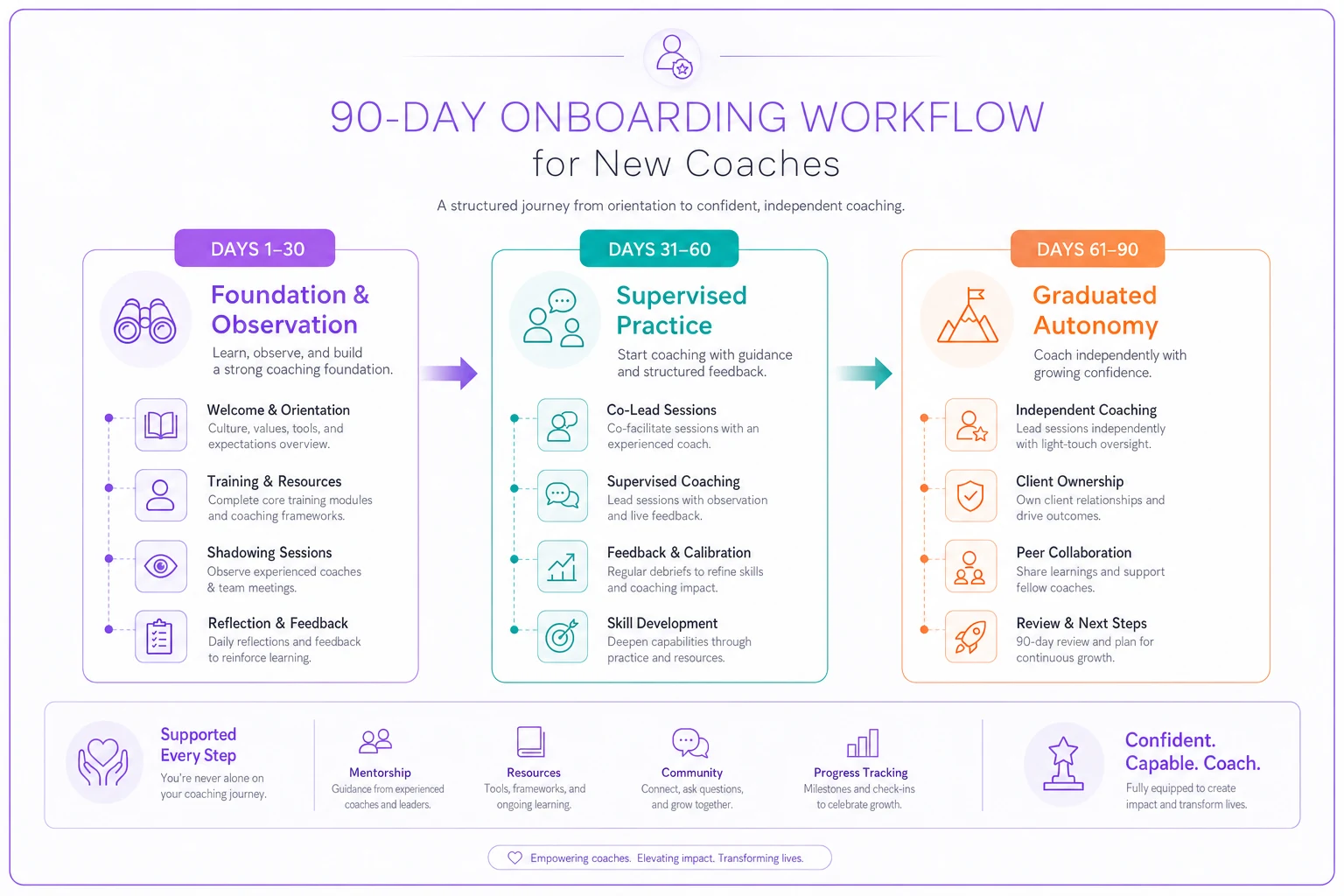
Days 1–30: Foundation and Observation
Week 1 is systems and administrative training—platform setup, SOP review, shadowing the intake coordinator, and working through your methodology training. Weeks 2 and 3 shift to observation: shadowing senior coaches across at least 10 sessions, documenting reflections using a structured template, reviewing 20 or so past client files to understand what good documentation actually looks like.
Week 4 moves into assisted practice. The new coach co-leads a few sessions, handles the intake portion under supervision, and submits documentation for review. Before moving to Phase 2, they need to pass a documentation quality audit.
Days 31–60: Supervised Practice
Weeks 5 and 6 introduce a limited caseload—three to five low-complexity clients, sessions recorded for review, daily check-ins with a supervisor, and documentation reviewed within 24 hours. Weeks 7 and 8 expand that to 10–15 clients, shift check-ins to weekly, and add a first-month metrics review. The milestone here is maintaining 90% documentation compliance before moving forward.
Days 61–90: Graduated Autonomy
Weeks 9 and 10 build toward 80% of the target caseload, introduce one complex case with support, and bring the coach into team case consultations. The final two weeks complete the ramp: full caseload authorization if metrics are met, a shift to monthly supervision, and a formal 90-day performance review. The milestone is client satisfaction above the practice average.
The key is graduated complexity. Don't throw new coaches into the deep end with difficult clients. Start them with stable, engaged clients, then increase complexity as they demonstrate competence. It sounds obvious but most practices skip this entirely.
Supervision cadences that catch problems before clients notice
Supervision in most coaching practices becomes crisis management—you only talk to coaches when something goes wrong, and by then the problem has already touched clients.
| Experience Level | Individual Supervision | Group Supervision | Performance Reviews |
|---|---|---|---|
| New (0–6 months) | Weekly, 60 min | Ad-hoc | As needed |
| Developing (6–18 months) | Bi-weekly, 45 min | Monthly | Quarterly |
| Experienced (18+ months) | Monthly | Monthly | Annual |
Without structure, supervision just becomes venting. Use a consistent format for every session:
-
Administrative check (5 min) Documentation current? Schedule issues? Platform problems?
-
Case review (30 min) Present specific cases using a structured format
-
Professional development (10 min) Skill building, training needs, growth goals
-
Action items (5 min) Clear next steps with follow-up dates
Document supervision sessions the same way you document client sessions. It creates accountability and helps you spot patterns over time. A coach who raises the same concern across three months of sessions probably needs more than a quick answer.
Quality assurance beyond client satisfaction scores
Client satisfaction scores lie. Clients give high ratings because they like their coach personally, even when the coaching isn't working. Or they rate low because they're frustrated with their own lack of progress. Neither tells you much about actual quality.
Documentation Quality Audit (Monthly)
-
Are session notes completed within 24 hours?
-
Do notes follow the required format?
-
Is progress toward goals tracked quantifiably?
-
Are risk factors and concerns flagged appropriately?
Session Structure Audit (Quarterly)
-
Adherence to methodology in recorded sessions
-
Appropriate session pacing
-
Goal-setting and accountability practices
-
Boundary maintenance
Client Progress Audit (Monthly)
-
Average time to first breakthrough
-
Goal completion rates
-
Engagement metrics (homework completion, session attendance)
Administrative Compliance (Weekly)
-
Schedule adherence
-
Communication response times
-
Platform usage compliance
-
Billing and payment documentation
Pro tip: Build a simple dashboard that shows documentation compliance rates per coach on a rolling 30-day basis. When a coach drops below 85%, that's your trigger for a check-in—not to reprimand, but to ask what's going on.
Track these by coach, monthly, and watch for drift. The documentation audit catches most problems early. When documentation quality drops, it almost always signals either overwhelm or disengagement—and both need attention before they affect clients.
Handoff protocols that maintain continuity when coaches leave
Coaches leave. They start their own practices, relocate, have kids, change careers. The real test of a scalable operation is whether client care continues without a crisis when it happens.
Most practices handle transitions badly—they wait until the coach gives notice, then scramble to reassign clients. Clients feel abandoned. A lot of them leave the practice entirely.
Continuous Preparation
-
Every client file contains a transition summary updated quarterly
-
Summary includes
current goals, progress to date, working style preferences, sensitivities, effective approaches
-
All coaches trained on transition protocol during onboarding
-
Client data stored centrally, not in coach personal files
Planned Transition Process (4-week minimum)
-
Week 1
Departing coach informs clients, introduces successor
-
Week 2
Joint session with both coaches
-
Week 3
New coach leads, departing coach observes
-
Week 4
New coach solo, departing coach available for questions
-
30-day follow-up
Brief check-in call from departing coach
Emergency Transition Process
-
Practice owner contacts clients within 24 hours
-
Interim coach assigned immediately
-
Full file review before first session
-
Extended intake session to rebuild rapport
-
Weekly check-ins for first month
The transition summary is the piece most practices skip—and it's exactly where they pay for it later. Without it, the incoming coach starts blind, spending the first few sessions rebuilding context that should have been documented months ago. Good documentation habits across the board make this whole process significantly less painful when the time comes.
Measuring fidelity to your model (and why it matters)
"Fidelity" sounds academic, but it just means whether your coaches are actually delivering what you promise. If you market a specific approach or methodology, clients expect consistency regardless of which coach they see.
Methodology Fidelity
-
% of sessions using the core framework
-
Completion rate for standard assessments
-
Adherence to session structure
-
Use of prescribed tools and exercises
Process Fidelity
-
Intake process completion rate
-
Documentation timeliness
-
Follow-up protocol adherence
-
Boundary maintenance score
Outcome Fidelity
-
Client progress rates by coach
-
Retention rates by coach
-
Goal achievement rates by coach
-
Referral rates by coach
Track these monthly, by coach, and watch for outliers. When someone's metrics drift, it usually means they're overwhelmed, burning out, or quietly developing their own approach that conflicts with your model. That conversation needs to happen early. "I noticed you haven't been using the goal-setting framework lately—what's going on?" Often coaches don't even realize they've drifted. Sometimes they have valid concerns about the model that are worth hearing.
The technology foundation that makes scaling possible
Manual systems break at scale. You cannot effectively manage quality across multiple coaches using spreadsheets and shared folders. The coordination overhead alone will bury you.
Most coaching practices choose technology in the wrong order. They start with scheduling software, bolt on a documentation system, add billing, and end up with a patchwork operation where nothing talks to anything else. Then they wonder why they still feel disorganized at eight coaches when they felt fine at two.
The right approach starts with integrated data. Every client interaction, session note, payment, and communication should live in one system—not just for convenience, but because patterns only emerge when you can see the full picture. When you can connect session notes to retention data, you might discover that clients who don't set concrete goals in their first three sessions are significantly more likely to drop out. That kind of insight is invisible when documentation and billing live in separate systems.
AI-powered operational platforms can surface quality issues before they compound—when documentation drops off, when coaches start showing signs of overload, when clients are quietly disengaging. It's not about replacing human judgment. It's about catching the things that get missed in daily operational noise.
Automating routine coordination—scheduling, reminders, documentation prompts, supervision scheduling—frees up real mental space too. When coaches aren't constantly juggling administrative tasks, they can actually focus on their clients.
Building a practice that scales without losing what made it work
The practices that successfully grow understand something that sounds obvious once you hear it: systems create freedom, not constraints. When everyone knows the playbook, coaches can focus on what they're actually there to do.
Your hiring scorecard gets the right people in the door. Your onboarding system gets them productive without cutting corners on quality. Your supervision cadence catches problems before they reach clients. Your QA process keeps delivery consistent. Your handoff protocols protect client relationships when transitions happen.
Start with one system. The hiring scorecard or documentation standards usually have the biggest immediate impact. Build the habit of systematic thinking, then layer in additional protocols as you grow. These systems serve the mission—they don't replace it.
The goal isn't to build a coaching factory. It's to create a practice that delivers consistent, high-quality work to more clients than you could ever serve alone. The systems are just the scaffolding that makes that possible.
Ready to elevate your coaching business?
Join hundreds of coaches using Guidyly to save time, enhance client engagement, and grow their practice.