

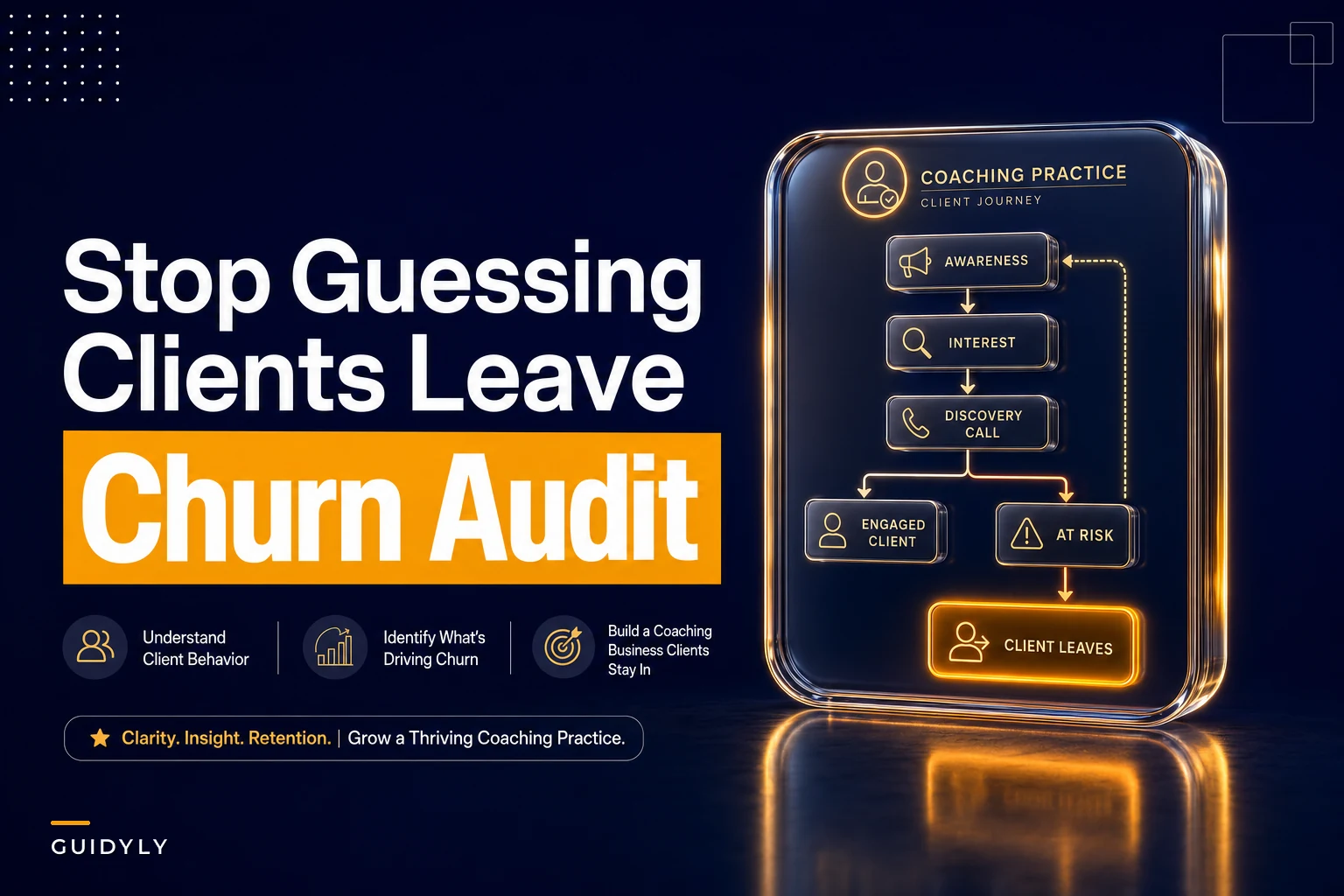

Most coaches treat client exits like mystery novels — they know someone left but never quite figure out why. You get the polite email about "changing priorities" or "budget constraints," nod sadly, then move on to the next prospect. Meanwhile, the same operational cracks that lost that client are still there, waiting to claim the next one.
Running a churn audit for coaches isn't about sending satisfaction surveys or having awkward exit interviews where clients tell you what they think you want to hear. It's about building a systematic process to uncover the real reasons clients leave, categorize those reasons into fixable patterns, and create operational changes that actually stick.
The five-category churn matrix that captures most exits
Across dozens of coaching practices, the same patterns show up. Clients rarely leave for one reason — it's usually a combination of things that build up quietly over time. But those factors almost always fall into five categories you can actually do something about.
Expectations misalignment happens when what clients thought they were buying doesn't match what they experience. Maybe they expected weekly accountability texts but you only send monthly check-ins. Or they thought sessions would be tactical workshopping but you're focused on mindset work. The disconnect starts during sales conversations and compounds with every session that follows.
Outcomes disappointment is trickier because sometimes the client's goals were unrealistic from day one. A business coach whose client expected to triple revenue in 60 days. A career coach whose client wanted a CEO role despite having two years of experience. But often it's really about progress visibility — clients are actually improving but can't see it because nobody's tracking the right metrics or pausing to celebrate small wins.
Logistics friction kills more coaching relationships than most coaches want to admit. The client who churns after three rescheduled sessions. The executive who drops because your only availability falls during their busiest hours. The startup founder who can't access session recordings because your tech stack doesn't support it. Death by a thousand scheduling cuts.
Billing surprises extend beyond just the dollar amount. It's the coach who charges for a "quick call" between sessions. The unexpected invoice for email support. The auto-renewal that hits when the client thought they were month-to-month. Even when those charges are technically justified, they erode trust fast.
Fit erosion is what happens when the right client at signup becomes the wrong client six months later. Their business scales and now they need strategic advisory, not tactical coaching. Their life situation shifts and intensive sessions become overwhelming. The chemistry that worked initially fades as they evolve. This isn't failure — it's natural evolution that good coaches try to get ahead of.
Across dozens of coaching practices, the same patterns show up. Clients rarely leave for one reason — it's usually a combination of things that build up quietly over time. But those factors almost always fall into five categories you can actually do something about.
Building your exit interview framework without making it weird
The hardest part about exit interviews is that clients don't want to hurt your feelings. They'll give you surface-level feedback that sounds helpful but misses the real issues. You need a framework that gets past politeness without feeling like an interrogation.
Never miss a session or detail again.
Guidyly helps you book, manage, and track every coaching session efficiently.
- Centralized session scheduling
- Automated client reminders
- Progress tracking & notes
No credit card required
Start with timing. Send this message within 24 hours of cancellation: "I completely understand your decision and want to make the transition smooth. Would you be open to a 20-minute call next week to help me understand what worked and what didn't? Your honest feedback would genuinely help me improve the experience for future clients."
Around 60% will say yes if you ask within that first day. Wait a week and that drops to roughly 20%.
Your interview guide needs to balance structure with actual conversation. Open with acknowledgment: "Thanks for taking time for this. I know ending a coaching relationship can feel a bit awkward, but your insights are genuinely valuable. There are no wrong answers — I'm just curious about your experience."
-
When did you first start thinking about ending our work together?
-
Was there a specific moment, or did things accumulate over time?
-
Did you talk through this decision with anyone else before deciding?
Value perception questions:
-
What originally made you excited to work together?
-
Which parts of our work actually met those expectations?
-
Where did reality differ from what you were expecting?
Friction points questions:
-
What parts of our process felt harder than they should have?
-
Were there moments you almost reached out but held back?
-
If you could change three things about how we worked together, what would they be?
Alternative evaluation questions:
-
Are you planning to work with another coach?
-
What will you look for differently next time?
-
What would have needed to change for you to stay?
Referral likelihood questions:
-
Would you refer someone in a different situation to me?
-
Who do you think would be a perfect client for my style?
-
What would you tell a friend who was considering working with me?
The real value comes from follow-up probes. When they say "scheduling was tough," dig deeper: "Can you walk me through the last time you tried to book a session?" When they mention "not seeing progress," ask: "How were you measuring progress in your own mind?"
Record these calls (with permission) or take detailed notes. You're listening for exact phrases, specific moments, and emotional language that reveals where the real friction lives.
The data audit checklist that tells the truth numbers won't admit
Exit interviews give you stories, but data gives you patterns. Most coaches already have this data sitting across different systems — they just never connect the dots. Here's what you need to pull together for each churned client from the past 12 months.
Engagement metrics:
-
Total sessions scheduled vs. attended
-
Average days between sessions
-
Homework completion rate
-
Communication frequency between sessions
-
Portal login frequency (if you track it)
Financial patterns:
-
Original package purchased
-
Payment history and any late payments
-
Refund or credit requests
-
Price objections during renewal discussions
-
Total lifetime value
Journey milestones:
-
Time from signup to first session
-
Number of rescheduled sessions
-
Program progress checkpoints hit or missed
-
Recorded wins or breakthroughs
-
Support tickets or complaint emails
Relationship indicators:
-
Referrals given (or not given)
-
Testimonial provided (or declined)
-
Social media engagement with your content
-
Response time to your messages
-
Session energy (if you track it)
Build this into a simple spreadsheet where each row is a churned client and columns capture these data points. You're looking for patterns like: clients who reschedule their second session have significantly higher churn, or clients who don't complete week one homework rarely make it past month two.
The uncomfortable truth is that most churn signals appear weeks or months before the actual cancellation. That client who stopped turning on their camera during Zoom sessions. The executive who went from same-day email responses to three-day delays. The founder who stopped sharing wins in your Slack channel. These behavioral shifts predict churn better than any satisfaction score.
Creating your categorization system that actually drives action
Raw exit interview transcripts and spreadsheet data don't fix anything on their own. You need a categorization system that turns those insights into operational changes.
Take every churn reason and map it to one of the five categories, then rate its fixability and business impact.
Here's how that looks in practice. Take "I wasn't seeing enough progress" — a classic exit reason. First, figure out the real category. Is this Expectations (they expected faster results than you promised)? Outcomes (your program genuinely wasn't delivering)? Or Fit (they needed something you don't offer)?
| Fixability | Definition |
|---|---|
| Immediate fix: | Can be solved with a process change this week |
| Systematic fix: | Requires new systems or tools to solve |
| Structural fix: | Needs program redesign or business model changes |
| Cannot fix: | Outside your control or would compromise your core value |
Finally, calculate impact by multiplying frequency by revenue loss. If "scheduling conflicts" caused 5 churns last quarter at $2,000 lifetime value each, that's a $10,000 problem. If "wrong fit from day one" caused 2 churns at $8,000 each, that's a $16,000 problem. Work on the expensive problems first.
Your categorization might surface some uncomfortable truths. Maybe 40% of your churn is "cannot fix" because you're attracting the wrong clients through your marketing. Or maybe 60% falls into the "immediate fix" bucket — simple operational improvements you've just been too busy to make.
The remediation map that connects problems to actual workflows
Identifying churn causes without fixing them is just expensive research. You need a remediation map that connects each churn category to specific operational changes you can actually make.
For expectations misalignment, the fix usually starts in sales and onboarding. Create a "working with me" document that explicitly outlines session structure, between-session support, communication style, and expected time commitments. During sales calls, use language like "Some coaches do X, but I specifically do Y because..." to set clear boundaries early. Build a day-7 check-in where you ask directly: "Is this matching what you expected?"
Outcomes disappointment requires better progress tracking and more deliberate celebration. Set up monthly milestone reviews where you show clients progress across multiple metrics, not just their primary goal. Create a wins tracker where clients log small victories between sessions. Send a "progress report" email every 30 days showing movement across different dimensions — confidence scores, action items completed, insights gained, habits built.
Logistics friction demands operational flexibility you might resist. Offer at least one early morning and one evening slot per week, even if it's not your preference. Set up session recording so clients who miss can catch up. Create an "emergency reschedule" option that lets clients move sessions with a couple hours notice a few times per quarter. Yes, it's inconvenient for you. But it's less inconvenient than losing a $5,000 client.
Billing surprises connect directly to your pricing structure. Move away from hourly billing toward package pricing. Include a "what's included and what's not" section in every contract. Send payment reminders five days before processing. Create a "pause option" for clients who need a break but aren't ready to fully exit. The operational overhead of managing pauses is worth the retained relationships.
Fit erosion requires proactive graduation paths. Create an alumni program for clients who've outgrown 1-on-1 coaching but still want connection. Build partnerships with coaches who serve adjacent niches for warm handoffs. Add a relationship review at the six-month mark where you explicitly discuss whether the fit is still right. Sometimes the best retention strategy is helping clients leave gracefully before they leave frustrated.
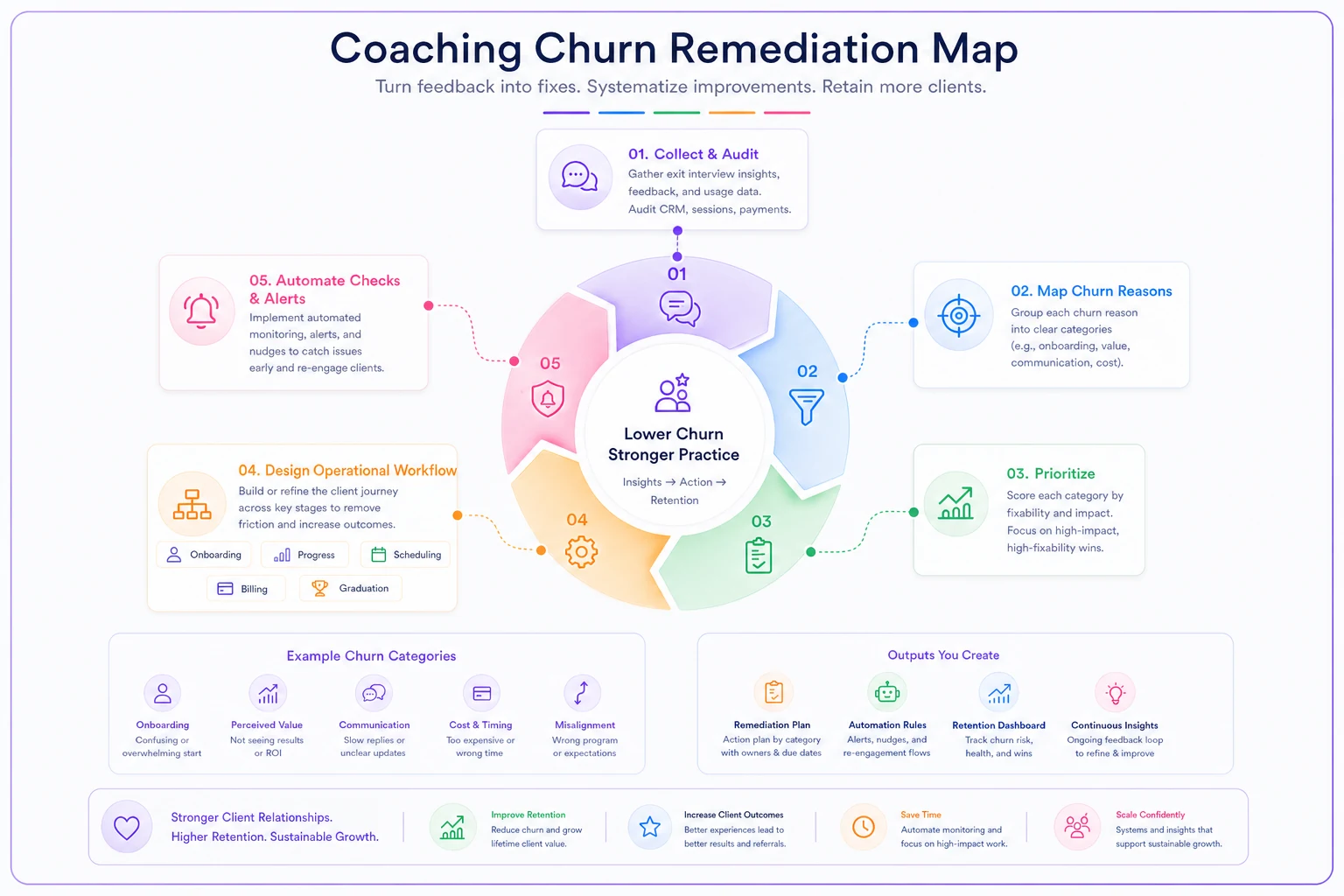
This visual helps your team see how a problem becomes a workflow so fixes actually get implemented.
Identifying churn causes without fixing them is just expensive research. You need a remediation map that connects each churn category to specific operational changes you can actually make.
The monthly audit rhythm that catches problems before they become exits
Running a churn audit once a year is like checking your tire pressure after you already have a flat. You need a monthly rhythm that catches early warning signals while you can still intervene.
Every month, pull three data points:
-
Clients who've rescheduled twice or more
-
Clients who haven't logged into your portal or platform in two or more weeks
-
Clients whose session attendance dropped below 80%
These are your at-risk clients. Don't wait for them to cancel. Reach out with something simple: "I noticed our rhythm has been a bit off lately. Everything okay on your end? Would it help to adjust our approach?"
Run the three data point pull on the first business day of each month so flags don't pile up unnoticed.
About half will mention friction points you can immediately address. The other half might be too polite to complain but will appreciate you noticing.
Also track positive signals monthly:
-
Clients who referred someone
-
Clients who completed all homework
-
Clients who shared wins publicly
-
Clients who renewed or upgraded
These thriving clients are your template for what's working. Study their journey, document what's different about their experience, and systematize those elements for everyone else.
The most effective coaches also run quarterly "stay interviews" with their best clients. Ask what's keeping them engaged, what they'd miss most if they left, and what one thing would make the experience even better. This data is just as valuable as exit interviews — and a lot less depressing to collect.
Building your operational fixes into repeatable systems
The gap between knowing why clients churn and actually preventing it usually comes down to systems. You identify that clients leave due to unclear expectations, create a better onboarding process, use it twice, then drift back to old habits when things get busy.
The fix is building improvements into your operational platform where they happen automatically. Your expectations-setting document becomes a template that sends to every new client without you thinking about it. Your progress tracking becomes a dashboard that updates after each session. Your at-risk client identification runs through automated reports instead of manual checking.
This is where AI-powered operational software starts to matter for coaches — not because you need fancy technology, but because human discipline fails when you're juggling 15 clients, marketing, admin, and trying to have a life. The patterns you identify in your churn audit become rules in your system. Client misses two sessions? Automatic check-in goes out. Client hasn't logged homework in 10 days? You get an alert to review their engagement. Payment fails? A soft dunning sequence starts immediately.
The best coaches centralize their churn intelligence into their daily operations. Every exit interview insight becomes a process improvement. Every categorized churn reason gets a corresponding workflow fix. Every monthly audit finding triggers an operational adjustment. Without that systematic approach, you're just collecting interesting data about why your business is quietly leaking revenue.
The uncomfortable math of fixing churn versus finding new clients
Most coaches don't do this math: reducing churn by just 10% often has the same impact as increasing new client acquisition by 25-30%. If you have 20 clients averaging $3,000 in lifetime value and you lose 5 per quarter, that's $60,000 in annual churned revenue. Cut that to 4 losses per quarter and you've recovered $12,000 — probably more than whatever you'd make from the new marketing campaign you're planning.
The real leverage comes from stacking improvements. Better expectations-setting reduces early churn. Clearer progress tracking reduces mid-program exits. Flexible logistics reduces friction-based departures. Put those together and suddenly your average client stays eight months instead of five. At $500 per month, that's an extra $1,500 per client in lifetime value.
But the biggest impact isn't financial — it's operational. Lower churn means less time on sales, less time onboarding replacement clients, less time rebuilding momentum from scratch. More time goes toward actually coaching, refining your methodology, and building things that scale.
The churn audit template isn't just about understanding why clients leave. It's about building a system that makes leaving less likely, less frequent, and less surprising when it does happen. Every coach loses clients. The ones who grow are the ones who know exactly why, have categorized the reasons honestly, and built fixes into their operations that hold even when things get hectic.
The patterns are predictable. The categories are consistent. The fixes are usually simpler than expected. What's missing is the discipline to audit regularly, categorize honestly, and implement changes that stick.
Start with last quarter's exits. Run the interviews. Pull the data. Build the categorization. Create one operational fix for your biggest churn category. Then next month, add another. Within six months, those polite goodbye emails stop feeling like mysteries and start feeling like manageable operational problems with clear solutions.
Your clients aren't leaving because they don't like you. They're leaving because something in your operational system created more friction than value. Find that friction, fix it systematically, and watch retention improve while your stress levels actually drop.
Your clients aren't leaving because they don't like you. They're leaving because something in your operational system created more friction than value. Find that friction, fix it systematically, and watch retention improve while your stress levels actually drop.
Ready to elevate your coaching business?
Join hundreds of coaches using Guidyly to save time, enhance client engagement, and grow their practice.