

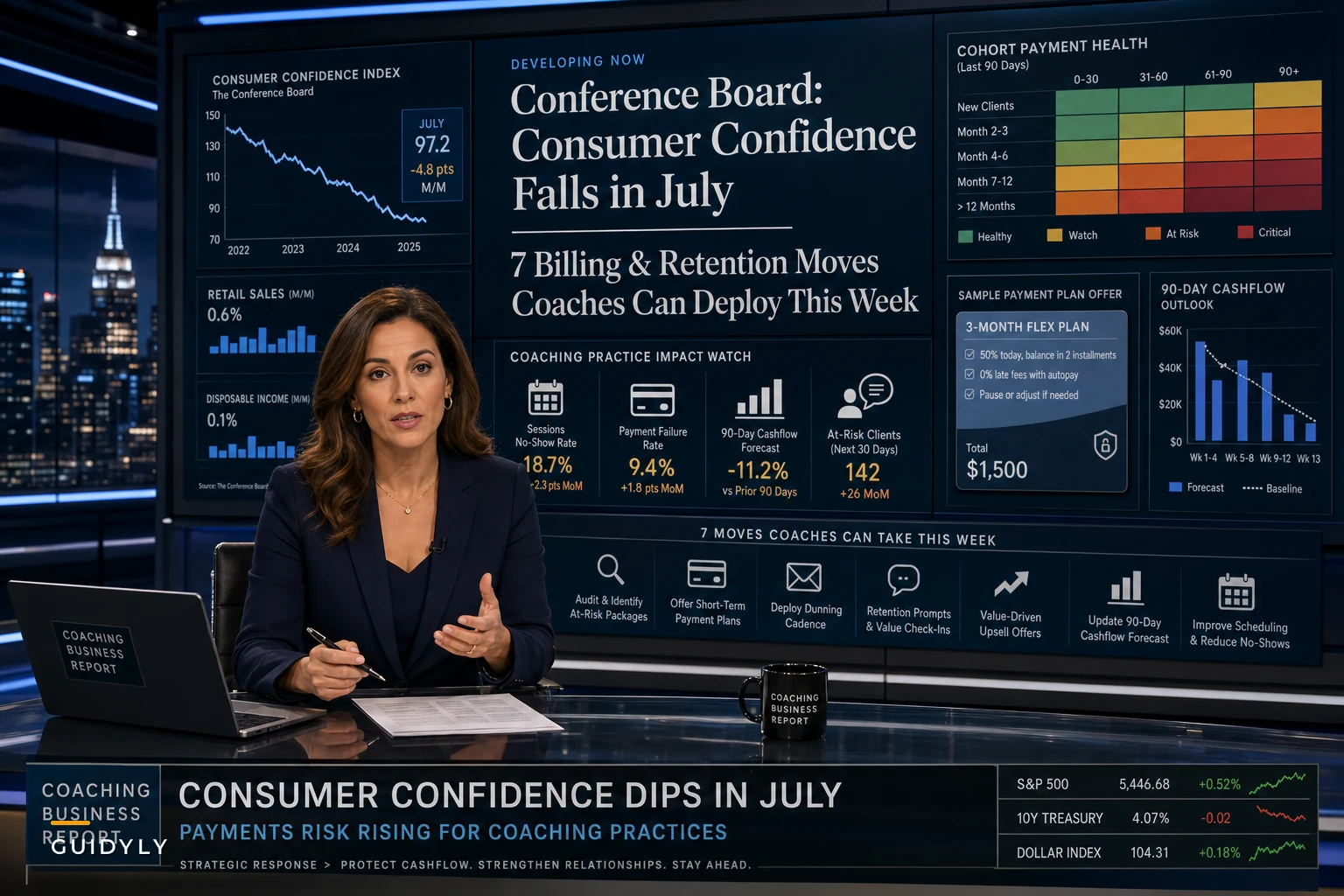

The Consumer Confidence Index dropped to 90.8 in July, and for coaches and consultants, that's not just an economic headline to scroll past. It's an operational warning with a pretty direct line to your revenue over the next few months.
When consumer confidence slides, discretionary spending gets cut first. Coaching sits squarely in that category for most clients. The pattern is predictable: prospects hesitate longer before signing, existing clients scrutinize renewal decisions more carefully, and payment failures tick up as people juggle tighter budgets.
What most coaches miss is that the revenue impact starts showing up in small operational cracks weeks before it hits your monthly P&L. A credit card decline here. A client asking to pause there. A prospect going quiet after seeming ready to sign. These aren't random events during a confidence drop—they're early signals that your coaching payments strategy needs adjustment now, not after you've already felt the damage.
The Hidden Cash Flow Squeeze Most Coaches Don't See Coming
Payment operations in coaching practices run on patterns. You know roughly when clients pay, which cards tend to fail, how many follow-ups it usually takes to collect something overdue. These patterns become invisible assumptions—until confidence shifts and breaks them all at once.
The damage tends to come in three waves. First, your new client pipeline slows as prospects delay decisions. Then your existing clients start showing payment stress—more declines, more payment plan requests, more "can we push this to next month" conversations. Then accounts receivable starts ballooning because collection gets harder across the board.
Most coaching practices are running on somewhere between 45 and 60 days of cash runway. When all three waves hit at the same time, that buffer disappears fast. One practice I looked at last year went from comfortable cash flow to genuinely scrambling in about seven weeks when a similar confidence drop hit their market. They had no payment strategy adjustments ready. Nothing to pull.
The painful part is your fixed costs don't care. Rent, software, insurance—none of that adjusts when clients start missing payments. That asymmetry is what actually crushes small practices that haven't built any defensive payment operations.
Move 1: Implement Graduated Payment Recovery Sequences
Standard dunning emails don't hold up when confidence drops. The blunt "YOUR PAYMENT FAILED" message that worked fine six months ago now triggers cancellations instead of payment updates. You need sequences that acknowledge economic reality while still protecting your revenue.
Never miss a session or detail again.
Guidyly helps you book, manage, and track every coaching session efficiently.
- Centralized session scheduling
- Automated client reminders
- Progress tracking & notes
No credit card required
Start with a pre-decline strategy. Three days before any recurring charge, send a low-key reminder that includes your rescheduling link. Frame it as helping them avoid a service interruption, not chasing money. This simple pre-emptive message tends to reduce failed payments by around 15-20% based on patterns I've tracked across coaching platforms.
When payments do fail, your first touch should assume technical issues rather than financial ones. Something like: "Hey, looks like your bank flagged our charge—happens sometimes with recurring subscriptions. Here's a quick link to update your details when you get a chance." You're solving the problem without making the client feel exposed.
Your second attempt shifts tone slightly. Acknowledge that payment stuff is annoying and offer a brief grace period. "I know sorting this out is a hassle. Your coaching access continues for the next 72 hours while you update your information. If something bigger is going on, just reply and we'll figure it out."
Only on the third attempt do you introduce consequences, and even then, lead with empathy. "I haven't heard back about the payment update, so I'll need to pause your coaching access tomorrow at noon. If you're dealing with something unexpected, let me know—we have options."
Timing matters more than most people think. Day 1, Day 3, Day 5, then Day 7 works better than daily messages. You're trying to recover revenue without torching the relationship in the process.
Move 2: Create Financial Flexibility Options Before Clients Ask
Clients hate asking for financial accommodations. Most will ghost you before admitting they can't afford next month. When confidence drops, you need visible flexibility options that clients can select without an awkward conversation.
-
First, a pause option that keeps clients in your ecosystem without monthly charges. They might get monthly check-in emails and access to group resources—enough to maintain connection until they're ready to resume. This prevents permanent churn from what's often just temporary financial stress.
-
Second, a reduced-frequency option. If someone's doing weekly sessions at $800/month, offer twice-monthly at $450. You lose some revenue, but you keep the relationship and some cash flow. It's also a lot easier to scale back up from reduced frequency than to re-acquire a churned client from scratch.
-
Third, payment plans for packages. Instead of requiring $3,000 upfront for a three-month intensive, offer $1,100/month over three months. The small premium covers your added risk while making the program accessible during tighter times.
Display these options somewhere visible—your client portal, your payment communications, somewhere they don't have to dig for it. When clients can see flexibility is available, they're more likely to reach out before fully disconnecting. One practice I worked with saw voluntary pause requests increase significantly after they made these options visible, but their actual churn dropped around 40% because clients weren't permanently leaving anymore.
| Option | Description |
|---|---|
| Pause option | keeps clients in your ecosystem without monthly charges. They might get monthly check-in emails and access to group resources—enough to maintain connection until they're ready to resume. |
| Reduced-frequency option | If someone's doing weekly sessions at $800/month, offer twice-monthly at $450. You lose some revenue, but you keep the relationship and some cash flow. |
| Payment plans for packages | Instead of requiring $3,000 upfront for a three-month intensive, offer $1,100/month over three months. The small premium covers your added risk while making the program accessible during tighter times. |
When clients can see flexibility is available, they're more likely to reach out before fully disconnecting.
Move 3: Shift to Value Demonstration Billing Cycles
Monthly billing makes sense in stable conditions. When confidence drops, it turns into a monthly decision point where clients reconsider the expense. Every billing cycle becomes a potential exit.
Consider shifting stable clients to quarterly or semi-annual billing with a real incentive attached. Something like 5-8% off for quarterly, 10-15% for semi-annual. This locks in revenue before conditions potentially worsen and removes multiple decision windows.
The operational piece that matters here: you need to demonstrate value accumulation within those longer cycles. If someone pays quarterly, send a 6-week progress summary that reminds them why they made the investment. Not a generic newsletter—actual documentation of their progress.
Package billing cycles with clear deliverable milestones. "This quarter includes 12 sessions, 2 progress assessments, quarterly goal planning, and unlimited email support." When clients see the full scope spelled out, the value proposition holds up better during uncertainty.
For new clients still testing the relationship, keep monthly options—but position them as starter rates. Frame quarterly billing as the standard professional engagement. That framing subtly encourages commitment without pressure.
Move 4: Restructure Package Offerings for Psychological Safety
During confidence drops, clients need to feel like they're making a smart, protected investment. The packaging should reduce perceived risk without gutting your revenue per client.
Shift toward achievement-based packages instead of time-based ones. Rather than "3 months of coaching for $3,000," position it as "Launch Your Side Business Package—typically 10 to 14 weeks, $3,000." The outcome focus makes it feel like an investment rather than a recurring expense, and the flexible timeframe reduces pressure.
Add completion guarantees where it's operationally feasible. "If you attend 90% of sessions and complete your assignments but don't hit the specified outcome, we'll continue working together at no additional cost for up to four extra sessions." Engaged clients almost always hit their milestones anyway, so the actual risk is lower than it sounds.
Starter packages that convert to full programs are worth building out. A $497 two-session assessment with a detailed action plan, crediting toward a full program if they continue within 30 days, captures hesitant prospects while creating momentum toward higher-value work.
Your packaging should also acknowledge the current environment without being heavy-handed about it. "Resilience Coaching Package" or "Uncertainty Navigation Program" speaks to the moment without feeling opportunistic.
Move 5: Accelerate Collection Cycles Without Being Aggressive
The longer an invoice sits unpaid, the less likely you'll collect it—and that probability drops faster during confidence declines. But aggressive collection kills relationships that might recover once conditions stabilize.
The approach that works is frequent, low-pressure touches that keep payment top-of-mind without making anyone feel hunted. Instead of waiting 30 days to follow up on an overdue invoice, check in after 5 days: "Quick heads up—looks like last week's invoice might have gotten buried. Here's the link again for whenever you get a chance."
Use multiple channels but vary the message. Email the invoice, text a friendly reminder, leave a voicemail for anything significantly overdue. Each touch should feel like you're helping them stay organized, not escalating.
For overdue accounts, immediate payment incentives can move things along. "If you can clear this invoice by Friday, I'll credit $50 toward next month's sessions." The small discount costs less than the probability-adjusted uncertainty of not collecting at all, and it creates urgency without confrontation.
One thing worth keeping separate: payment conversations and coaching conversations. Don't spend session time discussing overdue bills—handle that operationally through your billing recovery sequences. Sessions should focus entirely on value delivery, which ironically makes clients more likely to prioritize paying you.
Move 6: Build Payment Intelligence Into Your Operations
Most coaches track backward-looking metrics—last month's revenue, past due accounts, churn rate. During confidence drops, you need to see what's coming, not what already happened.
Track payment velocity: how quickly clients pay after invoicing. When that average stretches from 3 days to 5, then to 7, you're seeing early stress signals. In one platform I analyzed, payment velocity extending by 2-3 days preceded actual payment failures by roughly three weeks. That's a useful lead time if you're watching for it.
Monitor payment method changes. Multiple clients switching from credit cards to debit cards, or from premium cards to basic ones, often signals financial pressure 30-45 days before actual payment problems surface.
Create cohort payment health scores. Group clients by start date and track their collective payment behavior. When entire cohorts show stress, you know it's environmental rather than individual. That distinction matters for how you respond.
Watch for partial payment requests too. When clients start asking to pay half now and half in two weeks, they're actively managing cash flow. These requests tend to spike before broader payment failures hit your practice. Accommodating them proactively is almost always better than scrambling reactively.
AI automation in modern billing platforms makes this kind of intelligence gathering much more manageable. Instead of trying to track these patterns manually, the right system can flag payment anomalies automatically and prompt you to reach out before failures happen.
Here's a simple workflow diagram idea.
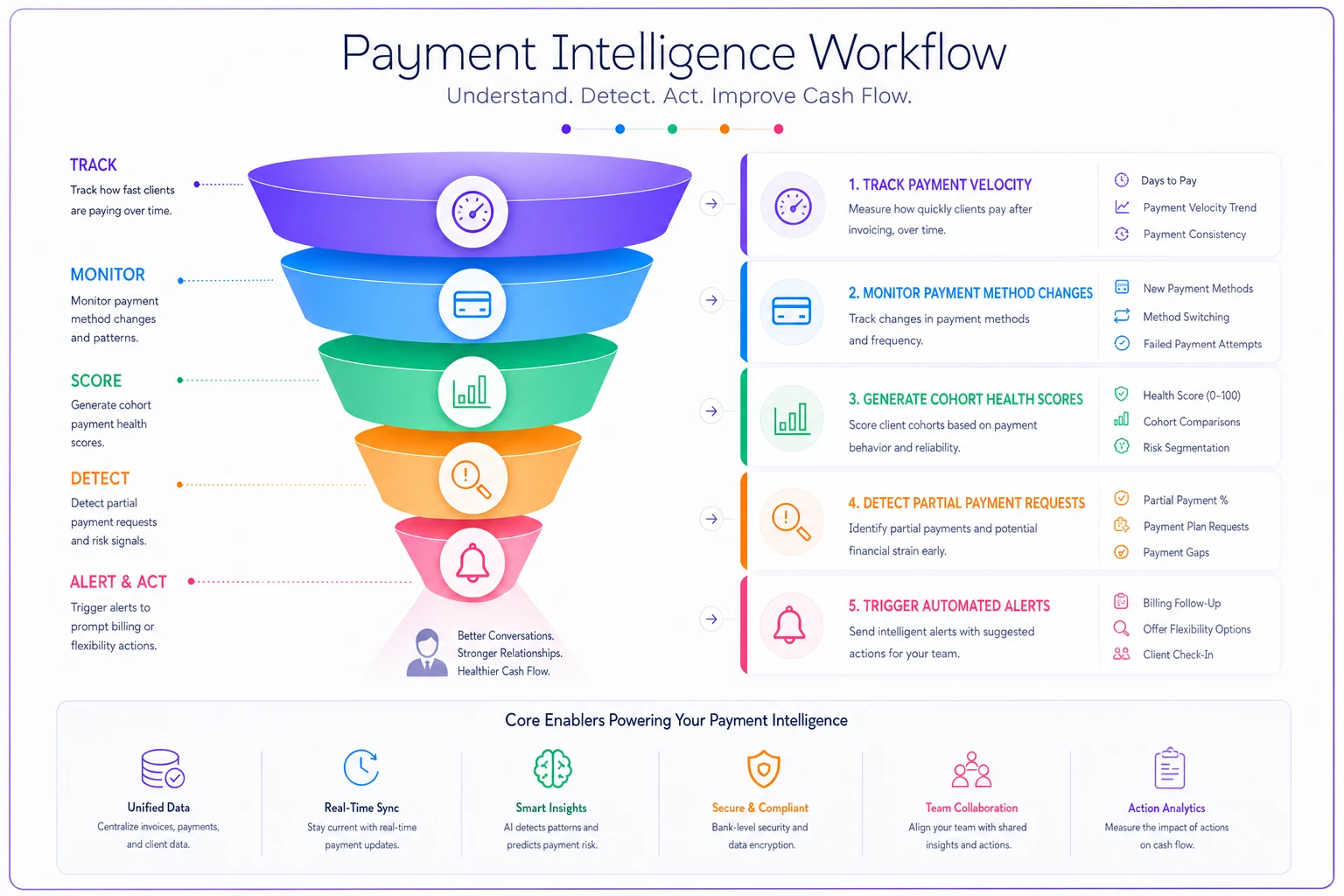
Watch payment velocity weekly—small shifts often precede bigger problems.
AI automation in modern billing platforms makes this kind of intelligence gathering much more manageable.
Move 7: Strengthen Retention Through Value Concentration
When clients feel economic pressure, they run every expense through a harsh ROI filter. Your coaching needs to deliver concentrated, undeniable value that survives that scrutiny.
Shift from broad coaching toward specific, measurable outcomes. Instead of "leadership development," focus on "reduce your weekly meeting time by 3 hours while improving team performance metrics." Specific promises with measurable results justify continued investment even when people are tightening up.
Add asynchronous value between sessions. Relevant articles, quick voice notes, brief written feedback on their progress—these cost you minutes but significantly increase perceived value. Clients who get two or three touches between sessions tend to show noticeably better retention during downturns.
Create documentation clients can reference. Progress trackers, achievement summaries, written notes on breakthroughs—tangible proof of advancement. When someone's deciding whether to continue, physical evidence of progress carries real weight.
Group components added to individual packages are worth considering too. A monthly group call for clients working on similar goals costs you one hour but adds meaningful perceived value. Peer interaction also creates community bonds that improve retention on their own, regardless of economic conditions.
The Compound Effect of Integrated Payment Strategy
These seven moves work significantly better together than piecemeal. Payment flexibility reduces the need for aggressive collection. Value concentration makes payment acceleration feel natural rather than transactional. Intelligence systems help you deploy flexibility before clients even have to ask for it.
The practices that hold up best during confidence drops aren't necessarily the ones with the biggest cash reserves. They're the ones with operational flexibility baked into their coaching payments strategy—systems that can bend without breaking because they were built to adapt to client stress rather than amplify it.
It's worth building a payment strategy playbook that documents exactly which levers you'd pull at different confidence levels. When the index drops below 95, maybe you activate soft payment reminders. Below 90, you turn on payment flexibility options. Below 85, you shift into value concentration mode. Having those triggers predetermined means you're not making emotional decisions when things get stressful.
Real Results From One Practice's Strategy Shift
A career coaching practice in Denver faced similar conditions about 18 months ago when local tech layoffs hit confidence hard in their market. They implemented five of these seven moves within three weeks of seeing the first payment stress signals.
Over the following quarter: new client acquisition dropped 22%, but revenue only fell 8%. Client retention improved from 73% to 81% despite the headwinds. They credited proactive payment flexibility and concentrated value delivery between sessions.
The most interesting finding—clients who actually used the payment flexibility options showed higher lifetime value once conditions improved. The pause option, which felt like revenue loss initially, created a pool of re-engagement opportunities that converted at nearly 60% over the following six months.
Taking Action Without Overreacting
Consumer confidence fluctuates. Overreacting to every dip destroys operational consistency and burns out your team. These moves should feel like operational evolution, not emergency pivots.
Start with the low-lift changes. Pre-payment reminders and soft acceleration can usually be running within days using existing tools. Payment flexibility options might take a week to structure and communicate properly. Full package restructuring should wait until you see sustained pressure, not just one bad month.
Most of these adjustments can be temporary if needed. Document what you implement and why—that makes reversal straightforward once conditions stabilize. Some changes, like payment intelligence and value concentration, will almost certainly improve your practice regardless of what the economy does.
The goal isn't to maximize revenue during a downturn. It's to maintain enough cash flow to stay operational while preserving the client relationships that will matter when things recover. Coaches who prioritize relationship preservation over short-term revenue extraction consistently come out ahead across economic cycles.
The Conference Board's Consumer Confidence measure publishes monthly updates you can track against your own payment metrics. When confidence rebounds above 100, you can gradually unwind the defensive measures while keeping the operational improvements that make your practice stronger regardless of conditions.
Your next step is straightforward: audit your current payment operations against these seven moves and identify which three you could realistically implement in the next two weeks. Even three of these in place puts you ahead of most coaching practices that won't react until the revenue impact becomes impossible to ignore.
Ready to elevate your coaching business?
Join hundreds of coaches using Guidyly to save time, enhance client engagement, and grow their practice.