


Most coaching practices discover their quality problem the same way: a client leaves, you pull the session notes to figure out why, and you realize the coach never actually followed the program. They improvised. Maybe it worked, maybe it didn't — but there was no way to know until the client was already gone.
The usual fix is some heavy QA process nobody sustains. Supervisors are supposed to review recordings, fill out a 14-item rubric, give written feedback, and track it all in a spreadsheet. For about three weeks it works. Then the supervisor has their own clients, the backlog builds, and QA quietly dies. What's left is a form in a shared drive that hasn't been touched since Q2.
The problem isn't that coaches don't care about quality. It's that the measurement system is too expensive to run. If scoring one session takes 25 minutes, and you have six coaches doing 20 sessions a week, nobody's doing the math — because the math is impossible.
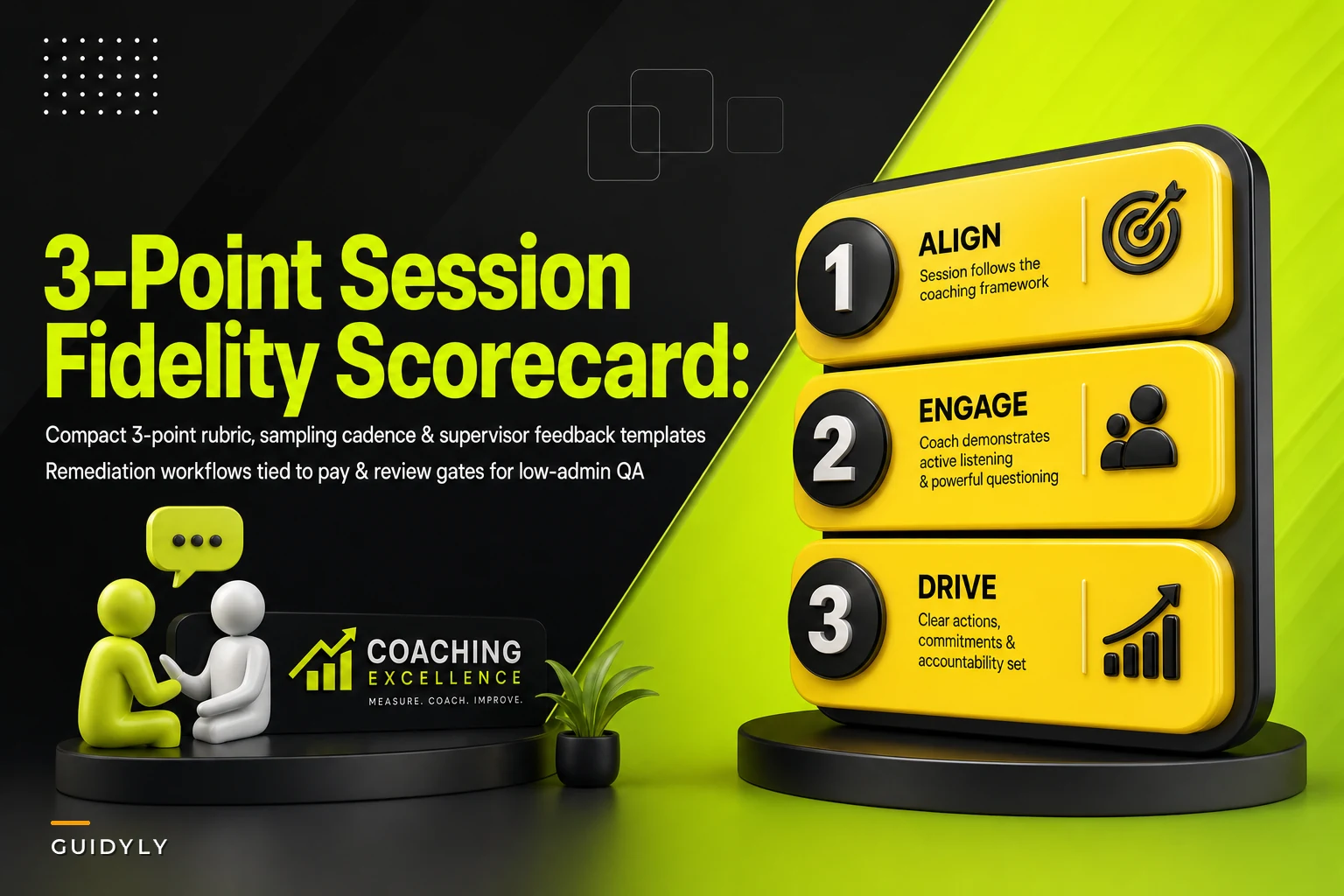
So this is a different approach. Three dimensions, scored fast, sampled smartly, tied to real feedback and a remediation path that actually connects to compensation. The whole point is session fidelity scoring coaching teams can sustain long-term, not a perfect academic instrument that collapses under its own weight.
Why fidelity drifts in the first place
Fidelity drift isn't dramatic. No coach wakes up and decides to abandon the method. It happens in small, reasonable-seeming steps.
A coach skips the check-in because the client "obviously wants to get to the problem." They drop the homework review because last session's assignment didn't get done and it feels awkward to dwell on it. They let a session run on venting because it feels supportive. Each decision is defensible in isolation. Stacked over 15 sessions, the coaching looks nothing like the program you sold.
In practice, this usually happens fastest with your best coaches. The strong ones have enough instinct to wing it and still produce decent sessions, so they stop leaning on the structure. Weaker coaches cling to the script because it's the only thing holding them up. This creates a weird inversion: your senior people drift most, and they're the ones nobody's reviewing because you "trust them."
The other driver is that nobody ever defined what fidelity means for your specific programs. "Follow the method" isn't measurable. If you can't name the three things a session must contain, your coaches are each inventing their own definition. Across a six-person team, that's six different programs wearing the same brand name.
The 3-point rubric (and why three is the ceiling, not the floor)
The temptation is always to measure everything. Resist it. The number of dimensions you score is directly proportional to how fast QA dies. Three is the sweet spot — enough to catch real drift, few enough to score in under five minutes.
Never miss a session or detail again.
Guidyly helps you book, manage, and track every coaching session efficiently.
- Centralized session scheduling
- Automated client reminders
- Progress tracking & notes
No credit card required
| Dimension | 0 — Missing | 1 — Partial | 2 — Solid |
|---|---|---|---|
| Structure fidelity | Session skipped core program elements (check-in, agenda, homework loop) | Hit some elements, but out of sequence or rushed | Followed the program arc as designed |
| Client-direction fidelity | Session drifted off-goal; no connection to the client's stated outcome | Partially on-goal, but wandered | Clearly advanced the client's committed outcome |
| Accountability fidelity | No homework set, no prior homework reviewed, no next step | One of those present but weak | Prior work reviewed + clear next commitment set |
These three dimensions cover the failure modes that actually cause churn. Structure keeps the program recognizable. Client-direction keeps sessions from becoming expensive venting. Accountability is the single biggest predictor of client progress, and it's consistently the first thing to vanish when drift sets in.
A perfect session scores 6. Anything at 5–6 is fine. A 3–4 is a yellow flag. A 0–2 needs a conversation. You don't need weighted averages or composite indexes — the raw number does the job.
One thing worth calling out: the 0/1/2 scale forces a decision. The classic mistake is a 1–5 or 1–10 scale, where reviewers cluster everything in the safe middle and scores stop meaning anything. With three options, "partial" is the only hedge available, and even that feels uncomfortable enough that people commit to a real judgment.
Sampling cadence: stop reviewing everything
The single biggest reason QA fails is the assumption that you review every session. You don't. You can't. And you don't need to.
-
New coaches (first 90 days) 3 sessions per week, reviewed. This is where habits set. It should be baked into onboarding the same way you'd handle SOPs and hiring scorecards for a multi-coach practice.
-
Established coaches 2 sessions per month, randomly selected. Random is the operative word. If a coach knows which session is being reviewed, you're measuring their best behavior, not their average.
-
Any coach with a recent yellow/red score bump to weekly until they string together three clean reviews, then drop back to baseline.
-
Any coach tied to a churned client auto-pull the last two sessions with that client. Not as punishment — as diagnosis.
For a six-coach team with five established and one new, that's roughly 10–14 reviews a month once the new hire ramps down. At five minutes each, that's under 90 minutes of supervisor time monthly. That number is the whole game. If your QA load doesn't fit inside a coffee break, it won't survive contact with a busy week.
Use a spreadsheet RAND() column to pick sessions.
The random selection matters more than people expect. A common pattern: a practice reviews "the Tuesday 2pm session" every week, coaches figure it out within a month, and Tuesday 2pm becomes the most textbook-perfect session of the week while everything else drifts freely. Pull sessions by random draw, not by schedule.
Supervisor feedback templates (because blank boxes kill feedback)
The reason supervisors skip feedback isn't laziness — it's the blank text box. Staring at an empty "comments" field after a long day is enough friction to make anyone write "good session, keep it up" and move on. Useless feedback.
Green (5–6): > "Strong session. You handled [specific moment] well. One thing to push further next time: [one stretch suggestion]."
Yellow (3–4): > "Solid in [dimension that scored 2], but [dimension that scored 0–1] slipped. Specifically, [one concrete observation]. For next session, try [one concrete action]."
Red (0–2): > "This session drifted from the program on [dimensions]. The biggest gap was [specific]. Let's talk this week — I want to understand what was happening, then we'll map a fix together."
These templates force one specific observation and one concrete next action. Feedback that lists five things gets ignored; nobody changes five behaviors at once. Capping the ask at one change per review is the only amount that actually sticks.
Also notice the red template doesn't deliver a verdict — it opens a conversation. A red score should never land as a surprise written judgment. That's how you get defensive coaches and quiet resentment. The written note schedules the conversation; the real feedback happens live.
Remediation workflow, and where compensation actually enters
Most practices either do nothing with bad scores or overreact. A bad score sits in a drawer, or it instantly becomes a performance-review bomb. Neither works. You need a graduated path.
-
One red or two consecutive yellows triggers a remediation conversation — not a warning, a working session. Supervisor and coach watch a clip together, name the gap, pick one behavior to fix.
-
A 30-day focus window opens. Sampling goes weekly. The coach knows exactly which dimension they're being watched on.
-
Three consecutive clean reviews closes the window. Done. No permanent record, no lingering cloud.
-
Failure to improve across the window escalates — and this is the only point where compensation enters the picture.
The compensation link has to be handled carefully or it poisons the whole system. If every score directly moves someone's pay, coaches start gaming reviews and hiding hard clients. What works is tying compensation to the remediation outcome, not individual scores. A coach who dips and recovers loses nothing. A coach who can't sustain fidelity after a full support window has a comp conversation — because at that point it's a capability or fit issue, not a bad week.
This is the same trap the broader comp design conversation runs into. If you reward the number instead of the behavior behind it, people optimize the number. If you're working out how pay connects to performance, it's worth reading through how to avoid perverse pay incentives in a coaching comp system before you wire scores to dollars — the failure modes there apply directly to fidelity scoring too.
A simple remediation workflow visualization.
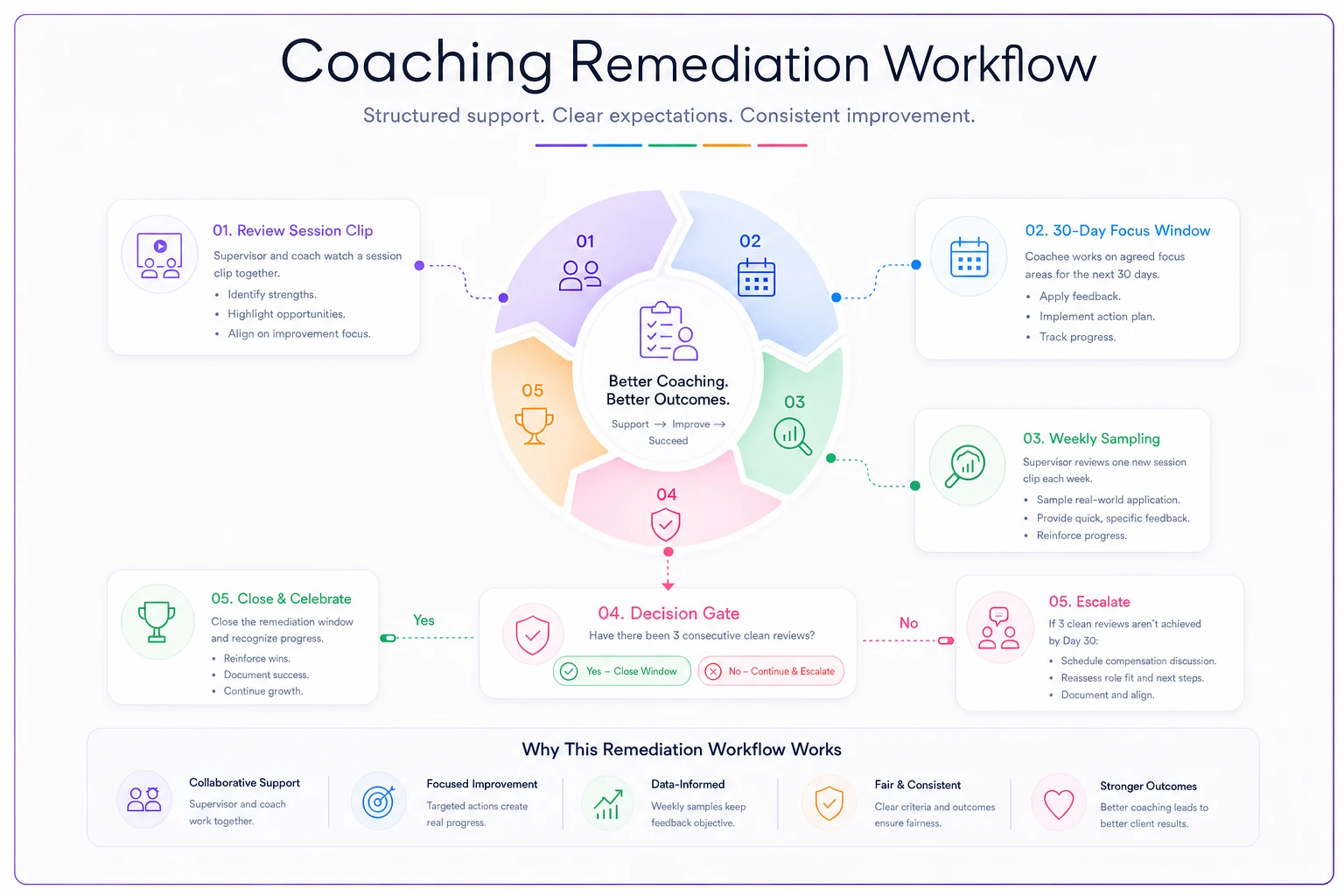
The checkpoint model keeps it clean: scores inform coaching and development continuously, but only cross into compensation at defined gates after support has been offered and documented. Coaches can see exactly where the line is, which removes the anxiety that makes people hide problems.
A quick checklist before you launch this
Before rolling this out, make sure you've got:
-
[ ] Three dimensions defined in your own program language, not generic ones
-
[ ] A 0/1/2 anchor description for each dimension, written down and shared with coaches
-
[ ] A random session-selection method (even a spreadsheet RAND column works)
-
[ ] Feedback templates for green/yellow/red saved somewhere one click away
-
[ ] A remediation path with explicit entry and exit criteria
-
[ ] A clearly communicated line between scoring and compensation
-
[ ] Buy-in from coaches before the first review — ambush QA breeds resentment
That last point gets skipped constantly. Walk the team through the rubric, score a couple of practice sessions together, let them push back on the anchors. A rubric coaches helped shape gets taken seriously. One that appears out of nowhere in a Monday email gets treated as surveillance.
A real scenario
A four-coach leadership-coaching practice was losing clients around the eight-week mark and couldn't pin down why. Session notes looked fine. NPS was okay. But renewals sat around 55%, and the founder suspected the coaching itself was inconsistent across the team.
They rolled out a three-dimension scorecard — structure, client-direction, accountability — and started sampling two random sessions per coach per month. The first round was ugly in a useful way. Two coaches averaged around 5.5. One hovered at 4. One senior coach, the one everyone assumed was the strongest, came in at a 3 average because he'd quietly stopped setting homework entirely. He was a great conversationalist and a terrible accountability partner, and nobody had caught it because his clients loved the sessions right up until they stopped progressing.
The remediation window took about six weeks. He didn't need a new skill — he needed to reinstate one habit he'd dropped. Once accountability fidelity came back, his clients started showing measurable progress between sessions again.
Across two quarters, renewals moved from the mid-50s to roughly 70%. The founder spent maybe 90 minutes a month on QA. The bigger win wasn't the number — it was that fidelity stopped being a mystery. When a client churns now, the review history shows whether it was a coaching gap or something else entirely, and that answer comes in minutes instead of guesswork.
When this makes sense — and when it doesn't
This system is built for practices with more than one coach, or a solo coach planning to hire. If you're a solo practitioner with no team, a formal fidelity scorecard is overkill — you're better off with a simple self-review habit and none of the supervisor machinery.
It's also a bad fit if your method is genuinely improvisational by design. Some therapeutic and deep-work coaching styles intentionally resist structure. Forcing a fidelity rubric onto a practice that doesn't have a defined program arc just measures conformity to something that doesn't exist. Define the program first. Score fidelity second.
And it shouldn't be the first thing a brand-new practice builds. If you're still figuring out what your program even is, you have nothing to measure fidelity against. Get the delivery model stable, then add QA on top of it.
The core idea is small and stubborn: quality drifts invisibly, and the only thing that catches it is a measurement light enough to actually run every week. Three points, a random sample, a one-change feedback note, and a remediation path that treats pay as a last gate rather than a first stick. Keep it that lean and it'll still be running next year — which is more than most QA systems can claim.
Ready to elevate your coaching business?
Join hundreds of coaches using Guidyly to save time, enhance client engagement, and grow their practice.