



Most compensation problems in coaching practices don't start with greed or laziness. They start with a spreadsheet that seemed reasonable at the time. You pay per session, per new client, or on a flat salary, and for a while it works. Then the practice grows, you hire a second and third coach, and slowly the numbers start telling a story you didn't intend.
Coaches start front-loading sessions. Or avoiding difficult clients. Or quietly extending engagements that should have graduated months ago. Nobody's being dishonest — they're just responding to how they get paid. That's the core problem with coach compensation and performance metrics: pay design is behavior design, whether you meant it to be or not.
This piece is about building a compensation system that holds up as you scale — one that ties pay to verified outcomes, retention, and quality, without creating incentives that quietly damage the practice. I'll walk through pay bands, calculation examples, adjustment rules, and the governance you need so the system doesn't get gamed.
The core tension nobody wants to say out loud
Every compensation model is trying to balance three things that pull against each other:
-
Volume — how much work gets done
-
Retention — whether clients stay and renew
-
Quality — whether clients actually get results
The trouble is that optimizing any single one usually damages the other two. Pay purely on volume and you get burned-out coaches rushing through sessions. Pay purely on retention and you incentivize keeping clients dependent instead of graduating them. Pay purely on outcomes and you push coaches toward cherry-picking easy clients while avoiding the messy, high-need ones.
What tends to happen in small practices is that owners pick one metric because it's easy to measure, then act surprised when the other two degrade. A typical example: a practice moves to per-new-client bonuses to grow revenue, hits enrollment targets, and six months later realizes churn climbed because coaches were rewarded for landing clients, not keeping them.
A balanced scorecard exists specifically to stop any one metric from dominating. It doesn't remove the tension — it manages it.
Why single-metric pay breaks at scale
When you're a solo coach, none of this matters much. You feel the whole business. If a client churns, you know why. If someone isn't progressing, you adjust. Your incentives are automatically aligned because you are the practice.
Never miss a session or detail again.
Guidyly helps you book, manage, and track every coaching session efficiently.
- Centralized session scheduling
- Automated client reminders
- Progress tracking & notes
No credit card required
The moment you add coaches, that alignment disappears. There's now a gap between what's good for the practice and what's good for the individual coach's paycheck. That gap is where perverse incentives live.
-
At 2 coaches informal, everyone knows each other, problems get caught in conversation.
-
At 4–5 coaches you can no longer see everyone's caseload. Someone's retention is quietly bad and you don't notice for a quarter.
-
At 6+ coaches compensation formulas start driving real money, and coaches optimize hard for whatever the formula rewards. Small design flaws become expensive.
The mistake owners make is designing pay for the practice they have — small, visible, trust-based — instead of the practice they're building toward. By the time the cracks show, you've already trained your team to behave in ways that are hard to undo.
If you haven't stood up a reliable measurement layer yet, that's the prerequisite here. You can't pay on metrics you can't trust. Worth reading through how to operationalize your coaching KPI dashboard before you attach money to any of these numbers.
The balanced scorecard: four weighted pillars
The version that holds up best in small practices uses four pillars with fixed weights. The weights matter more than the exact metrics, because they're what prevent any single behavior from taking over.
| Pillar | Weight | Example metric | What it protects against |
|---|---|---|---|
| Verified outcomes | 35% | % of clients hitting agreed goals | Coasting, activity-without-progress |
| Retention & renewal | 25% | Renewal rate, avg. engagement length vs. plan | Churn, premature drop-off |
| Quality & fidelity | 25% | Note completeness, plan adherence, client CSAT | Rushed sessions, cutting corners |
| Volume / capacity | 15% | Sessions delivered vs. target caseload | Underutilization |
Notice volume is the smallest weight, not the largest. That's deliberate. In most practices that struggle with quality, volume was overweighted — usually because it's the easiest thing to count. Counting sessions is trivial; verifying outcomes takes real work. So people measure what's easy, pay on it, and the practice drifts toward throughput.
A few notes on why each pillar is shaped this way:
Verified outcomes must be verified, not self-reported by the coach. If a coach both delivers the coaching and grades whether it worked, you've built a conflict of interest into the highest-weighted pillar. Outcomes need to be tied to client-confirmed milestones or objective measures agreed at the start of the engagement.
Retention is intentionally capped at 25% and paired with an adjustment rule (more on that below) so coaches aren't rewarded for keeping clients longer than the client needs. Retention should reward appropriate longevity, not dependency.
Quality carries the same weight as retention because in coaching, quality is the leading indicator of both outcomes and retention. It predicts the other two but lags in showing up in revenue — which is exactly why people underinvest in it unless pay forces the issue.
Sample pay bands
Here's a realistic band structure for a small-to-mid practice. Numbers are approximate and regional, but the structure is the part worth copying.
| Level | Base (annual) | Scorecard bonus target | Total OTE |
|---|---|---|---|
| Associate Coach | ~$48k–$54k | up to ~$8k | ~$56k–$62k |
| Coach | ~$58k–$66k | up to ~$14k | ~$72k–$80k |
| Senior Coach | ~$72k–$82k | up to ~$22k | ~$94k–$104k |
| Lead / Mentor Coach | ~$88k–$98k | up to ~$30k | ~$118k–$128k |
Two design principles worth calling out:
First, base pay should be enough to live on before any bonus. If coaches feel they need the bonus to pay rent, they'll chase metrics in unhealthy ways. The bonus should feel like upside, not survival. A rough rule: base should cover roughly 80% of what a coach reasonably expects to earn.
Second, the bonus-to-base ratio grows with seniority, not shrinks. Senior coaches have more control over outcomes and more influence over the practice, so more of their pay can reasonably ride on results. Junior coaches are still learning — putting big money at risk on metrics they can't yet fully control just creates anxiety and bad behavior.
A worked calculation example
Run a mid-level Coach with a bonus target of $14,000 for the year, paid quarterly ($3,500 per quarter target).
-
Verified outcomes (35% weight) scored 90% of target → 0.90 × 0.35 = 0.315
-
Retention (25% weight) scored 80% → 0.80 × 0.25 = 0.20
-
Quality (25% weight) scored 100% → 1.00 × 0.25 = 0.25
-
Volume (15% weight) scored 70% → 0.70 × 0.15 = 0.105
Total composite score: 0.87
Quarterly payout: 0.87 × $3,500 = ~$3,045
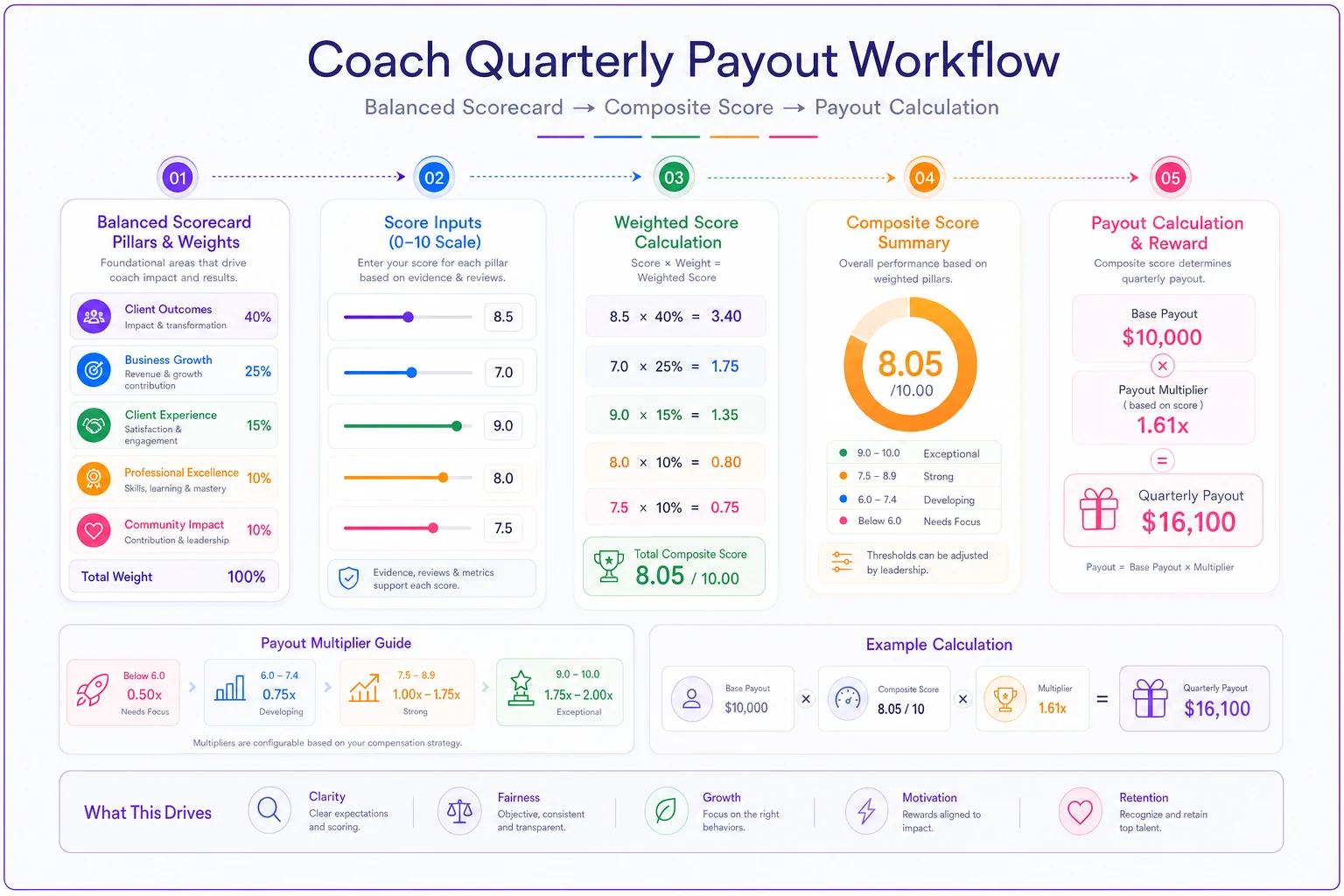
This diagram shows how weighted scores feed into the composite and produce the payout.
This coach underperformed on volume (70%) but nailed quality (100%) and did well on outcomes. Under a volume-heavy plan, they'd have been penalized hard for seeing fewer clients — even though they were producing better results per client. The balanced scorecard pays them fairly for the trade-off they actually made.
Compare that to a coach who ran hot on volume (110%, capped at 100%) but let quality slip to 60% and had retention problems at 65%. Their composite lands around 0.79 — lower — despite doing "more." That's the system working. More sessions with worse outcomes should not pay better than fewer sessions with strong outcomes.
Adjustment rules that stop the gaming
A scorecard alone isn't enough. Smart people optimize formulas, so you need guardrails — adjustment rules that override the raw math when something looks off.
-
Outcome verification gate. No outcome credit pays out unless the milestone is confirmed by the client or an objective measure. Coach self-attestation alone doesn't count. This kills the single biggest gaming vector.
-
Retention cap with a graduation credit. Retention only pays up to the planned engagement length. If a coach keeps a client past the point where goals were met, extra months don't add retention points — and there's a separate small bonus for clean, on-time graduations. This flips the incentive: finishing well beats stringing along.
-
Quality floor. If quality drops below a set threshold — note completeness or CSAT under a defined line — the outcome and volume bonuses are reduced regardless of how high they scored. You can't buy your way out of poor quality with volume.
-
Cherry-picking check. Track the difficulty mix of each coach's caseload. If a coach's book is suspiciously easy — all high-motivation, low-need clients — outcome scores get normalized against caseload difficulty. Otherwise you reward coaches for dodging the hard clients, which is one of the most corrosive things a comp plan can do.
-
Clawback on early churn. If a client churns within a short window after a renewal or enrollment bonus, part of that bonus reverses. Prevents front-loading enrollments that don't stick.
The cherry-picking rule is the one most practices skip, and it quietly does the most damage. When difficult clients feel like a threat to someone's paycheck, they get passed around, under-served, or subtly nudged out the door. A good comp system makes taking on a hard client neutral or slightly positive — never punishing.
Governance: who owns the numbers
Compensation systems rot when the person being measured controls the measurement. That's the governance failure that turns a good scorecard into theater.
-
Data ownership sits outside the coach. Outcome verification, CSAT collection, and note audits are handled by an ops role or the owner — not the coach whose pay depends on them.
-
Quarterly comp review, not annual. Perverse incentives compound. Catching drift every quarter means a bad pattern costs you three months, not twelve.
-
A written change log. Every time you adjust a weight or a target, record why and when. Coaches need to trust the rules aren't being changed reactively to lower payouts.
-
A dispute path. Coaches can flag a scored metric they think is wrong, with a defined review process. This isn't just fairness — disputes are how you find measurement bugs.
-
Blind spot audits. Once a quarter, pull a few closed engagements at random and check whether the scorecard's story matches the actual client experience. When they diverge, your metrics are lying to you.
This governance layer connects directly to the operational maturity work covered in scaling without losing quality — the same SOP discipline that keeps delivery consistent is what makes scorecard data trustworthy enough to pay on.
Where the data actually comes from
The whole system depends on trusting the numbers, and that's usually the breaking point in small practices. If verifying outcomes means manually chasing clients for confirmation every quarter, it won't happen consistently — and inconsistent measurement is worse than none, because it looks objective while being arbitrary.
In practice, the numbers need to flow from the systems coaches already use: session records, homework completion, milestone confirmations, renewal dates, satisfaction check-ins. When that data is scattered across calendars, email threads, and someone's memory, the scorecard becomes a monthly reconstruction exercise that nobody wants to do.
Automate milestone confirmations and CSAT collection where possible to avoid quarterly data reconstruction.
This is where an operational platform with some automation earns its place — not as a magic bonus calculator, but as the plumbing that captures milestone confirmations, flags quality-floor breaches before payout, and pulls retention and outcome data into one place without a coach having to self-report it. The point isn't the software; it's that measurement stays honest without heroic manual effort. If your comp system requires someone to spend a day each quarter rebuilding spreadsheets, it will quietly degrade.
When this makes sense — and when it doesn't
When a balanced scorecard is worth it: you have at least three coaches, real revenue at stake, and you're seeing early signs of misalignment — churn creeping up, quality complaints, coaches gravitating toward easy clients. The complexity pays for itself once individual pay decisions are large enough to distort behavior.
When it's overkill: you're a solo coach or a two-person shop where you can see everything. Building a four-pillar weighted scorecard for two people you talk to daily is bureaucracy for its own sake. Keep it simple until the gap between practice-good and coach-good actually opens up.
Who should not do this: anyone who can't yet reliably measure outcomes and retention. If your data is guesswork, a scorecard just formalizes the guessing and attaches money to it — which is worse than a simple, honest salary. Fix measurement first, then pay on it.
A real scenario
A four-coach leadership practice was running per-session pay plus a per-renewal bonus. On paper, revenue looked fine — roughly $40k–$45k a month. But renewals were softening and two of the four coaches had noticeably higher client complaints.
When they dug in, the pattern was clear: the renewal bonus was rewarding coaches for keeping clients enrolled, so engagements were drifting long past their useful life. Clients renewed once, felt they weren't progressing, and left for good instead of becoming long-term advocates. Meanwhile, the volume pay meant the busiest coach was also the one with the thinnest session notes.
They moved to a balanced scorecard: outcomes weighted heaviest, a retention cap with a graduation credit, a quality floor, and quarterly reviews owned by the practice manager rather than the coaches. Total payout dollars barely changed — this wasn't a pay cut in disguise. But the distribution shifted toward the coaches producing real results.
Over the next couple of quarters, on-time graduations went up, complaint volume dropped significantly, and — the part that surprised them — renewals actually improved. Clients who graduated cleanly came back later or referred others. The coaches who'd been gaming volume adjusted their behavior within a quarter, because the formula finally rewarded what they knew they should've been doing anyway.
The takeaway
Compensation isn't an HR afterthought you bolt on once the practice is running. It's one of the most powerful operational levers you have, and it's constantly training your team toward some behavior — the only question is whether it's the behavior you actually want.
A balanced scorecard, honest weights, adjustment rules that assume people will optimize the formula, and governance that keeps the measurers separate from the measured: that's the whole system. Get the weights right, verify outcomes independently, cap the incentives that reward dependency, and review often enough to catch drift before it costs you a year. Do that, and you stop accidentally paying your coaches to do the wrong things well.
Compensation isn't an HR afterthought you bolt on once the practice is running. It's one of the most powerful operational levers you have, and it's constantly training your team toward some behavior — the only question is whether it's the behavior you actually want.
A balanced scorecard, honest weights, adjustment rules that assume people will optimize the formula, and governance that keeps the measurers separate from the measured: that's the whole system. Get the weights right, verify outcomes independently, cap the incentives that reward dependency, and review often enough to catch drift before it costs you a year. Do that, and you stop accidentally paying your coaches to do the wrong things well.
Ready to elevate your coaching business?
Join hundreds of coaches using Guidyly to save time, enhance client engagement, and grow their practice.