

Most coaches treat graduated clients like closed files. The engagement ends, the final session wraps, maybe there's a nice thank-you note, and then nothing. Six months later that client has hired someone else, forgotten your name, or worse—recommended a different coach to the exact person who should have been referred to you.
The math on this is brutal when you actually look at it. A former client already trusts you, already got results, and already knows how to work with you. Re-engaging them costs a fraction of acquiring someone cold. Yet the average solo or small coaching practice has zero structured system for staying in touch with people who finished the program. The relationship just decays by default.
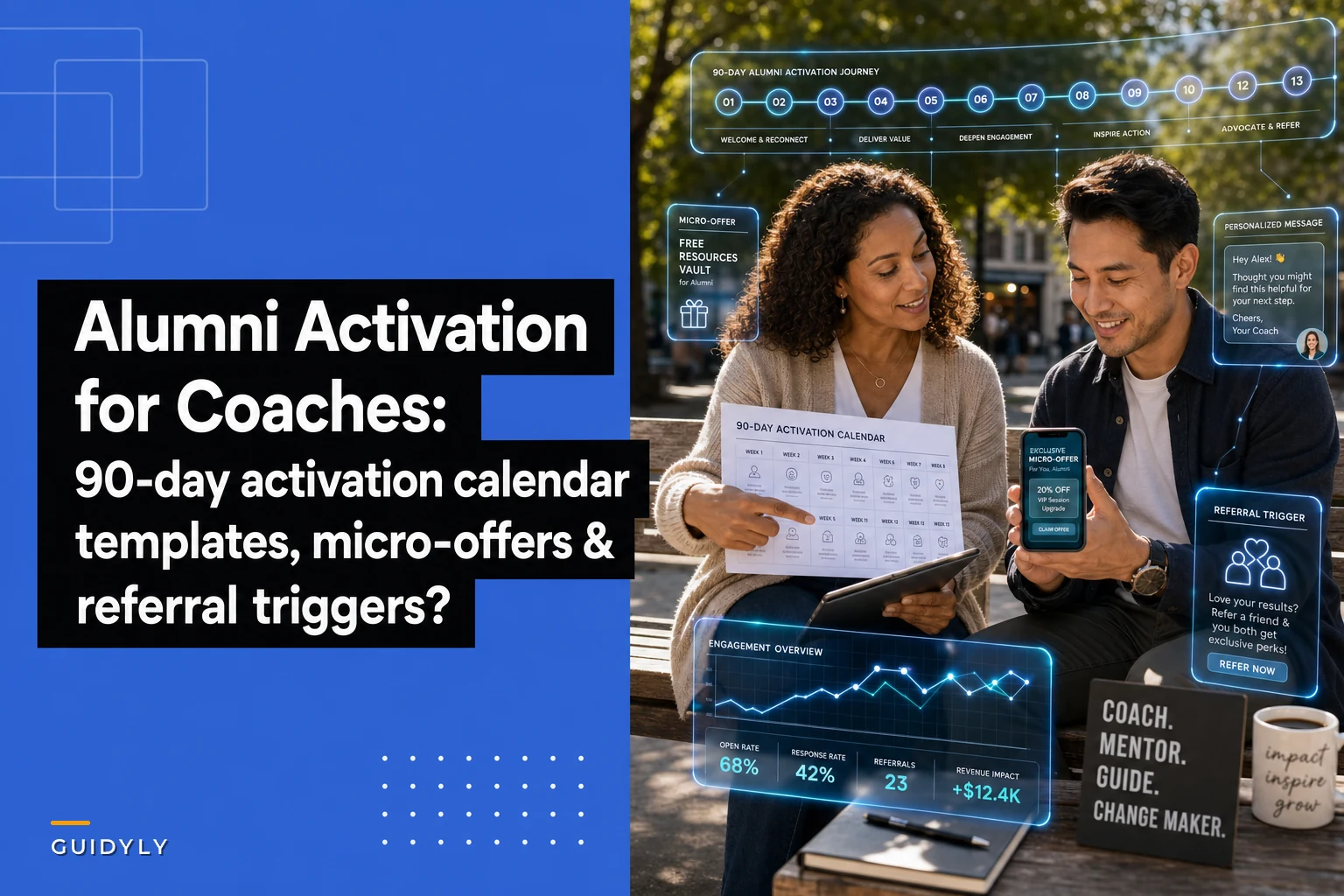
A real coaching alumni program isn't a newsletter. It's a deliberate 90-day cadence of light touches, small paid offers, and specific moments where you ask for referrals. Done right, it runs mostly on templates and takes maybe 30–45 minutes of actual attention per week. This post lays out exactly what that calendar looks like, what to send, and what to measure so you know it's working.
Why alumni go cold (and why it's not their fault)
The failure isn't emotional. Clients don't leave because they stopped liking you. They go cold because nothing ever pulled them back.
In real operations, this usually happens in a predictable pattern. The program ends on a high—someone's just hit a goal, they're grateful, they'd say yes to almost anything. Then life absorbs them. Two weeks pass. The momentum fades without the weekly structure your sessions provided. By week eight they're quietly backsliding and slightly embarrassed about it. By month four they assume you've moved on to newer clients and don't want to "bother" you.
That embarrassment gap is the thing almost nobody accounts for. A client who regressed a little often avoids the coach who helped them, because reaching out means admitting they slipped. So the reactivation has to come from you, and it has to feel low-pressure enough that they don't feel judged for going quiet.
The other reason alumni go cold is purely operational: you're busy with current clients. Follow-up is the first thing to fall off the plate when you're at capacity. Which is exactly why this needs to be a calendar, not a good intention.
The 90-day structure at a glance
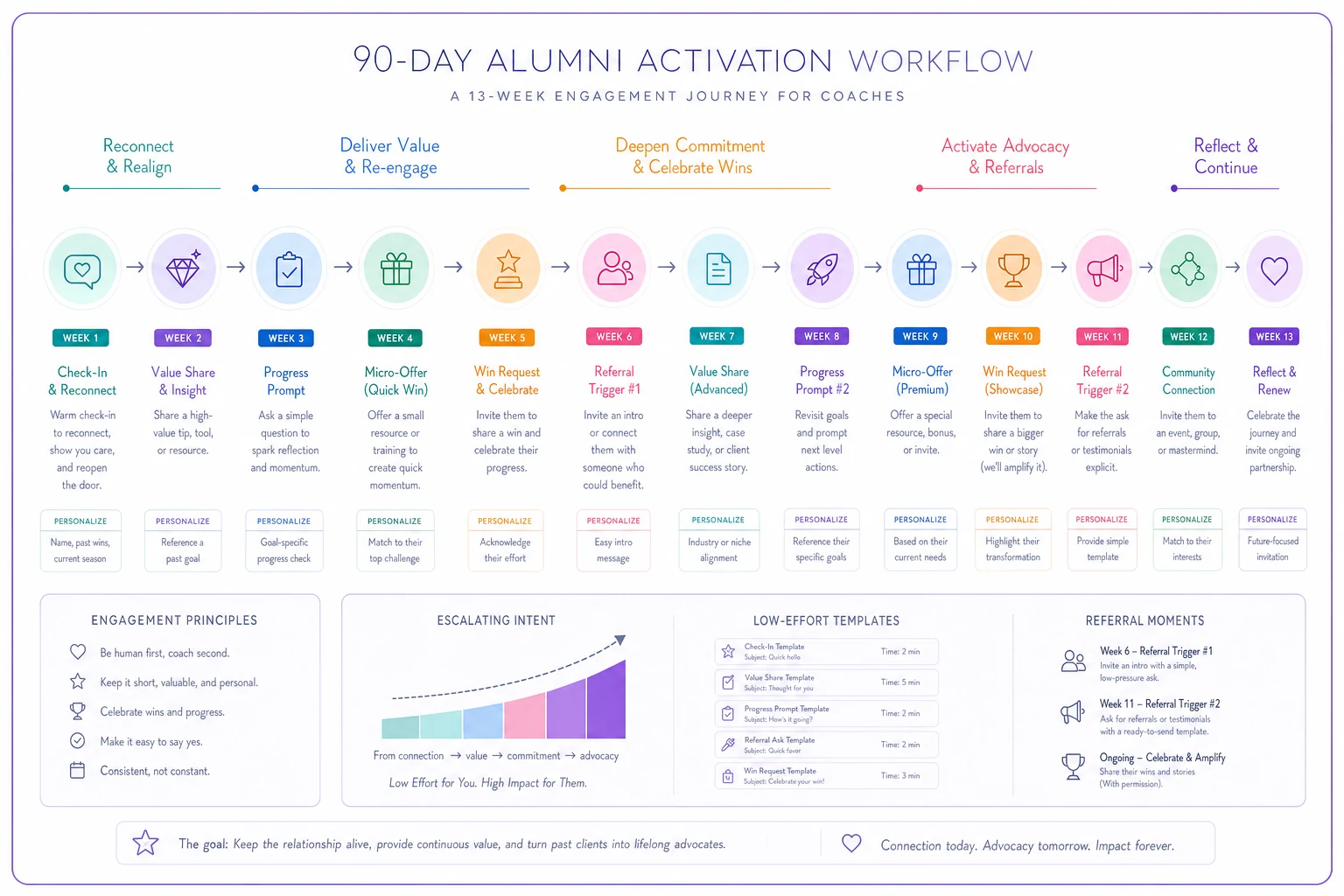
The idea is to spread light contact across three months, escalating gently from "how are you doing" to actual offers and referral asks. Every touch has a job. Nothing is random.
Never miss a session or detail again.
Guidyly helps you book, manage, and track every coaching session efficiently.
- Centralized session scheduling
- Automated client reminders
- Progress tracking & notes
No credit card required
| Week | Touch Type | Purpose | Effort |
|---|---|---|---|
| 1 | Personal check-in (1:1) | Reopen the relationship, no ask | Low |
| 2 | Value share (group/broadcast) | Stay useful, stay visible | Very low |
| 4 | Progress prompt | Surface who's slipping, who's winning | Low |
| 6 | Micro-offer #1 (tune-up session) | First small paid re-entry | Medium |
| 8 | Win request / testimonial nudge | Capture proof, deepen bond | Low |
| 9 | Referral trigger | Ask when goodwill is high | Low |
| 11 | Micro-offer #2 (mini-package or workshop) | Bigger re-entry point | Medium |
| 13 | Reflection + open door | Close the cycle, restart quietly | Low |
The offers come after value, not before. That ordering matters more than most coaches realize. Alumni who get pitched in week one convert worse and unsubscribe faster than alumni who get two genuine touches first.
A simple visual of the 90-day workflow.
The offers come after value, not before. That ordering matters more than most coaches realize. Alumni who get pitched in week one convert worse and unsubscribe faster than alumni who get two genuine touches first.
The communications: what to actually send
Templates keep this sustainable, but they should read like you, not like a sequence. The trick is writing each template with obvious blanks where a specific personal detail goes—that one line of personalization is what separates a reactivation from a mass email people ignore.
Always include that one line of personalization referencing a concrete detail from their program.
Week 1 — The check-in. This is 1:1 and it references something specific from their program. Not "Hi, how are you doing!" but "Hi Marcus—thinking about that promotion conversation you were prepping for when we wrapped. Did it end up happening?" The specificity signals you actually remember them. Keep it under four sentences. No offer. No link. Just a real question.
Week 2 — The value share. A short, useful thing tied to what your alumni have in common. A one-paragraph reframe, a checklist, a two-minute audio note. The goal is to show up in their inbox being helpful before you ever show up asking for anything.
Week 4 — The progress prompt. A single question that gets them to self-assess: "On a scale of 1–10, how consistent have you been with [the core habit] since we finished?" The low scores tell you exactly who's slipping and needs a tune-up. The high scores tell you who's ready to be asked for a referral or a testimonial. This one prompt effectively segments your entire alumni list for you.
Week 8 — The win request. "What's one thing that's stuck since we worked together?" People love answering this, and their answers become your testimonials and your clearest signal of what actually delivered lasting value. Tie this into a proper capture workflow if you're collecting proof for marketing.
Week 13 — The reflection. Close the loop with a warm, no-pressure message that leaves the door open. "It's been about three months—wherever you are with things, I'm here if you want a reset." Then the cycle quietly restarts for the next cohort.
Micro-offers: the re-entry points that convert
Full programs are a big commitment. Alumni who finished six months ago aren't ready to re-commit to twelve weeks and four figures. So the offers in this calendar are deliberately small—easy yeses that reopen the working relationship.
Two micro-offers do most of the work:
-
The tune-up session. A single paid session, priced accessibly, framed as a check-in and course-correction. Aimed at alumni who scored low on the week-4 progress prompt. The framing removes the embarrassment: "a tune-up" implies maintenance, not failure.
-
The mini-package or workshop. A 3-session sprint or a small-group workshop on a specific problem. This catches alumni who are doing well but want to level up on something new. Higher price than the tune-up, still well below your full program.
The pattern that works: price the tune-up so low it's an obvious yes for someone who's slipping, and let a portion of those sessions naturally lead back into a fuller engagement once the person remembers how much better they operate with support.
One thing worth avoiding—don't discount your core program to alumni as the reactivation offer. It trains people to wait for deals and undercuts your current clients. Small, distinct offers protect your pricing while still giving alumni a way back in.
Referral triggers: asking at the right moment
Referrals fail mostly because of timing. Coaches ask when it's convenient for them—usually when they need clients—instead of when the client is most primed to say yes.
The highest-conversion moment is right after someone reports a win. So the calendar puts the referral ask in week 9, immediately following the win-request in week 8. Someone who just told you "I finally negotiated that raise" is emotionally ready to hear "Who else in your world is stuck on something like this?"
Make the ask specific, not broad. "Do you know anyone who'd benefit?" gets vague nods. "Who's one person you know who's dealing with the same thing you were three months ago?" gets an actual name. The narrower the prompt, the more your alumni can picture a real person.
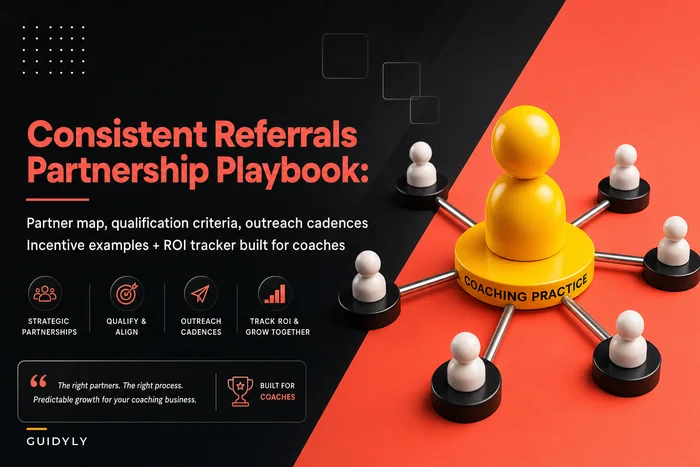
If referrals are a persistent weak spot in your practice, it's worth building a proper structure around partners and outreach cadence too—there's a full breakdown in this partnership playbook for consistent referrals that pairs well with the alumni triggers here. Alumni referrals and partner referrals are two different pipelines, and mature practices run both.
What to measure
This is where most alumni efforts quietly die—nobody tracks whether it's working, so it never gets improved and eventually gets dropped. You only need a handful of numbers.
-
Reactivation rate — % of alumni who take any micro-offer within the 90 days
-
LTV uplift — average additional revenue per alumnus after the program ended, versus before you ran the calendar
-
Referral conversion — referrals generated per 10 alumni contacted, and how many became paying clients
-
Response rate per touch — which messages actually get replies (this tells you what to cut or rewrite)
-
Re-entry-to-full-program rate — how many tune-up clients eventually return to a fuller engagement
Track these in a simple spreadsheet with one row per alumnus and columns for each touch. You don't need software to start. You need discipline about logging what you sent and what came back.
One pattern worth watching: if your response rate is fine but reactivation is low, your offers are wrong. If your response rate is low across the board, your messages read like marketing and need to sound more personal. The metrics tell you which problem you actually have.
A real scenario
A solo leadership coach with roughly 40 past clients over two years had never done any structured follow-up. Alumni just drifted off. She built the 90-day calendar in a spreadsheet, wrote the templates once, and ran it against her whole alumni list in two waves.
Over the first cycle, around 7 alumni booked the tune-up session and 2 came back for a mini-package. The week-9 referral trigger produced 5 named introductions, 2 of which became paying clients. Nothing dramatic in isolation—but that's roughly $4k–$6k in reactivation and referral revenue from people who cost her almost nothing to reach, plus a batch of fresh testimonials from the win-requests.
The bigger shift was that she stopped treating "past client" as a dead end. The list became an asset she works on a schedule instead of a graveyard of names in her CRM.
When this makes sense—and when it doesn't
This calendar is worth building if you have at least 15–20 former clients, offer something people can meaningfully re-engage with, and finished those relationships on good terms. Below that number, the templating overhead isn't worth it—just reach out personally to each person.
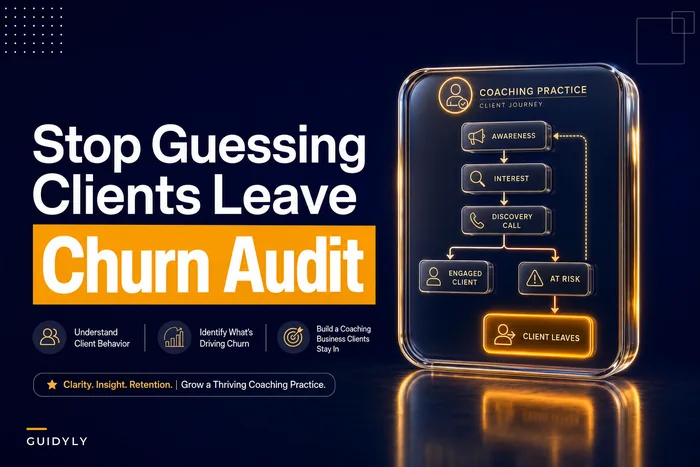
It's a bad fit if your alumni had mixed or poor results. Reactivating unhappy former clients doesn't produce referrals; it produces awkward conversations and possibly bad word-of-mouth. In that case your effort belongs upstream—understanding why people didn't get results, which starts with a proper look at why clients leave and what to fix before you invest in reactivation at all.
And if you're currently at full capacity with no room for new or returning clients, hold off. There's no point triggering demand you can't serve. Get the capacity question sorted first, then turn the alumni calendar on.
Getting started this week
You don't need to build the whole thing before you begin. Write the week-1 check-in template, personalize it for ten former clients, and send it. That's the entire first step. See what comes back. The replies alone will teach you more about your alumni than any plan will.
From there, add one touch at a time as the weeks roll. Within a quarter you'll have a repeatable system that quietly turns finished clients into repeat revenue, referrals, and proof—running on a schedule instead of on your memory and good intentions.
The former clients who trust you most are the ones you're least likely to hear from unless you reach out first. A simple calendar fixes that. Start with the ten names you already know should have heard from you months ago.
The former clients who trust you most are the ones you're least likely to hear from unless you reach out first. A simple calendar fixes that. Start with the ten names you already know should have heard from you months ago.
Ready to elevate your coaching business?
Join hundreds of coaches using Guidyly to save time, enhance client engagement, and grow their practice.