



Most coaching experiments fail before they start — not because the idea was bad, but because the math was never going to work. You've got a cohort of 14 people. You split them into two groups of 7, change one thing, and wait to see if attendance improves. Three weeks later one group looks a little better, so you conclude your new format "works" and roll it out to everyone.
The problem is that with 7 people per group, one client's vacation or one bad week wipes out your entire signal. You didn't measure an effect. You measured noise and gave it a name.
This is the core tension in A/B testing for coaching programs: you want to make evidence-based decisions, but you don't have Facebook-scale traffic. You have small numbers, messy human behavior, and a real cost to running any experiment at all. The goal isn't to copy the enterprise A/B playbook. It's to build something lighter — a way to test that respects small samples, protects you from fooling yourself, and still moves your program forward.
Here's how to do that without pretending you're running a clinical trial.
Why coaches keep running experiments they can't learn from
The failure pattern is almost always the same. Someone reads about split-testing, applies it to a group of 10–20 clients, and treats a 15% difference between two tiny groups as a real result.
With cohorts under 30 people, most "wins" you'll see fall within the range of random variation. If you flipped a coin 7 times in each group and one group got more heads, you wouldn't announce a discovery. But that's effectively what happens when a coach compares homework completion between two groups of 8 and calls a difference meaningful.
There's a second, quieter problem. Coaches change several things at once — new onboarding email, a new session format, a different homework structure, all rolled out together. Even if the cohort improves, you have no idea which lever did it. Next cohort, you can't reproduce it because you don't know what "it" was.
So before any templates: with small cohorts, you're not trying to prove statistical significance in the textbook sense. You're trying to detect large, obvious effects reliably, and stop wasting cycles chasing small ones you can't see anyway.
What small cohorts can and can't detect
This is the single most useful thing to internalize. Your cohort size determines the minimum effect you can realistically catch. Small samples can only detect big swings.
Never miss a session or detail again.
Guidyly helps you book, manage, and track every coaching session efficiently.
- Centralized session scheduling
- Automated client reminders
- Progress tracking & notes
No credit card required
| Total cohort size | What you can realistically detect | What's basically invisible |
|---|---|---|
| Under 10 | Only huge, obvious changes (like homework going from 30% → 70%) | Anything under a ~30-point swing |
| 10–20 | Large effects (20–30 point shifts) | Subtle tweaks, small copy changes |
| 20–40 | Moderate-to-large effects (15–25 points) | Small optimizations |
| 40–80 | Moderate effects (10–15 points) | Marginal gains |
The takeaway isn't "small cohorts are useless." It's that small cohorts should only be used to test bold changes, not fine-tuning. If your hypothesis is "changing the reminder send time from 6pm to 7pm will lift attendance," a 12-person cohort will never tell you. But "replacing solo homework with a paired accountability structure will lift completion" — that might produce a swing large enough to actually see.
A practical rule worth keeping: if you can't imagine the change producing at least a 20-point difference, don't run it as a formal experiment with a small cohort. Just make the change and monitor it as an operational tweak instead.
A hypothesis template that keeps you honest
> We believe [specific change] > will cause [specific metric] to move from [current baseline] to [target] > for [which clients / which cohort] > because [the mechanism you think is driving it]. > We'll call it a win if [decision threshold] > and we'll kill it if [failure threshold].
> We believe assigning homework in paired buddy groups > will cause weekly homework completion to move from ~45% to 65%+ > for the incoming 16-person cohort > because social accountability reduces the "I'll do it later" drift. > We'll call it a win if completion holds above 60% for three consecutive weeks, > and we'll kill it if it stays below 50% after week two.
The magic is in the last two lines. Most coaches never write down what would make them stop. So experiments never really end — they just fade into "I think that helped?" Writing the kill condition upfront protects you from motivated reasoning later.
Low-n sample-sizing heuristics (no calculator required)
You don't need a power-analysis tool for cohorts this size. You need a few rules of thumb that keep you from overinterpreting.
-
The 5-per-cell floor. Never split a group so small that either side has fewer than 5 people. Below that, a single person's behavior dominates the result. If your cohort is 8, don't split it — run a before/after against your last cohort instead.
-
Prefer sequential over split. With tiny cohorts, comparing your new cohort against your previous cohort baseline is often more stable than splitting one cohort in half. You get the full group size on each side, and you avoid the awkwardness of giving half your clients a worse experience.
-
The three-week persistence rule. Don't trust a single week. A change is only "real" in small cohorts if the effect holds for three consecutive measurement periods. Human behavior spikes and dips; persistence filters out the noise.
-
Round your expectations down. Whatever lift you're hoping for, assume you'll only reliably detect something twice that size. Hoping for 10 points? You'll only catch 20+. Plan accordingly.
-
One variable at a time — really. With small n, confounded experiments are worse than no experiment, because they produce confident wrong conclusions. If you must change two things, accept that you're piloting, not testing.
These aren't statistically rigorous in the academic sense. They're operationally honest, which matters more when the alternative is pretending your n=14 study proved something.
A runbook you can actually follow
Here's the step-by-step process for running one clean experiment on a small cohort, start to finish:
-
Pick one metric that already has a baseline. Attendance rate, homework completion, or renewal intent. If you don't know your current number, you're not ready — measure the baseline for one cycle first.
-
Write the hypothesis using the template above. If you can't fill in every line, the experiment isn't defined well enough to run.
-
Decide split vs. sequential. Under 20 people, lean sequential (new cohort vs. last cohort). Over 20, a split can work if both cells clear 5+.
-
Lock the change and don't touch anything else. No mid-experiment "improvements." Consistency of everything else is what makes the one change interpretable.
-
Measure at fixed intervals. Same day of week, same method, every week. Inconsistent measurement is its own source of fake variation.
-
Apply the three-week persistence rule before deciding. Don't call it early because week one looked great.
-
Compare against your pre-written thresholds — not your gut. This is where the kill/win conditions earn their keep.
-
Write down the result even if it's boring. "No detectable effect" is a real finding. It saves you from re-running the same idea six months later.
The runbook looks simple, and it should be. The discipline isn't in complexity — it's in refusing to skip steps 4, 6, and 7, which is where nearly every coaching experiment quietly falls apart.
Below is a rough map of how one cycle flows in practice:
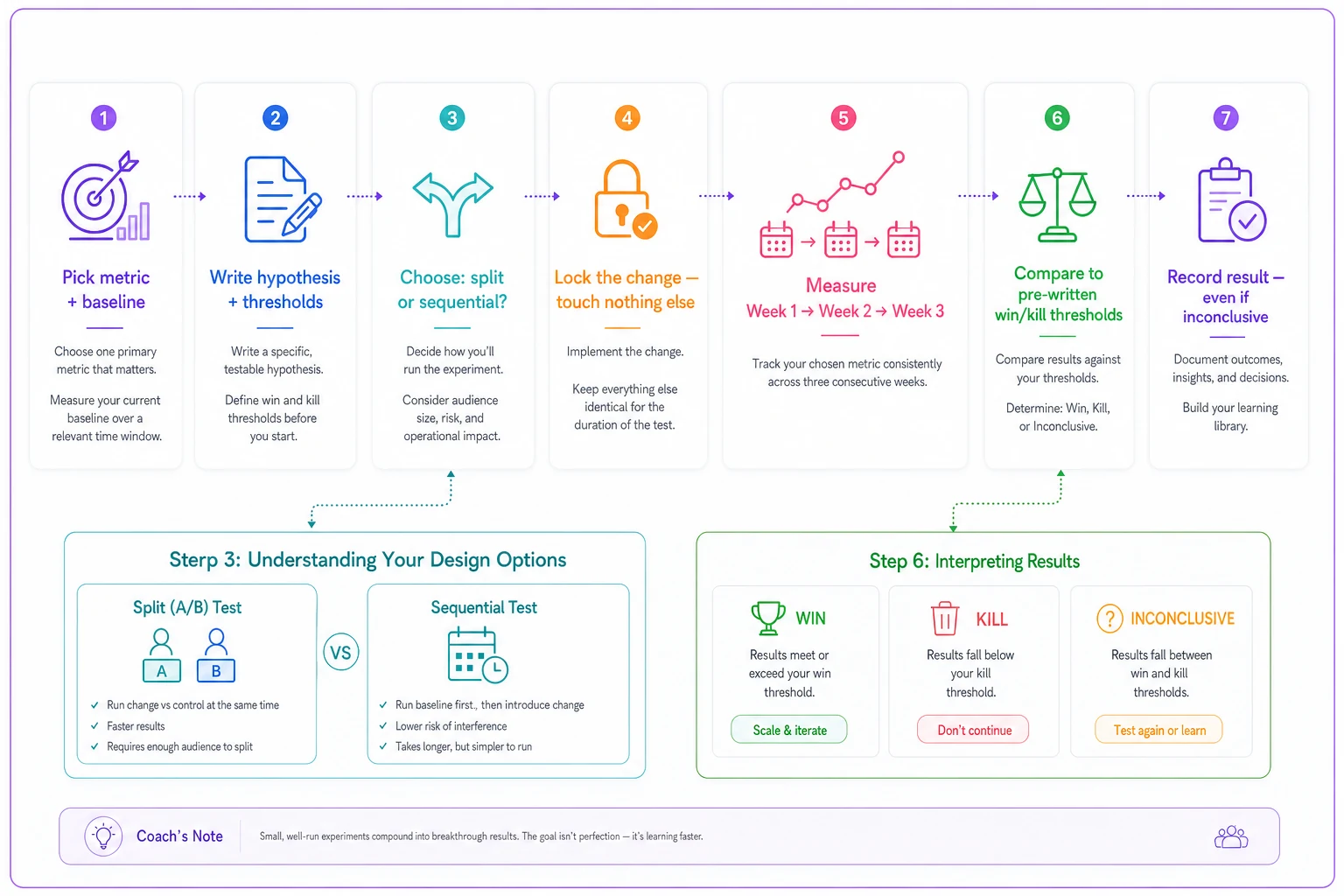
[Pick metric + baseline] ↓ [Write hypothesis + thresholds] ↓ [Choose: split or sequential?] ↓ [Lock the change — touch nothing else] ↓ [Measure: Week 1 → Week 2 → Week 3] ↓ [Compare to pre-written win/kill thresholds] ↓ [Record result — even if inconclusive]
Choosing metrics: attendance, homework, and renewal each behave differently
Not all coaching metrics respond to experiments the same way, and treating them identically is a common mistake.
Attendance is relatively fast-moving. You'll see shifts within a week or two, which makes it one of the better metrics for small-cohort testing. If you're experimenting on scheduling or reminder structure, this is where changes show up quickest. Coaches who've tightened their reminder systems — the kind covered in this playbook on automated session reminders — often see attendance move fast enough to detect even in small groups.
Homework completion is behavioral and social. It responds well to structural changes (buddy systems, deadlines, format changes) but is noisy week to week because life happens. This is exactly why the three-week persistence rule matters most here.
Renewal signals are the hardest to test in small cohorts. Renewals happen at the end of a program, you get one data point per client, and the sample is by definition small. You basically can't A/B-test renewal directly with 15 people. Instead, test leading indicators — engagement, attendance consistency, perceived progress — that you already believe correlate with renewal. Then track whether the experiment cohort renews at a higher rate over time, treating it as a slow, accumulating signal rather than a clean test.
The short version:
-
Testing attendance? Small cohorts are fine. Effects show fast.
-
Testing homework? Doable, but demand three weeks of persistence.
-
Testing renewal directly? Don't. Test leading indicators instead and watch renewal as a trailing metric across cohorts.
| Metric | How quickly it moves | Small cohort friendly? | Notes |
|---|---|---|---|
| Attendance | Fast (1–2 weeks) | Yes | Best starting point for experiments |
| Homework completion | Medium (2–3 weeks) | Yes, with persistence rule | Noisy; require three-week hold |
| Renewal | Slow (end of program) | No | Track as trailing signal only |
The table isn't meant to be exhaustive — it's a quick gut-check before you commit to what you're measuring.
A simple tracker that prevents the "I think it worked" problem
You don't need fancy software, but you do need one consistent place. The failure mode is scattered notes — attendance in one spot, homework in a spreadsheet, gut feelings in your head. When it's time to decide, you can't reconstruct what happened.
-
Experiment name and the one-line hypothesis
-
Metric and baseline number
-
Win threshold and kill threshold (written before starting)
-
Week 1 / Week 2 / Week 3 readings
-
Decision
kept, killed, or inconclusive
-
One-sentence note on why
The point isn't sophistication — it's that the thresholds were written down first, so you can't rationalize a fuzzy result into a win afterward.
The bigger operational challenge is data collection consistency, not analysis. If your attendance and homework numbers are already flowing into one place automatically — pulled from session logs and assignment check-ins rather than manually retyped each week — running clean experiments gets dramatically easier. Your baselines and weekly readings are actually trustworthy instead of half-remembered. That's usually the difference between coaches who test regularly and coaches who tried it once, found the tracking annoying, and gave up.
A real scenario with numbers
A solo career coach ran cohorts of around 12–15 clients on a rolling basis. Homework completion sat at roughly 40–45%, and she suspected it was dragging renewal. Her instinct was to add more reminders, but she'd already tightened those — using a tiered approach similar to what's outlined in this messaging playbook for cutting no-shows and cancellations — and completion hadn't really moved.
So instead of another reminder tweak — a small change her cohort size could never detect — she went bold. She restructured homework into paired accountability groups, where two clients checked in with each other mid-week. That's exactly the kind of large-swing change small cohorts can measure.
She ran it sequentially: the new 14-person cohort against the previous one. She wrote the thresholds first — win at 60%+ held for three weeks, kill below 50% after week two. Completion climbed to the high 50s in week one, dipped slightly, then settled around 62–65% by week three. Because it cleared the persistence rule, she kept it.
The honest part: she couldn't cleanly prove renewal improved, because that's a trailing metric on a tiny sample. But over the next two cohorts, renewal ticked up noticeably, consistent with her theory. That's how small-cohort experimentation actually works — one confident structural finding, plus a slow-accumulating trailing signal, rather than a single clean p-value.
When formal testing makes sense — and when it doesn't
Run a formal experiment when:
-
The change is bold enough to produce a large swing
-
You have a clean baseline for the metric
-
You can hold everything else constant for a few weeks
-
The metric responds quickly (attendance, homework)
Skip the formality and just make the change when:
-
The tweak is minor (send times, wording, small format edits)
-
Your cohort is under 10 and can't be split or compared cleanly
-
The effect you're hoping for is small — you won't detect it anyway
-
You're changing several things at once and can't isolate them
Who should not do this at all: if you're running your first cohort or two, don't experiment yet. You have no baseline, no stable process, and every change is confounded with just learning to run the program. Get to a repeatable baseline first. Experiments are for programs that already work and want to work better — not for finding out whether the program works at all.
The mindset that makes small-cohort testing worth it
The coaches who get value from A/B testing for coaching programs aren't the ones with the fanciest stats. They're the ones who accept the constraint honestly: small cohorts can only see big effects, so only test big changes, demand persistence before believing anything, and write down your kill conditions before you start.
Do that consistently, and you stop running experiments that were always going to be inconclusive. You stop rolling out "wins" that were really just one client's good week. Over a few years of cohorts, you build a slow, reliable base of things you actually know work — a program that's genuinely tuned rather than just tinkered with.
The math will never be perfect at this scale. But honest, disciplined, boldly-scoped experiments beat confident guesses every time.
The math will never be perfect at this scale. But honest, disciplined, boldly-scoped experiments beat confident guesses every time.
Ready to elevate your coaching business?
Join hundreds of coaches using Guidyly to save time, enhance client engagement, and grow their practice.