
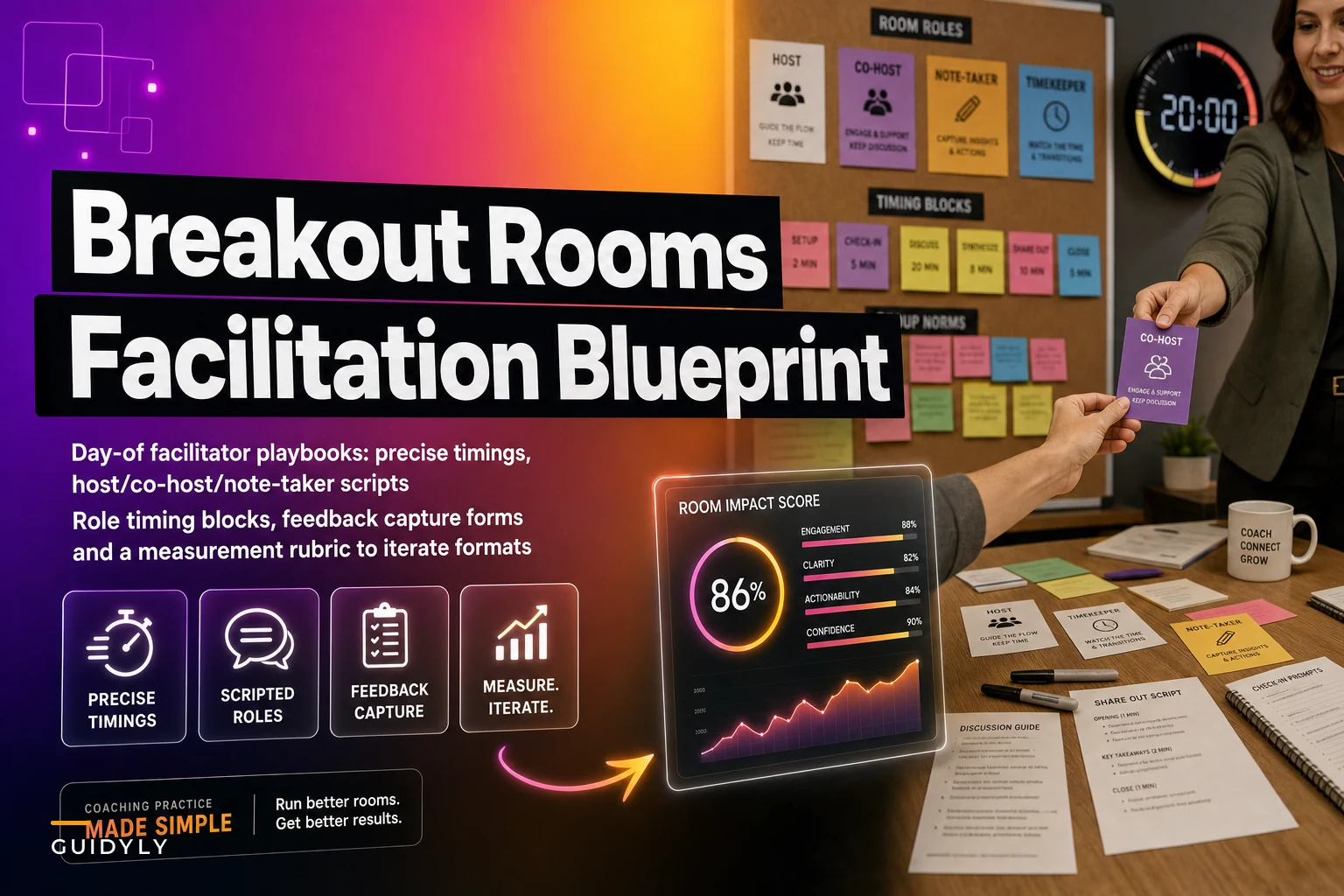

The most common breakout failure isn't bad facilitation. It's a dead first 90 seconds. Participants land in a room, nobody knows who talks first, someone mumbles "so… who wants to start?" and nearly half the usable time evaporates before anyone says anything real. By the time a group finds its footing, you're calling them back.
If you run cohort workshops, group coaching, or corporate sessions with more than a dozen people, your breakouts are either your biggest engagement engine or your biggest silent dropout zone. Rarely a middle ground. And the difference almost never comes down to how charismatic your facilitators are — it comes down to whether the room has structure baked in before anyone arrives.
This is a blueprint you can hand to a facilitator who has never run one of your sessions and they'll still produce a usable result. That's the bar. A breakout facilitation blueprint for coaches should work without you in the room.
Why breakouts quietly fail (and why it's not the people)
The usual explanation is "the group just didn't gel." That's almost always wrong. When you look at recordings of breakouts that flopped versus ones that worked, the difference shows up in the mechanics, not the personalities.
Three patterns come up over and over:
No role assignment. Everyone is a participant, which means nobody owns time, nobody captures anything, and the conversation drifts. A room with four equals and no host defaults to the most confident person dominating — or nobody leading at all.
Instructions that live in the main room. The facilitator explains the task beautifully to 30 people, then splits them up — and the moment they're separated, half the room forgot what they were supposed to do. There's no artifact traveling with them into the room.
No clock discipline. Breakouts don't fail at the start as often as they fail in the middle. Groups hit the real question around minute six, then get yanked back at minute eight because the timing was never designed around when good conversation actually happens.
A typical example looks like this: a 90-minute leadership cohort allocates 20 minutes to breakouts, feels good about it, and loses 7–8 of those minutes to logistics, re-explaining, and the awkward silence tax. That's not a 20-minute breakout. That's a 12-minute breakout wearing a 20-minute label.
The timing blocks that actually match how conversation works
Forget round numbers. Design your blocks around the natural arc of a small-group conversation: orientation, surface-level sharing, the real exchange, and synthesis. Most coaches skip straight to "discuss" and wonder why it stays shallow.
Never miss a session or detail again.
Guidyly helps you book, manage, and track every coaching session efficiently.
- Centralized session scheduling
- Automated client reminders
- Progress tracking & notes
No credit card required
Here's a timing structure that holds up across most formats. Adjust the total, keep the proportions.
| Phase | % of total time | What happens | Common mistake |
|---|---|---|---|
| Landing | ~10% | Host reads the prompt aloud, confirms roles | Skipped entirely; group starts cold |
| Round-robin | ~20% | Each person answers one narrow question, no cross-talk | Letting it turn into open discussion too early |
| Open exchange | ~45% | The actual conversation, host steers | Starting here with no warm-up |
| Synthesis | ~20% | Note-taker reads back 2–3 points the group agrees on | Running out of time, no capture |
| Buffer | ~5% | Slack for tech and transition | Assuming zero overhead |
For a 15-minute breakout, that's roughly: 90 seconds landing, 3 minutes round-robin, 7 minutes open, 3 minutes synthesis, and a minute of slack. The round-robin is the part everyone wants to cut and the part that saves the whole thing. When every person has already spoken once, the open phase starts warm instead of frozen.
Worth noting: the synthesis block is non-negotiable and almost always the first thing to get eaten. If you only protect one segment with a hard stop, protect that one. A breakout with no capture is a conversation nobody can act on.
Protect the synthesis block with a hard stop.
Here's a quick visual of the timing workflow.
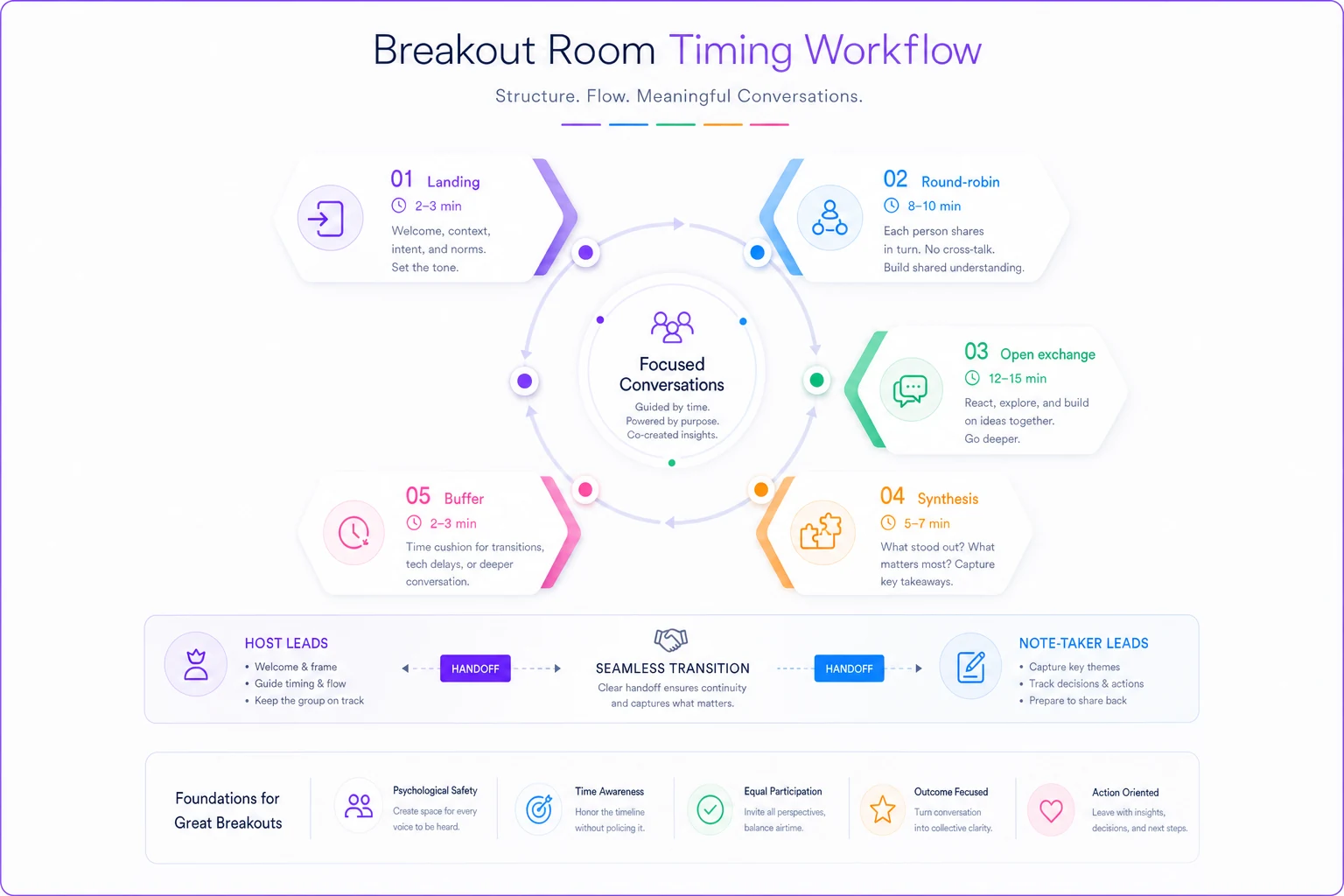
This visual maps the phases and proportions so facilitators can see where to place hard stops and handoffs.
Scripts: host, co-host, and note-taker
Scripts feel over-engineered until you've watched a nervous first-time host freeze. The point isn't to make facilitators robotic — it's to remove the cognitive load of inventing structure on the spot so they can actually pay attention to the people in the room.
Host script
-
(Landing) "Hey everyone — quick one. We've got about [X] minutes. Here's the question we're working on: [read prompt]. We'll each take a turn first, then open it up. I'll keep us on time."
-
(Round-robin) "Let's go around once. Keep it to about 30 seconds each — just your first reaction. I'll start, then go clockwise."
-
(Open exchange) "Okay, now let's dig in. [Name], you mentioned [X] — can you say more?"
-
(90-second warning) "We've got about 90 seconds. [Note-taker], want to pull together what we landed on?"
-
(Close) "Great — when we're back in the main room, [note-taker] will share our top points."
Co-host script
-
Watches the timer and gives the host silent cues (chat message or hand signal) at the midpoint and the 90-second mark.
-
Pulls in quiet participants
"We haven't heard from [name] yet — what's your take?"
-
Handles tech problems so the host never breaks flow.
If you're short on people, the host and co-host can be the same person — but only in small rooms and only with experienced facilitators. Don't combine them for a first-time host.
Note-taker script
-
During open exchange, jot only
points of agreement, strong disagreement, and open questions.
-
At the 90-second mark
"Here's what I'm hearing — [point 1], [point 2]. Did I miss anything?"
-
Capture the final version into the shared form before the room closes.
That last step matters. Notes that live in someone's head or a local notepad never make it back. The capture has to happen inside the room, before the merge.
The feedback capture form (keep it to five fields)
Most coaches either capture nothing from breakouts or capture a wall of text nobody reads. The sweet spot is a short, structured form the note-taker fills out in the last two minutes. Anything longer and it won't get done.
-
Room/group identifier (so you can match patterns later)
-
Top 2 points the group agreed on (short bullets)
-
One open question or sticking point (this is gold for iterating content)
-
Energy level (quick 1–5 — were people engaged or checked out?)
-
One thing the facilitator would change (one sentence)
That open-question field is the one most people leave out and the one that teaches you the most. When the same sticking point shows up across three or four rooms, that's not a facilitation problem — it's a signal your curriculum has a gap. This is the same logic behind treating session content as something you refine over time, the way you would when you productize bespoke coaching work into a modular system instead of rebuilding from scratch each cohort.
A short measurement rubric to iterate your formats
You can't improve breakouts you don't score. But the scoring has to be light enough that you'll actually do it after every session — not a 20-item evaluation that gets abandoned by week three.
-
Participation spread — did most people speak, or did two dominate?
-
Depth — did the group get past surface-level into something real?
-
Capture quality — did the note-taker produce usable output?
-
Time fit — was the block too short, too long, or about right?
Track these across sessions in a simple sheet. After three or four runs of the same format, patterns emerge fast. If depth is consistently a 2, your prompt is probably too broad or your round-robin too long. If time fit is always "too short," you're underallocating — stop cramming breakouts into the last ten minutes.
A realistic read: a format scoring 4s on participation and capture but a 2 on depth usually has a prompt problem, not a people problem. Rewrite the prompt to be narrower and more provocative, run it again, and watch depth move.
Real scenario: a 6-week leadership cohort
A coach running a leadership cohort — about 24 participants, six weekly 90-minute sessions — kept hearing the same complaint in feedback: "breakouts felt rushed" and "I didn't really connect with my group."
Looking at the actual structure: breakouts were 18 minutes, no assigned roles, instructions given only in the main room, no capture. Each room lost roughly 6–7 minutes to orientation and drift. Real conversation time was closer to 11 minutes, and nothing came back from the rooms except vague verbal summaries.
The fix was pretty straightforward. Assign a host and note-taker per room, drop a one-line prompt and the role scripts into each room, add a mandatory round-robin, and require the five-field capture form before closing. Total breakout time stayed roughly the same.
By week four, the feedback shifted. "Rushed" comments dropped off, energy scores on the capture forms climbed from mostly 2s and 3s into 4s, and — the part that surprised the coach — the open-question field surfaced two recurring sticking points that led to reworking a module between cohorts. The breakouts stopped being filler and started feeding the curriculum.
When this level of structure makes sense — and when it doesn't
This blueprint is built for scale and repeatability. It's worth the setup when:
-
You run groups of 12+ and split into multiple rooms.
-
You use facilitators or co-hosts who aren't you.
-
You run the same format across multiple cohorts and want to improve it over time.
-
You're selling into organizations and need consistent, defensible delivery.
It's overkill when you're running a single breakout in a one-off workshop with eight people you'll never group again. Full scripts and capture forms add friction that isn't worth it for a throwaway session. In those cases, a single clear prompt and a visible timer does the job.
And don't roll this out mid-cohort without warning your facilitators. Scripts and roles need a quick dry run. Dropping a new structure on a nervous first-time host live, with no prep, usually produces a worse result than letting them wing it.
Making it repeatable without rebuilding every time
The real payoff isn't one good breakout — it's not having to reinvent the format every session. Once you've got timing blocks, role scripts, a capture form, and a rubric that fit your style, they become reusable assets. New facilitator joins? Hand them the host script. New cohort starts? The prompts and forms are already built.
This connects to how you structure the opening weeks of any program. The same discipline that makes a breakout work — clear roles, a tight prompt, a visible clock, and capture that feeds back into your content — is what makes a structured cohort kickoff and early-engagement calendar hold together. Breakouts aren't a standalone technique; they're one gear in a system where every session produces something you can learn from.
Start with one format. Run it three times with the capture form on. Score it, read the open-question field, tighten the prompt, and run it again. That loop — not a better personality in the host chair — is what turns breakouts from the part of your session you dread into the part that quietly does the most work.
Ready to elevate your coaching business?
Join hundreds of coaches using Guidyly to save time, enhance client engagement, and grow their practice.