


Most coaches capture testimonials backwards. They wait until a client gets results, scramble for permission, then awkwardly ask for a favor. The client feels put on the spot. The coach feels pushy. Nobody's happy.
The better approach treats testimonial capture as an operational process that starts during onboarding, not after success happens. When you build consent into your coaching workflow from day one, clients understand what you're asking for, why it matters, and how their story helps others. The testimonials become stronger because clients mentally prepare to share their journey as they progress through milestones.
The trust problem that kills testimonial quality
What typically happens when coaches request testimonials without a proper consent workflow: a client finishes their 12-week program, makes significant progress, and the coach sends a quick email asking for a testimonial. The client wants to help but feels uncomfortable. They worry about privacy, how their story will be used, where it might appear. Some ghost the request entirely. Others provide generic, watered-down feedback that doesn't capture their real transformation.
The operational failure here isn't the ask itself—it's the missing foundation of trust and clarity around how client stories get shared. Without clear consent protocols, clients default to caution. They give you surface-level quotes instead of the detailed case studies that actually convert prospects.
This becomes especially problematic for coaches working with sensitive transformations. Career coaches helping executives leave toxic workplaces. Life coaches supporting clients through divorce. Business coaches working with entrepreneurs bouncing back from failure. These powerful stories drive the highest conversions, but they require the highest levels of trust to capture ethically.
Building consent into your onboarding flow
The coaching testimonial consent workflow starts during your initial intake process. Not as a heavy legal document, but as a natural part of setting expectations. You're essentially creating a graduated consent model that respects client boundaries while maximizing your ability to capture meaningful evidence.
Never miss a session or detail again.
Guidyly helps you book, manage, and track every coaching session efficiently.
- Centralized session scheduling
- Automated client reminders
- Progress tracking & notes
No credit card required
"Part of our mission involves sharing client success stories to help others facing similar challenges. With your permission, we may request to document parts of your journey for educational and marketing purposes. This is entirely optional and won't affect your coaching experience. You can change your mind at any time."
During your first session, briefly mention this again. Frame it as helping future clients who are where your current client is today. Most clients appreciate knowing their story might help someone else—they just need to understand how it works.
Create a simple consent tiers system:
| Consent Tier |
|---|
| Anonymous quotes only |
| First name and industry |
| Full name and general story |
| Detailed case study with metrics |
| Video testimonial |
| Speaking at events or podcasts |
Let clients choose their comfort level upfront, with the understanding they can always scale up or down. This removes the pressure while keeping the door open for deeper stories later.
Milestone-triggered capture points
Instead of waiting until the end to capture everything, build testimonial touchpoints around natural coaching milestones. This creates better stories and reduces the memory burden on clients trying to recall their entire journey months later.
For a typical 3-month coaching program, you might set capture points at:
Week 2-3: Initial breakthrough Document the "aha" moment when they first see a new possibility. Capture their words about what shifted. This becomes powerful "before" content even if they don't complete the full transformation.
Week 6: Midpoint progress Record specific wins and obstacles overcome. Get quantitative metrics where possible. This shows the journey, not just the destination.
Week 10: Near completion Capture the transformation story while it's fresh. Include unexpected benefits they didn't anticipate when starting.
3 months post-program Follow up to document sustained results. This addresses the "does it stick?" question prospects always have.
Tie capture points to calendar reminders sent to both coach and client to make participation frictionless.
"You mentioned in our session that you landed three new clients this week using the framework we developed. Would you be comfortable with me sharing that win (with or without your name) to inspire others on a similar path?"
Interview scripts that get real stories
Generic questions produce generic testimonials. "How was your experience?" gets you "It was great!" Instead, use structured interview prompts that pull out specific, visceral details.
Opening context questions:
-
Walk me through a typical Tuesday before we started working together
-
What specific incident made you realize you needed help?
-
What were you telling yourself about why change wasn't happening?
Transformation questions:
-
Tell me about the first time you tried [specific technique] and what happened
-
What result surprised you most?
-
What would your day look like now if we hadn't worked together?
Specificity prompts:
-
Instead of "results improved," can you give me actual numbers?
-
Rather than "more confident," describe a specific situation where you acted differently
-
Not just "better relationships," but what exactly changed in how you interact?
The key is asking for stories, not summaries. You want scenes, not statements. Details make testimonials believable and help prospects see themselves in similar situations.
Verification checklist for ethical use
Before using any testimonial, run through this verification protocol to ensure you're maintaining trust while maximizing impact:
Consent verification:
-
Written permission on file for this specific use case
-
Confirmation of which tier of sharing they approved
-
Any restrictions noted (no last name, no company mention, etc.)
Accuracy check:
-
All claims factually correct
-
Numbers and timelines accurate
-
Context preserved (not misleading through selective editing)
Platform alignment:
-
Approved for this specific platform (website vs. social vs. email)
-
Format matches what client consented to (text vs. video vs. audio)
-
Audience matches expected use (public vs. private groups)
Update protocol:
-
Client has current contact info for modification requests
-
Clear process for removal if requested
-
Annual check-in for long-term testimonials
Document each verification in your operational system. This protects both you and your clients while demonstrating professional standards if questions arise.
The marketing-ready case study outline
Strong case studies follow a structure that preserves client dignity while maximizing conversion impact. Here's the framework that consistently produces ethical yet effective stories:
Opening snapshot (2-3 sentences) Current state post-transformation. Start with the win to hook attention.
The breaking point (1 paragraph) Specific moment or pattern that drove them to seek help. Include emotional and practical pain points.
The journey (2-3 paragraphs) Key milestones, breakthroughs, and obstacles. Include enough detail to feel real without oversharing. Mention specific tools or frameworks you used together.
-
Revenue increase
from $X to $Y monthly
-
Time saved
Z hours per week
-
Specific wins
landed dream job, launched business, healed relationship
-
Unexpected benefits
better sleep, clearer boundaries, renewed confidence
The new normal (1 paragraph) Day-to-day life now. Future plans enabled by transformation.
Direct quote (2-3 sentences) Powerful statement in client's voice about the experience or results.
Keep case studies between 400-600 words. Longer overwhelms readers; shorter lacks credibility.
Template consent language that actually protects everyone
Vague consent creates problems later. Use specific language that clarifies exactly what you're asking for. Here's language that's worked across many coaching practices:
Basic testimonial consent:
"I give permission for [Coach Name] to use my testimonial for marketing purposes, including but not limited to website, social media, and promotional materials. I understand I can request modifications or removal at any time by contacting [email]."
Case study consent:
"I authorize [Coach Name] to develop a case study based on my coaching experience. I've reviewed the draft and approve its accuracy. I understand this may include [metrics/results/challenges] and will be used to help potential clients understand the coaching process."
Video testimonial consent:
"I grant [Coach Name] permission to record and use video footage of my testimonial across marketing channels. I understand this may be edited for length and clarity while preserving the authentic meaning of my statements."
Add modification rights: "I retain the right to request reasonable modifications or removal of my testimonial with 30 days notice."
Include platform specifications: "This consent covers use on: [website, YouTube, LinkedIn, Facebook, Instagram, email newsletters]."
Never use blanket "all marketing purposes" language without specifying platforms. Clients who are comfortable on your website might not want their story showing up in Facebook ads targeting their industry peers.
Common consent mistakes that damage relationships
Even well-meaning coaches make consent errors that erode trust. These failures often happen when you're excited about a client's results and forget process.
The assumption trap Just because someone posts about their success on social media doesn't mean you can screenshot and reuse it. Always get explicit permission, even for public posts.
The context shift A client agrees to share their story on your website, then sees it in a Facebook ad targeting their industry peers. Even if technically covered by consent, this feels like betrayal. Always specify where stories will appear.
The perpetual use problem Using a testimonial from 2019 about weight loss when that client has since gained the weight back. Or featuring a business success story after the business closed. Set expiration dates or annual review cycles for testimonials.
The detail creep Client approves a general success story, then you add specific revenue numbers they mentioned privately in session. Always get consent for the exact version you plan to use, not a general concept.
How AI automation streamlines consent tracking
Managing a proper coaching testimonial consent workflow manually becomes overwhelming as your practice grows. Tracking consent levels, capture points, and usage rights across dozens of clients requires systematic organization—and spreadsheets just don't cut it past a certain point.
This is where AI-powered operational software makes a real difference. Instead of scattered documents and calendar reminders, you can build automated workflows that track consent status, trigger milestone capture reminders, and maintain usage records in one place. The automation handles the administrative burden while you focus on the human side—conducting great interviews and crafting compelling stories. AI-assisted platforms can monitor consent expiration dates, flag testimonials that need updating, and make sure you're never accidentally using outdated permissions.
Here's a simple visual of the automated consent tracking workflow.
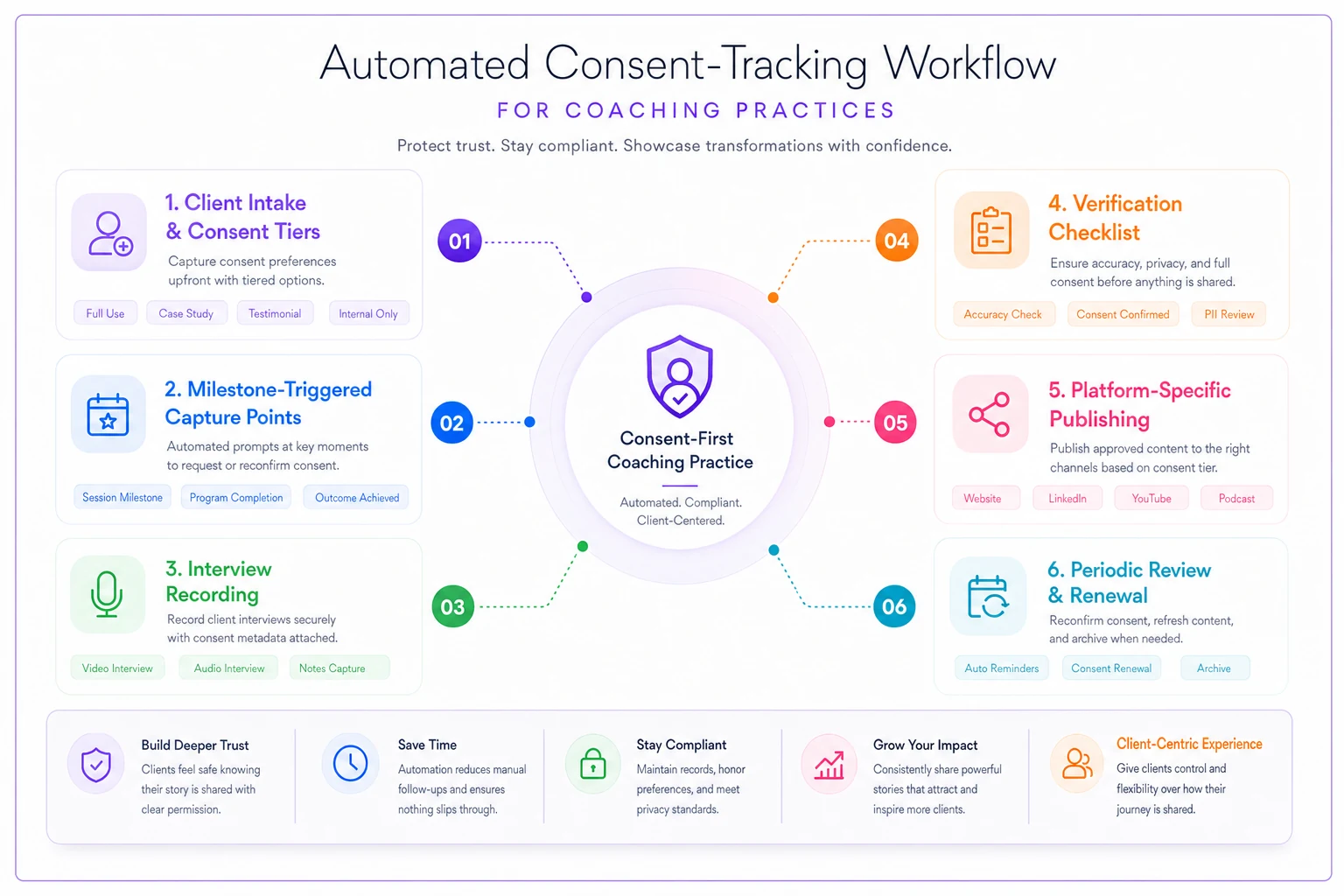
For practices managing multiple coaches, this kind of operational software becomes essential for maintaining consistent consent standards. Each coach follows the same capture workflow, uses approved interview scripts, and adheres to verification protocols—and the system tracks all of it, reducing legal risk while keeping testimonial quality high.
If you're also thinking about how client retention connects to your testimonial pipeline, this churn audit template is worth looking at. And if referrals are part of your growth strategy, pairing a strong testimonial workflow with a structured partnership playbook makes both work better.
Turning trust into sustainable social proof
The most successful coaches understand that testimonial capture isn't about extracting value from clients—it's about documenting transformation in ways that serve everyone involved. When you build ethical consent workflows into your operations from day one, testimonials become a natural output of great coaching rather than an awkward ask.
Your clients want their success stories told. They're proud of their transformations and want to inspire others facing similar challenges. The coaching testimonial consent workflow simply provides the structure and safety that makes sharing feel good for everyone involved.
Start implementing these protocols gradually. Begin with your next new client. Build consent into their onboarding. Set milestone markers. Use the interview scripts during natural celebration moments. Before long, you'll have a library of powerful, ethical testimonials that convert prospects while honoring the clients who trusted you with their transformation.
Each testimonial represents a real person who chose to be vulnerable about their struggles and growth. Honor that vulnerability through careful consent management, thoughtful capture processes, and respectful usage. Do this consistently, and you'll never struggle for social proof again.
The difference between coaches who can't get testimonials and those with a steady stream of compelling case studies usually isn't talent or results—it's having the operational foundation that makes sharing stories feel safe and celebrated rather than scary and uncertain.
Ready to elevate your coaching business?
Join hundreds of coaches using Guidyly to save time, enhance client engagement, and grow their practice.