

Most coaching practices don't have a marketing problem. They have a buyer confusion problem.
The offer that lands a $6k individual client and the offer that lands a $60k corporate leadership program are usually built by the same coach, using the same language, sent through the same funnel. And then the coach wonders why the enterprise deal stalled in "we'll circle back after Q3" limbo for five months.
Different buyers move through completely different decision machinery. A consumer buys on emotion and books within a week. A small-business owner buys on ROI but pays out of their own pocket, so trust matters more than the pitch deck. An HR or L&D buyer can't buy at all without artifacts — decks, pilot plans, procurement approvals — and touches four other people before signing. Same coach, same skill, three totally different sales operations behind them.
This is the part that breaks quietly. You can be great at all three and still lose money on two of them because your go-to-market for coaching practices was never actually designed per-buyer. It just grew.
Below is what each buyer type actually requires — the artifacts, the channel economics, and the operational handoffs that have to exist behind the scenes.
The core mistake: running one GTM motion for three different economics
There's a pattern that shows up in almost every practice trying to grow past the solo-coach ceiling.
The coach starts consumer. Word of mouth, a few social posts, discovery calls, done. That motion works up to a point. Then a corporate opportunity lands — someone's employer wants to bring them in — and the coach improvises the entire enterprise sale from scratch. No pilot structure, no ROI framing, no procurement plan. They win it on relationship, deliver beautifully, and then can't repeat it because nothing was systematized.
Meanwhile the channel opportunity — partnerships, referrals from adjacent professionals, reseller-style arrangements — never gets built at all, because it doesn't scream for attention the way a direct sale does.
What breaks at scale isn't the coaching. It's that three motions with three cost structures are being run out of one calendar and one brain. The consumer motion has low deal size and high volume. The corporate motion has high deal size and long cycles. The channel motion has near-zero acquisition cost but requires patience and partner enablement. You can't resource them the same way, and you definitely can't measure them the same way.
Here's the split that matters before going blueprint by blueprint.
| Dimension | Direct-to-Consumer | Small-Business Buyer | HR / Enterprise |
|---|---|---|---|
| Typical deal size | $1.5k–$8k | $8k–$25k | $30k–$150k+ |
| Sales cycle | Days to 2 weeks | 3–6 weeks | 3–9 months |
| Decision makers | 1 (the client) | 1–2 (owner + maybe partner) | 4–7 (HR, L&D, finance, sponsor) |
| Required artifacts | Testimonials, offer page | Simple ROI framing, proposal | ROI deck, pilot plan, security/compliance answers |
| Primary channel | Content, referrals, ads | Referrals, local network, partnerships | Warm intros, RFPs, procurement |
| CAC tolerance | Low | Medium | High (but amortized over contract) |
| Who handles ops after sale | Coach | Coach + light admin | Coach + program coordinator |
The rows people skip are the last two. Every buyer type creates a different operational handoff the moment the deal closes, and if that handoff isn't planned, delivery quality drops exactly when the stakes are highest.
Blueprint 1: Direct-to-Consumer
Consumer coaching is deceptively simple to start and deceptively hard to keep profitable. The channel economics are unforgiving because deal sizes are small, so anything that inflates acquisition cost eats the whole margin.
Never miss a session or detail again.
Guidyly helps you book, manage, and track every coaching session efficiently.
- Centralized session scheduling
- Automated client reminders
- Progress tracking & notes
No credit card required
The channel reality. Paid ads rarely pencil out for a solo consumer coach unless the offer is $3k+ and the funnel converts cold traffic — which it usually doesn't. What actually works is a referral-plus-content loop: past clients feed new ones, and content warms strangers into discovery calls. The math only holds if your booked-call-to-client rate stays north of roughly 30–40%. Below that, you're burning attention faster than you're converting it.
Required artifacts (kept minimal on purpose):
-
A single strong offer page with 3–5 outcome-specific testimonials
-
A discovery-call script with a qualification gate (not everyone should book)
-
An intake and fit-scoring step before the paid engagement starts
-
A simple reactivation sequence for people who didn't buy the first time
The resourcing. This motion should stay lean. If you're hiring anyone here, it's part-time admin to protect your calendar, not a salesperson. The handoff is short: sale closes, onboarding sequence fires, first session gets scheduled. The failure point is almost always the gap between "said yes" and "first session" — people ghost in that window more than any other.
When D2C makes sense
When your average client value is high enough that a handful of clients funds the practice, and when you genuinely enjoy volume relationship management.
When it's a bad idea
When your rate is low and you're trying to scale by adding more one-to-one seats. You'll cap out on hours long before you hit your revenue goal. That's the ceiling that pushes coaches toward group programs or corporate — and often they jump before fixing consumer economics, which just moves the problem.
Blueprint 2: The Small-Business Buyer
This is the most underrated segment and the one most coaches skip straight past on their way to "enterprise." A small-business owner buying coaching for themselves or a couple of key people sits in a strange middle zone: they think like a consumer emotionally but justify like a corporation financially.
The mistake is pitching them like enterprise (too much process, too many artifacts, kills the momentum) or like a consumer (too little ROI justification, and they can't rationalize the spend). You need a middle motion.
Channel economics. This segment lives on referrals and partnerships. A small-business owner trusts other owners and the professionals already in their orbit — accountants, fractional CFOs, business consultants. Building those referral relationships is slow but the acquisition cost is close to nothing once it's running. If you're serious about this segment, the partnership playbook approach with a partner map and outreach cadence is where the real leverage is, not cold outreach.
Required artifacts:
-
A one-page ROI framing (not a 20-slide deck) — what the engagement is expected to change and roughly what that's worth
-
A proposal template with 2–3 tiered options
-
A short case example that matches their business size
-
A simple pilot or trial-month structure to lower the yes barrier
A realistic example. A coach working with owner-operators of home-services businesses, deal size around $12k for a six-month engagement. Cold outreach converted somewhere around 2–3% and burned time. After redirecting energy into three referral partners — a bookkeeper, an industry consultant, a local business group — roughly 60% of new deals started arriving pre-warmed. Close rate on warm referrals sat near 45–50% versus the low single digits cold. Same coach, same offer. The channel was doing the heavy lifting.
The operational handoff nobody plans for
When you sell to a business owner, delivery bleeds into their operations. They'll want to loop in a team member, share results, sometimes expand the engagement. If your delivery is purely one-to-one with no structure for expansion, you leave money on the table and the relationship plateaus.
Blueprint 3: HR / Enterprise Buyers
Enterprise is where coaches either build a real business or lose six months chasing a logo. The economics are attractive — one contract can equal thirty consumer clients — but the motion is a different sport entirely.
The single biggest misread: treating the enthusiastic champion as the decision. Your sponsor loves you. Your sponsor cannot sign. Between them and the contract sits L&D, HR, finance, procurement, and sometimes legal. Every one of them can stall the deal, and none of them care about your coaching philosophy. They care about risk, measurable outcomes, and whether this survives budget review.
Required artifacts (non-negotiable here):
-
A proper ROI deck tied to business metrics the buyer already tracks (retention, ramp time, promotion readiness)
-
A structured pilot plan with defined success criteria and a conversion path
-
A sales cadence built around a multi-stakeholder buying group, not a single contact
-
Answers ready for procurement
data handling, confidentiality, insurance, references
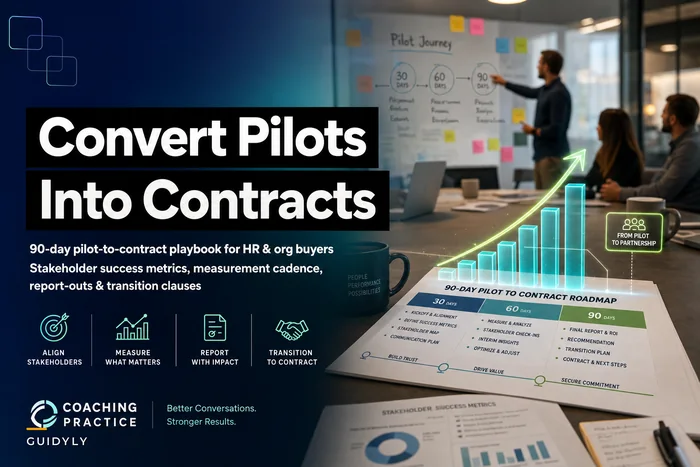
The pilot is the whole game. A well-run pilot de-risks the big contract and gives your champion the evidence they need to sell you internally. A vague pilot ("let's do a few sessions and see") converts almost never because there's nothing to point at when budget season arrives. If enterprise is your growth path, treat pilot conversion as its own discipline — the 90-day corporate pilot playbook that turns pilots into contracts covers the structure that actually holds up under procurement scrutiny.
The enterprise sales cadence, step by step
-
Discovery with the sponsor — understand the business problem in their language, not coaching language.
-
Map the buying group — who signs, who influences, who can block. Get names.
-
Deliver the ROI framing — tie the program to metrics finance already reports.
-
Propose a scoped pilot — fixed timeline, defined cohort, explicit success criteria, pre-agreed conversion terms.
-
Run the pilot with instrumentation — collect the evidence you'll need before you need it.
-
Present results to the full buying group — not just the champion.
-
Convert to annual or multi-cohort contract — with the pilot data doing the persuading.
When enterprise is a bad idea
When you're solo with no delivery support and no operational buffer. Enterprise contracts come with reporting requirements, coordination overhead, and multiple stakeholders expecting responsiveness. If you win one and can't service it while keeping your other clients happy, the win becomes a liability. Coaches routinely underestimate the coordinator-level work an enterprise account generates — scheduling across a cohort, aggregating outcomes, managing the sponsor relationship. That's a role, even if part-time.
The part that connects all three: ops handoffs
What turns a collection of tactics into an actual go-to-market system is the handoff from sold to delivered.
Each buyer type creates a different handoff, and the failure mode is always the same shape: the sale gets all the attention, the transition gets none, and quality dips right after the client's expectations peak.
-
Consumer handoff yes → onboarding sequence → first session. Short window, high ghost risk. Automate the scheduling and confirmation so nobody falls through.
-
Small-business handoff yes → kickoff → possible team involvement → expansion check-in. Needs a structure for looping in additional people without redesigning delivery each time.
-
Enterprise handoff contract → cohort setup → coordinator assignment → reporting cadence → renewal motion. This is a project, not a booking.
A quick self-audit for whether your handoffs are actually built:
-
[ ] Does every closed sale trigger a defined next step without you manually initiating it?
-
[ ] Is there a named owner for post-sale coordination in each buyer type (even if it's still you)?
-
[ ] Do enterprise accounts have a reporting rhythm agreed before delivery starts?
-
[ ] Is there a defined moment where expansion or renewal gets raised, rather than hoping it comes up?
-
[ ] Can you tell, per channel, what a client actually costs you to acquire and serve?
That last one is where the whole system either makes sense or doesn't. When your operational data lives in one place — leads, channel source, deal size, delivery hours, renewal status — you can finally see which of your three motions is actually funding the practice and which is quietly draining it. Most coaches discover their favorite motion isn't their most profitable one. This is where AI-assisted operational software earns its place: not by generating pitches, but by tracking the handoffs, surfacing where deals stall by channel, and cutting the manual coordination that eats a solo coach's week. The value is in seeing the whole system clearly, not in any single automation.
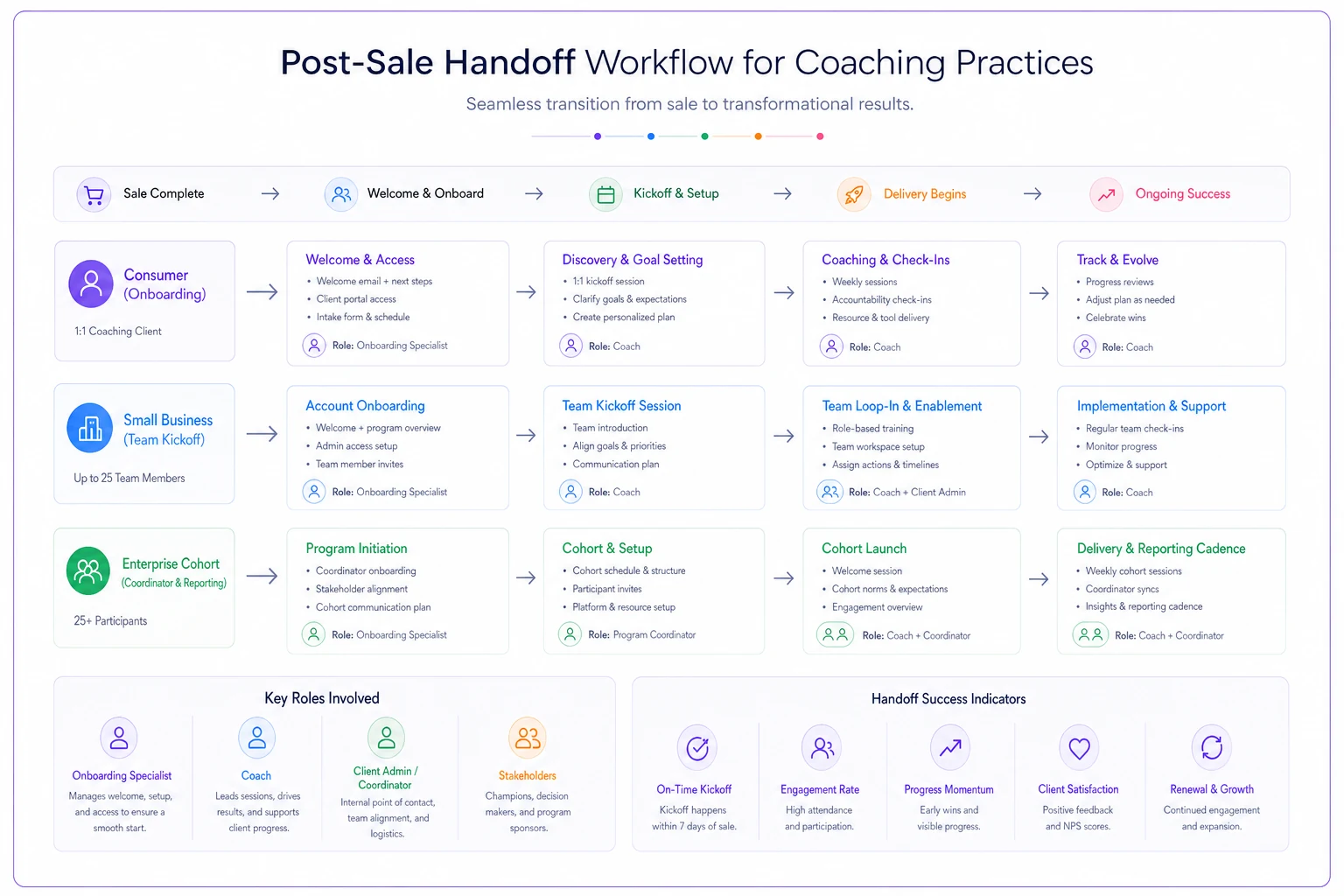
This visual shows the sold→delivered flow across consumer, small‑business, and enterprise motions.
Resourcing: what each motion actually needs from you
A practical way to think about staffing and time, because running all three at full intensity is how coaches burn out.
| Motion | Your time load | Support needed | First hire |
|---|---|---|---|
| D2C | High (calls, delivery) | Low | Part-time admin |
| Small-business | Medium | Partnership nurturing | Referral-relationship time, not headcount |
| Enterprise | Front-loaded, then cyclical | High during pilots | Program coordinator |
Most sustainable practices don't run all three equally. They pick one primary engine, keep a second as a supporting channel, and treat the third opportunistically. Trying to give equal energy to consumer volume, small-business referrals, and enterprise cycles simultaneously is the fastest way to do all three badly.
A short real scenario
A mid-career leadership coach was running purely consumer — around 14 one-to-one clients, roughly $9k–$11k a month, fully maxed on hours with no room to grow. Enterprise leads occasionally appeared and died in the "we're interested" stage because there was no pilot structure and no ROI framing to hand a decision-maker.
The shift wasn't dramatic on the surface. She kept consumer as a supporting channel, capped it, and rebuilt her enterprise motion around a scoped 90-day pilot with defined success metrics and a real deck. First pilot converted to a two-cohort annual contract in the mid five figures. The second, no. But even a 50%-ish pilot conversion rate at that deal size reshaped the economics — one enterprise contract replaced several months of consumer grind, and freed hours instead of consuming them.
Bringing it together
The reason go-to-market for coaching practices feels chaotic is that most coaches are running three businesses' worth of sales motion out of one improvised system. The offer might be identical. The buyers are not.
Map each buyer to its real economics. Build the specific artifacts each one requires — testimonials for consumers, ROI framing for owners, full decks and pilot plans for enterprise. Then plan the handoff from sold to delivered, because that's where quality quietly erodes and where scale actually lives or dies.
Pick your primary engine. Support it with a second. Stay opportunistic on the third. And keep your channel and delivery data somewhere you can actually see it — because the practices that grow cleanly are the ones that know which motion is paying for the others.
Ready to elevate your coaching business?
Join hundreds of coaches using Guidyly to save time, enhance client engagement, and grow their practice.