

Most coaches assign homework the same way they'd assign a college essay—here's what to do, see you next week. Then they wonder why completion rates sit around 30-40% even with motivated clients paying thousands for transformation.
The problem isn't the clients. It's the homework architecture.
After building operational platforms for coaching businesses, the pattern gets obvious pretty fast. Coaches who hit 70%+ completion rates don't just assign better homework—they build an entire system around getting it done. Homework design coaching isn't about motivation or accountability alone. It's about operational precision in how assignments flow through a client's actual life.
The Real Cost of Poor Homework Completion
When homework doesn't get done, coaching breaks. Not immediately, but gradually.
The coach starts doubting their approach. Maybe the client isn't ready? Maybe the program needs restructuring? Sessions shift from building on completed work to rehashing why nothing happened. Progress stalls. The client feels guilty. The coach feels frustrated. Renewal rates drop from around 65% to somewhere near 40%.
One executive coach had her entire business model tied to homework completion. Her clients paid $8,000 for a 3-month program. When completion sat below 50%, about 2 in 10 clients renewed. When it hit 75%, that jumped to 6 in 10. That's a $32,000 revenue swing per cohort—purely from how homework was structured and tracked.
The frustrating part? Most coaches never measure completion rates systematically. They track session attendance, they track revenue, but the actual engine driving results stays invisible.
Micro vs Macro Assignments: The Fundamental Split
Not all homework is created equal, and coaches who understand this distinction tend to be the ones actually getting work done.
Never miss a session or detail again.
Guidyly helps you book, manage, and track every coaching session efficiently.
- Centralized session scheduling
- Automated client reminders
- Progress tracking & notes
No credit card required
Micro assignments take under 15 minutes and require minimal cognitive load. Daily gratitude entries, a single breathing exercise, sending one reconnection text. These build momentum and create habit loops.
Macro assignments need 30-90 minutes of focused work. Strategic planning exercises, relationship maps, career vision documents. They drive breakthrough insights but require protected time and real mental energy.
Most coaches default to macro assignments because they feel more impactful. "Complete this values assessment workbook" sounds more transformational than "text one friend daily." But without micro assignments creating daily touchpoints, macro work often just doesn't happen.
The optimal mix tends to be around 70% micro, 30% macro for most coaching contexts. A leadership coach might structure it like this:
-
Daily
5-minute morning intention setting (micro)
-
Daily
One specific feedback conversation (micro)
-
Weekly
45-minute strategic planning session (macro)
-
Bi-weekly
Full stakeholder analysis (macro)
Business coaches working with entrepreneurs often need a different ratio—closer to 50/50, since their clients already operate in execution mode. Life coaches might run 80% micro to build basic habits first.
Timing Rules That Actually Work
Assignment timing matters more than assignment quality. A well-designed exercise given at the wrong moment becomes worthless.
The 48-Hour Rule: Any assignment requiring more than 30 minutes needs to be started within 48 hours of the session, or completion probability drops below 25%. This isn't a motivation issue—it's about cognitive distance. After two days, the session energy fades and the assignment feels disconnected from the coaching relationship.
The Sunday Problem: Never make Sunday the default due date. Most clients use Sundays for family, rest, or planning the week ahead. Monday becomes cramming day, Tuesday becomes guilt day, and by Wednesday they've mentally written off the assignment entirely.
Elastic Deadlines: Instead of "complete by next session," try "complete by Thursday, share by Saturday." Two touchpoints—one for doing, one for reflecting. Completion rates tend to jump around 20% with just this one change.
A career coach moved all macro assignments to Tuesday/Wednesday completion (when her corporate clients had the highest energy and fewest meetings) and micro assignments to morning routines. Completion went from 45% to 70% in six weeks.
Default Nudges and Natural Accountability
Traditional accountability—"did you do your homework?"—creates a parent-child dynamic that quietly undermines adult learning. Effective coaches build accountability into the assignment structure itself.
The Screenshot Standard: Instead of asking clients to "track your morning routine," ask them to "screenshot your phone's alarm history every Friday." The specific, observable action creates accountability without judgment.
The Buddy Block: Pair clients for specific assignments. Not vague accountability partners, but assignment buddies with defined roles. One client does the exercise, the other asks three specific questions about it. Both learn, both stay engaged.
Public Commitment Variants:
-
Email draft method
Client writes an email to their spouse or a friend about what they're committing to, saves it as a draft, sends it after completing
-
Calendar screenshot
Client screenshots their calendar showing time blocked for the assignment
-
Voice memo check-in
Client sends a 60-second voice memo right after completing, while the energy is still fresh
None of these are punitive. They're structural. The accountability lives in the system, not in the coach's judgment.
Completion Micro-Metrics Most Coaches Miss
Most coaches track homework as binary—done or not done. That's like measuring business health as "made money" or "didn't make money."
Attempt Rate: How many clients started the assignment? This separates motivation issues from completion issues. If 80% start but only 40% finish, you have a complexity problem, not an engagement problem.
Depth Score: On a 1-5 scale, how thoroughly was it completed? A half-done strategic plan might be more valuable than a fully-completed gratitude list.
Time-to-Start: Days between assignment and first attempt. Under 2 days signals high engagement. Over 4 days usually points to a structural problem.
Revision Rate: How many clients go back and expand their initial work? High revision rates indicate strong value perception.
One health coach implemented these metrics and found something unexpected—her most "engaged" clients based on session energy had the lowest depth scores. They were performing engagement in sessions but not doing deep work between them. She restructured her entire program based on that single insight.
The Scaffolding System
Homework fails when it exists in isolation. Coaches who consistently get work done build scaffolding that makes completion almost inevitable.
Pre-work Scaffolds:
-
Send assignment overview 24 hours before the session
-
Include estimated time investment
-
Specify required materials or environment
-
Link to previous related work
During-work Scaffolds:
-
Embedded timers (work for exactly 20 minutes)
-
Mid-point check-ins (after 10 minutes, assess where you are)
-
Escape hatches (if stuck for 5 minutes, skip to the next section)
-
Example anchors (show what "good enough" looks like)
Post-work Scaffolds:
-
Immediate celebration prompt (text yourself one win)
-
Next-step clarity (what happens with this work going forward?)
Add a 'chaos option' to every assignment—a 5-minute version for when kids are melting down and time disappears.
A life coach working with busy mothers added a "chaos option" to every assignment—a 5-minute version for when kids are melting down and time disappears. Completion rates hit 85% because clients knew they could always do something.
Templates That Drive Completion
Generic assignments get generic results. Structured templates with fill-in components get specific completions.
The 3-2-1 Reflection Template:
-
3 observations from this week
-
2 patterns you notice
-
1 experiment for next week
Simple, memorable, completable. Coaches use variations of this for everything from leadership development to relationship coaching.
The Before/During/After Template:
-
Before
What's your energy level? (1-10)
-
During
What specific action will you take?
-
After
What shifted? (one sentence)
Works for any behavioral change assignment. The structure itself creates completion momentum.
The Decision Matrix Template:
| Option | Upside (Best Case) | Downside (Worst Case) | Most Likely | Gut Feeling |
|---|---|---|---|---|
| A | [fill in] | [fill in] | [fill in] | [score 1-10] |
| B | [fill in] | [fill in] | [fill in] | [score 1-10] |
| C | [fill in] | [fill in] | [fill in] | [score 1-10] |
Career coaches, business coaches, life transition coaches—everyone can use this. The template turns overwhelming decisions into something manageable, which is most of the battle.
Nudge Sequences That Actually Work
Automated reminders increase completion, but most coaches use them wrong. One reminder the day before a due date isn't a nudge sequence—it's a stress trigger.
The Activation Sequence (for macro assignments):
-
Day 0 (session day)
Assignment summary + calendar blocking prompt
-
Day 1
"Quick start" nudge—just open the document or worksheet
-
Day 3
Progress check—"Even 10 minutes counts"
-
Day 5
Deadline approach—"Tomorrow is ideal completion day"
-
Day 6
Final nudge—"Today's the day, you've got this"
The Habit Sequence (for micro assignments):
-
Daily same-time nudge for week one
-
Every other day for week two
-
Twice weekly for week three
-
Weekly check-in after that
The Comeback Sequence (for missed assignments):
-
Day 1 after miss
"No judgment—what got in the way?"
-
Day 3
"Modified version attached—15 minutes max"
-
Day 7
"Let's discuss alternatives in our next session"
A relationship coach tested a dozen different nudge sequences and found that positive framing ("Time to invest in your growth") outperformed accountability framing ("Don't forget your commitment") by roughly 30% in completion rates.
Integration Points for Different Coaching Styles
Executive/Leadership Coaches: Focus on micro assignments that integrate into existing workflows. "After your next team meeting, capture one leadership insight" beats "complete this leadership assessment" almost every time. Roughly 60% micro assignments that happen during work, 40% macro reflection exercises.
Health/Wellness Coaches: Layer assignments into existing routines. Morning assignments attach to coffee or breakfast, evening assignments to bedtime routines. The goal is making homework feel like an enhancement, not an addition. Start with 90% micro for habit formation, gradually shift toward 60/40 as routines solidify.
Business Coaches: Tie every assignment to revenue or time impact. "This exercise will clarify your pricing strategy" motivates more than "explore your relationship with money." These clients respond to homework that connects directly to business metrics—make that connection explicit.
Career Coaches: Use project-based macro assignments (portfolio updates, network mapping) supported by daily micro actions (one LinkedIn connection, one skill practice). The combination of visible progress and daily momentum keeps clients engaged through long transition periods.
When Smart Homework Design Backfires
Sometimes optimized homework design creates unexpected problems. A coach specializing in perfectionist recovery created such clear, structured assignments that her clients' perfectionistic tendencies kicked into overdrive. Completion rates were high, but clients were spending three times the recommended time on each exercise.
The fix: she added "maximum time" constraints and "good enough" markers to every assignment. "Spend no more than 20 minutes" and "stop when you have three examples" became standard instructions.
Another coach working with ADHD entrepreneurs found that too many nudges created overwhelm. The solution was letting clients choose their nudge frequency during onboarding—daily, twice weekly, or weekly. Completion rates actually improved when clients had control over the system. Autonomy over the process matters, especially for clients who already struggle with external structure.
Building Your Homework Completion System
Here's the operational framework coaches hitting 70%+ completion rates tend to follow:
Week 1-2: Baseline Measurement
-
Track current completion rates
-
Note which assignments get done and which get skipped
-
Survey clients on homework barriers
-
Time how long assignments actually take
Week 3-4: Structure Testing
-
Introduce micro/macro split
-
Test one nudge sequence
-
Add completion scaffolding to one assignment
-
Measure changes
Week 5-6: Template Development
-
Create 3-5 reusable templates
-
Add timing rules to all assignments
-
Build assignment buddy pairings
-
Track completion metrics
Week 7-8: Optimization
-
Adjust ratios based on data
-
Refine nudge sequences
-
Modify scaffolding based on client feedback
-
Lock in what works
Visualizing this week-by-week flow can help teams implement it.
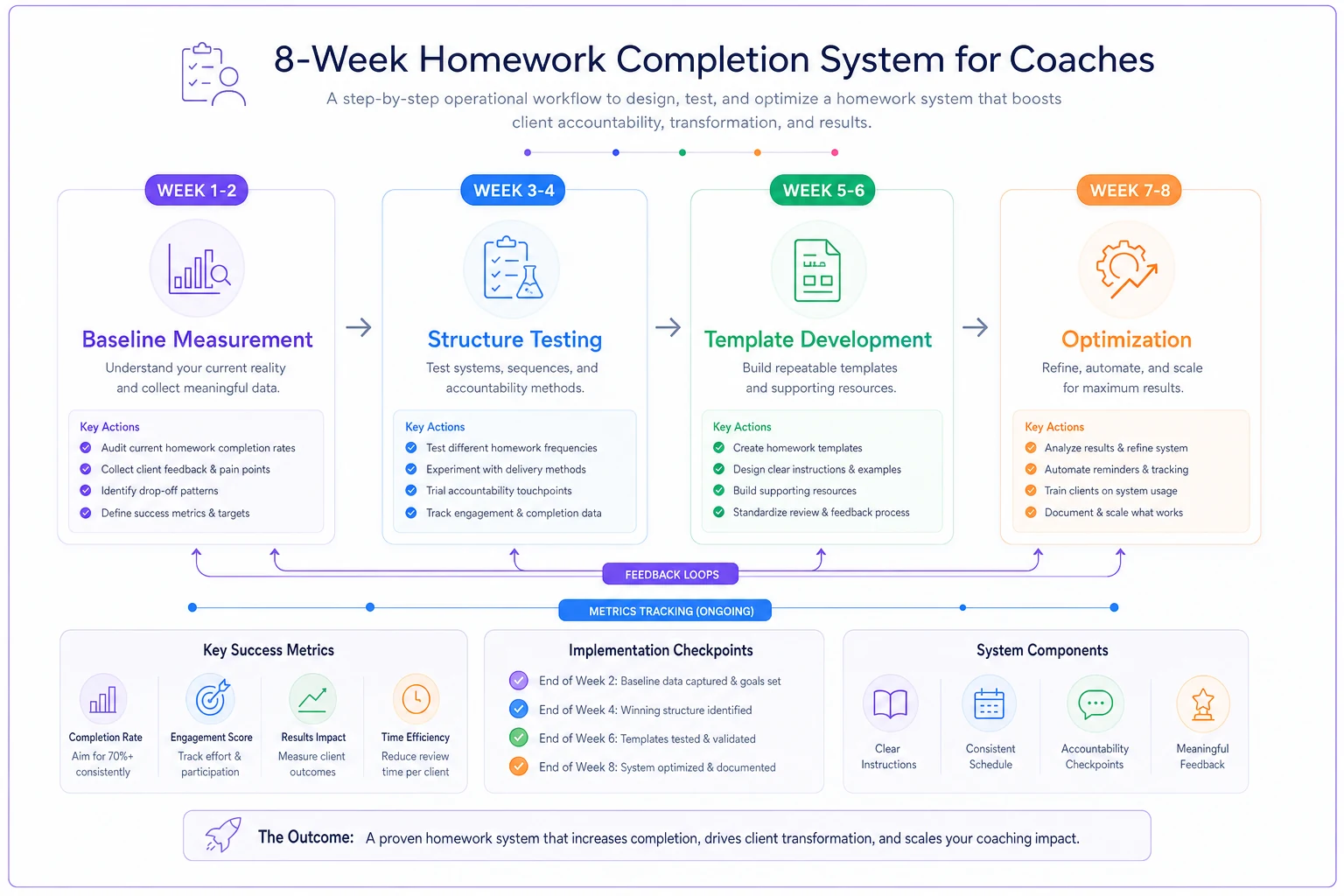
A career coach using this system went from 35% completion to 72% in 8 weeks. More importantly, her client results shifted too—average time to job offer dropped from 5.5 months to 3.5 months.
The Technology Layer
Homework design coaching starts with structure and psychology, but technology amplifies what's already working. Modern coaches use operational software to automate the repetitive logistics while preserving the human connection.
Assignment management platforms can handle nudge sequences automatically, track completion metrics in real time, and use AI automation to personalize reminder language based on how individual clients communicate. One coach found that her analytical clients responded better to data-driven nudges ("You're 67% through this week's assignments") while her creative clients preferred progress-based framing ("Two exercises down, one to go!").
The automation handles the logistics—sending reminders, tracking completions, organizing submissions. That frees coaches to focus on what actually matters: reviewing the work and preparing session content based on what got done.
Technology only amplifies solid architecture, though. No amount of automation fixes poorly designed assignments or missing accountability structures.
Making It Stick
The gap between coaches struggling with 30% homework completion and those hitting 70%+ isn't about client quality, motivation tactics, or willpower-based accountability. It's operational precision in how homework is designed and delivered.
Start with the micro/macro split. Add timing rules that respect how clients actually live. Build accountability through structure, not judgment. Track completion metrics beyond "done or not done." Create templates that make starting easier than avoiding.
Treat homework design as an operational system, not an afterthought. The session is where insights happen. Homework is where transformation happens. When the architecture is right, retention improves, results accelerate, and referrals increase because clients actually get what they paid for.
Coaches who understand this don't just assign homework—they engineer systems where follow-through feels like the path of least resistance. Not because they're pushing clients harder, but because the structure does the heavy lifting.
Once you see homework as an operational challenge rather than a motivation challenge, the solutions become obvious. Structure beats willpower. Systems beat reminders. Completion beats perfection, every single time.
Coaches who understand this don't just assign homework—they engineer systems where follow-through feels like the path of least resistance. Not because they're pushing clients harder, but because the structure does the heavy lifting.
Ready to elevate your coaching business?
Join hundreds of coaches using Guidyly to save time, enhance client engagement, and grow their practice.