

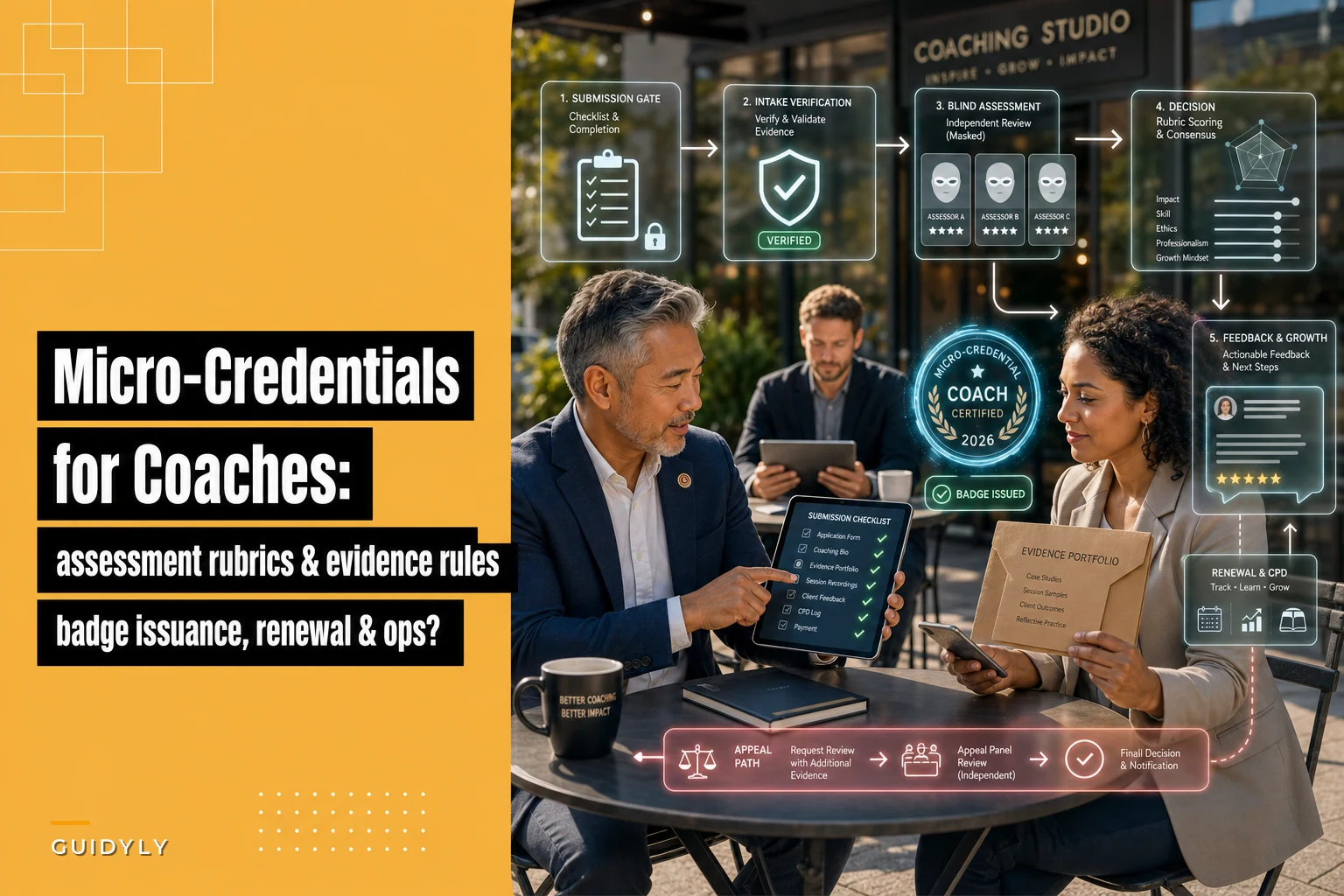

A micro‑credential sounds simple until the first cohort finishes and someone emails asking, "So… how do I actually get the badge?" That's the moment most coaches realize they built a certificate, not a certification. The difference is operational. A certificate is a PDF you email. A certification is a system — rubrics, evidence, verification, expiry, and a defensible answer to "what does this badge actually mean?"
This is a manual for that system. Narrow scope on purpose: how to run the assessment and issuance machinery for a paid micro-credential that sits alongside your coaching program. Not marketing, not pricing strategy, not learning design philosophy. Just the ops that make a badge mean something and stay cheap to administer.
Why most coaching micro-credentials quietly fall apart
The failure almost never happens at launch. It happens around cohort three or four, when the founder-coach is no longer personally reviewing every submission and the "standard" lives entirely in their head.
The pattern plays out like this: a coach launches a credential with a vague rubric ("demonstrate competence in the framework"), reviews the first 12 submissions personally, and approves 11 of them because they feel right. Then they bring in a second assessor, or the cohort grows to 40, and suddenly the pass rate swings wildly depending on who's grading. One assessor passes 95%. Another passes 70%. A client who failed emails a friend who passed with weaker work, and now you have a credibility problem and a refund conversation happening at the same time.
The root cause is that the evidence of competence was never pinned down. "Demonstrate competence" is not a standard. It's a vibe. And vibes don't survive scale, staff turnover, or an annoyed client asking why they didn't pass.
The second common failure is renewal — or the total absence of it. Coaches issue lifetime badges because it's less work, then two years later the credential is attached to a framework they've since revised twice. The badge now certifies something the holder may never have learned. That's a quiet liability sitting in the market with your name on it.
Start with the evidence, not the rubric
Most people build the rubric first and then scramble to figure out what work samples prove it. Reverse that. Decide what a competent person actually produces, then write the rubric against that artifact.
Never miss a session or detail again.
Guidyly helps you book, manage, and track every coaching session efficiently.
- Centralized session scheduling
- Automated client reminders
- Progress tracking & notes
No credit card required
A rubric describing abstract qualities ("shows strong coaching presence") forces every assessor to invent their own evidence. A rubric tied to a specific artifact ("a recorded 20-minute coaching session plus a written reflection using the four-part debrief template") tells everyone exactly what they're looking at.
The artifacts that work well for coaching micro-credentials tend to be:
-
A recorded demonstration (a real or simulated session, 15–30 minutes)
-
A written case analysis applying your framework to a client scenario
-
A reflection document connecting their choices to specific model components
-
A short artifact the client themselves produced under the candidate's guidance
Pick one or two. Three artifacts per candidate is usually the ceiling before assessment time starts eating your margin. If you want a sharper view on tying activities to provable results, the thinking in turning coaching activities into verifiable outcomes maps directly onto choosing credential evidence.
Writing a rubric that two different assessors score the same
The test of a rubric isn't whether it reads well. It's whether two assessors, grading the same submission separately, land within a point of each other. That's inter-rater reliability, and it's the single thing that separates a credible credential from a liability.
A rubric that passes this test has three traits:
-
Each criterion describes observable behavior, not inferred quality. "Asks open questions" is observable. "Demonstrates curiosity" is interpretation.
-
Each performance level has a concrete anchor. Not "good / fair / poor" but a described example of what a 3 looks like versus a 2.
-
The scale is short. A 0–3 scale beats a 1–10 scale every time. The more gradations you add, the more assessors disagree about the middle.
Here's a compact rubric structure that holds up under multiple graders:
| Criterion | 0 — Not Met | 1 — Developing | 2 — Competent | 3 — Strong |
|---|---|---|---|---|
| Question quality | Mostly leading or closed questions | Mix, but defaults to closed under pressure | Consistently open, client-led | Open questions that visibly shift client thinking |
| Framework application | Framework absent or misapplied | Names the model but applies loosely | Applies the correct component at the right moment | Adapts the framework fluidly to the client's situation |
| Session structure | No discernible arc | Opens or closes well, not both | Clear contracting, body, and close | Structure invisible but fully present |
| Reflection depth | Describes what happened only | Some self-critique | Links choices to model with specific reasoning | Identifies alternative moves and trade-offs |
Set your pass threshold as a rule, not a feeling. Something like: "Competent (2) or higher on every criterion, with no single 0, and a total of at least 8 of 12." Write that down before you grade a single submission, because the temptation to adjust the bar after seeing results is enormous and it destroys consistency.
One pattern worth watching: assessors drift toward the middle when they're tired. On a 0–3 scale, a fatigued grader gives everything a 2. Rotate grading in short blocks and spot-check a sample against a second assessor every cohort to catch drift early.
The evidence collection workflow
This is where the admin burden actually lives, and where most credentials turn into a part-time job the founder never wanted. The workflow needs to handle four things cleanly: submission, intake verification, assessment, and the appeal path.
A clean version looks like this:
-
Submission with a checklist gate. The candidate submits through one channel with a self-check: recording included, reflection attached, consent confirmed for any client featured. Submissions missing an item get bounced before an assessor ever touches them. Incomplete submissions are the biggest silent time-drain in credential ops.
-
Intake verification. Someone (or a simple automation) confirms the artifacts are what they claim to be — the recording actually plays, the reflection is the candidate's own work, consent is on file. This is a 90-second check that prevents hours of downstream mess.
-
Blind-ish assessment. The assessor grades against the rubric, ideally without knowing whether the candidate is a favorite or a struggler. Where possible, strip names from reflections. Full anonymity is hard with video, but reducing bias cues helps consistency.
-
Decision and feedback. Pass, resubmit, or fail — each with a templated feedback block tied to the rubric criteria. "You scored a 1 on framework application; here's the specific moment where the model would have changed your next question." Feedback tied to the rubric cuts appeal volume dramatically because the reasoning is visible.
-
Appeal path. A single, documented route for contesting a result, reviewed by a second assessor who didn't do the original grade. Having this written down before anyone appeals is what keeps a disputed result from becoming a reputation fight.
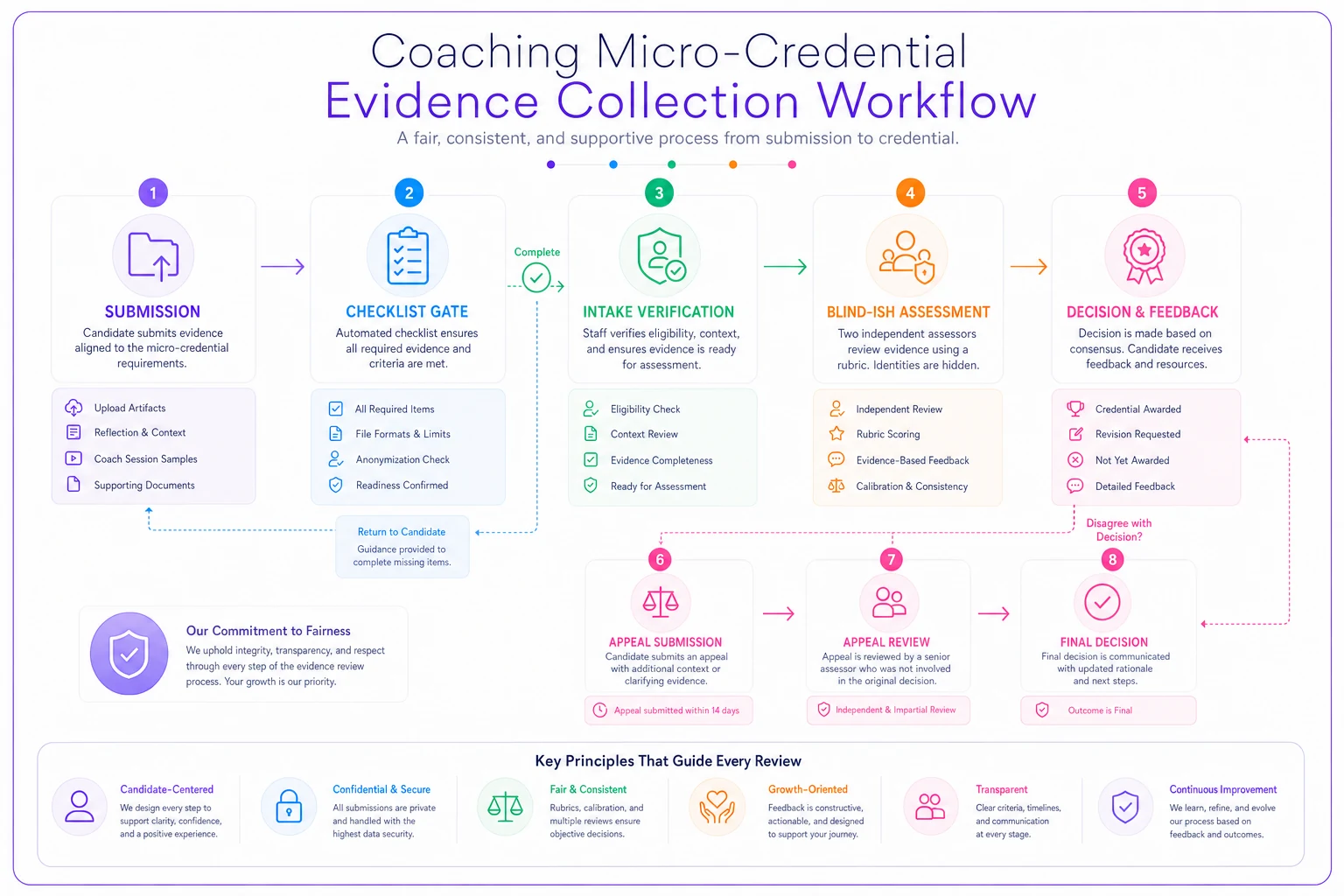
A simple flow diagram like this keeps everyone aligned on who does what at each step.
On consent: any artifact featuring a real client needs explicit, documented permission before it enters assessment. This is non-negotiable, and it's the kind of thing that's trivial to set up and painful to retrofit after a complaint.
Badge issuance: make it verifiable or don't bother
A badge no one can verify is decoration. The entire point of a credential is that a third party — an employer, a prospective client, a referral partner — can confirm it's real and current.
At minimum, every issued badge should carry:
-
A unique credential ID
-
Issue date and expiry date
-
The specific competencies it certifies (not just a program name)
-
A verification method — a public lookup page or a signed record the holder can share
You don't need a fancy platform for this. A well-structured verification page with a searchable credential ID works fine. What you do need is for the issuance record and the verification record to be the same source of truth. The classic ops failure here is issuing the badge from one system and maintaining the verification list in a spreadsheet that someone forgets to update. Now a revoked or expired credential still shows as valid, and you've certified something false.
Tie issuance to the assessment decision directly. The badge should be generated from the passing record, not re-entered by hand. Every manual re-entry step is a place where a typo turns into a wrong name on a credential or a mismatched expiry date.
Renewal cadence: the part everyone skips
Lifetime credentials are a trap. Your framework evolves, your standards rise, and the market changes. A badge issued in 2023 against your old model shouldn't carry the same weight in 2026 as a freshly earned one — but if you never built expiry in, it does.
A sane renewal cadence for a coaching micro-credential usually lands around a two-year validity window with a lightweight renewal, rather than a full re-assessment. Full re-assessment every cycle is too expensive for everyone and nobody renews. The renewal needs to be real enough to mean something and light enough that people actually do it.
A workable renewal structure:
| Element | At initial issuance | At renewal (every ~24 months) |
|---|---|---|
| Evidence required | Full artifact set + reflection | One updated artifact OR proof of continued practice |
| Assessment depth | Full rubric | Abbreviated check against current standard |
| Admin trigger | Program completion | Automated reminder at 90, 30, and 7 days before expiry |
| Cost to holder | Full credential fee | Reduced renewal fee |
The reminder cadence matters more than people expect. A credential that silently expires with no warning feels like a bait-and-switch to the holder, even when the terms were clear up front. Three nudges — 90 days, 30 days, 7 days — recover the vast majority of renewals that would otherwise lapse through simple forgetfulness.
Decide your lapse policy in advance too. If someone lets a badge expire, can they renew late, or do they re-earn from scratch? Write it down. Ambiguity here produces exactly the kind of "let me talk to the owner" escalation you're trying to design out of your practice.
Where lightweight automation earns its keep
You can run a small credential entirely by hand, and for your first cohort you probably should — you'll learn where the friction actually is. But the admin doesn't scale linearly. It scales with the number of touchpoints per candidate, and those multiply fast: submission checks, consent tracking, grading assignment, feedback delivery, issuance, verification upkeep, and renewal reminders across every active badge holder you've ever certified.
Automate the routing and record-keeping, keep the judgment human.
The tasks that quietly consume the most hours are the repetitive, rule-based ones: bouncing incomplete submissions, assigning graders, sending templated feedback, generating badges from passing records, firing renewal reminders on schedule. These are exactly the places where a workflow platform or a few well-built automations remove manual steps without touching the part that requires judgment — the actual assessment. A coach's time should go into grading borderline submissions and improving the rubric, not chasing down who submitted what and whether their consent form is on file.
The principle is simple: automate the routing and record-keeping, keep the judgment human. A credential loses all value the moment assessment starts feeling mechanical, so that stays with a person. Everything around it — the intake gate, the verification record, the expiry clock — is plumbing, and plumbing should run itself.
A real scenario
A solo leadership coach ran a six-week framework program and bolted on a paid micro-credential at around $350, on top of the program fee. First cohort: 14 candidates, all graded personally, all against a loose one-paragraph standard. It felt fine.
By the third cohort — around 38 candidates with a second assessor helping — the cracks showed. Grading time ran close to 40 minutes per submission because the rubric was vague enough that each one required re-litigating the standard. Two candidates who failed appealed, and because there was no documented rubric or appeal path, both got escalated into long email threads that ended in partial refunds just to close them out. Pass rates between the two assessors differed by roughly 20 points.
The fix wasn't complicated. They rebuilt the rubric onto a 0–3 scale tied to two specific artifacts, wrote an explicit pass rule, added a submission checklist gate, and documented an appeal route reviewed by the second assessor. Grading time dropped to around 15 minutes per submission because the decision became "score against anchors" instead of "decide what good means, again." Appeals in the following cohort: one, resolved in a single reply pointing at the rubric score. The two assessors' pass rates landed within a few points of each other.
The credential didn't get more rigorous-sounding. It got more defensible, and cheaper to run at the same time.
When a micro-credential makes sense — and when it doesn't
It makes sense when:
-
Your framework is stable enough that "competence in it" is a real, assessable thing
-
You have genuine demand from people who need to prove they can apply your method (internal coaches, consultants reselling your approach, program graduates seeking credibility)
-
You're willing to maintain the assessment standard over time, not just launch it
It's a bad idea when:
-
Your method is still changing every cohort — you'll be certifying a moving target
-
The only reason you're launching it is revenue, with no one actually needing verification
-
You can't commit to maintaining the verification record and renewal cadence, because an unmaintained credential is worse than none
Who should probably not do this yet: a coach on their first or second delivery of a program. You don't know your own standard well enough to codify it, and the artifacts you'd assess haven't stabilized. Run the program a few more times, watch what competent output actually looks like, then build the credential around that evidence. If you're still formalizing the program itself, the sequencing in productizing bespoke coaching work is the better starting point — the credential comes after the product is stable.
The one thing to get right
If you take a single operational principle from all of this: define the evidence and the pass rule before you sell a single seat. Almost every credibility problem, refund fight, and assessor disagreement traces back to a standard that was improvised after the fact.
A micro-credential is a promise that a badge means something specific and verifiable. The rubric, the evidence workflow, the verification record, and the renewal clock are just the machinery that keeps that promise honest when you're no longer the only person in the room. Build the machinery small and strict first. It's far easier to loosen a tight standard than to tighten a loose one after you've already issued badges you can't fully stand behind.
Ready to elevate your coaching business?
Join hundreds of coaches using Guidyly to save time, enhance client engagement, and grow their practice.