

Most coaches can tell compelling stories about client transformations. They've got the testimonials, the breakthrough moments, the before-and-after narratives. What they don't have is a systematic way to capture, measure, and present actual outcome data that corporate buyers and more sophisticated clients increasingly demand.
The disconnect is frustrating. A leadership coach helps a client improve team performance but can't quantify the retention impact. An executive coach guides someone through a career transition but has nothing concrete on decision velocity or stakeholder satisfaction. A wellness coach transforms someone's habits but has no standardized way to track behavioral consistency beyond self-reported check-ins.
This isn't about turning coaching into pure metrics. It's about building an evaluation system that captures real outcomes while you focus on actual coaching work.
The Corporate Buyer's Question That Stumps Most Coaches
A career coach with 8 years of experience recently lost a $45,000 corporate contract. Not because her coaching wasn't effective—pilot participants loved the experience. She lost it because when procurement asked for "outcome metrics beyond satisfaction scores," she scrambled to pull together anecdotal feedback and LinkedIn recommendations.
The buyer's response: "We need evidence of impact on promotion rates, internal mobility metrics, and performance review improvements. Can you provide that?"
She couldn't. Most coaches can't.
This gap between coaching effectiveness and outcome documentation creates three real operational problems:
Revenue ceiling limitations. Without verifiable outcomes, you're competing on price and personality rather than proven impact. Corporate contracts stay out of reach. Premium pricing feels hard to justify.
Program improvement blindness. When you don't systematically track what works, every program feels like starting from scratch. You might sense certain modules land better than others, but without data, you're guessing.
Scale complexity explosion. The moment you bring on associate coaches or expand programs, outcome consistency becomes nearly impossible to maintain without some measurement infrastructure.
The traditional solution—hiring an external evaluator or building academic-grade research protocols—doesn't work for most coaching practices. Too expensive, too complex, too disconnected from how coaches actually operate day to day.
Breaking Down a Lightweight Evidence Pipeline
A functional coaching program evaluation system needs five components that work together without requiring a statistics degree.
Never miss a session or detail again.
Guidyly helps you book, manage, and track every coaching session efficiently.
- Centralized session scheduling
- Automated client reminders
- Progress tracking & notes
No credit card required
1. Outcome Construct Definition
Stop trying to measure "leadership effectiveness" or "personal growth." These abstract concepts resist measurement and invite skepticism from anyone writing a check.
Instead, define specific behavioral indicators that connect to business outcomes:
| Abstract Goal | Measurable Construct | Data Collection Method |
|---|---|---|
| Better leadership | Meeting participation rate changes | Calendar analysis before/after |
| Career advancement | Applications submitted per month | LinkedIn activity tracking |
| Team performance | Project completion variance | Sprint data comparison |
| Communication skills | Email response time reduction | Inbox metrics sampling |
| Stress management | Work hours boundary maintenance | Time tracking patterns |
Each construct needs three things:
-
Observable behavior (not internal state)
-
Countable occurrence (not subjective rating)
-
Business-relevant connection (not coaching jargon)
2. Validity Checks Without Statistical Complexity
Academic validity testing involves correlation matrices and factor analysis. Practical validity testing means asking three questions:
Face validity: Would a skeptical CFO accept this as evidence? Tracking "meditation minutes" for an executive presence program probably won't cut it. Tracking "unscheduled meeting requests received" as a proxy for perceived approachability has a fighting chance.
Convergent validity: Do multiple indicators point the same direction? A productivity coaching program might track task completion rates, calendar density changes, and project milestone achievement. If all three improve, the signal gets stronger.
Pragmatic validity: Can participants actually provide this data without it feeling like homework? Daily mood ratings fail. Weekly project status works.
3. Sampling Rules That Balance Rigor and Reality
Full population measurement isn't necessary or practical. Strategic sampling creates sufficient evidence:
Baseline sampling: Collect 2-3 weeks of baseline data before coaching begins. Don't announce you're measuring—this prevents artificial inflation.
Intervention sampling: During active coaching, sample every third week to avoid measurement fatigue.
Follow-up sampling: At 30, 60, and 90 days post-program to demonstrate sustainability.
For group programs, use stratified sampling:
-
High performers (top 20%)
-
Middle performers (middle 60%)
-
Struggling participants (bottom 20%)
This prevents cherry-picking while keeping data collection manageable.
4. Data Collection Templates That Actually Get Used
Complex surveys get abandoned. Simple templates get completed.
The 3-2-1 Weekly Tracker:
-
3 specific actions taken this week
-
2 measurable outcomes observed
-
1 obstacle encountered
The Comparison Checkpoint: Before coaching: "I spend roughly __ hours weekly on strategic work" During coaching: "This week I spent _ hours on strategic work" Difference: __ hours (directional change matters more than precision)
The Behavioral Tally Sheet:
-
Interrupted others in meetings
||||
-
Asked clarifying questions
||||||
-
Gave positive feedback
|||
These low-tech tools consistently outperform sophisticated surveys because participants actually use them.
5. Effect Size Calculation Without Statistics Software
Forget statistical significance. Focus on practical significance using simple math:
Percentage change: (After - Before) / Before × 100
A sales coaching client increases weekly prospect calls from 12 to 18. Effect size: 50% increase Context: Industry average is 15 calls/week Interpretation: Moved from below-average to above-average performance
Standard deviation units: (After - Before) / Baseline variation
If meeting participation varies by ±3 comments normally, and coaching increases participation by 6 comments, that's a 2-standard-deviation improvement—meaningful change, not random fluctuation.
Time-to-outcome reduction: Days from problem to resolution
Before coaching: Average 21 days to address team conflicts After coaching: Average 8 days to address team conflicts Effect: 62% reduction in resolution time
A simple visual of the evidence pipeline process:
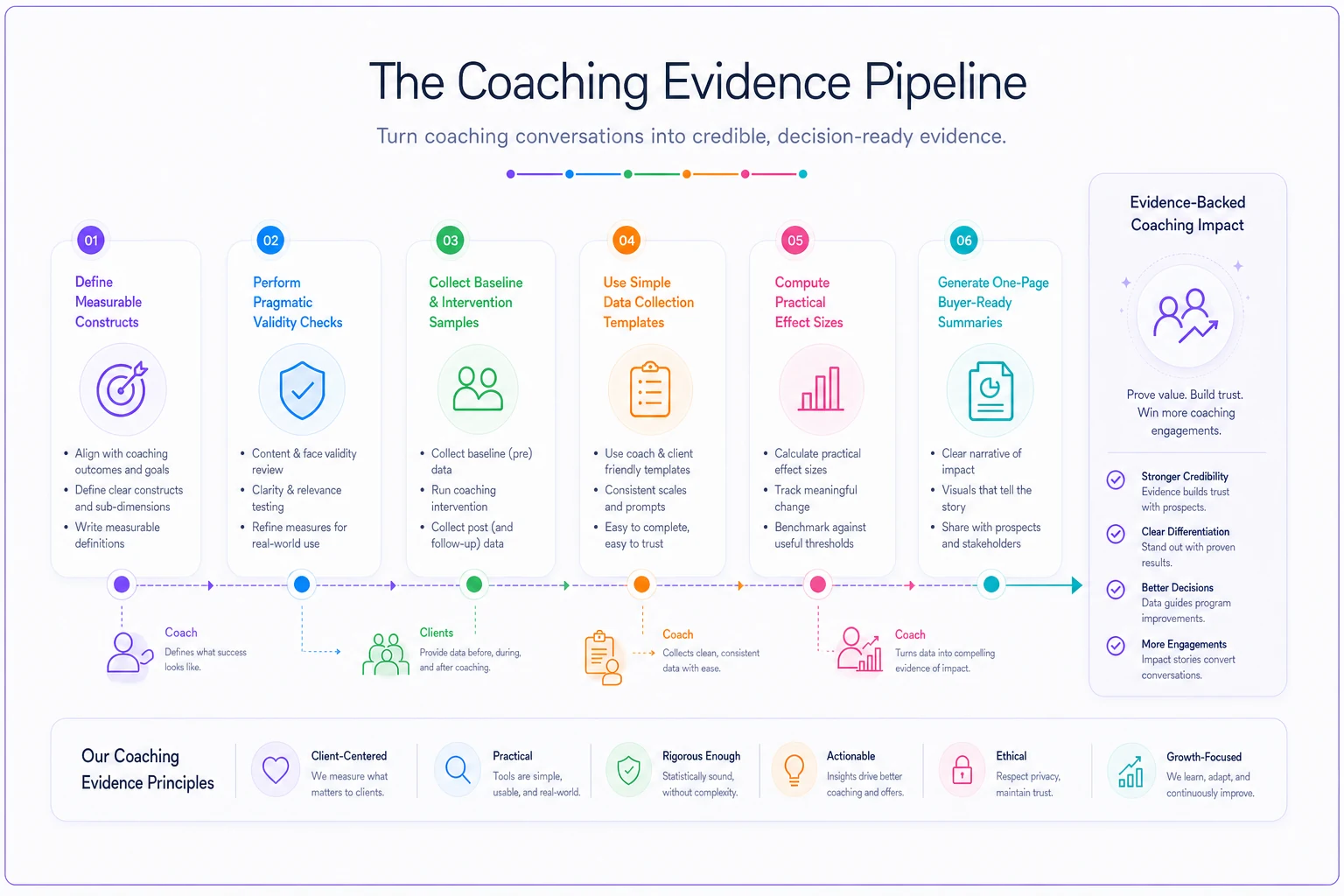
This maps the flow from construct definition through effect-size calculation.
Building Buyer-Ready Outcome Summaries
Corporate buyers don't want 40-page evaluation reports. They want one-page evidence summaries that answer three questions:
-
What changed?
-
By how much?
-
Will it last?
Here's the structure that works:
Program Overview (2 sentences)
-
Participant profile and program duration
-
Core focus area addressed
Key Outcomes (3 bullet points)
-
Specific metric + percentage change
-
Business impact translation
-
Sustainability indicator
Evidence Base (1 paragraph)
-
Data collection method
-
Sample size and timeline
-
Validation approach
Supporting Details (1 table)
One executive coach using this format increased her corporate contract close rate from around 15% to closer to 45% without changing her actual coaching approach—just her evidence presentation.
Common Failure Modes in Evaluation Systems
Over-measurement syndrome: Tracking 47 different metrics across 12 dimensions creates analysis paralysis. Pick 3-5 core outcomes and stop there.
The causation trap: Claiming coaching alone caused all improvements invites scrutiny. Position coaching as a "significant contributor" to observed changes rather than the sole driver.
Delayed implementation: Waiting to build the perfect evaluation system before starting measurement usually means never starting. Begin with one simple metric, then expand from there.
Client resistance neglect: Some clients hate tracking. Build optionality into contracts—standard program vs. an enhanced version with outcome measurement at a 20% price premium for the evidence value.
Integration with Existing Coaching Operations
Your evaluation system needs to mesh with current workflows, not create a parallel process that nobody maintains.
If you're already tracking KPIs in a dashboard, add outcome metrics as a third column next to operational and financial metrics. The same data infrastructure supports both internal operations and client evidence.
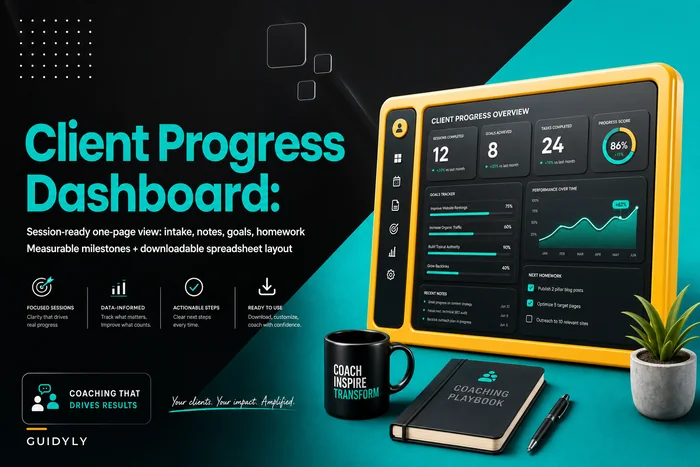
For coaches running client progress dashboards, integrate outcome tracking directly into session planning. The five-minute check-in becomes your data collection moment without adding separate steps.
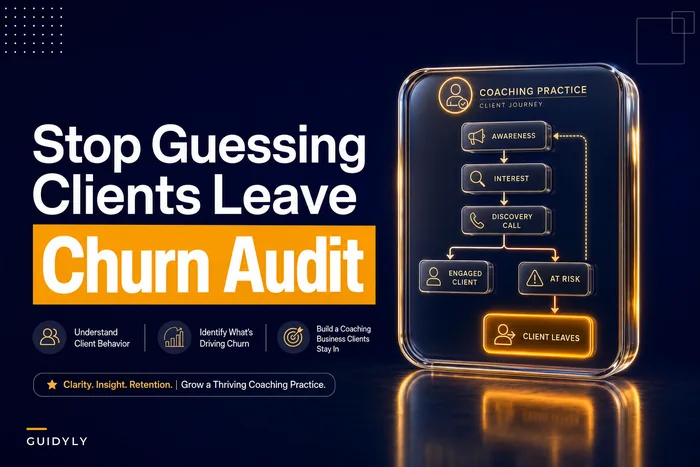
When conducting churn audits, compare outcome achievement between retained and lost clients. Often the difference isn't satisfaction—it's measurable progress toward stated goals.
The Technology Stack for Outcome Tracking
Manual tracking in spreadsheets works for under 10 clients. Beyond that, you need some system support.
Data collection layer: Simple forms (Google Forms, Typeform) feeding into a central database. Avoid complex survey platforms—they add friction without adding value.
Storage and processing: A basic database (Airtable, Notion) with views for each client. Calculate running averages and change scores automatically.
Visualization tools: Simple charts showing trajectory over time. Clients need to see progress, not just raw numbers.
Report generation: Templates that pull latest data into formatted summaries. Spending two hours per client on manual report creation kills profitability fast.
Automate effect-size calculations in your database so report numbers stay current without manual work.
This is where AI-assisted operational platforms make evaluation sustainable at scale. Instead of manually calculating effect sizes and assembling summaries, automation handles the computation while you interpret results and guide client strategy. The evaluation system runs in the background while coaching happens in the foreground.
When Evidence Pipelines Make Sense (And When They Don't)
Strong fit scenarios:
-
Corporate coaching contracts over $25,000
-
Group programs with 10+ participants
-
Certification or credentialing requirements
-
Competitive differentiation needs
-
Grant-funded programs
Poor fit scenarios:
-
Life coaching focused on self-discovery
-
Single-session interventions
-
Clients explicitly resistant to measurement
-
Markets that prioritize relationship over results
The evaluation infrastructure investment needs to match the business model. A $150/month membership program doesn't justify complex outcome tracking. A $15,000 leadership development program does.
Making Evaluation Operational, Not Optional
The shift from anecdotal to evidence-based coaching isn't about becoming more academic. It's about building operational systems that capture what's already happening in your practice.
Start with one measurable construct for your signature program. Define it clearly, track it simply, calculate change in a straightforward way. Once that becomes routine, add a second metric. Build the evidence habit before you worry about building the evidence system.
Most coaches worry that measurement will make their work feel mechanical. In practice, the opposite tends to happen—when you can demonstrate impact, you spend less time justifying value and more time creating it.
The coaching program evaluation system isn't about proving you're a good coach. It's about building the operational infrastructure that lets your outcomes speak louder than your marketing ever could.
The shift from anecdotal to evidence-based coaching isn't about becoming more academic. It's about building operational systems that capture what's already happening in your practice.
Start with one measurable construct for your signature program. Define it clearly, track it simply, calculate change in a straightforward way. Once that becomes routine, add a second metric. Build the evidence habit before you worry about building the evidence system.
Most coaches worry that measurement will make their work feel mechanical. In practice, the opposite tends to happen—when you can demonstrate impact, you spend less time justifying value and more time creating it.
The coaching program evaluation system isn't about proving you're a good coach. It's about building the operational infrastructure that lets your outcomes speak louder than your marketing ever could.
Ready to elevate your coaching business?
Join hundreds of coaches using Guidyly to save time, enhance client engagement, and grow their practice.