



Most coaching practices collect outcome data and then let it die. It sits in session notes, a spreadsheet, a Typeform export, a testimonial doc nobody opens. The measurement happens. The revenue that measurement should unlock never does.
The gap isn't a measurement problem — it's a translation problem. The number that proves your program works and the number that closes a renewal or wins a corporate contract are almost never the same number, and they almost never live in the same format. A coach might have solid before/after data on client confidence or revenue lift, but when a buyer's procurement team asks "what's the ROI," that evidence is trapped inside a format only the coach understands.
An outcomes to revenue operating system for a coaching practice is the connective tissue between what you measure and what you sell. It's a set of rules and templates that routes measurement outputs into the exact artifacts buyers need, the pricing logic that outcomes should trigger, and the renewal signals that tell you when to move. Get this wired correctly and your evidence pipeline stops being a reporting chore and starts being the engine that drives contracts forward.
Why measurement rarely converts into money
The pattern across practices that measure well but sell poorly is almost always the same: the measurement system and the revenue system were built by different parts of the brain, at different times, for different reasons.
The measurement side usually gets built because a coach wanted to prove their work matters — to clients, to themselves, sometimes to a skeptical corporate sponsor. So it gets designed around rigor. Clean baselines, follow-up surveys, maybe a control comparison if the coach is disciplined. If you've already built a solid evaluation framework — and if you haven't, the approach in Turn Coaching Activities Into Verifiable Outcomes is the right foundation — you've got clean, defensible data.
The revenue side gets built around persuasion. Proposals, pricing pages, renewal conversations. And these two systems basically never talk to each other. The coach ends up manually pulling numbers out of the evaluation system every time a proposal needs building, reformatting them into something a buyer can digest, hoping the story holds together.
That manual bridge is where practices lose money. Three things break in it:
-
Latency. By the time a coach assembles the evidence for a renewal, the renewal window is closing. Momentum matters in coaching sales, and a two-week delay to "pull the numbers together" kills deals that were 90% closed.
-
Inconsistency. Every proposal tells the outcome story slightly differently because it's hand-built each time. Buyers notice when your ROI logic shifts between the pitch and the renewal.
-
Loss of the strongest evidence. The most compelling data point often never makes it into the buyer artifact because it wasn't the metric the coach happened to remember that day.
Practices that scale well stop treating "assemble the evidence" as a task and start treating it as a mapping — a defined rule that says: this measurement output feeds this buyer artifact, triggers this pricing rule, and flags this renewal signal. Once it's a mapping instead of a task, it becomes repeatable. And repeatable is the whole game.
The three destinations every measurement output should have
Every meaningful outcome you measure should map to at least one of three destinations. If a metric doesn't feed one of these, you're either measuring something that doesn't drive revenue, or you're missing revenue that metric could unlock.
Never miss a session or detail again.
Guidyly helps you book, manage, and track every coaching session efficiently.
- Centralized session scheduling
- Automated client reminders
- Progress tracking & notes
No credit card required
| Destination | What it does | Example metric | Artifact it produces |
|---|---|---|---|
| Buyer artifact | Converts evidence into something a prospect or sponsor can act on | Confidence lift, goal attainment %, 90-day behavior change | ROI one-pager, executive summary, case snapshot |
| Pricing rule | Ties a measured result to a pricing or packaging decision | Retention rate, outcome achievement rate, cohort completion | Tier upgrade trigger, value-based pricing input, guarantee terms |
| Renewal trigger | Signals when to initiate a renewal or expansion motion | Milestone completion, sponsor engagement, usage cadence | Renewal alert, expansion proposal cue, at-risk flag |
The mistake most practices make is mapping every metric only to the first column. They build reports and testimonials, then wonder why pricing stays flat and renewals require heroic effort. The pricing and renewal columns are where the actual money is, and they're the columns nearly everyone skips.
Worth noting: when a coach can point to a retention rate tied to a specific program structure, they've earned the right to raise prices without flinching. When they can't, every rate increase turns into a negotiation they're likely to lose. The measurement-to-pricing link isn't optional — it's the difference between charging for hope and charging for evidence.
Template 1: The ROI one-pager
The ROI one-pager is the workhorse buyer artifact. Its entire job is to take your cleanest outcome data and present it in the language a buyer uses to make decisions — not the language your evaluation system uses.
-
The claim, up top, in one sentence. "Participants improved [specific outcome] by [range] over [timeframe]." Not a paragraph. One line a busy sponsor can repeat to their boss.
-
The evidence block. Two or three metrics, each with a baseline, a result, and the sample size. Sample size matters more than coaches think — a buyer who's been burned before is looking for whether this is real or anecdotal.
-
The cost-comparison anchor. What the outcome is worth versus what the program costs. For corporate buyers this is often reduced turnover or ramp time; for individuals it's income change or opportunity cost.
-
The proof-of-method footer. One line on how you measured, so the numbers don't read as marketing. This is where practices with real evaluation rigor pull ahead.
The operational rule that makes this repeatable: the one-pager should be populated from your measurement system, not written from memory. The claim sentence, the evidence block numbers, the sample size — those are all fields your evaluation data already contains. The template is a container; the measurement pipeline fills it.
One caveat worth naming: the ROI one-pager is powerful for corporate and organizational buyers who need to justify spend upward. It's often overkill for individual consumer clients, who buy on connection and specific transformation more than aggregate ROI stats. Forcing an ROI one-pager on a consumer sale can make an emotional decision feel clinical.
Template 2: The pricing-experiment spec
This is the least-used template in coaching practices and probably the highest-leverage one. A pricing-experiment spec is a short, disciplined document that turns "I think we could charge more" into a testable, measurable change.
-
What outcome data justifies the change? Point to the specific metric. If you can't, you're guessing.
-
What exactly changes? Price, package structure, guarantee, payment terms — name the single variable.
-
Who's in the test group and who's the comparison? Even a rough comparison beats none.
-
What's the success metric and the guardrail metric? Success might be revenue per client; the guardrail is retention, because a price change that lifts revenue but tanks retention is a loss dressed as a win.
-
How long does it run before you decide? Set the window in advance so you don't stop early on noise.
Coaches skip this because pricing feels like intuition, and running it as an experiment feels cold. But every practice that's raised prices sustainably did it by treating pricing as something that earns its increase through evidence. The spec is how you avoid the two failure modes: raising too timidly (leaving money on the table for years) and raising blindly (bleeding clients you didn't need to lose).
If you want the underlying math for what pricing changes actually do to profitability, Unit Economics for Coaching Practices is where a pricing-experiment spec should draw its guardrail numbers from. A pricing test without a clear read on CAC and LTV can look successful on a monthly revenue chart while quietly destroying long-term value.
Template 3: The go/no-go gate
Go/no-go gates are decision checkpoints that stop the two most expensive mistakes in a coaching practice: taking on work that won't produce evidence you can sell, and pushing a renewal or expansion that isn't actually ready.
The intake gate asks: can this engagement produce measurable outcomes? If a client won't commit to a baseline measurement, or the outcome they want can't be measured in any credible way, that engagement will never feed your evidence pipeline. It might still be worth taking — but you take it with eyes open, knowing it's a revenue engagement, not an evidence engagement.
The renewal gate asks: do we have the evidence to earn this renewal or expansion? Instead of a coach anxiously deciding whether to bring up renewal, the gate checks the criteria and gives a clear read.
A simple renewal gate checklist:
-
[ ] Baseline and follow-up data both captured
-
[ ] At least one outcome hit its target threshold
-
[ ] Sponsor or client has engaged with a progress artifact in the last 30 days
-
[ ] No unresolved at-risk flags (missed sessions, negative feedback, payment issues)
-
[ ] ROI one-pager can be populated with current data, not stale data
Three or more green means proceed with confidence. Two or fewer means the renewal conversation is premature — fix the gaps first, or you're walking into a "we're not sure it worked" conversation you'll lose.
The insight buried in gates: they protect you from your own optimism. Coaches are relentlessly hopeful about their clients, which is a strength in the room and a liability in the pipeline. The gate is the cold-eyed second opinion that keeps hope from becoming a business model.
How the pieces connect as one workflow
Individually these templates are useful. Wired together, they become an operating system.
Here's a simple diagram of how the intake gate, measurement outputs, templates, and renewal gates connect as a loop.
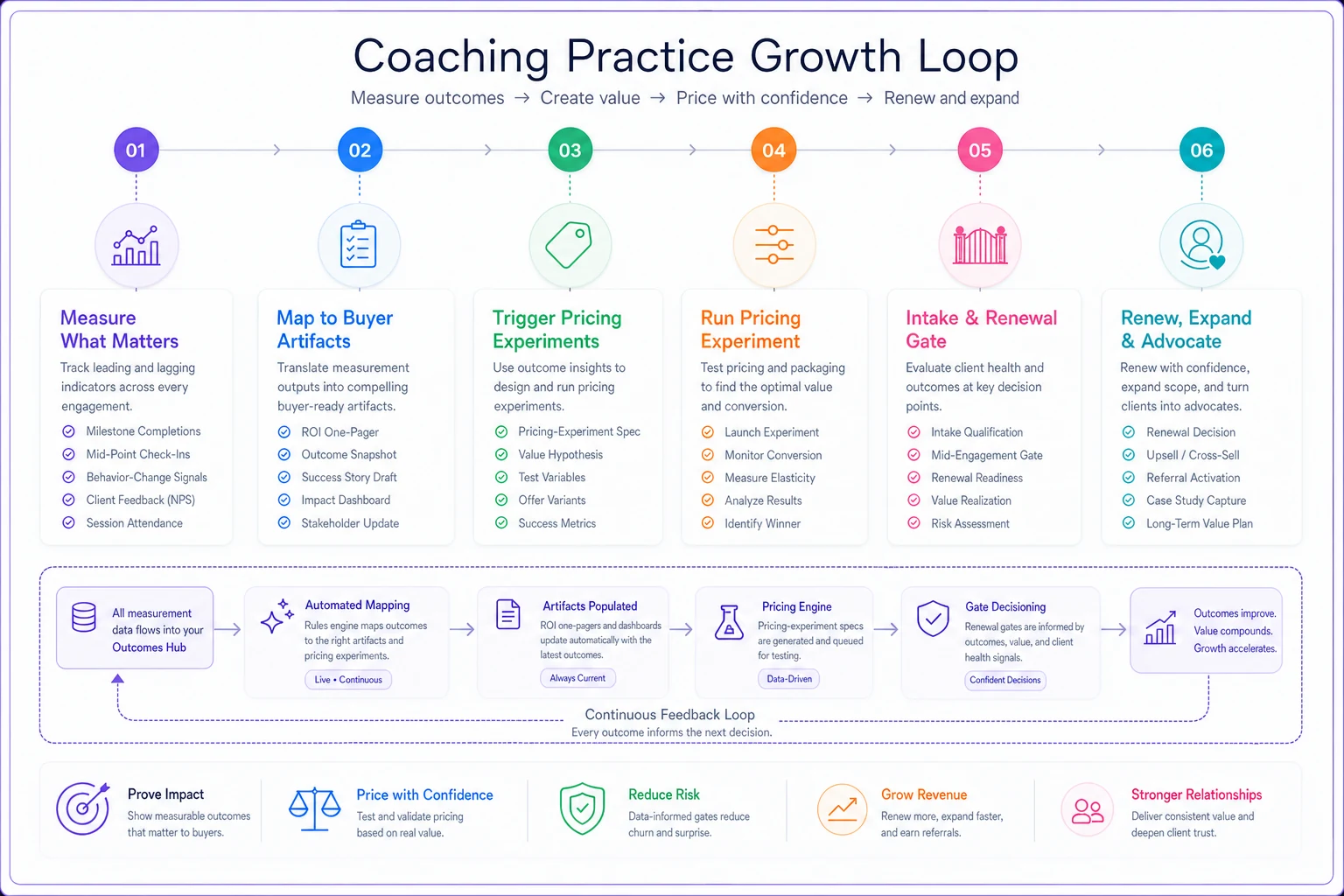
A client finishes their baseline at intake — the intake gate confirms the engagement can produce measurable outcomes, so it gets tagged as an evidence engagement. Throughout the program, measurement outputs accumulate: milestone completions, mid-point check-ins, behavior-change signals. Each output is mapped to its destinations. Milestone data feeds the renewal trigger. Outcome data feeds the ROI one-pager. Retention and completion patterns across cohorts feed the pricing-experiment spec.
Tag engagements as 'evidence' at intake so measurement outputs route automatically to buyer artifacts and renewal gates.
As the renewal window approaches, the renewal gate runs its check against the accumulated data. If it clears, the ROI one-pager is already populated — no scramble, no two-week delay — and the renewal conversation happens while momentum is still hot. Meanwhile, patterns across many clients feed pricing decisions: if retention on a given package is consistently strong, that's the evidence a pricing-experiment spec needs to justify a rate test on the next cohort.
The whole thing runs on a loop. Each engagement's outcomes make the next engagement easier to sell and price. That's what turns an evidence pipeline into an engine rather than a filing cabinet.
What breaks at scale — and where software earns its place
At solo scale, a coach can hold most of this in their head. They remember which client is ready to renew, they know their outcome numbers cold, they can hand-build a one-pager on a Sunday night. Painful, but survivable.
It stops being survivable somewhere around the point where a practice adds a second and third coach, or crosses into managing several dozen active clients. Measurement outputs scatter across multiple coaches' systems, renewal triggers fire for clients nobody's watching, and pricing data lives in fragments that never get aggregated. The manual bridge that worked for one coach collapses under coordination load.
That's the honest place where an outcomes to revenue operating system stops being a set of templates and needs to become software — not because software is trendy, but because the mapping and triggering work is exactly the kind of repetitive, rule-based coordination that humans do badly and inconsistently at scale. When measurement outputs need to automatically populate buyer artifacts, when renewal gates need to check criteria across dozens of clients without anyone remembering to look, when pricing data needs to aggregate across coaches — that's where an AI-assisted operational platform handles the routing quietly in the background so your coaches stay in the room with clients instead of assembling spreadsheets.
The point of automating it isn't to replace judgment. The gates, the pricing calls, the buyer conversations — those stay human. What gets automated is the routing: making sure the right measurement output reaches the right artifact and fires the right trigger, every time, without depending on someone's memory.
When this makes sense to systematize: you're running multiple concurrent engagements, you sell to organizations that demand ROI documentation, or you've missed renewals simply because nobody flagged them in time.
When it's premature: you're a solo coach with a handful of clients and long-standing relationships. The overhead of building the system exceeds what it returns until you have enough volume for the coordination cost to bite.
A real scenario
A three-coach leadership practice was doing solid evaluation work — clean baselines, 90-day follow-ups, good outcome data. Corporate renewal rate was sitting somewhere around 55%, and it wasn't because the work was bad. Renewals kept coming up while the evidence was still buried in each coach's notes. By the time someone assembled an ROI summary for the sponsor, the budget conversation had already moved on without them.
They mapped their measurement outputs to the three destinations, built a renewal gate that ran about 45 days before each contract ended, and templated a one-pager that pulled directly from their existing outcome data. Nothing about the coaching changed. What changed was that the evidence showed up on time, in a format sponsors could forward upward, while there was still budget to renew against.
Over the next few contract cycles, corporate renewals climbed into the high 70s. They also caught two expansion opportunities the old process would have missed — clients whose outcome data clearly justified a larger engagement that nobody had been positioned to notice. The revenue lift came entirely from evidence they were already collecting, just never routed toward the decisions that pay.
Who should not build this
If your practice runs almost entirely on referral and relationship, and your clients never ask for outcome proof, this system may add structure you don't need. Forcing ROI one-pagers into a warm, trust-based consumer practice can make it feel transactional in a way that costs you more than it earns.
And if your measurement foundation isn't solid yet — no reliable baselines, inconsistent follow-ups — don't build the revenue layer first. An operating system that routes bad or missing data just distributes the weakness faster. Fix the evidence, then wire it to revenue.
For everyone else — practices with real outcome data, organizational buyers, or the coordination load that comes with growth — the value isn't in measuring more. It's in making sure everything you already measure actually reaches the decisions that produce revenue. The measurement is the hard part, and most coaches have already done it. The system is just making that work finally pay for itself, cycle after cycle.
Ready to elevate your coaching business?
Join hundreds of coaches using Guidyly to save time, enhance client engagement, and grow their practice.