


Most coaches who "productize" end up with a folder of PDFs and a landing page. They rebuild the same intake, the same week-one workbook, and the same accountability sequence for every new offer — just reworded. It feels like progress because there's a new product name. But under the hood, the marginal cost of launching offer #4 is almost identical to offer #1. Nothing compounded.
That's the core problem this article addresses. Not "how do I package my coaching" — that's been covered thoroughly, including in the modular program system for productizing bespoke work. This is about the operating model underneath: how a program gets built once, reused across your portfolio, and feeds your sales and renewal systems without constant manual intervention. What makes a program productization operating model actually economical is reuse — and reuse doesn't happen by accident.
The reuse gap: why "productized" coaches still work like custom shops
A pattern that shows up constantly: a coach builds a solid flagship program. It sells. So they build a second one for a different audience, then a lighter entry offer, then a corporate version. Four products. On paper, a portfolio.
But when you open the files, you find four separate copies of nearly the same onboarding email, four different versions of the "goal-setting worksheet" that are 80% identical, four progress-tracking systems that don't share a single field. When the coach improves the goal-setting exercise, they fix it in one place and forget the other three. Version drift sets in.
This is the reuse gap. The offers are productized on the outside — fixed price, fixed name, fixed promise — but bespoke on the inside, with every asset rebuilt from scratch. And the economics reflect it. The whole promise of productization — that your fifth launch should cost a fraction of your first — never materializes because you didn't build shared components. You built four snowflakes wearing the same uniform.
A useful gut check: if you can't answer "how many of my assets are shared across two or more programs?" with a real number, you don't have a productization operating model. You have a product catalog.
Modules as the unit of reuse, not programs
The fix starts by changing what you consider your "product." Most coaches treat the program as the atomic unit. In a real reuse economy, the module is the atomic unit, and programs are just configured bundles of modules.
Never miss a session or detail again.
Guidyly helps you book, manage, and track every coaching session efficiently.
- Centralized session scheduling
- Automated client reminders
- Progress tracking & notes
No credit card required
A module is a self-contained chunk that does one job: a diagnostic module, a habit-installation module, a stakeholder-mapping module, a 30-day accountability module. Each one has its own template, its own facilitation script, its own worksheet, its own success signal. Once a module exists and works, it should slot into any program that needs that job done — with light configuration, not a rebuild.
A module template, done properly, isn't just a doc. It's a small kit:
-
The asset (worksheet, framework, exercise) with variable slots for context
-
A facilitation script so any coach — including a future hire — can deliver it consistently
-
A success signal
what tells you the module actually worked for this client
-
Config notes
what changes when this module is used for a solo founder vs. a corporate cohort
The config layer is where the money is. If your goal-setting module has three configurations — consumer, corporate, alumni — you maintain one core asset and three thin variants instead of three full copies. Improve the core, all three inherit it. That's when reuse economics start working for you instead of against you.
A practical example: a coach with a mature module library ships a new corporate offer by assembling seven existing modules and building only two new ones. First-launch effort might've been six weeks. The same launch later takes around ten days — most of it configuration and sequencing, not creation. That gap is the operating model paying off.
Launch gates: stop shipping programs that quietly cost you money
Reuse creates a new risk. When launching gets cheap, you launch too much. Half-baked offers, overlapping products that cannibalize each other, programs that never hit enough volume to justify their maintenance. Every live program has an ongoing carrying cost — support, updates, renewal handling — whether it sells or not.
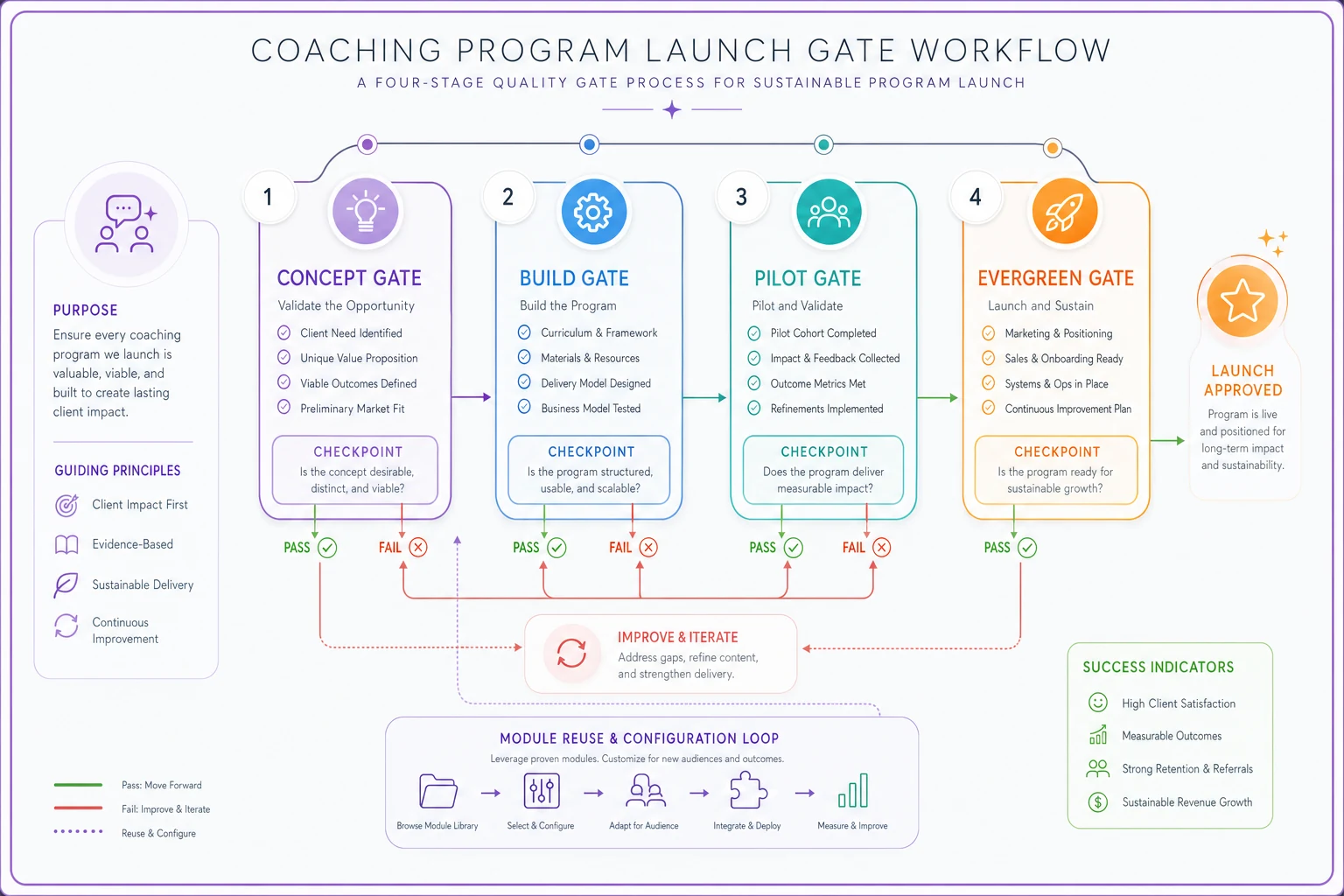
Launch gates are the control. A gate is a checkpoint a program must clear before moving to the next stage. Nothing advances on enthusiasm alone.
A workable four-gate sequence:
-
Concept gate — Does this offer solve a buyer problem you can name, and does at least 60–70% of it come from existing modules? If it's mostly net-new build, that's a red flag, not a green light.
-
Build gate — Are the modules templated, scripted, and configured? Is there a defined success signal for the program as a whole, not just vibes?
-
Pilot gate — Has it run with a small real cohort, and did the outcome data hold up? This is where your program evaluation and verifiable-outcomes system earns its keep — you want evidence the modules produce results, not just completion.
-
Evergreen gate — Is the offer stable enough to sell continuously without you babysitting it? Are renewal triggers and buyer artifacts wired in?
A quick visual of the launch-gate flow helps teams spot where offers get stuck.
The mistake that shows up most often: coaches treat the pilot gate as a formality. They run one cohort, everyone's polite, and they promote it to evergreen. Six months later it has 40% completion and quiet churn nobody diagnosed. The gate exists precisely to catch that before you build a sales machine on a leaky product.
When launch gates are overkill
If you're a solo coach running one or two programs, formal gates are bureaucracy. You'll clear them in your head. Gates start earning their weight when you're maintaining four-plus live offers, or when more than one person can launch things — because that's when uncoordinated launches start colliding.
Buyer artifacts: the assets that feed sales and renewal
Almost everyone skips this part. Every module and program should generate buyer artifacts — the tangible outputs a client walks away with that also happen to be sales and renewal fuel.
A completed diagnostic becomes a "here's your baseline" document. A mid-program review becomes a progress snapshot. An end-of-program summary becomes both a client deliverable and the exact evidence you need to justify renewal or an upsell. These artifacts do double duty: they serve the client and they feed your revenue systems.
| Artifact | Generated at | Serves the client | Feeds the business |
|---|---|---|---|
| Baseline diagnostic | Onboarding | Clarity on starting point | Qualification, price justification |
| Progress snapshot | Mid-program | Motivation, course-correction | Early renewal signal, upsell timing |
| Outcome summary | Program end | Proof of results | Renewal case, testimonial source, case study |
| Portfolio path map | Renewal point | "What's next for me" | Cross-sell into next program |
The pattern worth noticing: artifacts are where delivery and revenue stop being separate departments. When your delivery process naturally produces the evidence your renewal process needs, you've closed a loop most practices leave wide open — usually rebuilding a "renewal deck" by hand every time, from memory.
Portfolio-level reuse economics
Zoom out from individual programs and look at the whole portfolio. This is where the operating model either compounds or collapses.
The number that matters most is your reuse ratio — roughly, the share of a new program built from existing components. Track it. When your first program launches, the ratio is 0% by definition. If your fourth program is still launching at 20–30% reuse, your library isn't maturing; you're just accumulating snowflakes faster.
-
First program high build cost, no leverage
-
Programs two and three build cost drops as shared modules emerge
-
Program four onward launch cost approaches configuration cost — you're mostly sequencing and branding
One scenario worth sharing. A consulting-style coach was carrying five programs, all independently maintained. Content updates ate roughly a day and a half a week across the portfolio, because every fix had to be applied in five places, and half the time she missed one. After restructuring into a shared module library — around a dozen core modules with configs — update time dropped to a few hours a month, and new offer launches went from "a project" to "about a week." Revenue didn't triple overnight; the win was that she stopped spending her margin maintaining redundant copies, and could actually launch a seasonal offer without dreading it.
The counterintuitive part: the biggest gain from portfolio reuse usually isn't faster launches. It's cheaper maintenance. Fixing one thing once, and having every program inherit it. That's the recurring dividend.
The roadmap for evergreen lines
Not every program should be evergreen. Some are cohort-based by nature, some are seasonal, some are one-time corporate engagements. Evergreen lines — offers that sell continuously with minimal manual intervention — are the ones that benefit most from this whole system, because their economics live or die on maintenance cost.
-
It's built mostly from stable, reused modules (fewer moving parts to break)
-
Its outcomes are verified, not assumed
-
Its buyer artifacts generate automatically through delivery
-
Its renewal triggers are defined and fire without you remembering
-
Its support load is predictable enough to not eat your week
Sequencing your roadmap around this changes how you prioritize. Instead of "what's the next exciting program," the question becomes "which offer is closest to evergreen-ready, and which shared modules unlock the most future offers?" A module that only serves one program is a low-priority build. A module that could slot into three future programs is a portfolio investment.
The mistake here is building for the launch instead of the line. Coaches pour energy into a splashy launch, hit a revenue spike, then watch it decay because the offer was never structured to run continuously. Evergreen lines are less exciting to launch and far more valuable to own.
Where systems and tooling actually help
You can run a lot of this in spreadsheets and docs, and you probably should start there — build the model before you buy anything. The tooling question only becomes real once reuse and version control get too big to hold in your head.
-
Module version control — so improving the core asset propagates to every program using it, instead of you manually hunting down copies
-
Artifact generation — so progress data captured in delivery automatically assembles into renewal-ready buyer artifacts, no rebuild
-
Launch-gate tracking — so you can actually see which programs are stuck at which gate, instead of a mental to-do list
-
Renewal triggers — so the signals in your progress data fire the right sales action at the right time rather than depending on you noticing
The point isn't the software. The point is that a reuse economy has coordination overhead — keeping versions straight, keeping artifacts flowing, keeping gates enforced — and that overhead grows with your portfolio. Centralizing it is what keeps the model from quietly reverting to snowflakes as you scale.
Who should not do this yet
If you're delivering fully bespoke, high-touch work to a handful of premium clients, a heavy productization operating model will slow you down and dilute what makes you valuable. Reuse economics reward volume and repetition. A boutique practice built on customization shouldn't force everything into modules.
Same applies if you're pre-product-market-fit. Don't build a module library for offers you haven't validated. You'll template your assumptions and lock in the wrong structure. Sell a few things manually first, notice what repeats, then extract modules from what already works. The library should emerge from real delivery, not from a whiteboard.
The shift worth making
The difference between a coach with a product catalog and a coach with a productization operating model isn't more offers. It's that one rebuilds every time and the other compounds. Every module built well makes the next program cheaper. Every buyer artifact does double duty. Every launch gate stops a costly mistake before it ships. And every evergreen line keeps earning without eating your calendar.
Start small: pick two existing programs, find the assets they share, and turn those into your first real modules with proper templates and configs. Track your reuse ratio from that day forward. That single number will tell you, more honestly than any revenue figure, whether your portfolio is compounding or just growing.
Start small: pick two existing programs, find the assets they share, and turn those into your first real modules with proper templates and configs. Track your reuse ratio from that day forward. That single number will tell you, more honestly than any revenue figure, whether your portfolio is compounding or just growing.
Ready to elevate your coaching business?
Join hundreds of coaches using Guidyly to save time, enhance client engagement, and grow their practice.