


Most coaches handle their coaching client lifecycle operations the same way: they wing it. Leads come in through various channels, onboarding happens whenever they remember to send that welcome email, and client renewals? Usually a panicked message three days before the contract expires.
This works fine when you have eight clients. Once you hit 20+ active clients, plus another dozen prospects somewhere in the pipeline, things start falling apart. Emails slip through cracks. Handoffs between discovery calls and actual coaching sessions get messy. Alumni clients—who should be your easiest renewals—drift away because nobody's keeping those relationships warm.
Coaches who actually scale aren't just better at coaching. They've built a framework that treats each client stage as its own mini-operation with clear ownership, real metrics, and actual decision rules. Not because they love operations, but because they got tired of dropping balls and losing revenue.
The Seven-Stage Client Journey Nobody Maps (But Should)
A typical coaching practice has seven distinct client stages, each needing a different operational approach:
Lead → Prospect → Onboarding → Active Client → Renewal Decision → Alumni → Advocate
Sounds simple. But here's what usually happens:
The lead stage gets all the attention because coaches feel the pressure of needing new clients. They'll spend hours perfecting their discovery call script while completely ignoring what happens after month three of coaching. The active client stage runs on autopilot—weekly sessions happen, notes get typed up, invoices go out. But there's no systematic way to spot when a client is drifting, when they might be ready for a different program, or when they'd be a better fit for group coaching.
The alumni stage? Usually non-existent. Former clients just disappear. Maybe they get a holiday email if you remember. Meanwhile, these are people who already know your value, trust your process, and could easily become repeat buyers or referral sources with minimal effort.
Stage Ownership That Actually Works
In a practice with multiple coaches or support staff, ownership confusion kills efficiency. The sales-oriented coach handles discovery calls but then hands off new clients to the operations person with zero context. The admin schedules sessions but has no authority to handle payment issues. Everyone's partially responsible, which means nobody's truly accountable.
Clear ownership looks like this:
Lead to Prospect: Marketing owner or lead coach handles initial touchpoints, qualification, and discovery scheduling. They own the CRM data, follow-up sequences, and conversion metrics.
Prospect to Onboarding: Sales or senior coach owns the evaluation process, program matching, and contract negotiation. They're responsible for the handoff package—goals, concerns, context from discovery.
Onboarding to Active: Operations or assigned coach owns the first 30 days, including intake forms, initial goal-setting, platform access, and early engagement monitoring.
Active to Renewal: Primary coach owns ongoing engagement, progress tracking, and early renewal conversations. They flag issues for operations support but maintain relationship ownership.
Renewal/Alumni Management: Operations or relationship manager owns systematic follow-up, re-engagement campaigns, and alumni programming.
The key isn't just assigning roles—it's defining what "ownership" actually means. Does the owner have full decision authority? Budget control? What requires escalation? Without those boundaries, you'll still have confusion, just with fancier titles.
Micro-Metrics That Reveal Problems Before They Explode
Standard coaching metrics—total clients, revenue, session completion rate—tell you what already happened. By the time your monthly revenue drops, the damage is done. Clients who didn't renew made that decision weeks earlier. Prospects who ghosted had concerns during discovery that nobody addressed.
Never miss a session or detail again.
Guidyly helps you book, manage, and track every coaching session efficiently.
- Centralized session scheduling
- Automated client reminders
- Progress tracking & notes
No credit card required
Micro-metrics catch issues while you can still do something about them:
Lead Stage:
-
Response time to initial inquiry (target
under 4 hours during business days)
-
Discovery call booking rate (healthy range
40–60% of qualified leads)
-
No-show rate for discovery calls (worth investigating if it climbs above 25%)
Prospect Stage:
-
Days from discovery to proposal (faster isn't always better—rushed proposals tend to convert worse)
-
Proposal acceptance rate by program type
-
Time to first objection (earlier is actually a good sign—means they're engaged)
Onboarding Stage:
-
Intake form completion time (if it drags past a week, they're already disengaging)
-
First session attendance
-
Week-one action completion rate
Active Client Stage:
-
Session rescheduling frequency (more than once a month signals something)
-
Homework submission consistency
-
Communication volume changes (sudden drops and sudden spikes both matter)
Renewal Stage:
-
Renewal conversation timing (starting 45 days out vs. scrambling at day 3)
-
Program upgrade consideration rate
-
Price sensitivity indicators
These aren't metrics you check monthly. Response time gets checked daily. Homework submission gets reviewed weekly. The whole point is catching drift before it becomes departure.
Building Your Trigger Library
Triggers are pre-defined events that automatically prompt specific actions. Not every decision needs human judgment in the moment—most operational patterns in coaching are predictable enough to systematize.
A basic trigger library that prevents common failures:
| Trigger Event | Automated Action | Human Follow-up Required |
|---|---|---|
| No response to discovery call invite after 48 hours | Send "Did you still want to connect?" email | Review lead quality if pattern emerges |
| Intake form incomplete after 5 days | Automated reminder + calendar link for support call | Coach reviews for complexity issues |
| Client cancels 2 sessions in a row | Flag in system + automated check-in message | Coach schedules re-engagement call |
| Payment fails | Soft retry after 3 days | If second failure, operations handles directly |
| 30 days before contract end | Renewal sequence begins | Coach prepares customized renewal proposal |
| Client hits major milestone | Celebration email + testimonial request | Coach personalizes acknowledgment |
| No client communication for 14 days | Gentle check-in from system | Coach reviews last session notes |
| Alumni hasn't engaged in 90 days | Quarterly update + value-add content | Consider for re-engagement campaign |
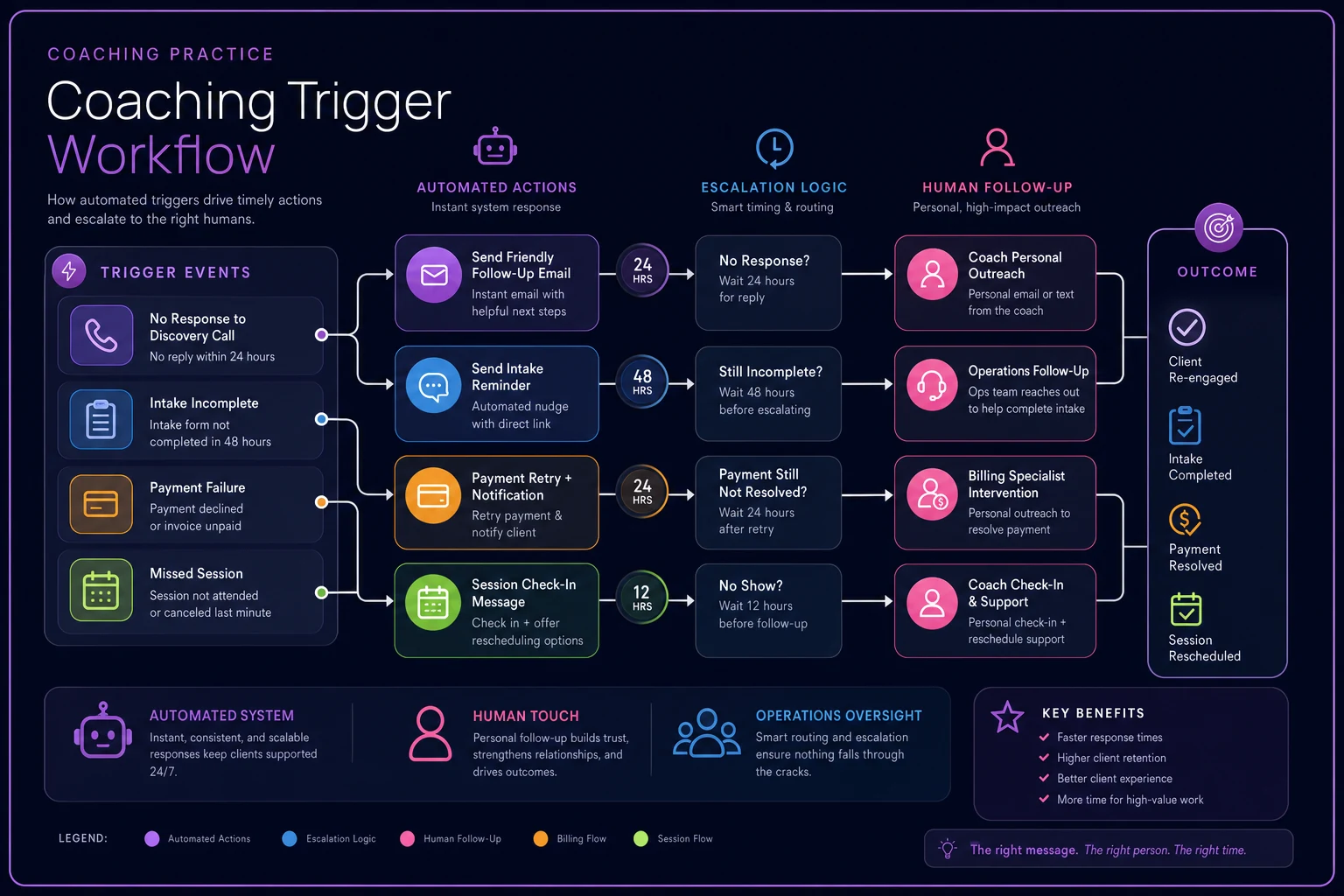
The real value shows up when triggers stack. A client who cancels two sessions AND hasn't submitted homework AND has a failed payment? That's not three separate issues—that's one client in crisis who needs immediate attention.
Here's a simple visual of how triggers lead to actions and escalations.
The Difference Between Alerts and Actions
Too many coaches set up alerts for everything, then drown in notifications. Your operations manager gets seventeen "client hasn't logged in" messages daily. Eventually, you ignore all of them.
Action triggers require someone to do something specific within a defined timeframe. Client didn't show up for their first session? That's an action trigger—someone needs to call within a couple hours.
Alert triggers are informational but don't demand immediate response. Client logs in at an unusual hour? Worth noting, not urgent.
Escalation triggers start as alerts but become actions when patterns emerge. One missed homework assignment is an alert. Three in a row escalates to action.
The Quarterly Review Framework That Prevents Revenue Leaks
Most coaches review their business when they're worried about money or when their accountant forces them to. By then, negative patterns have already hardened into lost clients and missed opportunities.
A proper quarterly review isn't about feeling good or bad about your numbers. It's about catching operational drift before it hits revenue.
Week 1 of Quarter: Stage Performance Analysis
-
How many leads entered vs. converted to prospects?
-
What was the prospect to client conversion rate?
-
How many clients renewed vs. churned?
-
Where are the bottleneck stages?
Look for stage-specific decay. Maybe your lead quality dropped but your conversion skills improved, masking the real problem. Or onboarding improved while renewal conversations got worse.
Week 2: Ownership Audit
-
Did designated owners stay accountable?
-
Where did handoffs break down?
-
Which stages had unclear ownership?
-
What got escalated that shouldn't have needed to be?
This isn't about blame—it's about identifying system failures versus people failures. System failures need process fixes. People failures need training or support.
Week 3: Trigger Effectiveness Review
-
Which triggers fired most often?
-
Which led to successful interventions?
-
What problems slipped through existing triggers?
-
Where did triggers generate noise without real value?
One coaching practice discovered their "client quiet for 7 days" trigger fired constantly but rarely indicated a real problem. Meanwhile, they had no trigger for clients who suddenly increased communication—which turned out to predict either breakthrough moments or crisis points.
Week 4: Renewal and Escalation Decisions
This is where you make actual changes:
Renewal Decisions:
-
Which processes deserve more resources?
-
What manual tasks could be automated?
-
Which metrics matter enough to track daily vs. monthly?
Escalation Updates:
-
What new escalation paths do you need?
-
Which existing escalations can be cut?
-
Who needs more decision authority?
System Adjustments:
-
Trigger threshold changes
-
Ownership reassignments
-
Metric additions or removals
-
Process simplifications
The quarterly review shouldn't just be analysis—it should produce a specific list of operational changes for the next quarter.
Common Lifecycle Failure Points and Their Fixes
Certain failure patterns show up repeatedly across coaching practices. Here are the ones worth knowing:
The Prospect Parking Lot: Prospects who "need to think about it" sit in your CRM for months. They're technically in your pipeline but realistically gone. Fix: Set a 21-day expiration on proposals with an automated "closing your file" message. Either they engage or you free up mental space.
The Onboarding Energy Dump: Coaches pour massive effort into a perfect onboarding experience—welcome packages, detailed assessments, elaborate goal-setting sessions. Then week three arrives and clients get generic weekly sessions. Fix: Spread that energy across the first 90 days. Consistently good beats one amazing week followed by mediocrity.
The Silent Struggler: Clients who are unhappy but keep showing up and paying—until suddenly they don't renew. They never complain, never miss sessions, but also never really progress. Fix: Build struggle detection into your regular check-ins. Ask specifically about challenges, not just wins.
The Renewal Scramble: Thirty days before contract end, you realize you haven't discussed continuation. Now it feels salesy and desperate. Fix: Start renewal conversations at the 60% mark of any program. Frame it as planning, not selling.
The Alumni Abandonment: Former clients who had great experiences just drift away. No follow-up, no community, no reason to stay connected. Fix: Create an alumni track with quarterly value touches—industry insights, peer connections, refresher sessions. Keep them warm for future programs or referrals.
When Automation Makes Things Worse
The temptation with coaching client lifecycle operations is to automate everything. Set up elaborate email sequences, scheduling systems, trigger networks. But over-automation creates its own problems.
A wellness coach automated their entire onboarding sequence—19 emails over 30 days, automated homework reminders, scheduled check-ins. Engagement dropped significantly. Clients felt like they'd hired a robot. The human touch points were so rare that the relationship never actually formed.
Smart automation supports human interaction rather than replacing it:
-
Automate scheduling and rescheduling, but personally confirm first sessions
-
Automate payment processing and receipts, but personally discuss program investment
-
Automate homework reminders, but personally acknowledge completion
-
Automate alumni newsletters, but personally invite people to special events
The best lifecycle systems feel highly personal while running largely on their own. Clients get consistent, timely communication. Coaches spend time coaching instead of administrating.
Setting Up Lifecycle Operations Without Overwhelming Your Practice
Building this entire system at once would paralyze most practices. You can't restructure everything while maintaining current clients and revenue. Here's a sequence that actually works:
Month 1: Map your current state. Document what actually happens at each stage, who does what, and what metrics you can easily access. Don't judge or fix—just observe and record.
Month 2: Implement basic triggers for your biggest pain points only. Usually that means a new client onboarding trigger and a renewal reminder. Get these working before adding anything else.
Start by automating the single biggest pain point, not every process at once.
Month 3: Assign clear stage ownership, even if it's all you initially. Define what each stage owner controls versus what requires discussion.
Month 4: Add micro-metrics for your weakest stage. Losing prospects? Track prospect stage metrics. Renewals low? Focus there.
Month 5: Run your first quarterly review using whatever data you have. Don't wait for perfect information.
Month 6: Expand your trigger library based on patterns identified in the review.
This approach means you're always improving operations without disrupting current delivery.
The Unexpected Benefits of Lifecycle Thinking
Once coaches implement proper lifecycle operations, they tend to discover things about their business they couldn't see before.
One executive coach realized their highest-value clients all showed similar onboarding behaviors—they completed intake forms within 24 hours, scheduled their first three sessions immediately, and asked for extra resources unprompted. Now those behaviors serve as qualification signals, helping focus attention on prospects who demonstrate early engagement.
Another coach found their alumni referrals converted at roughly triple the rate of cold leads but took about half the time to close. They shifted focus from broad marketing to alumni cultivation, reduced marketing costs, and grew revenue.
The lifecycle framework also makes delegation possible. When you can hand someone a clear stage with defined metrics, triggers, and decision rules, they can actually own it. This is how solo coaches grow into group practices without losing quality or burning themselves out.
Building This Into Your Tech Stack
Modern coaching operations need technology, but probably not as much as software vendors want you to believe. The core lifecycle system runs on three components:
CRM for stage tracking: Something that lets you move clients through stages, tag them appropriately, and trigger actions based on stage changes. Doesn't need to be fancy—just reliable.
Communication platform: Email sequences, SMS reminders, and client portal notifications flowing from one place. Central control matters more than features.
Metrics dashboard: Somewhere to see your micro-metrics without digging through multiple systems. Could be as simple as a spreadsheet pulling data from your other tools.
AI-powered operational platforms can tie these pieces together while adding intelligent triggers and automated workflows. Instead of manually checking whether clients have gone quiet, the system monitors communication patterns and flags concerns. Rather than remembering to start renewal conversations, the platform initiates them based on engagement data and contract timelines. The best setups feel invisible—coaches focus on coaching while the system handles the operational layer running underneath.
Making Lifecycle Operations Sustainable
The biggest risk with any operational system is abandonment. You build elaborate processes, maintain them for two months, then let them decay until you're back to chaos.
They run without daily attention. If you have to manually check things constantly, the system breaks the moment you get busy.
They generate obvious value. Every stage owner should see clear benefits from their metrics and triggers. The moment it feels like bureaucracy, people stop participating.
They evolve with your practice. A 10-client practice needs different operations than a 50-client practice. Build evolution into the quarterly review process.
They survive personnel changes. When someone leaves, their stage ownership should transfer cleanly. Documentation matters more than individual knowledge.
Coaches who sustain these systems long-term treat operations as part of service delivery, not overhead. Every clean handoff makes clients feel more supported. Every trigger that fires prevents a negative experience. Every quarterly review actually improves coaching outcomes.
Your coaching client lifecycle operations will never be perfect. Leads will occasionally slip through. Some clients will disengage despite your best systems. But with a real framework in place, those become exceptions instead of routine occurrences.
The difference between coaching as a practice and coaching as a business isn't just about revenue or client count. It's about building operations that deliver consistent value at every stage of the client journey—from that first inquiry to years-later alumni re-engagement. Each transition should feel intentional, supported, and worth something.
That's what separates sustainable coaching businesses from talented coaches who eventually burn out. Not the quality of their coaching, but the quality of everything built around it.
Ready to elevate your coaching business?
Join hundreds of coaches using Guidyly to save time, enhance client engagement, and grow their practice.