


Most coaches put real thought into onboarding and almost none into the exit. The engagement wraps, there's a vague "stay in touch" email, and the relationship just... evaporates. Six months later the client can't find their session summaries, you can't legally keep half the notes you're still storing, and the referral that should have come your way never does because the ending felt like a trailing-off instead of a clean close.
The offboarding window is short and weirdly high-leverage. It's the moment your client feels the most warmth toward you, the moment they're most likely to refer, and also the moment where privacy obligations quietly kick in. Handle it as an afterthought and you create legal exposure and leave money on the table. Handle it with a repeatable playbook and the exit becomes one of your best retention and referral triggers.
This is a tight, practical offboarding checklist for coaches — built around milestone triggers, export templates, consented transfer scripts, deliverable packs, and retention schedules. Not a philosophy piece. A system you can run the same way every time.
Why "milestone-triggered" beats "end-of-contract" offboarding
The default mental model is that offboarding happens when the contract ends. That's the first mistake, and it's structural.
If offboarding only fires at the final session, you're compressing four or five distinct tasks — data export, retention decisions, deliverable assembly, consent capture, referral ask — into the exact moment everyone is emotionally checked out. The client is already thinking about what's next. You're thinking about the next client in your pipeline. Nothing gets done well.
A few examples of triggers that actually work:
-
Final goal marked complete → kick off the deliverable pack assembly
-
Second-to-last session booked → send the consent + transfer script
-
Last invoice paid → release the export bundle
-
30 days post-final-session → run the retention schedule and purge what you shouldn't keep
The difference in practice is significant. When the trigger is an event, the work happens while the relationship is still live and the context is still fresh. When the trigger is "contract ended," the work happens never, or badly.
One pattern worth noting: coaches who offboard well tend to start the exit conversation around 60–70% through the engagement, not at the end. It feels counterintuitive — why talk about leaving when you're still mid-program? — but it reframes the ending as a planned graduation rather than a drop-off, and clients respond to that framing with noticeably more loyalty.
The four things every exit pack needs to handle
Before the checklist, it helps to separate the jobs offboarding is actually doing. They get tangled together constantly, which is why people skip steps.
Never miss a session or detail again.
Guidyly helps you book, manage, and track every coaching session efficiently.
- Centralized session scheduling
- Automated client reminders
- Progress tracking & notes
No credit card required
| Job | What it protects | Owner | Timing |
|---|---|---|---|
| Export | Client's access to their own work | You | Before final session |
| Retention | Your legal/privacy posture | You | 30–90 days post-exit |
| Handoff | Continuity (next coach, internal team, self-directed) | You + client | Final 2 sessions |
| Goodwill | Referrals, testimonials, re-engagement | You | Within 2 weeks of close |
The common failure is collapsing all four into "I'll send them their stuff." Export and retention are in direct tension — the client wants everything, and your retention policy says you shouldn't keep everything. Handoff and goodwill get skipped entirely because they feel optional. They're not. They're where the next engagement comes from.
The export template: what you hand over, and in what format
The export is the client's copy of the work. Get this wrong and you get the "can you resend my notes from March?" email eighteen months later, which is both annoying and a retention-policy problem.
Build one standardized export bundle so you're not reinventing it per client. A clean coaching export pack contains:
-
Engagement summary — goals set, goals achieved, a short arc of the work (1–2 pages, not a novel)
-
Session recap index — dated list of sessions with one-line summaries
-
Deliverables — any frameworks, assessments, worksheets, or custom plans you built for them specifically
-
Progress snapshot — before/after on whatever you measured
-
Resource list — books, tools, references you pointed them to
-
Self-direction guide — what to keep doing on their own
Notice what's not in there: your raw session notes, your internal observations, recordings you captured for your own purposes, anything licensed that they don't have rights to redistribute. The export is the client's work product, not your working files.
On format: export in something durable and openable. PDF for the summary documents, plain file formats for anything editable. Avoid handing over links to tools the client won't have access to after the engagement — a Notion page inside your workspace isn't a deliverable, it's a hostage situation waiting to happen.
If you capture a progress snapshot each session, assembling the "before/after" view at exit is pretty straightforward because the data already exists. This is one reason a running one-page client progress dashboard pays off at the exit — the final snapshot is just the last column of something you've been maintaining the whole time, not a scramble to reconstruct the arc from memory.
A quick visual of the export assembly workflow:
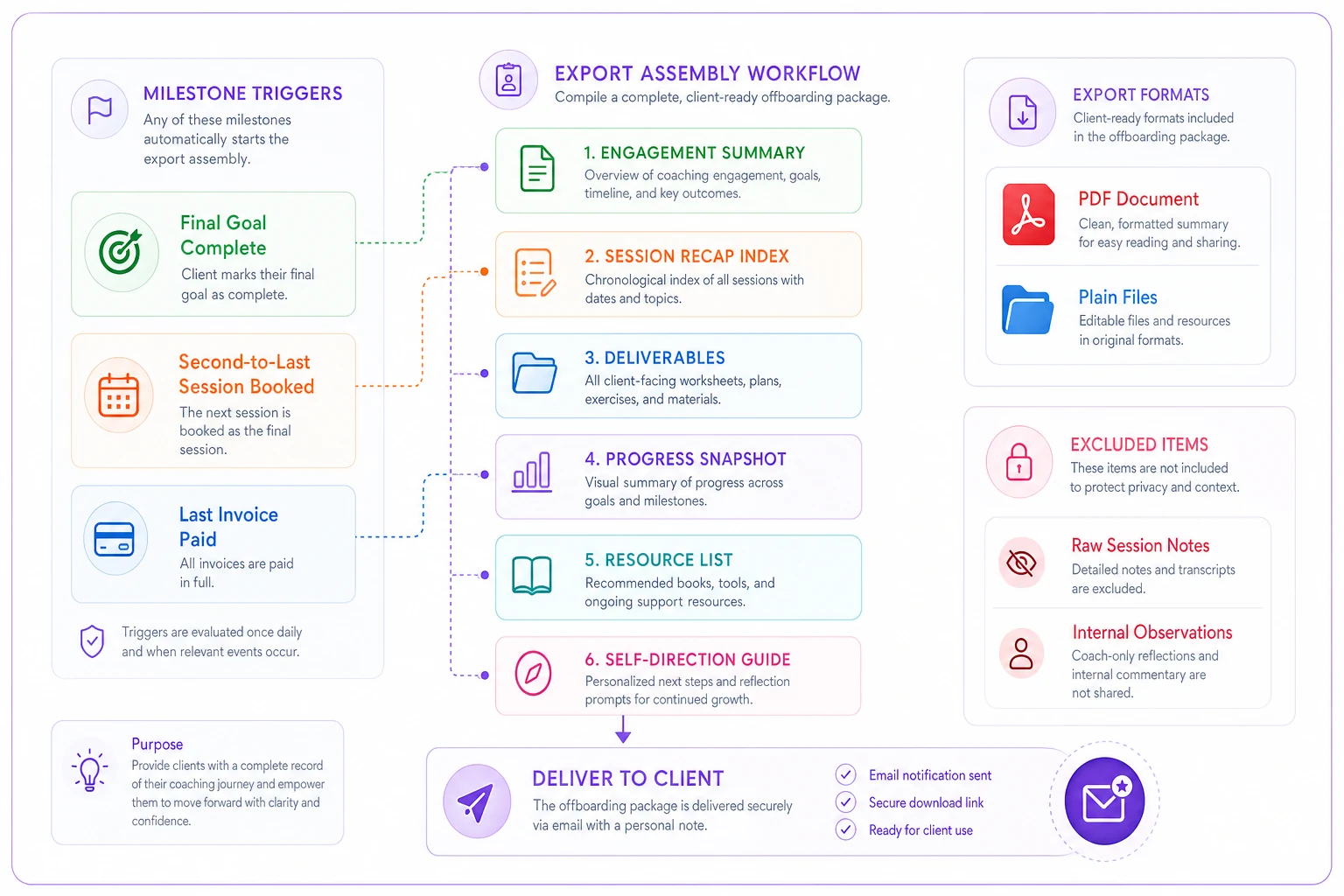
Use this to standardize your export assembly.
Consented transfer scripts: moving data the right way
This is where coaches get quietly exposed. A client finishes, asks you to "send everything to my new coach" or "share my file with my manager," and you forward a folder without a second thought. That forward can include notes the client never consented to share with a third party — especially anything about other people they mentioned in sessions.
Transfer needs explicit, scoped consent — not a vague "sure." The fix is a short script that defines what transfers, to whom, and with what limits.
> "Happy to put together a handoff for [recipient]. Before I do, I want to confirm what goes in it. I'll include [engagement summary, deliverables, progress snapshot]. I'll leave out my private session notes and anything that references other people you talked about. Does that scope work for you, and do you confirm you want these shared with [recipient]? A quick 'yes' in writing is all I need."
That written "yes" is the whole point. It scopes the transfer, documents consent, and protects you if the client later wishes they hadn't shared something.
When the handoff is to a next coach inside a multi-coach practice, add one more layer: strip or summarize anything that's genuinely your clinical judgment versus factual engagement history. The incoming coach needs context, not your unfiltered impressions. A good internal handoff note is factual and forward-looking — goals, what worked, what to watch — not a dump of everything you ever typed.
This maps closely to how you should already be handling recordings. If you've set up proper consent and retention rules around session recordings, the transfer logic is an extension of the same discipline — the session consent and retention checklist covers the recording side, and the transfer script is what happens when that consented material needs to move.
Retention schedules: what to keep, what to delete, and when
This is the part almost nobody builds, and it's the part that creates silent risk. After an engagement ends, you're still sitting on notes, recordings, intake forms, payment records, and message history. Some of it you're legally required to keep. Some of it you have no business keeping. Most coaches keep all of it indefinitely by default, which is the worst option.
A workable retention schedule assigns every data type a keep-duration and a disposal trigger:
| Data type | Keep for | Why | Then |
|---|---|---|---|
| Payment & invoice records | 7 years | Tax/financial requirements | Archive, then delete |
| Signed agreements & consent forms | Duration + 6 years | Dispute protection | Archive |
| Session notes | 1–3 years | Continuity if they return | Delete or anonymize |
| Session recordings | Per consent terms (often 30–90 days) | No reason to hold longer | Delete |
| Intake / assessment data | 1–2 years | Limited ongoing value | Delete |
| Marketing opt-ins | Until withdrawn | Consent-based | Honor withdrawal immediately |
Set disposal triggers at offboarding (for example, "purge recordings 60 days after final session") and automate them so they run without relying on memory.
The exact durations depend on your jurisdiction and professional body, so treat these as a starting frame, not legal advice. The important behavioral shift is this: deletion needs to be a scheduled action, not a decision you make case-by-case. The moment retention becomes a judgment call, it becomes "I'll keep it just in case," and "just in case" is how you end up holding seven years of session recordings you promised to delete in 90 days.
A clean practice sets a disposal trigger at offboarding — "purge recordings 60 days after final session" — and then actually executes it. If you're running any kind of operational system to manage client records, scheduling that cleanup is exactly the sort of task worth automating: a rule that flags or removes expired data on its due date, so the retention schedule enforces itself instead of relying on you remembering to clean house every quarter. The value isn't automation for its own sake — it's that the privacy promise you made actually gets kept without depending on your memory.
The goodwill layer: referral and testimonial asks, timed right
The exit is your highest-trust moment, and it's almost always wasted. The engagement wraps warmly, and then nothing — no referral ask, no testimonial request, no re-engagement path. The relationship cools and the opportunity closes.
The timing rule that matters: ask for the referral at the peak, not after the drift. The peak is usually the final session or within a week of it, when the client can still feel the result. Wait a month and you're asking a near-stranger.
A simple, non-awkward close-out sequence:
-
Final session — acknowledge the arc, hand over the export pack, name the result out loud
-
Within 48 hours — thank-you note + the deliverable pack link + one specific referral ask ("If you know someone wrestling with [the exact thing we fixed], I'd love an intro")
-
Within 1–2 weeks — testimonial request, scoped and consented
-
30 days — soft re-engagement check-in, no pitch
That testimonial request is its own small discipline — it needs consent, scope, and verification, not just a screenshot of a nice Slack message. The ethical testimonial capture workflow covers how to collect them cleanly, and offboarding is the natural trigger point to run it.
Worth sitting with: the referral ask lands completely differently when it follows a professional handoff versus a sloppy one. If the client just received a clean, thoughtful export pack, the ask reads as "this person is excellent and organized." If they received a vague "stay in touch," the ask reads as "this person wants something from me." Same words, opposite effect. The deliverable pack is the referral setup.
A real scenario: the leadership coach who was leaking referrals
A solo leadership coach running roughly 25–30 clients a year had a retention problem that didn't look like a retention problem. Churn was normal, results were good, clients were happy at the finish. But referrals were thin — maybe two or three a year from a satisfied base that should have been generating far more.
The issue was entirely at the exit. Engagements just ended. No deliverable pack, no structured ask, and session notes piling up in a drive nobody had organized since 2022. When clients came back months later asking for their old summaries, reconstructing them ate an hour or two each time.
The fix was a milestone-triggered offboarding playbook: deliverable pack assembled at the final-goal milestone, export bundle released on final invoice payment, a scripted referral ask inside 48 hours, and a retention schedule that purged recordings at 60 days and flagged notes for review at 18 months.
Over the following year, referrals roughly doubled — not a dramatic transformation, but a meaningful shift from a base that was already warm. The "can you resend my notes" requests mostly disappeared because clients left with a complete pack in hand. And the drive stopped being a liability, because deletion became a scheduled action instead of a someday intention. Nothing about the coaching changed. Only the ending did.
When this level of structure is overkill
If you run three or four engagements a year, you don't need a triggered system — you need a decent checklist and the discipline to run it. Building retention automation for a handful of clients is effort you'll never recoup.
This matters most when:
-
You're running enough volume that exits start overlapping
-
You capture recordings or sensitive data that carries real retention obligations
-
You operate in a multi-coach practice where handoffs between coaches are routine
-
Referrals are a meaningful part of your acquisition and you're currently leaving them on the table
And it's genuinely a bad idea to over-engineer the goodwill layer into something robotic. A templated referral ask that reads like a form email undoes the warmth the engagement built. The structure is for you — so the task happens consistently. The client should never feel the machinery.
The offboarding checklist
Run this on every engagement that crosses your volume threshold:
-
[ ] Milestone triggers defined — each offboarding task tied to an observable event, not a date
-
[ ] Exit conversation opened at ~60–70% through the engagement
-
[ ] Deliverable pack assembled — summary, recap index, deliverables, progress snapshot, resources, self-direction guide
-
[ ] Export delivered in durable, openable formats (no hostage links)
-
[ ] Consented transfer script sent if data moves to a third party, with written scope confirmation
-
[ ] Internal handoff note prepared (factual, forward-looking) if transferring to another coach
-
[ ] Retention schedule applied — every data type has a keep-duration and a disposal trigger
-
[ ] Disposal scheduled, not left to judgment (recordings especially)
-
[ ] Referral ask within 48 hours, specific and scoped
-
[ ] Testimonial request within 1–2 weeks, consented and verified
-
[ ] Re-engagement check-in at 30 days, no pitch
Run this on every engagement that crosses your volume threshold:
Closing thought
The ending of a coaching relationship isn't a formality to get through — it's the part of the engagement with the shortest window and the highest leverage. Done carelessly, it creates privacy exposure and quietly kills referrals. Done with a milestone-triggered playbook, it protects your clients' data, keeps your retention posture clean, and turns every satisfied client into a warm introduction and a potential return.
Build the system once. Trigger it on events, not dates. Keep the goodwill layer human and the retention layer automatic. The exit stops being the place where good work disappears and becomes the place where your next engagement begins.
Ready to elevate your coaching business?
Join hundreds of coaches using Guidyly to save time, enhance client engagement, and grow their practice.