


Most coaching practices don't fall apart because the strategy was wrong. They fall apart because a strategic decision got made in a vacuum and nobody translated it into the operational changes that decision actually required. You decide to add a cohort. Great. But your pricing stayed the same, your calendar didn't flex, your intake routing didn't change, and now you're running two delivery models with one set of systems built for the first one.
That gap — between "we decided to do X" and "here's exactly what X changes across pricing, staffing, KPIs, and tech" — is where practices quietly bleed margin and quality. A coaching operating charter closes it. Not a strategy deck, not a mission statement. A one-page document with decision gates that map each strategic move to the exact operational consequences it triggers.
Below is how the charter actually works, where practices get it wrong, and three example charters you can adapt for solo, small-team, and vendor setups.
Why strategic decisions rarely survive contact with operations
The pattern is almost always the same. A coach makes a good call — add a group program, hire a second coach, land a corporate account. The decision feels like a growth moment. What nobody notices is that it silently changes six or seven downstream systems at once, and none of those get updated until something breaks.
Take a common example. A solo coach doing 1:1 work at roughly $2,400 per engagement decides to launch a small cohort at $900 a seat. On paper the math is obvious — fill eight seats and you've beaten a single private client. But the cohort model doesn't just add revenue. It changes:
-
Delivery — group facilitation is a different skill and a different prep load than 1:1
-
Staffing — someone has to manage group logistics, async questions, and the inevitable stragglers
-
KPIs — completion rate and cohort attendance now matter in ways they never did for 1:1
-
Tech — you suddenly need a cohort container, group scheduling, shared materials, and progress tracking across eight people instead of one
-
Pricing — your 1
1 clients start asking why the group costs a third of what they pay
None of that shows up in the strategy conversation. It shows up three weeks in, when the coach is drowning in group admin and private clients feel devalued. The charter surfaces all of that before the decision goes live, not after.
What the charter actually is
Think of it as a decision-to-operations map on one page. The left side lists the strategic levers you might pull. The right side spells out, for each lever, the exact operational changes required and the threshold that triggers them.
Never miss a session or detail again.
Guidyly helps you book, manage, and track every coaching session efficiently.
- Centralized session scheduling
- Automated client reminders
- Progress tracking & notes
No credit card required
-
Operating baseline — the current state of pricing, delivery model, staffing, core KPIs, and tech stack. The "before" against which every change gets measured.
-
Decision gates — the specific strategic moves you're considering, each with a numeric or condition-based threshold that says "when this is true, pull the lever."
-
Change map — for each gate, the required updates across all five operational domains. Not vague ("hire more"), but specific ("add 0.5 FTE ops support when active seats exceed 20").
The charter refuses to let you change strategy without also writing down what breaks and what has to move. It's a forcing function disguised as a template.
The five domains every gate has to touch
A charter that only updates one or two domains is where failure usually hides. When you look at practices that scaled roughly and then stalled, the common thread is a decision that touched revenue but skipped delivery, or touched hiring but skipped KPIs. Every gate should force you to answer all five:
| Domain | The question the gate must answer | Where it usually breaks |
|---|---|---|
| Pricing | Does this change what we charge, how we package, or how existing clients perceive value? | New offer undercuts existing clients; no repricing of the old model |
| Delivery | What changes in how the work actually gets done — format, prep, cadence? | Group and 1:1 run on the same tooling and calendar logic |
| Hiring / Staffing | Do we need new people, new roles, or reallocated hours? | Founder absorbs the new load "temporarily" and never stops |
| KPIs | Which metrics now matter that didn't before? What do we stop watching? | Old dashboard tracks the old model; new model runs blind |
| Tech | What systems, integrations, or automations does this require? | Manual workarounds pile up until the founder is the integration layer |
What matters isn't the table itself — it's that a change in one column almost always demands a change in another. Add a cohort (delivery) and you'll need cohort-completion tracking (KPIs), a group container (tech), and someone to run the async layer (staffing). The charter makes those dependencies visible so you stop discovering them the hard way.
Decision gates and thresholds that actually work
A gate without a threshold is just a wish. "Hire when we're busy" is not a gate. "Hire an associate coach when the founder's active caseload exceeds 22 clients for two consecutive months" is a gate. The threshold does the deciding so you're not renegotiating with yourself every month.
-
Capacity gate — trigger a hire or a waitlist when active caseload crosses a set number for two months running. For most solo coaches that ceiling lands somewhere around 18–25 clients depending on session frequency.
-
Margin gate — reprice or restructure an offer when per-client contribution margin drops below a floor. If your fully-loaded delivery cost creeps past roughly 40% of the offer price, the gate fires.
-
Cohort gate — launch a group format only when you have a repeatable curriculum and enough qualified demand to fill at least 60–70% of seats. Half-full cohorts feel like proof and behave like losses.
-
Vendor / enterprise gate — move from consumer to organizational selling when a single account represents a meaningful share of revenue, or when you get two or more inbound corporate requests in a quarter.
-
Tech-debt gate — invest in real systems when the founder spends more than a set number of hours weekly on manual coordination. Once that passes about 6–8 hours a week, the manual approach is costing more than the software would.
The thresholds are yours to set. What matters is that they exist in writing before the pressure hits, because in the moment every decision feels urgent and every number feels flexible. Your unit economics should drive where these lines sit — if you haven't mapped CAC, LTV, and per-client profitability, the thresholds are guesses.
Example Charter 1 — Solo practice
A solo coach's charter is short because the whole thing lives or dies on the founder's time. The dominant constraint is hours, so most gates are capacity and margin gates.
Baseline: 12 active 1:1 clients at $2,000/engagement, all delivery by the founder, tracked in a spreadsheet and a calendar, no support staff.
-
Add cohort
triggers when the founder has run the same core content with 8+ private clients (curriculum is proven) AND has a waitlist of at least 6. On trigger — introduce cohort at ~$800/seat, cap the first run at 8 seats, add a group-completion KPI, adopt a shared cohort container, and reprice 1:1 upward to protect the premium.
-
First hire
triggers when caseload holds above 20 for two months. On trigger — bring in part-time async/admin support before a second coach, since the bottleneck is usually coordination, not delivery.
-
Reprice
triggers when contribution margin per client dips under the floor after cost creep. On trigger — raise new-client rates, grandfather existing clients for one cycle.
The mistake solo coaches make here is treating "add cohort" and "raise prices" as separate moods rather than linked gates. The cohort requires the 1:1 reprice, or the cheaper group offer cannibalizes the premium line.
Example Charter 2 — Small team
Once there's a second and third coach, the charter has to handle coordination, not just capacity. The failure mode shifts from "founder is overloaded" to "quality drifts between coaches and nobody can see it."
Baseline: 3 coaches, mix of 1:1 and one running cohort, roughly $18k–$24k monthly, shared scheduling tool, session notes inconsistent across coaches.
-
Add a coach
triggers when combined caseload utilization sits above ~80% for a quarter. On trigger — hire against a scorecard, assign a 90-day onboarding, and add a per-coach retention KPI so the new hire's clients don't quietly churn while everyone assumes ramp-up is normal.
-
Standardize delivery
triggers the moment the second cohort launches. On trigger — lock a shared curriculum, a single notes standard, and a cross-coach quality review, because two coaches improvising two versions of the same program is how a practice loses its outcomes story.
-
Comp change
triggers when a coach's book crosses a revenue line. On trigger — move to a base-plus model tied to retention and outcomes, not raw session count, to avoid rewarding volume over results.
This is the stage where the operational maturity model matters most — the gates you write should match the stage you're actually in, not the one you wish you were in. A team charter with solo-stage gates will keep sending every coordination problem back to the founder.
Example Charter 3 — Vendor / enterprise
The vendor charter is different in kind, not just degree. When you sell to organizations, the buyer, the delivery, and the reporting all change, and a single account can be large enough to distort the whole practice.
Baseline: 4 coaches, one large corporate account plus consumer clients, ~$35k–$45k monthly, contract-based delivery, reporting done manually per account.
-
Take a second enterprise account
triggers when the first account is stable AND you have the delivery capacity to run two without the founder personally covering gaps. On trigger — build a repeatable account-delivery playbook, add account-level KPIs (attendance, manager-reported outcomes, renewal signals), and staff a dedicated point of contact.
-
Concentration gate
triggers when any single account exceeds a set share of revenue — often somewhere around 30–35%. On trigger — deliberately invest in consumer or channel growth to reduce the risk that one lost contract cuts revenue in half.
-
Reporting scale gate
triggers when manual per-account reporting passes a weekly hour threshold. On trigger — systematize outcome reporting before it eats a full role.
Vendor motion also changes how you sell, not just how you deliver. If you're crossing from consumer into organizational accounts, the buyer-specific mechanics in a proper go-to-market approach are what the charter's vendor gates should connect to.
When a charter makes sense — and when it doesn't
When it makes sense: the moment you're running more than one delivery model, more than one coach, or seriously considering a strategic change that touches money. If you're about to add a cohort, hire, or land your first corporate deal, the charter pays for itself in avoided rework.
When it's premature: a brand-new solo coach with three clients and no proven offer doesn't need a decision-gate document. At that stage the "system" is you figuring out whether the work even sells. Writing gates for decisions you can't yet make is procrastination dressed as planning.
Who should skip the heavy version: if your practice is genuinely stable — same model, same size, no growth ambition this year — a full charter is overkill. A one-line baseline and two capacity gates will do. The document should match your appetite for change, not your appetite for planning.
A short real scenario
A two-coach practice was running 1:1 work plus one cohort, doing somewhere around $22k a month. The founder decided to add a second cohort because the first one "worked." No charter, no gates. Within six weeks both coaches were improvising slightly different versions of the curriculum, group attendance had slipped into the low 60s as a percentage, and two private clients had pushed back on price because the group looked like a bargain.
They rebuilt the decision as a gate exercise after the fact. The cohort gate should have required a locked shared curriculum and a filled roster before launch. The delivery gate should have forced a single notes standard across both coaches. The pricing gate should have nudged the 1:1 rate up to protect the premium. Once those three changes went in, attendance recovered into the high 70s over the next cycle, price objections stopped because the gap was intentional and explained, and the founder stopped being the tie-breaker on which version of the program was "right." Nothing dramatic — just the operational changes the strategic decision had needed all along, finally written down.
How the charter runs as a workflow
The charter isn't a document you write once and file. It runs on a simple loop:
-
Review the baseline monthly. Pull your current numbers for caseload, margin, and the KPIs that matter for your model. Ten minutes.
-
Check each gate against reality. Has any threshold been crossed for the required duration? If yes, the gate fires — that's the decision, already made.
-
Execute the change map. When a gate fires, you don't re-debate it. You run the pre-written list of operational changes across all five domains.
-
Update the baseline. The change becomes the new normal, and the next month's review measures against it.
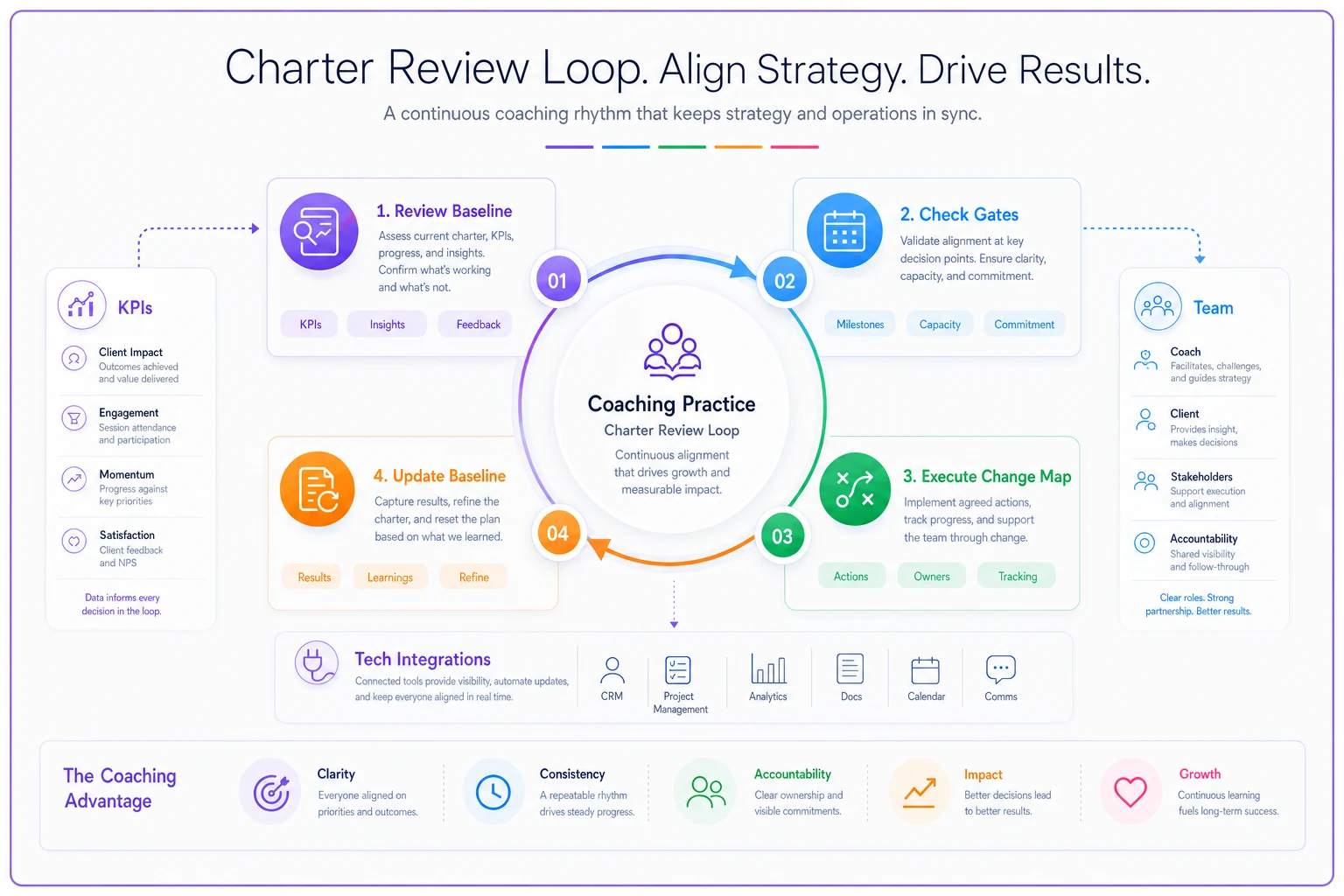
That loop is what keeps strategy and operations synchronized instead of drifting apart between planning sessions. Most practices run strategy on gut and operations on habit, and the two only meet during a crisis. The charter forces a small, regular meeting between them before the crisis has a reason to happen.
The point
A coaching operating charter isn't paperwork. It's the discipline of admitting that every strategic decision is really a bundle of operational decisions, and refusing to make the first without writing down the rest. Add a cohort, and you've also changed pricing, delivery, staffing, KPIs, and tech — whether you planned for it or not. The charter just makes sure you planned for it.
Start with one page. Write your baseline, pick the three or four gates that matter for your stage, and map each one to the exact changes it triggers. The document will be ugly and incomplete at first. That's fine. An ugly charter that forces the right questions beats a beautiful strategy deck that lets you skip them.
Ready to elevate your coaching business?
Join hundreds of coaches using Guidyly to save time, enhance client engagement, and grow their practice.