



Most coaching practices don't fail because the coaching is bad. They stall because the operations underneath the coaching stop matching the size of the business. A solo coach running everything from her inbox can be wildly profitable at 12 clients and completely underwater at 30 — same skills, same offer, same energy. What changed wasn't quality. It was the operating model.
The frustrating part is that the transition points aren't obvious while you're in them. You just feel busier, notice more small mistakes, and start losing evenings to admin you can't quite name. By the time the pain is loud enough to act on, you're usually two stages behind where your systems should be.
This is an attempt to map the whole thing — a coaching operational maturity model that treats the practice as a system moving through recognizable stages, each with its own bottlenecks, roles, KPIs, and failure modes. The point isn't to sprint to the last stage. It's to know which stage you're actually in, and what the next correct move is.
## The five stages (and why stage confusion is the real problem)
Most coaching businesses move through five operational stages. The trap is that revenue and stage don't move in sync. Plenty of coaches hit $200k solo and still operate like a stage-one hobby practice. Others hire a second coach at $90k and suddenly need stage-four coordination systems they never built.
| Stage | Rough shape | Core constraint | What breaks first |
|---|---|---|---|
| 1. Solo Improvised | 1 coach, everything ad hoc | The coach's time and memory | Follow-up and billing slip |
| 2. Solo Systemized | 1 coach, documented workflows | Personal capacity ceiling | Coach becomes the bottleneck |
| 3. Leveraged Solo | 1 coach + VA/contractor support | Handoff quality | Things fall between people |
| 4. Multi-Coach Team | 2–6 coaches, shared standards | Consistency across coaches | Quality variance, client mismatch |
| 5. Coaching Enterprise | 6+ coaches, layered management | Data and accountability across the org | Nobody owns outcomes |
The single most common mistake is operating one stage below reality — hiring people before documenting the work, or adding coaches before defining what "good" actually looks like. Every stage assumes you finished the one before it. Skipping is where practices break.
## Stage 1: Solo Improvised — where the whole business lives in your head
Everything works here because you are the system. You remember who owes homework, who's wobbling, who hasn't paid. That memory is the operating model, and it's genuinely fine for a while.
Never miss a session or detail again.
Guidyly helps you book, manage, and track every coaching session efficiently.
- Centralized session scheduling
- Automated client reminders
- Progress tracking & notes
No credit card required
The failure mode is quiet. It's not a dropped client — it's the pattern of small slips. A renewal you forgot to bring up. A session you double-booked. A prospect who emailed twice and got no reply because it landed during a heavy coaching week. None of these individually feels like a crisis, so nobody treats them as an operational signal. They should.
KPIs that matter here: honestly, very few. Track two things — weekly new-conversation count (are leads coming in?) and collected revenue vs. invoiced revenue (is money actually landing?). That's it. Anything more is premature at this stage.
The next correct move: don't buy software yet. Write down your three most repeated workflows — how a client goes from inquiry to first session, how you handle a session end-to-end, and how you invoice. Describe what you actually do, not what you wish you did. This is the raw material for everything after.
When to leave this stage: the moment you feel relief when a client cancels because it frees up admin time. That's your capacity screaming. Move to Stage 2 before you start resenting the work.
## Stage 2: Solo Systemized — documenting yourself out of the bottleneck
This is the stage most coaches skip, and skipping it poisons everything downstream. You're still solo, but the workflows now exist outside your head — in templates, checklists, and a basic tool stack.
A typical example: a career coach at around 18 active clients moves her intake, scheduling, reminders, and payment into a connected setup. Nothing fancy. But now a client who inquires on a Tuesday gets an automatic intake form, a booking link, and a confirmation — without her touching anything until the actual conversation. She got back roughly 5–7 hours a week. More importantly, she stopped dropping leads during busy stretches.
The reason this stage is non-negotiable: you can't delegate or scale a process that only exists as intuition. When you hire in Stage 3, you'll hand people your documented workflows. If there's nothing to hand over, you'll transfer chaos to someone else and pay for the privilege.
Roles: still just you, but wearing labeled hats. Block your calendar by function — coaching hours, admin hours, sales hours — so you can later peel each off to someone else.
KPIs to add:
-
No-show / late-cancel rate (should drop once reminders are systematic)
-
Lead response time (aim for under a few hours)
-
Renewal rate at end of engagement
-
Utilization — coaching hours vs. total worked hours
Document the three workflows from Stage 1 before building anything else.
Failure mode: over-engineering. Coaches at this stage sometimes spend two months building a Notion cathedral instead of coaching. Systemize the three workflows from Stage 1. Resist the rest.
## Stage 3: Leveraged Solo — the first handoff, and the first things falling between people
You're still the only coach, but now there's help — a VA, a contractor handling admin, maybe a part-time community manager. This is where a new class of failure appears: things that break not inside a task, but between people.
In practice, this usually happens at the seams. The VA schedules a client but doesn't flag that the client mentioned wanting to cancel. The intake form gets filled out but nobody routes the high-fit prospect to a sales call quickly. Payment fails and sits in a queue nobody owns. Each person did their job. The handoff was just undefined.
This is where thinking about your systems as connected data flows starts to matter, not just individual tools. A useful mental model comes from mapping how information moves between your people and platforms — the kind of thing covered in Coach Systems Architecture: Integration Patterns, Data Flows and the Failure Modes to Plan For. The core idea: every handoff needs a defined trigger, an owner, and a place the information lives. Without those three things, work leaks.
A workflow that breaks here (and how to fix it):
Broken version — prospect fills intake → sits in a shared inbox → VA sees it "eventually" → sometimes forwards to coach → coach responds when free. Three undefined handoffs, zero ownership.
-
Prospect submits intake (trigger)
-
Form auto-scores fit and routes hot leads to a booking link, cold leads to a nurture sequence (rule)
-
VA owns follow-up on anything unbooked within 24 hours (owner)
-
Coach sees only pre-qualified, booked calls (clean handoff)
-
Outcome logged in one shared record every person can see (single source of truth)
> [GRAPH: Lead intake workflow — from prospect submission through fit scoring, VA follow-up, and coach handoff to a shared client record]
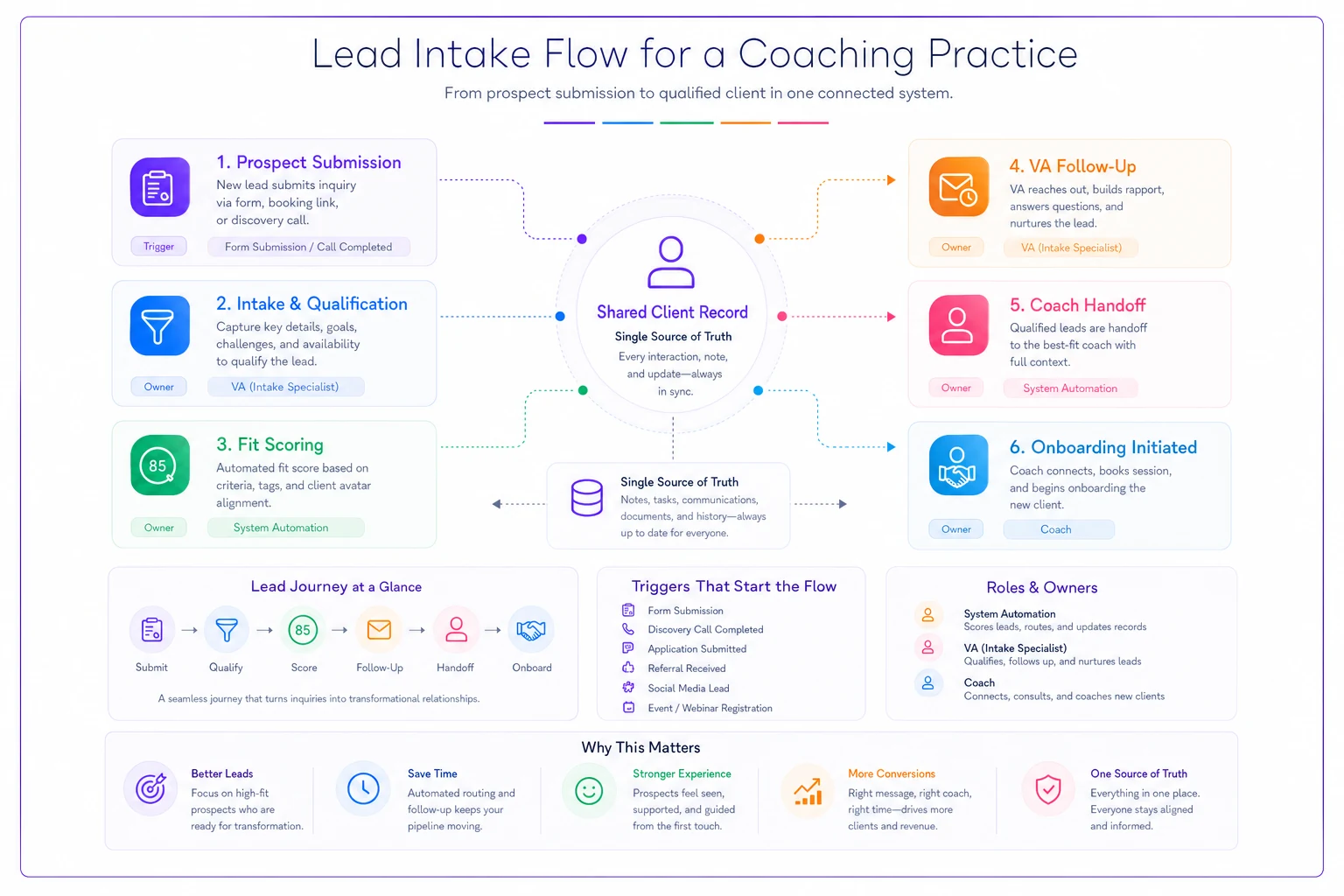
This diagram shows the triggers, who owns each handoff, and the shared record that prevents things from slipping through the cracks.
KPIs to add: handoff SLA compliance (did the VA respond within the defined window?), lead-to-booked-call conversion, and admin cost as a percentage of revenue.
When this stage is a bad idea: if your workflows aren't documented yet. Hiring a VA to run undocumented processes is how you end up managing someone who does things slightly wrong in ways you can't correct because you never defined "right."
## Stage 4: Multi-Coach Team — the consistency problem nobody warns you about
Adding coaches changes the fundamental problem. It's no longer "can I get everything done?" It's "does a client get the same quality regardless of which coach they land with?"
This is where practices quietly damage their reputation. Two coaches, two totally different session structures, two different follow-up habits, two different ideas of what a "good outcome" looks like. Clients talk. Referrals dry up when the experience is a coin flip.
Getting through this stage cleanly is mostly about standards and hiring — turning your documented workflows into trainable systems and hiring against a real scorecard instead of vibes. The mechanics of doing that without flattening what made your coaching good are worth studying carefully; there's a detailed treatment in Scale Without Losing Quality: SOPs, Hiring Scorecards and a 90‑Day Onboarding System for Multi‑Coach Practices.
The other landmine is compensation. The instant you have multiple coaches, how you pay them starts shaping how they behave — sometimes in ways you didn't intend. Pay purely on client count and coaches over-enroll and under-serve. Pay on session volume and they'll pad sessions. This is the stage to design incentives deliberately. The tradeoffs are laid out well in Avoid Perverse Pay: A Measurement & Compensation System Linking Coach Performance to Outcomes and Retention.
Roles that must now exist (even if part-time):
-
An operations owner (could still be you, but a distinct hat)
-
A lead coach responsible for coaching quality and coach calibration
-
Someone who owns client-coach matching and reassignment
KPIs to add:
-
Quality variance across coaches (client outcome or satisfaction spread)
-
Client-coach match rate and reassignment frequency
-
Coach utilization and caseload balance
-
Retention by coach — this one surfaces problems fast
Failure mode: the founder stays the "best coach" and refuses to let quality live in the system instead of in their own hands. If every hard client escalates to you, you haven't built a team — you've built a queue in front of yourself.
## Stage 5: Coaching Enterprise — when the problem becomes accountability at scale
With six-plus coaches and possibly pod leads or program managers, the constraint shifts again. Nobody has the full picture in their head anymore, and the risk is that outcomes stop having owners. A cohort underperforms and it's genuinely unclear whether it was the coach, the curriculum, the client mix, or the onboarding.
At this scale, the operating model has to answer one hard question continuously: who is accountable for what, measured how? This is less about tools and more about a data layer everyone trusts. If your coaches, ops team, and leadership are all looking at different numbers, you'll spend leadership meetings arguing about whose spreadsheet is right instead of fixing anything.
What actually changes at this stage:
-
Metrics roll up in layers — individual client, coach, pod/program, whole org
-
Reviews become rhythmic, not reactive (weekly ops, monthly cohort, quarterly strategy)
-
You start running real experiments on curriculum and onboarding because you finally have the sample size for results to mean something
KPIs at the org level: contribution margin per coach, cohort-level outcome rates, retention and expansion by segment, and forecast accuracy — are you predicting capacity and revenue within a reasonable band?
Failure mode: building enterprise reporting on a stage-three foundation. If your underlying data is entered inconsistently by different people, your dashboard is just confidently wrong at scale.
## A realistic 12–18 month roadmap between two stages
Roadmaps are only useful if they're specific to your jump. Here's a concrete one for the most dangerous transition — Stage 3 to Stage 4, moving from a leveraged solo to a real multi-coach team.
-
Months 1–3 Finish documenting every client-facing workflow to the point a stranger could follow it. Define what a "good session" and a "good outcome" mean in writing. Do not hire yet.
-
Months 4–6 Build a hiring scorecard tied to those standards. Run a paid trial engagement with one contract coach before any commitment. Watch the handoffs, not just the coaching.
-
Months 7–9 Onboard your first employed coach against a structured 90-day plan. Set up quality calibration — you and the new coach reviewing the same anonymized cases and comparing judgment.
-
Months 10–12 Introduce per-coach KPIs. Start tracking retention and outcome variance by coach. Fix compensation before it distorts behavior.
-
Months 13–18 Add a second coach now that the system — not your attention — is what maintains quality. Formalize the client-coach matching process.
Notice what's not in the first six months: hiring. The most expensive scaling mistake in coaching is bringing someone on two or three months before your systems can actually support them.
## A real scenario
A leadership coach running solo had built a solid Stage 2 practice — roughly $140k a year, workflows documented, decent tooling. She jumped straight to hiring two coaches within a couple of months because demand was strong.
Within a quarter, retention on new clients dropped noticeably and she was fielding complaints she'd never gotten before. The problem wasn't the coaches' skill. She'd skipped Stage 3 and Stage 4 groundwork — no defined handoffs, no quality calibration, no per-coach metrics. Both coaches were doing their honest best, just pointed in different directions.
She pulled back to one coach and spent about four months building calibration sessions, a matching process, and coach-level retention tracking. When she re-added the second coach, outcome variance between coaches tightened considerably and new-client retention recovered to roughly where her solo numbers had been. Same people. Different operating model. The fix cost her about six months and a chunk of pride — far cheaper than the reputation damage would have been if she'd kept pushing through.
## How to find your actual stage (a quick diagnostic)
Run this honestly. Check every statement that's reliably true, not aspirationally true.
-
[ ] My three core workflows are written down clearly enough for someone else to follow
-
[ ] Leads get a response without me personally remembering to send one
-
[ ] I know my no-show rate and renewal rate without guessing
-
[ ] Handoffs between me and any helper have a defined owner and deadline
-
[ ] There's a single place where client status lives that everyone can see
-
[ ] "A good session" is defined somewhere other than my own head
-
[ ] I hire against a scorecard, not a gut feeling
-
[ ] I can see retention and outcomes broken out by individual coach
-
[ ] My leadership decisions run on numbers everyone agrees are accurate
Where you first hit a no, that's roughly your working stage — and the work that follows is your real roadmap. Most coaches discover they're a full stage behind their revenue, which is completely normal and fixable.
Closing thought
The maturity model isn't a ladder you're supposed to climb as fast as possible. Plenty of excellent, profitable coaches deliberately stay at Stage 2 forever, and that's a legitimate choice. The mistake isn't staying small — it's operating one stage below your reality and blaming yourself for the friction that creates.
Growth in a coaching practice doesn't really come from working harder at the current stage. It comes from noticing when the stage has shifted underneath you, and rebuilding the operating model to match — before the small slips turn into lost clients you never quite understood you were losing.
Ready to elevate your coaching business?
Join hundreds of coaches using Guidyly to save time, enhance client engagement, and grow their practice.