


The gap between a cohort that works at 12 people and one that works at 60 isn't content. It's operations. Most coaches figure this out the hard way — usually around their third or fourth cohort, when something that felt alive and intimate suddenly feels like herding people through a sequence of Zoom rooms where half of them are on mute.
The content didn't change. The delivery system never existed in the first place.
What you had at 12 people was you — your attention, your memory, your ability to notice who'd gone quiet, who was dominating, who needed a nudge. That works until it doesn't. Past a certain headcount, your personal attention stops being enough, and if there's nothing built underneath it, the experience degrades in ways participants can feel but can't name. They just don't renew.
This is about the system layer most cohort programs skip entirely: standardized facilitator role-cards, breakout measurement, rotation logic, and community rituals that make a 50-person cohort feel as tended-to as a 12-person one. Not the curriculum. The machinery that delivers it.
Why cohort quality breaks at specific headcounts, not gradually
Most people assume cohort quality declines on a smooth curve — a little worse at 20, a little worse at 30. It doesn't work like that. It breaks at thresholds, and those thresholds are tied to facilitation ratios and coordination load.
A single facilitator can genuinely track maybe 8–12 active participants in a live session. Not "have them in the room" — actually track them: notice when engagement drops, catch the person who hasn't spoken in two sessions, adjust pacing in real time. Push past that and you're not facilitating anymore, you're presenting. The difference is invisible on a recording and painfully obvious to the quiet participant in row four who's already mentally checked out.
The first break happens around 15 live participants with one facilitator. The second happens when you add facilitators without adding structure — now you have inconsistency, because one person runs breakouts tight and warm while another lets them sprawl. Participants in different groups are having genuinely different programs. They talk to each other. They notice.
The third break is the one nobody sees coming: coordination overhead. Two facilitators can align with a hallway conversation. Five facilitators, rotating breakout assignments across six sessions, need a rotation matrix — otherwise people end up in the same groups repeatedly, facilitators lose track of who they've already worked with, and the "community" never actually forms. The admin work to prevent this grows faster than the headcount does.
None of these are content problems. They're all delivery-system problems, and they stack.
The four components of a cohort delivery operating system
A real cohort delivery operating system isn't a binder of best practices. It's a small number of standardized artifacts that make delivery repeatable regardless of who's running the room. Four of them matter most.
Never miss a session or detail again.
Guidyly helps you book, manage, and track every coaching session efficiently.
- Centralized session scheduling
- Automated client reminders
- Progress tracking & notes
No credit card required
1. Facilitator role-cards. A one-page definition of exactly what a given role does during a session — responsibilities, scripts, what they own, what they explicitly don't own. The point isn't to turn facilitators into robots. It's to eliminate the ambiguity that produces inconsistency. When "facilitator," "producer," and "scribe" are defined as distinct roles with distinct cards, two different people can run the same session and participants get the same experience.
2. Breakout measurement rubrics. Most breakout rooms are a black box. You send people off, they come back, and you have no idea whether anything happened. A rubric turns breakouts from hope into signal — a lightweight way for facilitators or room leads to score what actually occurred against a short set of criteria. This connects directly to the broader breakout facilitation mechanics around timing and roles that make small-group work function at scale.
3. Rotation matrices. A pre-built schedule of who-is-with-whom across the full program, designed so participants meet a wide slice of the cohort instead of cycling through the same three people. This is the single most under-built artifact in cohort delivery, and the one that most determines whether "community" actually forms.
4. Community rituals mapped to cohort size. The recurring, predictable moments that create belonging — openings, closings, recognition, peer accountability. The mistake is treating rituals as interchangeable across sizes. A ritual that creates warmth at 15 people creates dead air at 60.
Each of these scales differently, which is exactly why you need them defined before you grow, not after.
Facilitator role-cards: the artifact that kills inconsistency
When you bring on your first co-facilitator, the instinct is to have them shadow you, absorb your style, and do what you do. This is how you manufacture inconsistency. "Do what I do" is not a transferable instruction, because most of what you do is invisible even to you.
Role-cards force the invisible into the open. A clean set for a mid-size cohort usually looks like this:
| Role | Owns | Does NOT own | Active during |
|---|---|---|---|
| Lead Facilitator | Content flow, pacing, teaching moments, main-room energy | Tech issues, chat triage, timekeeping | Full session |
| Producer | Tech, breakout assignments, timing cues, recording | Teaching, answering content questions | Full session, heavy during transitions |
| Breakout Lead | Small-group facilitation, rubric scoring, surfacing themes | Main-room teaching, overall pacing | Breakouts only |
| Scribe / Community Lead | Capturing insights, chat engagement, follow-up nudges | Live facilitation, tech | During and after session |
The specific roles matter less than the principle: every responsibility has exactly one owner per session. When timekeeping belongs to "whoever notices," it belongs to no one, and your 90-minute session runs 112 minutes with the last module cut.
One thing that gets missed in real delivery: role-cards should include handoff scripts, not just responsibilities. The moment things go sideways is always the transition — Lead throws to breakouts, Producer is supposed to have rooms assigned, Breakout Leads are supposed to know their rooms. If the card says "Producer: assign breakouts" but doesn't say when and using what, you get fifteen seconds of awkward silence multiplied across every session. Fifteen seconds feels like a minute when forty people are watching.
Assign timekeeping to a specific role explicitly to avoid sessions running long.
People also make the mistake of assigning one person to one role permanently. For resilience, role-cards should allow rotation across cohorts. Your best breakout lead should eventually run producer so you're not one sick day away from a broken session.
Breakout measurement: turning a black box into signal
Breakouts are where cohort programs either come alive or quietly die, and most coaches have no idea which is happening because they can't see inside the rooms.
A measurement rubric fixes this without turning facilitation into surveillance. Keep it to four or five signals, scored fast by whoever's in the room:
-
Participation spread — did most people speak, or did one person dominate? (A simple 1–3.)
-
Task completion — did the group actually get through the prompt?
-
Energy — rough read on engagement
flat, steady, high.
-
Surfaced theme — one sentence on what came up that the main room should hear.
-
Flag — anyone struggling, disengaged, or needing follow-up?
That's it. A breakout lead can score this in the thirty seconds after a room closes. What it gives you is a cohort-wide view of where the program is landing and where it's thin. If three of six rooms flag "flat energy" on the same prompt, the prompt is the problem, not the participants. Without the rubric you'd blame the cohort.
Breakout rubric data is most valuable in aggregate over time, not in any single session. When you run the same program across cohorts and the same prompt keeps scoring low on participation, you've found a curriculum defect that would otherwise be invisible. This is the same logic behind building a modular program system — your delivery data tells you which modules actually work versus which ones only work when you personally run them.
Rotation matrices: the math behind community that actually forms
A scenario that plays out constantly: a 30-person cohort runs six sessions with breakouts of five. Feels like plenty of mixing. Participants end the program saying they only really got to know three or four people. The "community" was mostly an illusion.
The reason is that random breakout assignment produces far less mixing than intuition suggests. With no rotation logic, people cluster — the facilitator reuses rooms, friends drift together, overlap compounds. A rotation matrix solves this deliberately: it's a pre-computed schedule ensuring that across the program, each participant shares a room with as many different people as the math allows.
With 30 people, groups of 5, six sessions — a well-built matrix can get most participants to meet 20+ others instead of the 8–10 they'd encounter by chance. That difference is the difference between "nice program" and "I still talk to people from that cohort two years later."
Practically, rotation matrices need to account for:
-
Cohort size and group size — determines how many unique pairings are even possible.
-
Session count — more sessions, more rotation room.
-
Deliberate pairings — sometimes you want certain people together (peer accountability pods that persist) and others deliberately varied.
-
Facilitator continuity — do participants stay with one breakout lead for consistency, or rotate for breadth? Both are valid; pick on purpose.
-
Absences — your matrix has to degrade gracefully when four people miss session three.
That last point is where hand-built matrices fall apart. You spend an hour building a perfect rotation, three people drop, and now you're re-solving the constraint problem live while forty people wait. This is exactly the kind of coordination work that eats facilitator time and benefits from being generated and adjusted automatically rather than maintained in a spreadsheet someone dreads touching. Tools that handle this kind of logic — regenerating the matrix when attendance shifts, flagging who's under-connected — remove a category of work that otherwise lands on whoever's already running the session.
Below is a visual representation of the workflow for generating and adjusting rotation matrices.
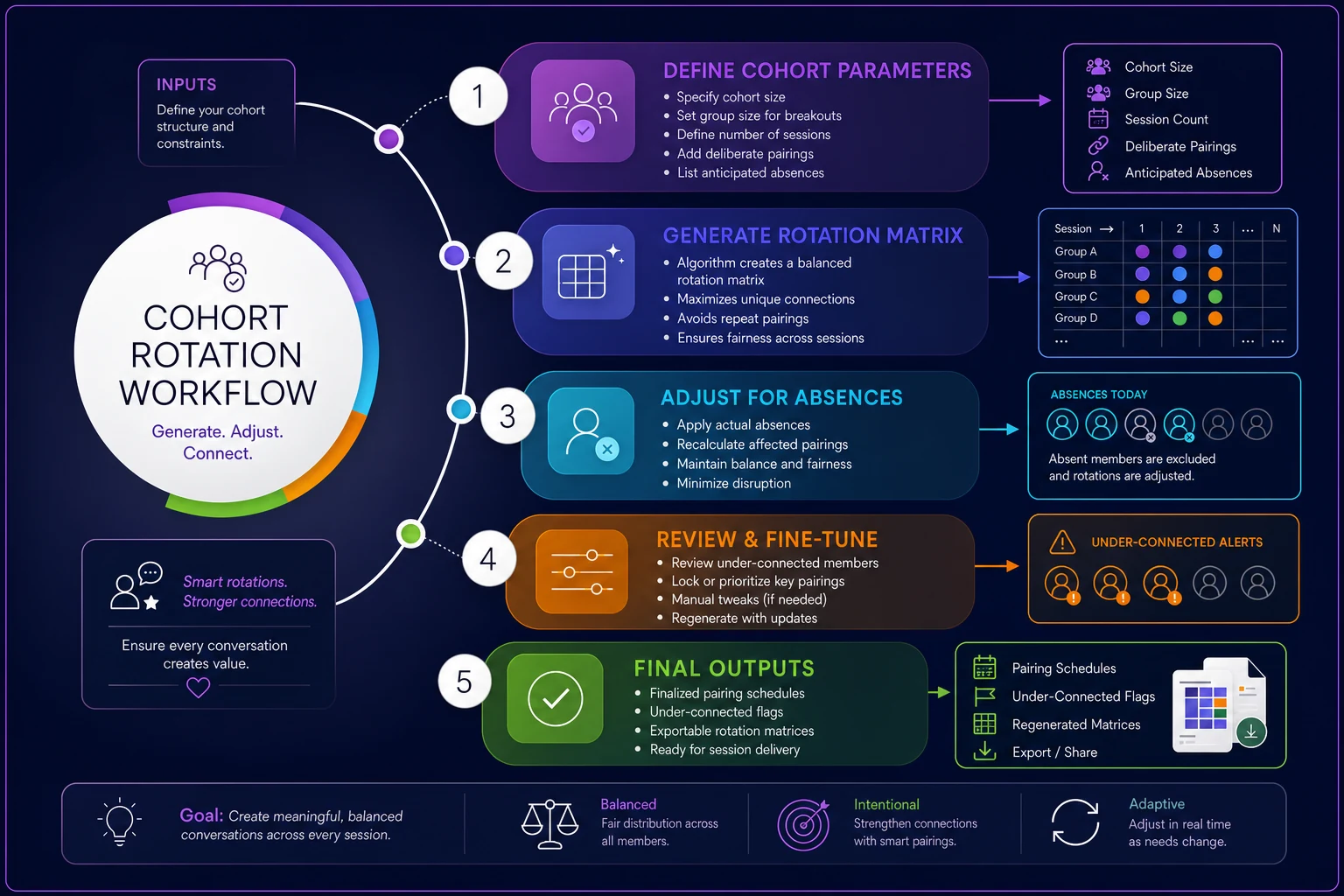
It shows decision points and automated adjustments.
Community rituals have to be re-engineered for size
Rituals are the part everyone copies and almost no one adapts. You see a 15-person cohort do a beautiful go-around where everyone shares a win, you try it at 55, and it takes nineteen minutes with the energy dead by person twelve.
The rule is straightforward: rituals don't transfer across sizes, they get redesigned. The function stays the same — belonging, recognition, continuity — but the mechanism has to change.
| Ritual function | 10–15 people | 25–40 people | 50+ people |
|---|---|---|---|
| Opening connection | Full go-around | Breakout check-ins, 2 shared to main | Chat waterfall + one spotlight |
| Recognition | Verbal, individual | Pod-level shout-outs | Structured nominations, async |
| Closing | Each person one word | Breakout reflections | Lead synthesis + chat |
| Peer accountability | Whole-group visible | Fixed pods of 4–5 | Pods with pod-leads |
The piece most people miss: at larger sizes, belonging comes from subgroups, not the whole group. Nobody feels belonging to a room of 60. They feel it to their pod of five. So at scale, rituals should operate at the pod level and only occasionally pull up to the full cohort for shared energy. Coaches who try to keep every ritual whole-group as they scale are the ones whose large cohorts feel cold despite "doing all the community stuff."
Rituals also need owners, which loops back to role-cards. The opening ritual won't run consistently across eight sessions and three facilitators unless someone's card says they own it, with the script attached.
A real scenario: a leadership program at the 40-person wall
A leadership coach I'd describe as genuinely good at the work and allergic to operations had been running cohorts of 18–20 comfortably for a couple of years. Strong renewals, warm community. She sold a corporate deal that pushed one cohort to 44 participants and brought in two contract facilitators to help.
It went sideways in the predictable ways. The two facilitators ran breakouts completely differently. Participants who landed in the looser rooms reported lower satisfaction — not because that facilitator was worse, but because the experience felt inconsistent. Breakout groups recycled, so the "expanded network" selling point to the corporate buyer mostly didn't materialize. The opening win go-around, untouched from the 18-person version, ate twenty minutes and died.
The fixes weren't dramatic. Role-cards for the three facilitators so breakouts ran the same way. A rotation matrix so the 44 actually mixed instead of clustering. Rituals rebuilt for size — pod-based openings, structured recognition instead of a go-around. Breakout rubrics so she could see across rooms she wasn't personally in.
The second run of the large cohort landed roughly where her 20-person cohorts had been on satisfaction — a real recovery from the first attempt. The corporate renewal happened. Nothing about the content changed.
When a full system is worth building — and when it isn't
This is real work, and not every coaching business needs it. Building role-cards, rubrics, rotation logic, and size-mapped rituals is overkill if you're running one small cohort a year by yourself. At that scale your personal attention is the system, and formalizing it just creates friction.
Build the full system when:
-
You're running cohorts above roughly 25 people, or multiple cohorts at the same time.
-
You have, or are about to add, facilitators other than yourself.
-
You're selling to organizations that expect consistency and will notice when they don't get it.
-
Community and network are part of what you're selling, not just the content.
Don't build it yet when:
-
You're still validating the program itself — nail the content before you industrialize delivery.
-
Your cohorts are small and solo-facilitated.
-
You're changing the curriculum every run. Standardize delivery once the program stabilizes, which ties into having a modular, reusable program worth standardizing around.
The honest failure mode is building elaborate delivery machinery around a program that isn't solid yet. Systems amplify what already exists. They won't save weak content, and they'll slow you down while you're still figuring out what the program should actually be.
Where this connects to the rest of your operation
A cohort delivery operating system doesn't live in isolation. The breakout rubric data feeds directly into how you track individual progress — the signals you capture in rooms should roll up into something like a one-page client progress view so a participant who's been flagged in breakouts three sessions running doesn't fall through the cracks between facilitators.
The role-cards connect to session preparation. If facilitators are running from standardized cards, the session structure itself should be standardized too — which is why cohort delivery and a consistent session agenda system tend to get built together. The agenda defines the sequence; the role-cards define who runs each part of it.
These artifacts only pay off when they're connected. A rotation matrix nobody can regenerate when four people drop, rubric scores living in a notebook, role-cards in a doc that facilitators never open mid-session — that's effort without leverage. The value shows up when the matrix adjusts for absences, rubric data aggregates across cohorts to surface weak modules, and role-cards are actually in front of facilitators during the handoff. The coordination that used to require constant attention becomes something the system handles. That's the whole point.
The real shift
The move from facilitator to operator feels uncomfortable because it seems like you're replacing what made your program special — your attention, your feel for the room — with structure. That's not the trade. The structure is what lets your attention scale. Role-cards don't make facilitation robotic; they free facilitators to be present instead of improvising logistics. Rotation matrices don't engineer community out of existence; they make sure it actually forms. Rubrics don't surveil breakouts; they let you see rooms you can't physically be in.
Cohort quality doesn't collapse because coaches stop caring at scale. It collapses because the caring was never built into a system that could carry it past the point where one person could hold everything in their head. Build the four artifacts — role-cards, rubrics, rotation matrices, size-mapped rituals — before you hit the headcount that breaks you, and growth stops feeling like a loss of something and starts feeling like reach.
Cohort quality doesn't collapse because coaches stop caring at scale. It collapses because the caring was never built into a system that could carry it past the point where one person could hold everything in their head. Build the four artifacts — role-cards, rubrics, rotation matrices, size-mapped rituals — before you hit the headcount that breaks you, and growth stops feeling like a loss of something and starts feeling like reach.
Ready to elevate your coaching business?
Join hundreds of coaches using Guidyly to save time, enhance client engagement, and grow their practice.