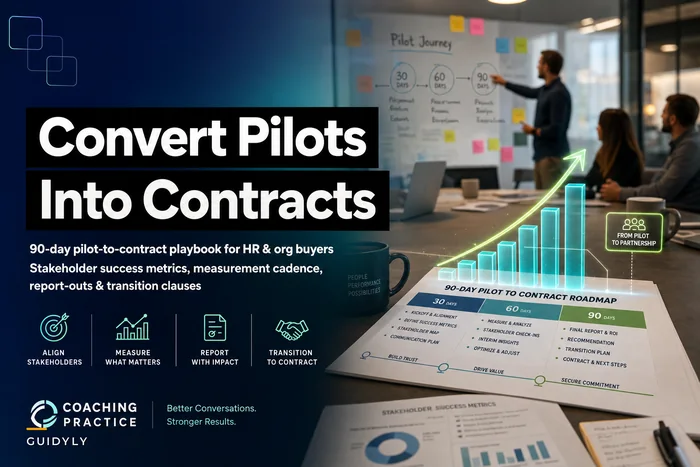



Most coaching practices that sell into organizations lose deals for a reason that has nothing to do with the quality of their coaching. They lose because the buyer needed a specific artifact at a specific moment — a security questionnaire response, a before/after measurement plan, a procurement-ready scope doc — and the coach showed up with a nice deck and a good story instead.
That gap between "we're great at the work" and "we're easy to buy from" is where a commercial operating model lives. Not a sales script. Not a CRM full of stages nobody updates. An actual operating model: a prescribed set of buyer artifacts, a cadence for producing them, and a clear line connecting the evidence you collect during delivery back into the next sale.
This is the part of the business that stays invisible until you try to scale, and then it breaks loudly.
Why the deal stalls aren't where coaches think they are
Walk through a stuck enterprise coaching deal and you'll usually find the same pattern. The champion loved the pilot. The feedback was strong. Then the deal entered procurement and went quiet for six weeks.
The coach assumes it's a budget issue or a priorities issue. Sometimes it is. But far more often, the deal stalled because the champion couldn't assemble the internal case fast enough. HR buyers almost never buy alone. They have to sell the purchase sideways to finance, upward to a VP, and across to legal and security. Every one of those people wants a different artifact.
What breaks is coordination, not persuasion. The champion is now doing your sales job for you, inside an organization you can't see into, armed with whatever scraps you handed them. If those scraps aren't the right ones, the deal dies of friction.
A typical example looks like this: a leadership coach runs a strong 8-person pilot with a mid-sized tech company. NPS is high, the sponsor is enthusiastic, and everyone agrees it should expand company-wide. Then legal asks for a data processing addendum, security sends a 90-question vendor assessment, and finance wants a cost-per-participant model benchmarked against the incumbent EAP. The coach has none of these ready. By the time they've scrambled through each one over three weeks each, the budget cycle has closed and the sponsor has moved on to a fire somewhere else.
The coaching was never the problem. The commercial operating model was missing.
The core idea: artifacts are the unit of progress
In a healthy enterprise sales motion, the thing that actually moves a deal forward isn't a meeting — it's an artifact changing hands. Each artifact either unblocks a specific stakeholder or produces evidence the next stakeholder needs.
Never miss a session or detail again.
Guidyly helps you book, manage, and track every coaching session efficiently.
- Centralized session scheduling
- Automated client reminders
- Progress tracking & notes
No credit card required
So the first job of a commercial operating model for coaching is to map, stage by stage, which artifact does what job. When you do that, your pipeline stops being a list of conversations and becomes a production line of documents, each one with an owner and a deadline.
The mental shift worth making: you're not trying to convince the buyer. You're trying to equip your champion to convince six other people without you in the room.
The practices that scale into real enterprise revenue treat their artifact library like a product. They build it once, keep it current, and reuse it across every deal. The ones that stay stuck rebuild everything from scratch for each opportunity, which means every deal moves at the speed of the coach's worst week.
Mapping the three stages: pilot, procurement, deployment
Enterprise coaching deals move through three distinct commercial phases, and each one fails differently. Treat them as separate systems with separate artifacts.
Stage 1 — Pilot (prove the mechanism)
The pilot exists to produce evidence, not just goodwill. The mistake here is running a pilot that feels great but measures nothing a finance person would accept. If you want the detail on structuring the pilot itself, the 90-day corporate pilot playbook covers the delivery mechanics. The commercial model cares about one thing on top of that: is the pilot generating the artifacts procurement will ask for later?
-
A baseline measurement snapshot captured in week one (if you don't capture a baseline, you can't prove change — and a lot of stalled deals trace back to exactly this being skipped)
-
A mid-pilot signal report so the sponsor has something to forward upward before the pilot even ends
-
A participant outcome summary tied to the metrics the buyer named at the start, not the ones that happened to look good
-
A reference quote or two, captured with consent, while enthusiasm is high
Stage 2 — Procurement (make yourself easy to buy)
This is the stage coaches are least prepared for, and it's where deals rot. Procurement isn't evaluating your coaching. They're evaluating your risk and your paperwork. The evidence you built around turning coaching activities into verifiable outcomes feeds directly into the business case here, but the business case alone won't clear procurement.
-
A security and data-handling response pack (fill in once, reuse forever)
-
A standard DPA / data processing addendum your lawyer has already blessed
-
A cost-per-participant model with 2–3 volume tiers
-
A scope-of-work template with deliverables, cadence, and exclusions spelled out
-
A business case one-pager written for finance, not for the champion
Stage 3 — Deployment (prove you can scale delivery)
The final blocker is operational credibility. The buyer wants to know that going from 8 people to 200 won't collapse quality. This is where your delivery systems become a sales asset.
-
A rollout plan with phased cohorts and named milestones
-
A coach-quality and consistency summary (how you ensure cohort 14 gets what cohort 1 got)
-
A reporting cadence sample showing exactly what the buyer will receive monthly
-
A escalation and support plan for when something goes sideways
The final blocker is operational credibility. The buyer wants to know that going from 8 people to 200 won't collapse quality. This is where your delivery systems become a sales asset.
The artifact library, laid out by buyer concern
Here's the part worth building once and never rebuilding. Map each artifact to the stakeholder who demands it and the stage it belongs to.
| Artifact | Stage | Stakeholder it unblocks | Reuse level |
|---|---|---|---|
| Baseline measurement snapshot | Pilot | Sponsor / Finance | Template, per-deal data |
| Mid-pilot signal report | Pilot | Champion | Template |
| Outcome summary | Pilot | VP / Finance | Template |
| Security response pack | Procurement | IT / Security | Fully reusable |
| Data processing addendum | Procurement | Legal | Fully reusable |
| Cost-per-participant model | Procurement | Finance | Template |
| Scope-of-work doc | Procurement | Procurement lead | Template |
| Business case one-pager | Procurement | Executive sponsor | Template |
| Rollout plan | Deployment | HR ops | Template |
| Quality consistency summary | Deployment | Sponsor | Fully reusable |
| Reporting cadence sample | Deployment | HR / Finance | Fully reusable |
The insight most people miss: the "fully reusable" rows are where your leverage lives. A security pack and a DPA take real effort to build once and then clear the same blocker in every future deal in a day instead of three weeks. Those rows alone can cut weeks out of a procurement cycle.
A working cadence, not a pile of templates
Templates without a cadence just become a shared drive full of good intentions. The operating model needs a rhythm that forces artifacts to get produced on time.
A simple cadence that works for a two-to-five person coaching practice selling into mid-market organizations:
-
Deal opens → within 48 hours, pull the artifact checklist for the current stage and assign owners.
-
Weekly 30-minute commercial standup → one question per open deal: which artifact is this deal waiting on, and who owns it? Not "how's it going." Specifically which document.
-
Stage gate review → a deal cannot move from pilot to procurement until the baseline snapshot and outcome summary exist. No exceptions, because this is exactly where deals leak.
-
Procurement sprint → when a deal enters procurement, the security pack and DPA go out proactively in the first week, before anyone asks. This single move signals you've done this before and quietly de-risks you in the buyer's eyes.
-
Post-close retro → capture which artifact was missing or slow, and fix the library so the next deal is faster.
The weekly standup question matters more than it looks. "How's that deal going?" produces vague optimism. "Which artifact is it waiting on?" produces an answer you can act on today.
Visualizing this cadence helps teams run it consistently.
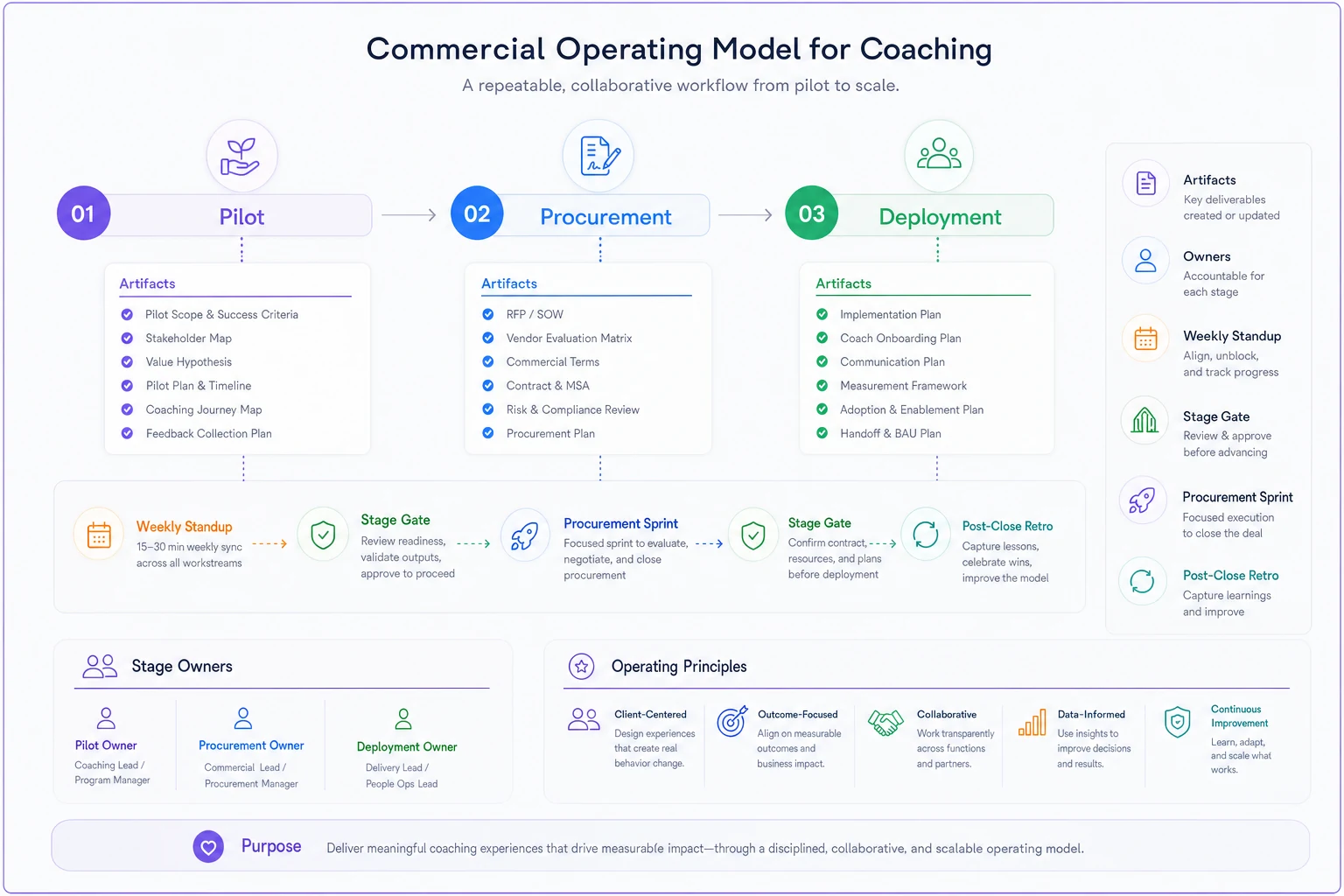
In your weekly commercial standup, keep the focus strictly on the single artifact question to avoid vague updates.
The weekly standup question matters more than it looks. "How's that deal going?" produces vague optimism. "Which artifact is it waiting on?" produces an answer you can act on today.
A real scenario
A four-person executive coaching practice was selling into HR departments at companies in the 500–2,000 employee range. They were winning pilots at a decent clip — maybe 6 or 7 a year — but converting only about a third into full contracts. The rest died somewhere in procurement.
They spent roughly a month building a proper artifact library: a security response pack, a lawyer-approved DPA, a tiered cost model, and three fill-in templates for pilot evidence. Then they added the weekly artifact-focused standup and the hard stage gate between pilot and procurement.
Over the following two quarters, their pilot-to-contract conversion moved from around a third to a bit over half. The deals that did close moved noticeably faster — procurement cycles that used to run 10–12 weeks were landing closer to 6. Nothing about their actual coaching changed. They just stopped making their champions improvise.
The partner who ran it put it plainly: they weren't closing more because they got better at coaching. They were closing more because the buyer never had to wait on them.
Where the tooling actually helps (and where it doesn't)
A shared drive and a spreadsheet can run this model for a while. What breaks first at scale is coordination — knowing which deal is waiting on which artifact, whether the DPA in this deal is the current approved version, and whether last quarter's outcome evidence is being reused in this quarter's business case.
This is where a workflow platform earns its place. AI-assisted operational software can pull the right artifact checklist for each deal stage automatically, flag deals sitting on a missing document, and keep your reusable packs versioned so nobody sends a buyer last year's security response. It can also take the raw delivery data from your pilots and shape it into the outcome summaries procurement wants, instead of someone rebuilding that export by hand every time.
The point isn't automation for its own sake. It's that the commercial model has a lot of moving parts across sales and delivery, and when those parts live in someone's head, the whole thing degrades the moment that person is busy or gone. Centralizing the artifact library, the cadence, and the evidence flow is what lets the model survive a growing pipeline.
When this is worth building — and when it isn't
Build this when:
-
You're selling into organizations with real procurement functions, not just individual buyers.
-
You're running more than a couple of enterprise pilots a year and conversion is leaking.
-
More than one person touches the sales process, so coordination actually matters.
Skip it (for now) when:
-
You're still primarily a solo consumer-facing coach. The artifact overhead won't pay for itself yet, and your energy is better spent on the demand side — the buyer-specific go-to-market blueprints are more useful at that stage.
-
You're pre-pilot and haven't proven the coaching works. Build the evidence first; the commercial model packages evidence, it doesn't manufacture it.
Who should not do this: practices chasing enterprise logos purely for prestige, without delivery systems that can actually scale past a single cohort. If deployment would break your quality, a slicker sales motion just gets you to a bigger failure faster.
The quick-start checklist
If you want to start building the model this week:
-
[ ] List every question a buyer has asked you in the last 12 months that slowed a deal
-
[ ] Group those questions by stage
pilot, procurement, deployment
-
[ ] Draft or template the five highest-leverage artifacts first (security pack, DPA, cost model, outcome summary, business case one-pager)
-
[ ] Mark which artifacts are fully reusable vs. per-deal
-
[ ] Add one weekly commercial standup with the single artifact question
-
[ ] Put a hard gate between pilot and procurement tied to evidence existing
-
[ ] After each closed or lost deal, update the library based on what was missing
Start with the reusable artifacts. They cost the most to build and save the most time, and they're the ones your champions will quietly thank you for when procurement finally clears in a week instead of a month.
The real takeaway
A commercial operating model isn't a sales technique layered on top of good coaching. It's the machinery that lets good coaching get bought inside organizations that are structurally built to slow purchases down. The coaches who win enterprise work aren't the most persuasive ones. They're the ones who make the buyer's internal job easy — who hand the champion the exact artifact needed to clear the next stakeholder, before anyone has to ask for it.
That's a systems problem, and systems problems reward preparation. Build the library once, run the cadence consistently, and let your delivery evidence feed back into your next sale. The deals you've been losing to procurement friction aren't lost to better competitors. They're lost to the wait — and the wait is something you can engineer out.
Ready to elevate your coaching business?
Join hundreds of coaches using Guidyly to save time, enhance client engagement, and grow their practice.