


Most coaches who start selling to companies eventually hit the same wall. The coaching itself is fine — great, even. What breaks is everything around it: the security questionnaire nobody was ready for, the pilot that never converted because outcome data lived in three different spreadsheets, the deployment where three coaches interpreted the same scope three different ways.
Selling into organizations isn't a bigger version of selling to individuals. It's a different operating system entirely. The buyer moves through distinct stages, each one generates its own paperwork and decision-makers, and if you don't have a system that hands work off cleanly between those stages, deals stall in the gaps. Not because your coaching is weak — because your operations leak.
This is the part almost nobody documents: what an enterprise operating model for coaching vendors actually looks like, mapped stage by stage. Not the sales tactics. The plumbing. Who owns what, what artifact has to exist before anything moves forward, and where the whole thing quietly falls apart when you scale from one enterprise client to eight.
Why the enterprise sale breaks where it does
The consumer sale is roughly linear: interest → call → close → deliver. One buyer, one decision, one relationship.
The enterprise sale is not one buyer. It's a discovery contact (usually L&D or a line manager), an economic buyer (a director or VP who controls budget), a procurement gatekeeper (legal, finance, vendor management), and eventually the actual participants receiving the coaching. These people care about completely different things and enter the process at different moments.
The typical failure isn't that a coach can't handle any single one of them. It's that the handoff between them is undefined. A coach nails a discovery conversation, the L&D contact gets excited, and then three weeks later procurement sends over a security questionnaire and a data-processing addendum — and the coach has nothing prepared. Momentum dies while they scramble. The champion who was excited moves on to other priorities.
What tends to happen across a lot of these deals is that the excitement generated in one stage has a short shelf life. If the next stage requires two weeks of scrambling to produce documents that should already exist, you burn the goodwill. The operating model exists to make each transition fast enough that the buyer never has time to cool off.
The four stages and what each one actually demands
Think of the enterprise motion as four stages, each with its own required artifacts, its own owner, and its own expectation for how fast you respond. This is the core of the whole model.
Never miss a session or detail again.
Guidyly helps you book, manage, and track every coaching session efficiently.
- Centralized session scheduling
- Automated client reminders
- Progress tracking & notes
No credit card required
| Stage | Buyer's real question | Required artifacts | Primary owner | Response SLA |
|---|---|---|---|---|
| Discovery | "Do you understand our problem?" | Discovery notes, tailored problem framing, capability one-pager, rough scope | Founder / senior coach | 24–48 hrs on follow-up |
| Pilot | "Will this actually work here?" | Pilot design doc, success metrics agreement, baseline data plan, participant list | Delivery lead | 48 hrs on scoping questions |
| Procurement | "Is it safe and defensible to buy?" | Vendor packet, MSA/SOW, insurance certs, data & privacy answers, references | Ops / founder | 3–5 business days on questionnaires |
| Deployment | "Is it running well?" | Kickoff plan, coach assignments, session cadence, reporting rhythm | Delivery lead + assigned coaches | Weekly reporting cadence |
The point of this table isn't the exact SLAs — those vary by your size. The point is that each column has a named owner and a defined artifact that must exist before the deal advances. When a stage has no owner, it defaults to the founder, and the founder becomes the bottleneck across every simultaneous deal. That's the scaling cliff.
Discovery: the stage where you accidentally over-promise
Discovery is where coaches feel most comfortable and cause the most downstream damage. You're in a good conversation, the client describes a messy problem, you say "yeah, we can build something for that." Six weeks later that offhand comment is in a pilot scope you can't profitably deliver.
The fix is an artifact: a discovery note that separates what they said they need from what you're actually committing to explore. One column for stated problem, one for hypothesized scope, one marked "not included / future phase." This becomes the raw material for the pilot design — and it protects you from scope you never meant to sell.
A pattern worth watching: the strongest discovery calls produce a narrower proposed pilot, not a broader one. Coaches who try to solve the whole org in the pilot rarely convert. The ones who pick one measurable slice — say, first-time managers in one division — tend to win far more often.
Pilot: where deals go to quietly die
The pilot is the highest-leverage and most mishandled stage. The reason pilots fail to convert usually isn't coaching quality. It's that nobody agreed in writing on what success looked like before the pilot started, so at the end there's no shared definition of "it worked."
-
A one-page pilot design (scope, participants, duration, cadence)
-
A success-metrics agreement signed off by the economic buyer, not just the L&D contact
-
A baseline data plan — what you measure at week zero so you have something to compare against at week twelve
-
A named internal sponsor who will be in the room for the readout
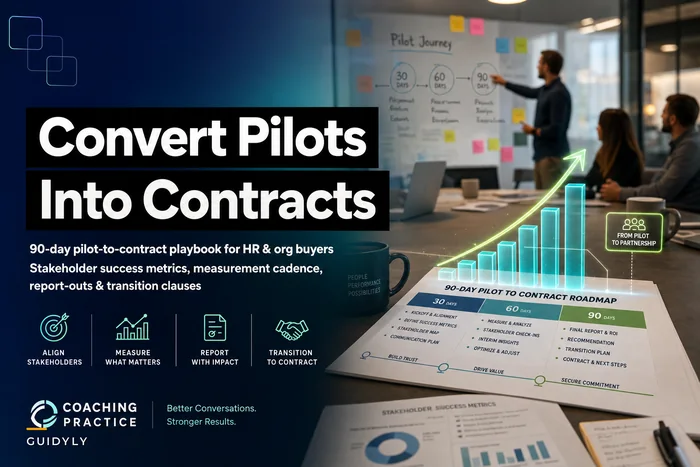
That baseline point is where most coaches lose the conversion. No starting measurement means your end-of-pilot readout is just testimonials and vibes, and procurement can't justify the spend on that. If you're running corporate pilots, the mechanics of actually converting them are worth studying in depth in the 90-day corporate pilot playbook, because the conversion is engineered before the pilot begins, not scrambled together at the end.
Procurement: the stage coaches are least prepared for
This is where solo and small coaching practices get ambushed. Everything was going great, and then a vendor management team sends a 60-question security and compliance questionnaire, a request for proof of insurance, a data-processing agreement, and questions about where participant data is stored and for how long.
Coaches who haven't sold enterprise before treat each of these as a one-off fire drill. Every new deal, they rebuild the answers from scratch. That's the mistake. These questions are roughly 85% identical across buyers. The answers should be written once, stored once, and reused.
Deployment: where quality quietly drifts
Once you win, the risk shifts from closing to consistency. If you've assigned three coaches to a client's cohort, the buyer now experiences three different coaching styles, three different note formats, three different levels of follow-through. To the client, that inconsistency reads as "this vendor doesn't have their act together."
Deployment needs a kickoff plan, explicit coach assignments, a standard session cadence, and a fixed reporting rhythm so the client sees the same picture every month regardless of which coach is delivering. The data flows that make this consistency possible are their own engineering problem — the systems architecture and integration patterns behind session data, reporting, and coach handoffs are what keep multi-coach delivery from turning into quiet chaos.
The SOC-lite vendor packet (built for coaches, not tech companies)
The practical thing that gets coaches through procurement fastest is a pre-built vendor packet. You don't need a full SOC 2 report to sell coaching — most buyers aren't demanding it. But they are demanding proof that you've thought about data, privacy, and continuity. A "SOC-lite" packet answers that without the six-figure audit.
Build this once and keep it in a single folder you can send in under ten minutes:
-
Company overview — legal entity, years operating, insurance details (professional liability / E&O, general liability, cyber if you have it)
-
Data handling summary — what participant data you collect, where it's stored, who can access it, and your retention/deletion policy
-
Confidentiality practices — how coach notes are secured, what stays private between coach and participant vs. what's reported to the employer
-
Subprocessor list — the tools you use (scheduling, video, notes, storage) and what data each one touches
-
Business continuity — what happens if a coach becomes unavailable mid-engagement; your backup and handoff plan
-
References — two or three named contacts from prior engagements who've agreed to be called
-
Standard agreements — your MSA and SOW templates, pre-reviewed by your own lawyer
The real value of this packet isn't the content — it's the speed. When procurement gets a complete, professional packet within days instead of a piecemeal trickle over three weeks, it signals you're a real operation.
Store the packet in a single shared folder so you can send it in under ten minutes.
Two coaching practices reach procurement at the same time; the one with a ready packet clears vendor review in around ten days, the one improvising takes closer to six weeks, and the buyer quietly starts wondering whether the slower vendor can handle a real engagement.
Role handoffs: the part that actually breaks at scale
With one enterprise client, the founder does everything and it works fine. With five or six running simultaneously, the founder becomes the single point of failure at every stage transition. This is the specific mechanism by which growing coaching practices stall out.
The handoff workflow that keeps things moving:
-
Discovery → Pilot. The person who ran discovery writes the discovery note and hands it to the delivery lead with a 15-minute verbal handoff. The delivery lead owns the pilot design from that point forward. Rule: nothing advances without a written discovery note.
-
Pilot → Procurement. When the buyer signals intent, ops takes over the paperwork thread while the delivery lead stays focused on finishing pilot delivery cleanly. Two people, two jobs, running in parallel — not one person context-switching between selling and delivering.
-
Procurement → Deployment. Once the contract is signed, ops hands the delivery lead a clean scope summary, and the delivery lead assigns and briefs coaches. Rule: coaches never start from the raw contract; they start from a one-page delivery brief.
-
Deployment → Renewal. The delivery lead owns the monthly reporting rhythm, which quietly becomes the renewal conversation. The renewal isn't a new sale; it's a continuation of a reporting relationship the client already trusts.
One failure mode worth calling out specifically: a stage with two owners is as bad as a stage with none. When both the founder and the delivery lead think they're handling procurement, the questionnaire sits untouched for a week because each assumes the other has it. Assign one name per stage. Write it down somewhere.
A quick visual of the handoff workflow helps teams internalize who owns each stage.
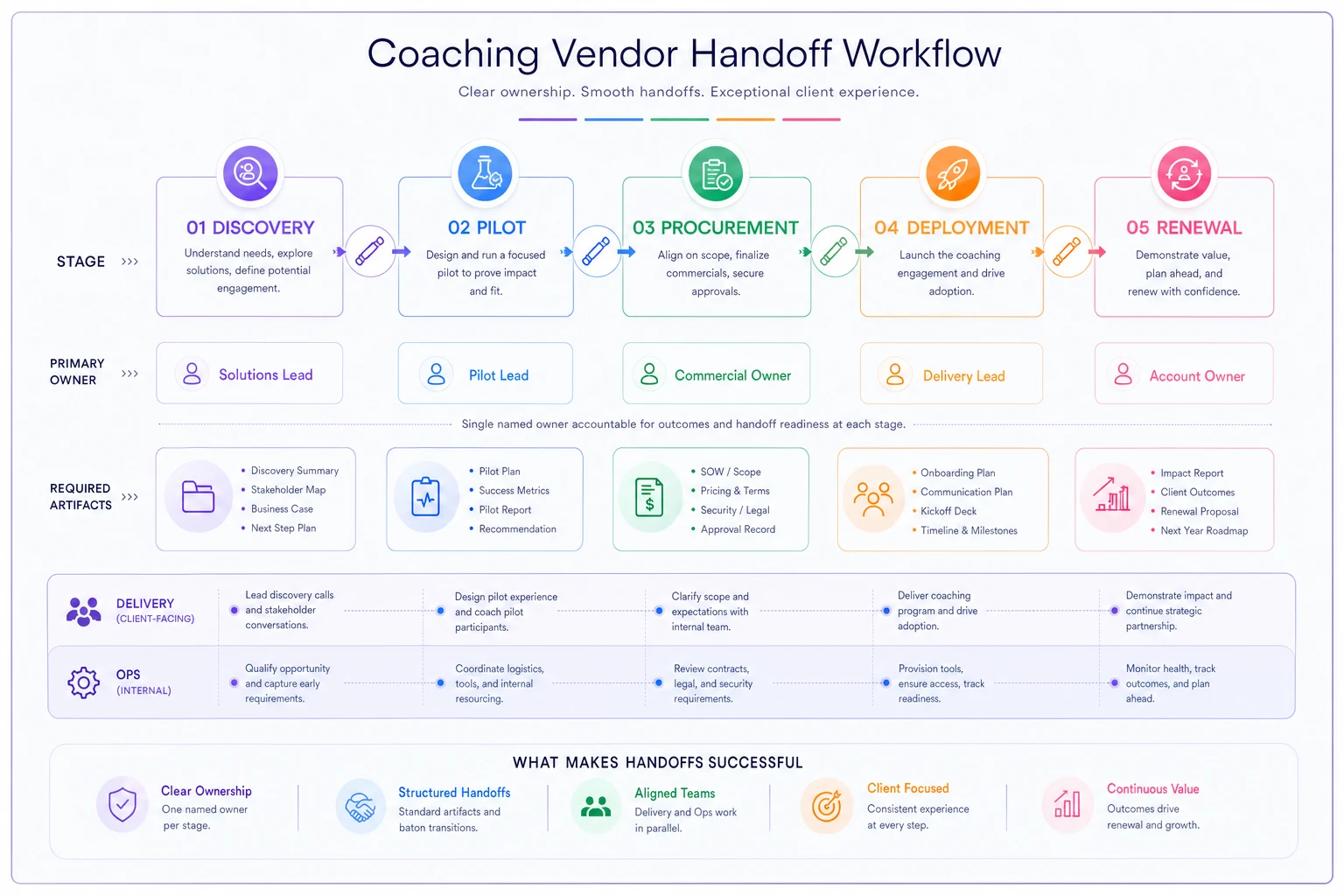
Assigning and documenting these handoffs removes ambiguity and prevents deals from stalling.
Low-engineer priorities: what to build first with limited resources
Most coaching practices don't have an operations team or a developer on call. So the question isn't "what's the perfect system" — it's "what do I build first that stops the most bleeding." In rough priority order:
-
First
the vendor packet.
Pure document work, no engineering, and it unblocks the stage that kills the most deals. -
Second
the pilot design and success-metrics template.
A shared doc that forces baseline capture before the pilot starts. This single template lifts conversion more than almost anything else. -
Third
a stage tracker.
Even a simple board showing which deal is in which stage, who owns it, and what artifact is outstanding. This replaces the founder's memory as the coordination layer. -
Fourth
standardized delivery briefs and reporting templates
so multi-coach delivery stays consistent across the client's experience.
The instinct is to build dashboards first because they look impressive. Dashboards don't unstick deals — the vendor packet and the metrics agreement do. Build the unglamorous artifacts that remove friction from stage transitions before you build anything that looks like a product.
A real scenario
A three-person coaching practice — one founder, two contract coaches — was pulling in around $180k a year, mostly from individual and small-team clients. They'd landed two corporate pilots in eighteen months and converted neither. Both got strong participant feedback. Both died anyway: one because the security questionnaire dragged for a month with no clear answers, the other because there was no baseline data and the buyer's finance team couldn't justify the spend.
They didn't change their coaching. They built three things: a SOC-lite vendor packet, a pilot design template with mandatory baseline capture and economic-buyer sign-off, and a simple stage tracker naming one owner per stage. The founder stopped being the default owner of procurement — one of the contract coaches took it over.
Over the following year they ran four pilots and converted three. Procurement time dropped from several weeks of stalling to roughly ten days on average. Corporate revenue went from zero converted deals to somewhere around $120k–$140k in signed multi-cohort work. The change wasn't better selling. It was closing the gaps between stages so deals stopped quietly leaking out.
When this model makes sense — and when it doesn't
When it makes sense: You're already getting corporate conversations, even if they're not converting. You have at least one other person who can own a stage. You're seeing deals stall specifically at procurement or pilot readout. The model exists to fix leaky transitions — if that's your problem, build it now.
When it's overkill: You do one corporate engagement a year and mostly serve individuals. Building a full four-stage operating model for a once-a-year event is wasted effort. Keep a vendor packet on hand and skip the rest until enterprise becomes a real revenue line.
Who should not do this yet: Solo coaches with no delivery capacity beyond themselves. If you can't staff a second coach, winning a multi-cohort enterprise deal will crush your delivery and damage your reputation in a market you actually want to be in long-term. Fix capacity first, then build the enterprise motion. The broader question of which buyer segments to pursue and in what order is worth thinking through with the buyer-specific go-to-market blueprints before you commit real resources to the enterprise track at all.
Putting it together
The enterprise operating model isn't about being more corporate or more polished. It's about recognizing that selling coaching to organizations is a relay race — and relay races are won or lost at the baton handoffs, not in the straightaways.
Map your four stages. Give each one a named owner and a required artifact. Build the vendor packet before you need it, force baseline capture before every pilot starts, and make sure no deal advances with an undefined handoff. Do those things, and your coaching quality — which was probably never the actual problem — finally gets to show up inside a process that doesn't bleed deals along the way.
Map your four stages. Give each one a named owner and a required artifact. Build the vendor packet before you need it, force baseline capture before every pilot starts, and make sure no deal advances with an undefined handoff. Do those things, and your coaching quality — which was probably never the actual problem — finally gets to show up inside a process that doesn't bleed deals along the way.
Ready to elevate your coaching business?
Join hundreds of coaches using Guidyly to save time, enhance client engagement, and grow their practice.