


Most coaching practices don't have a governance problem until suddenly they do. A client asks for their data back and you realize session recordings are scattered across three different cloud drives. A subcontractor coach starts using your materials for a competing program. A corporate client's legal team sends a security questionnaire and you have nothing to point to. None of these are catastrophic on their own. But they all trace back to the same missing layer: nobody ever decided how the practice governs itself.
Governance feels like overhead until it's the only thing between you and a bad outcome. And the frustrating part is that a workable framework for coaches isn't some 80-page compliance manual. It's a handful of connected controls that answer predictable questions before they become emergencies. This piece walks through how those controls fit together as a system — where they overlap, where they break as you add coaches and clients, and what a "good enough for now" version looks like that you can genuinely deploy in an afternoon.
Why governance breaks differently at each stage
The reason most coaches skip governance early is rational. When you're solo with 12 clients, you are the framework. You remember every consent conversation, you know where every note lives, and nobody else is touching client data. Governance is implicit, and implicit works fine at that size.
The trouble starts the moment anything gets distributed. A virtual assistant starts handling scheduling. You bring on a second coach. A corporate account requires you to store deliverables in their system. The knowledge that used to live in your head now has to live somewhere other people can find and follow. That transition is where practices get exposed — they carry solo-era habits into a multi-person operation without realizing anything has changed.
Governance failures almost never show up as one big event. They show up as small inconsistencies that compound. One coach records sessions and stores them locally, another uses the shared drive, a third doesn't record at all. Six months later a client requests deletion and you can't confidently say you found everything. The inconsistency is the risk. A governance framework mostly exists to eliminate "it depends on who did it."
| Practice stage | What usually governs behavior | Where it breaks | First control to add |
|---|---|---|---|
| Solo, <20 clients | Founder's memory | New helper joins, no documented rules | Unified consent + retention policy |
| 2–4 coaches | Verbal norms, group chat | Inconsistent data handling across coaches | RACI + recordkeeping controls |
| Multi-coach + corporate clients | Ad-hoc contracts | Subcontractor IP, security questionnaires | SOW guardrails + insurance proof |
| Established, referrals + partners | Reactive fixes | No response plan when something goes wrong | Incident runbook + quarterly audit |
The table isn't a maturity ladder you climb perfectly. Most practices are messy hybrids — a corporate client but no incident plan, three coaches but no written retention rule. The point is to see which control your current stage is quietly missing.
The six pieces and how they connect
People treat these as separate documents. They're not. They're one system where each piece assumes the others exist. Consent rules are meaningless if your recordkeeping doesn't enforce retention. A subcontractor clause is toothless if no audit ever checks whether contractors followed it. Think of the six pieces as a loop, not a checklist.
Never miss a session or detail again.
Guidyly helps you book, manage, and track every coaching session efficiently.
- Centralized session scheduling
- Automated client reminders
- Progress tracking & notes
No credit card required
1. Unified privacy and consent snippets. One consistent set of language that shows up everywhere client data is collected — intake forms, recording notices, testimonial releases, email footers. The failure mode is having different consent language in five places, which means you can't actually tell clients what you do with their data because the answer depends on which form they signed. If you record sessions at all, this connects directly to your retention and access rules. There's a deeper breakdown of that specific piece in this session consent, retention and access checklist worth pairing with your unified snippets.
2. Insurance and recordkeeping controls. Two things live here: proof you carry appropriate coverage (professional liability at minimum), and a documented rule for what you keep, where, and for how long. The insurance side matters more than coaches expect once corporate clients enter the picture — procurement teams often require a certificate of insurance before a contract moves forward. The recordkeeping side is what makes every other control enforceable.
3. SOW and subcontractor guardrails. The moment you use another coach — even one, even part-time — you need standard language covering IP ownership, confidentiality, data handling, and non-solicitation of your clients. The common mistake is treating the first subcontractor as a favor between friends and skipping the paperwork. That's exactly the relationship that goes sideways.
4. Incident-response runbook. A short document that answers: if client data is exposed, a recording leaks, or a coach mishandles confidential material — who does what, in what order, and within what timeframe. Most practices have nothing here, which means the response to an incident is improvised at the worst possible moment.
5. RACI matrix. Responsible, Accountable, Consulted, Informed — mapped across your core operational tasks. This is the piece that makes multi-coach practices actually function, because it kills the "I thought you were handling that" problem. It's the connective tissue between all the other documents.
6. Quarterly audit checklist. The mechanism that keeps the other five from rotting. Governance documents decay fast — people revert to old habits, new tools get adopted without policy updates, contractors slip through without signed agreements. A 30-minute quarterly review catches drift before it becomes exposure.
A one-day implementation sequence
You don't build this perfectly. You build a defensible first version and improve it quarterly. Here's an order that works because each step gives you the raw material for the next.
-
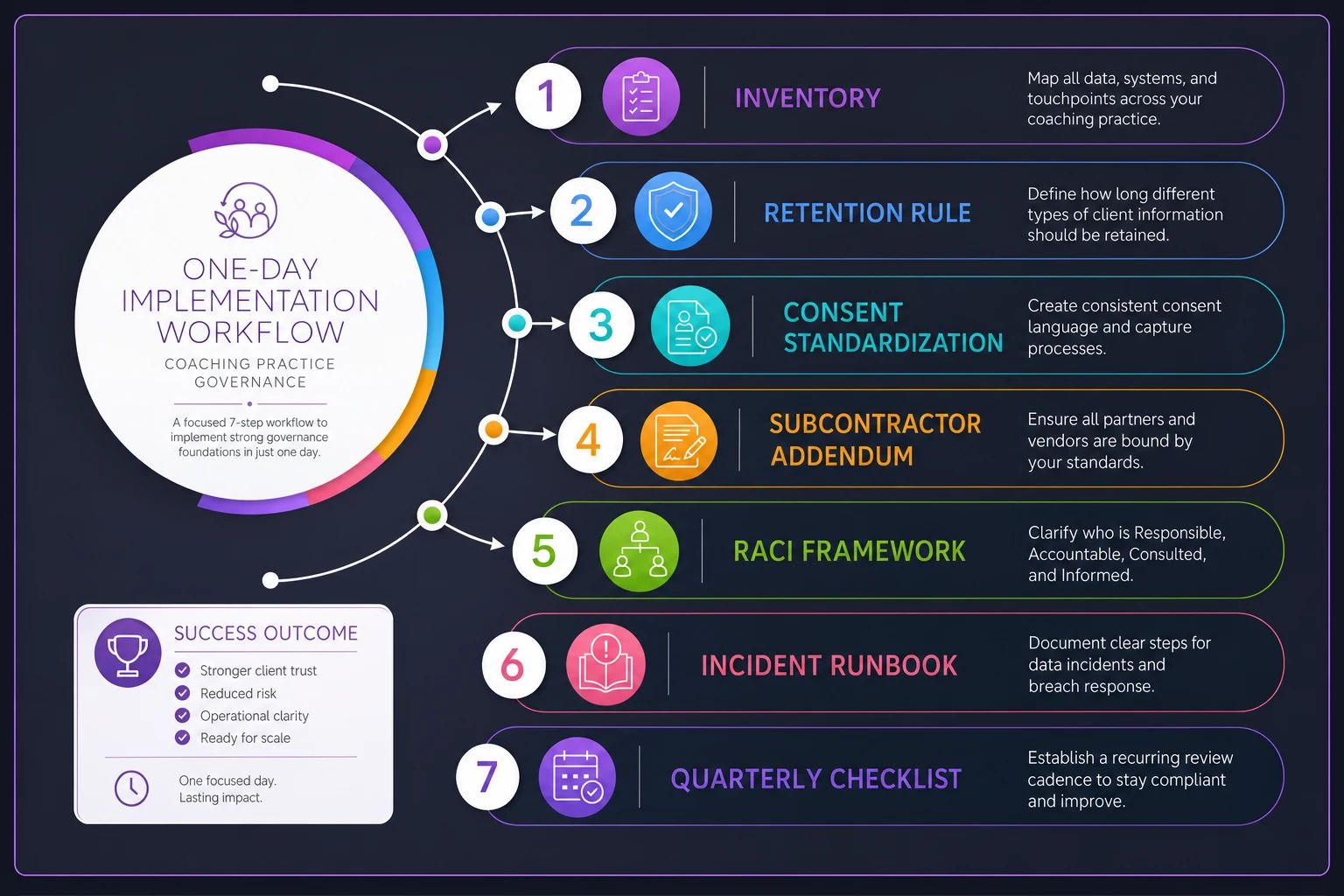
1. List every place you collect or store client data (30–45 min). Intake forms, email, scheduling tool, recording storage, notes system, payment processor. You can't govern what you haven't inventoried. This step alone surfaces more risk than most coaches expect — usually a forgotten drive or an old form still collecting data somewhere.
-
2. Write your retention rule (20 min). Decide how long you keep notes, recordings, and intake data, and when they get deleted. Keep it simple: "Session notes retained 24 months, recordings 12 months unless client requests earlier deletion." Realistic beats aspirational.
-
3. Standardize consent language (30 min). Draft one consent snippet and one recording-notice snippet. Paste them everywhere. Consistency is the whole win.
-
4. Draft the subcontractor addendum (30 min). Even if you have no subcontractors yet. A one-page addendum covering confidentiality, IP, and non-solicitation means you're never scrambling when you hire.
-
5. Build the RACI (30 min). Six to ten core tasks down the left, roles across the top. Fill in one letter per cell. Don't overthink it.
-
6. Write the incident runbook (30 min). Three scenarios, a first-responder name, notification steps, and a timeframe. One page.
-
7. Turn it all into a quarterly checklist (15 min). Every item above becomes a "still true?" line you review four times a year.
Start with the inventory — it usually surfaces the forgotten data sources that cause the most headaches.
This visual shows the recommended order and the flow between steps.
That's roughly four hours of focused work. Not glamorous, but it moves you from "we'd figure it out" to "we have a process."
The RACI is the piece everyone underestimates
Of the six, the RACI quietly does the most work in a growing practice — and it's the one coaches are most tempted to skip because it feels bureaucratic. It isn't. It's the answer to nearly every coordination failure a multi-coach practice runs into.
-
Client intake review — Assistant Responsible, Founder Accountable
-
Consent collection — Coach Responsible, Founder Accountable
-
Recording storage & deletion — Assistant Responsible, Founder Accountable, Coaches Informed
-
Subcontractor agreements — Founder Responsible & Accountable
-
Incident response lead — Founder Accountable, all Consulted
-
Quarterly audit — Founder Responsible, Coaches Informed
The insight most people miss: every row needs exactly one "Accountable." Not zero, not two. When two people are accountable for recording deletion, nobody deletes recordings — each assumes the other did. That single-owner rule is what prevents the compounding inconsistencies mentioned earlier. If you're growing past the point where the founder can hold all of this personally, the operational scaffolding in this guide on SOPs and 90-day onboarding for multi-coach practices pairs naturally with a RACI — the SOPs describe how, the RACI describes who.
A real scenario: what governance drift actually costs
Consider a boutique leadership-coaching practice — a founder plus two contract coaches, serving a mix of individual executives and two mid-size corporate accounts. Revenue somewhere around $240k–$260k a year. No formal governance; everything ran on the founder's memory and a shared Google Drive.
The trigger was a corporate renewal. The client's procurement team sent a vendor security questionnaire — data handling, retention policy, proof of insurance, subcontractor controls. The practice had none of it documented. Pulling answers together took the founder the better part of two weeks of scattered evenings, and the renewal stalled about six weeks longer than it should have. During that stall, the account was quietly re-evaluating other vendors. The deal was worth roughly $40k annually, and it nearly walked over paperwork.
After that scare, they stood up the compact pack over two sittings. The outcome wasn't dramatic revenue growth — it was speed and confidence. The next corporate questionnaire got answered in under a day. When one contract coach left, the signed non-solicit and IP addendum meant there was no ambiguity about client relationships or materials. A routine quarterly audit caught that old intake responses were still sitting in a deprecated form nobody had turned off — a small thing that could've been an ugly conversation if a client had asked.
The lesson wasn't that governance made them money. It was that the absence of it had been silently putting existing revenue at risk, and nobody had priced that in.
Where your systems and your governance have to agree
Governance documents that don't match how your tools actually work are worse than no documents, because they create a false sense of coverage. If your retention policy says recordings are deleted after 12 months but your storage tool never deletes anything automatically, you've written a promise you're breaking. This is where policy meets architecture, and it's a common failure point — the data flows and integration patterns that create these mismatches are covered in depth in this piece on coach systems architecture and failure modes.
The practical move is to make your quarterly audit check the tools, not just the documents. Does the scheduling tool still send the current consent snippet? Is the deletion rule actually running, or is it manual and therefore skipped? Are subcontractors' access permissions revoked when they leave? Software that centralizes client records, consent status, and retention timelines makes this easier — instead of chasing data across five systems, you're confirming one source enforces the rules you wrote. But the tool is downstream of the decision. The framework has to exist first; the system just enforces it consistently.
When this makes sense — and when it's overkill
When it clearly makes sense: you have any subcontractors, any corporate clients, or you record sessions. Any one of those three creates enough exposure to justify the full pack. Two or three of them and you're already overdue.
When a lighter version is fine: solo coach, individual clients only, no recordings, no plans to hire. In that case, build the consent snippets and the retention rule, skip the RACI and subcontractor addendum until you actually need them. Governance should match your surface area, not exceed it.
When it's a bad idea to over-invest: don't build a 50-page manual for a two-client practice. The most common governance mistake isn't skipping it — it's over-engineering it into something so heavy nobody maintains it. A one-page runbook that gets reviewed beats a comprehensive policy that gets ignored. Right-size it, then let the quarterly audit tell you what to add.
A quarterly audit checklist to steal
Run this four times a year. Fifteen to thirty minutes.
-
[ ] Data inventory still accurate? Any new tools collecting client data that aren't covered?
-
[ ] Consent language identical across every form, notice, and footer?
-
[ ] Retention rule actually being enforced — recordings and notes deleted on schedule?
-
[ ] Every active subcontractor has a signed current addendum on file?
-
[ ] Departed coaches' access fully revoked; their client materials accounted for?
-
[ ] Insurance certificate current and not expiring within the next quarter?
-
[ ] RACI still reflects who actually does each task?
-
[ ] Incident runbook first-responder still employed and reachable?
-
[ ] Any near-misses last quarter worth turning into a new control?
The last item is the one that keeps the whole thing alive. Governance improves fastest when you feed real near-misses back into it, rather than reviewing abstract policy in a vacuum.
The point isn't paperwork — it's not having to think
A governance framework earns its keep on the days something goes wrong, and on the days a serious client asks you to prove you're serious. The rest of the time it just runs in the background, quietly preventing the small inconsistencies that would otherwise pile up into a real problem.
Start with the inventory, write the retention rule, standardize your consent language, and put one name in the "Accountable" column for each task. That's a defensible first version you can build before the end of the day. Everything after that is just the quarterly habit of asking, is this still true? — which is honestly the entire discipline of governance, minus the intimidating vocabulary.
Ready to elevate your coaching business?
Join hundreds of coaches using Guidyly to save time, enhance client engagement, and grow their practice.