


Most coaching programs are built the way people cook without a recipe. You know roughly what works, you improvise based on the client in front of you, and the result depends heavily on your mood, your memory, and whether you happened to remember the exercise that landed well last quarter. That works fine for one coach with twenty clients. It falls apart the moment you try to hand the program to someone else, prove outcomes to a corporate buyer, or figure out which parts of your curriculum are actually doing anything.
The problem isn't that coaches lack good material. Most have plenty. The problem is that the material lives in their head, delivery is inconsistent, and there's no structured way to tell whether a module changed anything. When you can't see what's working, you can't improve it, you can't productize it, and you definitely can't defend it when a client asks "how do I know this is worth it?"
This piece is about building the connective tissue: a learning-design system grounded in how adults actually learn, wired to repeatable module patterns, assessment rubrics, and an evidence pipeline that feeds both your KPI dashboards and your ability to package what you do into a real product.
Why coaching curriculum quietly breaks
The breakdown almost never shows up as a dramatic failure. It shows up as drift.
A solo coach designs a strong six-week arc. The first cohort loves it. By the fourth cohort, she's swapped out two exercises "because they weren't working," added a bonus session that became permanent, and stopped assigning the reflection worksheet because nobody did it anyway. None of these changes are documented. None are tested. Each one felt reasonable at the time.
Now imagine that coach hires a second coach. There's no source of truth to hand over — just a folder of slides, a few Google Docs, and a lot of "you kind of have to be there." The new coach delivers something adjacent to the original program but meaningfully different. Client outcomes start varying not because of the clients, but because of who's teaching.
What tends to happen across a lot of coaching practices is that the curriculum isn't the bottleneck. The design discipline is. Adults don't learn from content alone — they learn from structured cycles of experience, reflection, application, and feedback. When a program has no repeatable structure for those cycles, every improvement is a one-off, and every one-off erodes consistency.
Adult-learning principles that should actually shape your modules
You don't need a graduate course in andragogy. You just need to translate a few well-established principles into actual module design decisions, because that's where they either show up or quietly disappear.
Never miss a session or detail again.
Guidyly helps you book, manage, and track every coaching session efficiently.
- Centralized session scheduling
- Automated client reminders
- Progress tracking & notes
No credit card required
-
Adults need relevance before content. They engage when they can see how something connects to a problem they have right now. A module that opens with theory loses them; a module that opens with their own situation earns attention.
-
Experience is the raw material. Adult learners bring years of context. Good modules pull that context out and work with it rather than talking over it.
-
Learning sticks through application and reflection, not exposure. Hearing a framework once changes almost nothing. Applying it, getting feedback, and reflecting on the result is where change actually happens.
-
Autonomy matters. Adults resist being managed and respond to being trusted with choices about how they practice.
The mistake most programs make is treating these as vibes rather than structural requirements. "Make it relevant" becomes a nice intention instead of a mandatory module component. The fix is to bake the principles into a pattern — a repeatable skeleton every module follows — so the design does the remembering for you.
The repeatable module pattern
Below is a module skeleton that holds up across topics and across coaches. The point isn't rigidity; it's that every module hits the same load-bearing beats, so quality doesn't depend on who's delivering.
-
Anchor (5–10 min) Start with the learner's current situation. A prompt, a diagnostic, a "where are you stuck right now" question. This creates relevance before anything is taught.
-
Input (10–15 min) The actual concept, framework, or skill. Kept deliberately tight. If your input section is longer than your application section, the module is upside down.
-
Application (bulk of the time) The learner does something with the input against their real context. This is where most of the module lives.
-
Feedback Coach or peer response tied to a rubric, not just reactions. This is what makes application count.
-
Reflection + commitment What did you notice, and what will you do differently before the next session? This produces behavior change and evidence.
The quiet advantage of a fixed pattern is that it makes your program legible. A new coach can deliver it. You can improve one beat without rebuilding the whole thing. And critically, it creates predictable moments where evidence naturally gets generated — the feedback and reflection steps are also your data-collection steps.
If you're thinking about turning your bespoke work into something repeatable, this module pattern is the foundation layer beneath a full modular program system. Progression maps and launch checklists sit on top of it, but they don't hold together without consistent module architecture underneath.
Assessment rubrics: the part everyone skips
Most coaches assess intuitively. They can tell when a client "gets it." The trouble is that intuition doesn't transfer, doesn't scale, and doesn't survive scrutiny from a corporate buyer who wants to know how you scored anything.
A rubric fixes this by making the invisible criteria explicit. It's not about turning coaching into a test — it's about naming what "good" looks like so that two coaches, or the same coach across two cohorts, judge the same performance the same way.
Here's a template structure that works for skill-based coaching modules:
| Dimension | Level 1 (Emerging) | Level 2 (Developing) | Level 3 (Proficient) | Level 4 (Fluent) |
|---|---|---|---|---|
| Application to real context | Applies concept generically, no personal specifics | Applies with some personal detail, still surface-level | Applies clearly to own situation with relevant nuance | Adapts concept independently to novel situations |
| Reasoning quality | States conclusions, no reasoning shown | Some reasoning, gaps in logic | Sound reasoning connecting concept to action | Reasoning anticipates trade-offs and edge cases |
| Behavioral commitment | Vague or no commitment | General intention, no specifics | Specific, time-bound action defined | Action defined plus a plan for obstacles |
| Reflection depth | Restates what happened | Notices patterns | Connects patterns to underlying drivers | Generates own insight beyond the module |
Two rules make rubrics actually usable rather than decorative:
-
Keep it to three or four dimensions. A rubric with nine dimensions never gets used consistently. Coaches revert to gut feel because scoring takes too long.
-
Write the levels in observable language. "Shows good understanding" is useless. "Applies the concept to their own situation with at least one specific example" is scoreable.
Limit your rubric to the dimensions your feedback step specifically targets so scoring stays fast and useful.
The rubric isn't just for grading. It's the specification for what your feedback step should push toward, and it's the schema for the evidence you'll collect. Once your rubric dimensions are stable, your scores become comparable across time — which is the whole game for measurement.
Building the evidence pipeline
This is where learning design stops being an education concept and becomes an operations one. An evidence pipeline is the flow that turns things happening inside sessions into structured data you can actually use.
[Capture] → [Structure] → [Aggregate] → [Feed Forward]
-
Capture. At the feedback and reflection beats, evidence gets recorded — a rubric score, a client's stated commitment, a short reflection note. The key is that capture happens inside the module flow, not as a separate admin task nobody gets around to.
-
Structure. Raw notes are useless at scale. Each piece of evidence needs to be tagged: which module, which rubric dimension, which client, which cohort, what score. Structure is what lets you later ask "how does Module 3 perform across all cohorts?" without re-reading fifty documents.
-
Aggregate. Individual scores roll up into module-level and program-level views. Now you can see that Module 3 consistently scores low on "behavioral commitment" — a signal that the module produces understanding but not action.
-
Feed forward. Aggregated evidence flows into two destinations
your improvement loop (which modules to fix) and your outcome reporting (what to show clients and buyers).
A sample set of evidence rules that keep the pipeline honest: every module generates at least one rubric-scored artifact — no score, no completion. Reflection commitments are logged verbatim, then tagged, because client language is the best raw material you have. A commitment isn't counted as "achieved" until it's confirmed in the following session, since self-report at the moment of commitment is intention, not evidence. And any module with fewer than three scored data points per cohort gets flagged as "insufficient evidence" rather than treated as passing.
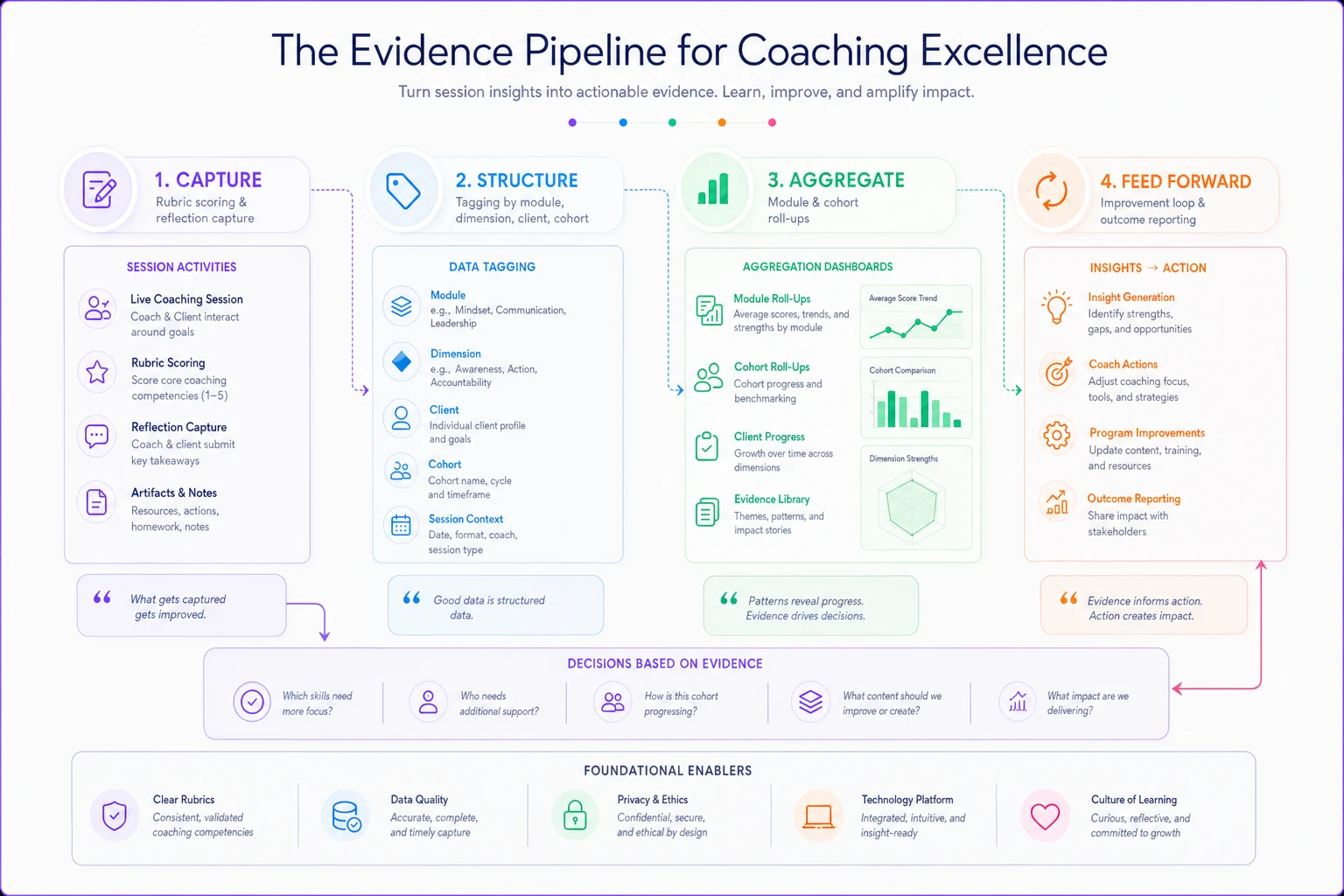
Here's a simple view of how session-level artifacts become the inputs for product and reporting decisions.
That last rule matters more than it looks. A lot of coaches convince themselves a module works based on one enthusiastic client. Small numbers lie constantly. Building an evidence threshold into your rules keeps you from re-engineering your whole program around a vocal minority.
This pipeline connects directly to the broader work of turning coaching activities into verifiable outcomes — the rubric scores and confirmed commitments are exactly the verifiable signals that make outcome claims defensible instead of anecdotal.
Measurement recipes that don't lie to you
Once evidence is flowing, the temptation is to build a dashboard with forty metrics. Don't. A few well-constructed measures beat a wall of numbers nobody trusts.
Module effectiveness score. For each module, average the rubric scores across the "application" and "behavioral commitment" dimensions specifically. Understanding is table stakes; you're measuring whether the module drives doing. A module averaging 3.2 on understanding but 1.8 on commitment is a redesign candidate, not a success.
Commitment-to-completion rate. Of the specific commitments clients make at the reflection beat, what percentage get confirmed as done in the next session? This is one of the most honest signals in coaching. In practice, a healthy range tends to land somewhere in the 55–70% zone. Much lower and your commitments are too big or too vague. Suspiciously high and clients are probably telling you what you want to hear.
Evidence coverage. What share of your modules have sufficient scored data? If half your program is running on "insufficient evidence," your outcome claims are built on sand — and you should know that before a buyer finds out.
Cohort drift. Compare rubric averages across cohorts for the same module. Rising, flat, or falling? Falling drift across cohorts usually means delivery is degrading — the module got quietly changed, or a newer coach is teaching it differently.
A quick note on realism: these numbers move slowly. You're not going to see a module effectiveness score jump from 2.1 to 3.4 in one cohort because you tweaked a slide. Real improvement looks like a gradual, noticeable climb over three or four cohorts, and the value of the pipeline is that you can actually see that climb instead of guessing.
From evidence to productization
The connection most coaches miss is this: the same evidence that improves your program is what makes it sellable as a product.
When you can say "this module scores an average of 3.4 on real-world application across six cohorts, and 64% of commitments get completed," you're no longer selling vibes. You're selling a specification with a track record. That's what lets you price confidently, hand delivery to another coach without quality collapsing, and stand in front of a corporate buyer who's used to vendors that can't prove anything.
The evidence pipeline also tells you what to package. Modules with strong, stable scores are your core product. Modules with high variance are still bespoke — they depend too much on the individual coach to be templated yet. Modules with low commitment scores need redesign before they go anywhere near a product tier. The data does the sorting for you.
And when you deliver, rubric scores double as the client-facing progress story. Instead of a subjective "you're doing great," clients see movement across dimensions over time — which is exactly the kind of thing that belongs on a one-page client progress dashboard they can look at every session. The evidence you collect for your own improvement loop becomes the proof that keeps clients engaged and renewing.
Where lightweight tooling helps
You can run a version of this on spreadsheets, and plenty of solo coaches do at first. It works until the volume of scored artifacts outgrows manual tagging — usually somewhere around a few active cohorts, when structuring and aggregating evidence by hand starts eating hours you don't have.
This is where an operational platform with AI-assisted tagging earns its place. Not to replace your judgment — the rubric scoring should stay human — but to handle the tedious middle: transcribing reflection notes, tagging them against modules and dimensions, rolling scores up into module and cohort views, and flagging which modules dropped below your evidence threshold. The workflow stays yours; the software removes the manual bottleneck between capturing evidence and actually using it. When the structuring is automated, the pipeline runs whether or not you have a free Sunday afternoon to update spreadsheets.
The trap to avoid is letting the tooling drive the design. The module pattern, the rubrics, and the evidence rules come first. Software makes them scale — it doesn't invent them for you.
When this system makes sense — and when it doesn't
When it's worth building: You're running structured programs (not purely open-ended sessions), you're planning to add coaches or productize, or you're selling to organizations that want proof. In any of these situations, the evidence pipeline stops being overhead and becomes the thing that lets you scale without your quality quietly rotting.
When it's overkill: You're a solo coach with a handful of long-term clients doing deeply personalized work, no intention to hire, and no buyers asking for outcome data. Forcing rubrics onto genuinely bespoke transformational work can flatten the exact thing clients pay you for. Build a light version — maybe just reflection capture and commitment tracking — and skip the rest until you actually need it.
Who should not do this yet: Coaches whose program still changes fundamentally every cohort. If your curriculum hasn't stabilized, you're measuring a moving target. Get the module pattern consistent first, run it twice without touching it, then start the evidence pipeline. Measurement before stability just produces noise you'll misread as signal.
A realistic scenario
A leadership coach ran a well-regarded 8-week program with individual clients and a couple of small group cohorts. Good reputation, strong testimonials, and no idea which parts of the program actually drove results. When a mid-size company asked for outcome data before signing a multi-cohort contract, she had nothing structured to show — just happy quotes.
The fix took about a quarter. She rebuilt her eight modules onto the standard pattern, wrote a four-dimension rubric, and started scoring one artifact per module. By the second cohort, the data showed something she hadn't expected: her most popular module — the one clients raved about — scored high on satisfaction but low on behavioral commitment. It felt great and changed almost nothing. Meanwhile a "boring" module scored highest on real-world application.
She redesigned the popular module around application instead of insight. Commitment-completion across the program moved from the low 50s into the mid-60s over the next two cohorts. More importantly, she walked into the corporate conversation with module-level effectiveness scores and a completion rate, and closed the contract. The evidence didn't just improve the program — it made the program sellable at a level she couldn't reach on reputation alone.
The takeaway
Learning design for coaching programs isn't an academic exercise, and it isn't about making your work rigid. It's about building enough structure that your program becomes visible to you — so you can see what works, fix what doesn't, hand it to someone else, and prove its value to people who need proof.
The pieces reinforce each other. Adult-learning principles shape the module pattern. The module pattern creates natural moments for evidence collection. Rubrics make that evidence comparable. The pipeline turns it into signal. And the signal feeds both your improvement loop and your ability to productize and report. Skip any one piece and the chain weakens — but build the whole thing, even a lightweight version, and you stop guessing about the one asset your entire practice is built on.
Ready to elevate your coaching business?
Join hundreds of coaches using Guidyly to save time, enhance client engagement, and grow their practice.