


Most coaching practices don't have a licensing problem until they suddenly have a very expensive one. The slide deck someone borrowed from a conference. The assessment framework a subcontractor "adapted" from a book. The stock photos in the workbook that got quietly reused across three corporate clients. None of it feels like a real risk when you're solo with a handful of clients. Then you land an enterprise account, their procurement team asks for content provenance, and nobody can actually say where half the materials came from.
This is the part of coaching operations that almost nobody builds a system for. People invest heavily in curriculum design, client outcomes, delivery quality — and then treat the sourcing and licensing of the underlying material as an afterthought. It works right up until it doesn't. The goal here is to give you a governance system that answers the boring-but-critical questions before they become legal or reputational ones: where content comes from, what you're actually allowed to do with it, how you store it, and what your contracts are promising clients about it.
Why coaching content licensing quietly breaks
Coaching content is unusually messy from a rights perspective. A single program might contain material you wrote, material you commissioned, material licensed from an assessment vendor, quotes from published books, frameworks adapted from public research, images from stock libraries, and slides that a former associate built during a contract that ended two years ago.
Every one of those has a different rights profile. And in most practices, they all live in the same Google Drive folder with no labels distinguishing any of them.
The reason this happens is structural, not careless. Content accumulates faster than governance does. In real operations, the sequence usually looks something like this:
-
Year one, you build everything yourself, so ownership is obvious.
-
Year two, you start borrowing — a model here, a graphic there — to move faster.
-
Year three, you hire or subcontract, and now other people are adding material whose origins you never actually see.
-
Year four, you're licensing your program to other coaches or selling it to corporates, and suddenly the provenance of every asset matters.
The failure point isn't one bad decision. It's the compounding of hundreds of small undocumented ones. By the time you need to prove you have the right to use something, the person who added it is gone and the source is forgotten.
The core operational question: build, buy, or borrow?
Before you touch license types or contracts, every piece of third-party material should pass through one decision. This is the top of the tree, and getting it wrong here creates cleanup work everywhere downstream.
Never miss a session or detail again.
Guidyly helps you book, manage, and track every coaching session efficiently.
- Centralized session scheduling
- Automated client reminders
- Progress tracking & notes
No credit card required
The operational decision path for any external material you're considering:
-
Is this material core to your differentiated value? If yes, strongly favor building or exclusively commissioning it. You don't want your signature framework resting on something anyone can license.
-
If it's supporting material, can you license it cleanly? Look for a clear commercial license before anything else. Convenience is not a license.
-
If no clean license exists, can you commission an original version? Often cheaper long-term than fighting ambiguous rights later.
-
If you must borrow or adapt, is the use genuinely permitted? Public availability is not permission. "I found it online" is where most trouble starts.
-
If none of the above is clean, drop it. Finding an alternative is almost always cheaper than a rights dispute during an enterprise deal.
A visual workflow of that decision path:
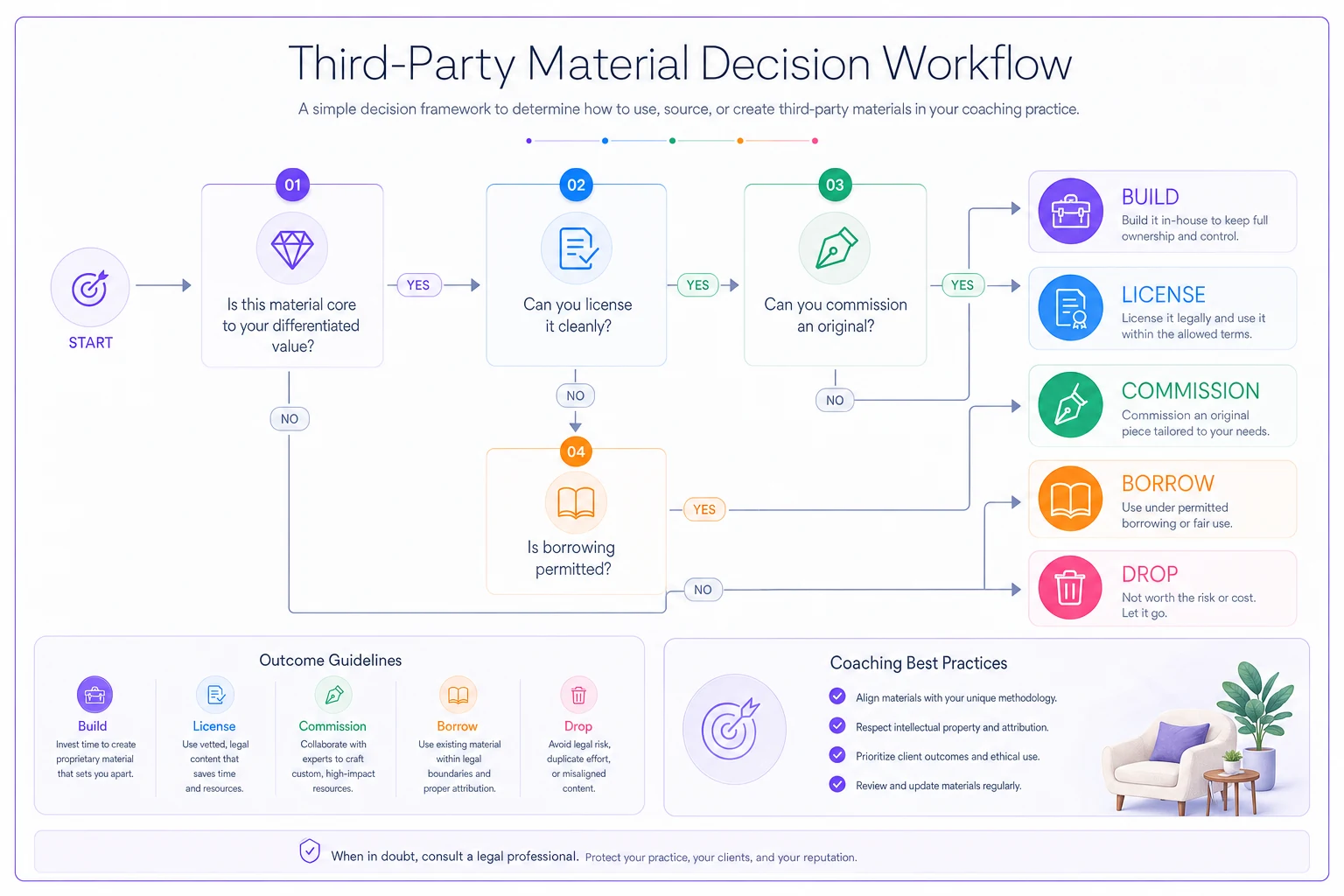
A pattern worth noticing: the material that causes the most legal pain is rarely expensive licensed content. It's the free-feeling stuff — a diagram from a blog, a "framework" from a popular business book, a photo pulled from a search. Paid licenses come with paperwork. Borrowed material comes with nothing, which is exactly the problem.
Choosing the right license type
Not all licenses are equal, and coaches routinely pick the wrong one because they optimize for price instead of use case. The mistake is licensing for the situation you're in now instead of the one you'll be in when you scale.
Here's a breakdown of the common license types coaches actually encounter and where each fits:
| License type | What it allows | Best for | Where it breaks |
|---|---|---|---|
| Personal / single-seat | One person's use, non-commercial or limited | Your own study, internal reference | Falls apart the moment you deliver it to clients |
| Standard commercial | Use in client-facing work, usually per-user or per-project | Solo and small-team delivery | Often silent on sublicensing to other coaches |
| Extended / enterprise | Broad commercial use, higher seat counts, distribution | Multi-coach practices, corporate rollouts | Expensive; renewal terms can trap you |
| Royalty-free (stock) | Repeated use after one-time fee | Images, icons, background assets | "Royalty-free" ≠ unlimited; check redistribution limits |
| Sublicensable | You can grant rights to others | Practices licensing programs to associate coaches | Rare and pricey; read the downstream restrictions carefully |
| Public domain / open (e.g., CC) | Varies wildly by specific terms | Reference frameworks, some visuals | Attribution and share-alike clauses trip people up |
The single most common licensing error in coaching practices: buying a standard commercial license, then later hiring associate coaches or licensing the program to a partner — actions the original license never covered. The license was fine for the business you were. It's now a liability for the business you've become.
Whenever you buy, ask one forward-looking question: "If I triple my delivery team and sell this program to three coaching partners, does this license still hold?" If the answer is unclear, you've found a future problem.
Repository rules: where governance actually lives
A licensing policy that isn't enforced at the storage layer is just a document nobody reads. Governance succeeds or fails at the repository — how material is stored, labeled, and retrieved.
The core principle is simple: provenance must travel with the asset. If someone can find and reuse a file without also seeing its rights status, the system is broken.
A workable repository ruleset:
-
Every asset gets a rights tag at upload. Options like
owned,licensed-standard,licensed-enterprise,commissioned,borrowed-permission-on-file, andunknown-do-not-use. -
Nothing enters "approved for use" without a source record. No source, no use. The
unknownbucket is quarantine, not a working folder. -
License documents are stored with the asset, not buried in a separate email thread. A licensed graphic should link to the actual license PDF, expiry date, and seat count.
-
Expiry dates are tracked. Licenses lapse. A diagram licensed for a two-year term is a liability in year three.
-
Access is scoped by role. Subcontractors upload to a review folder; only a designated owner promotes material into the approved library.
-
A quarterly audit checks the
unknownandborrowedbuckets. These are where risk quietly pools.
The insight most practices miss: your repository is also your knowledge system, and the two functions reinforce each other. When you treat content as documented, versioned, and sourced, you get cleaner curriculum improvements as a side effect. This connects directly to the discipline described in why session notes fail coaches and the lightweight KM system that turns notes into curriculum improvements — the same habit of capturing origin and context is what makes both content and notes actually reusable later.
Where AI-assisted tooling quietly helps
This is the kind of tracking that human diligence tends to lose over time — not because people are careless, but because tagging every asset at upload and remembering every renewal date is genuinely tedious. AI-assisted operational tools can flag untagged assets, surface licenses approaching expiry, and catch when a file marked personal-use shows up in a client-facing deliverable.
Require uploaders to attach the license PDF and an expiry date at the time of upload to prevent 'unknown' assets accumulating.
The licensing decisions stay human. The tooling just makes sure the enforcement layer doesn't quietly rot the way it always does in an unmanaged shared drive.
Attribution templates that don't create work
Attribution is where good intentions turn into inconsistency. One workbook credits a source in a footnote, another buries it on the last page, a third forgets entirely. Inconsistent attribution isn't just sloppy — it signals to a sophisticated buyer that your rights hygiene is loose everywhere.
Standardize it. Build two or three attribution templates and reuse them mechanically:
-
In-material credit (for adapted frameworks)
"Adapted from [Source], used under [license type]. Original © [holder]."
-
Image/asset credit line (footer or credits page)
"[Asset] via [library], licensed under [license]."
-
Program-level provenance statement (for enterprise deliverables): a single page listing all third-party material, source, license, and scope. Procurement teams love this, and it's your best defense if provenance is ever questioned.
That last one is underused and disproportionately valuable. When a corporate client's legal team asks about content sourcing — and at scale, they will — handing over a clean provenance statement ends the conversation in your favor. Not having one turns a routine question into a due-diligence problem.
Contract clauses to protect the portfolio
Licensing governance doesn't stop at inbound rights. Your own contracts — with clients, subcontractors, and licensing partners — either protect your portfolio or leave it exposed. This connects directly to the broader risk posture covered in the governance framework and risk controls for coaching practices; licensing clauses are one specific expression of that same control mindset.
A few clauses worth having in place:
-
Work-for-hire / IP assignment (subcontractor agreements). Any material a contractor creates for you should transfer to you explicitly. Without this clause, the associate coach who built your best module technically owns it.
-
Warranty of originality. Contractors warrant that what they deliver doesn't infringe others' rights. This gives you recourse if borrowed material sneaks in through the back door.
-
License scope definition (client contracts). Spell out exactly what the client can do with delivered material — internal use only, no redistribution, no resale. Silence here gets interpreted generously by clients.
-
Sublicensing terms (partner/associate agreements). If you license your program to other coaches, define precisely what they can and can't pass downstream.
-
Termination and material return. When a relationship ends, what happens to the content? Who keeps what?
The clause coaches most often skip is the warranty of originality in subcontractor agreements — and it's exactly the one that saves you when a contractor unknowingly imports infringing material. That warranty shifts the risk to the person who actually made the sourcing decision.
A real scenario
A mid-sized coaching practice — four coaches, mostly corporate leadership programs, somewhere around $40k–$50k monthly revenue — landed a pilot with a large enterprise client. Procurement asked for a content provenance breakdown as part of onboarding. The practice had no system for it.
The scramble took about three weeks. They found two licensed assessment tools whose commercial licenses didn't clearly cover multi-coach delivery, a set of slides an ex-contractor had built with no IP assignment on file, and a handful of images nobody could trace. They ended up rebuilding two modules from scratch and re-licensing one tool at the enterprise tier — an unplanned cost somewhere in the low four figures, plus the delay nearly cost them the deal.
Afterward, they built the actual system: rights tags at upload, license docs stored with assets, a warranty-of-originality clause added to every contractor agreement, and a standing provenance statement they could generate per client. The next enterprise inquiry, about six months later, took roughly a day to answer. Same question, completely different outcome — because the governance existed before it was needed.
When this level of governance actually makes sense
Not every practice needs the full system on day one. Match the effort to the stage.
Build the full system when:
-
You're delivering to corporate or enterprise clients who run procurement due diligence.
-
You have subcontractors or associate coaches adding material.
-
You license or plan to license your programs to other coaches.
-
Your content portfolio has grown past what one person can reasonably remember the origins of.
Keep it lightweight when:
-
You're a solo coach building everything yourself with minimal third-party material.
-
Your clients are individuals with no redistribution risk.
A newer solo coach with a small, self-authored library shouldn't be spending days tagging six documents they wrote themselves. That's governance theater. The tipping point is when other people or other rights holders enter your content supply chain — that's when undocumented provenance shifts from a tidy-to-have into genuine exposure.
Tying it back to outcomes
Clean licensing governance isn't purely defensive. A well-documented, clearly-owned content portfolio is a more valuable and more sellable asset — you can license it, scale it, and stand behind it without hesitation.
The same rigor that lets you prove provenance is closely related to the rigor that lets you prove results, which is the throughline in turning coaching activities into verifiable outcomes. Both come down to the same operational habit: don't let important things exist in your business without a record of where they came from and what they're allowed to do.
The practices that scale cleanly aren't the ones that never borrow material. They're the ones that decided early that every asset would carry its history with it. That single discipline — provenance travels with the asset — is what turns a messy content drive into a portfolio you can actually license, sell, and defend at scale.
Ready to elevate your coaching business?
Join hundreds of coaches using Guidyly to save time, enhance client engagement, and grow their practice.