

Most coaching practices don't hit a people problem until they've got three or four coaches and suddenly realize nobody actually agrees on what "good" means. One founder thinks the best coach is the one clients love. Another thinks it's the one who closes renewals. A third coach—who's been quietly carrying the hardest cases for two years—watches someone with less tenure get a raise because they happened to be in the room when the founder was feeling generous.
That's the moment people-ops stops being optional. Not when you hire your first coach. When your second and third hires start comparing notes.
This is the part of running a practice that founders avoid the longest, because it feels bureaucratic and a little cold. But the alternative isn't warmth—it's chaos dressed up as flexibility. When hiring, advancement, and pay aren't connected to the same underlying definition of quality, you get resentment, inconsistent client experience, and a payroll that grows faster than your margins can handle.
Here's how the whole system is supposed to fit together, where it breaks, and what a workable version actually looks like for a practice that isn't trying to build an HR department.
The core problem: three systems pretending to be unrelated
Hiring, promotion, and compensation are usually built at three different times by three different moods.
Hiring gets designed when you're desperate for help and scanning resumes at 11pm. Promotion gets invented the first time a good coach threatens to leave. Compensation gets patched together from whatever you offered the last person plus a nervous bump. None of these three decisions reference the same standard, because there isn't one yet.
The pattern underneath most dysfunctional people-ops: the practice can describe a good coach emotionally but not operationally. Ask a founder what makes someone great and you'll hear "clients trust them" or "they just get it." That's real, but you can't hire against it, you can't promote against it, and you definitely can't pay against it in a way that holds up when two coaches disagree about whether it's fair.
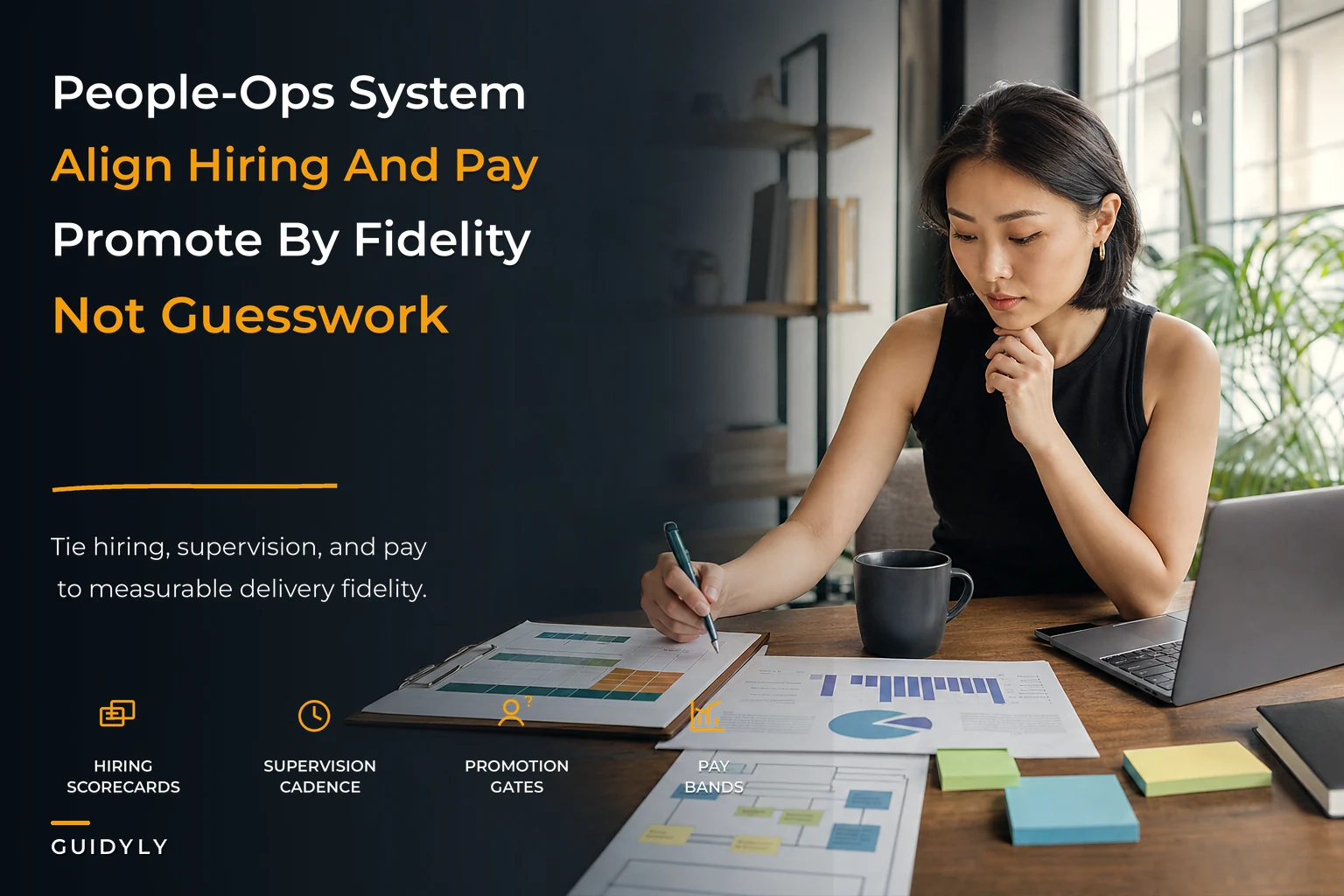
The fix isn't more documentation for its own sake. It's defining competence once, in a way that's observable, and then wiring every people decision to that same definition. When you do that, hiring scorecards, promotion gates, and pay bands stop being separate inventions and start being different views of the same thing.
Start with fidelity, not personality
The anchor for the entire system should be delivery fidelity—how closely a coach actually runs the thing you promised clients. Most practices skip this because it feels harder to measure than revenue or NPS. But it's the only metric that connects quality to money without creating perverse incentives.
Never miss a session or detail again.
Guidyly helps you book, manage, and track every coaching session efficiently.
- Centralized session scheduling
- Automated client reminders
- Progress tracking & notes
No credit card required
Tie everything to revenue and coaches learn to upsell and under-deliver. Tie everything to client satisfaction scores and coaches learn to be pleasant and avoid hard conversations. Fidelity measures whether the coaching actually happened the way it's supposed to—agenda followed, homework assigned, progress tracked, escalations handled. The mechanics of scoring this are covered in the 3-Point Session Fidelity Scorecard work, and the compensation implications are in that same measurement-and-pay system, so there's no need to re-litigate the scoring here.
What matters for people-ops is this: fidelity becomes the shared language. A hiring scorecard measures whether a candidate can demonstrate the behaviors that produce fidelity. A promotion gate measures whether they do it consistently across a caseload. Compensation rewards sustained fidelity, not a single good quarter or a loud personality.
Once you've got that spine, the rest of the system becomes a lot more obvious.
The hiring scorecard: filtering for what you'll later reward
A hiring scorecard that isn't connected to your competency rubric is just a nicer-looking gut feeling. The whole point is that the dimensions you score a candidate on should be the same dimensions you'll later use to decide if they get promoted.
This usually becomes obvious after a practice hires someone who interviewed brilliantly and then couldn't follow a program structure. The interview tested charisma. The job tested consistency. Those aren't the same skill, and the scorecard should separate them.
A workable scorecard for a coaching hire tends to cover four or five areas:
-
Delivery discipline — Can they run a structured session, or do they improvise everything? Give them a mock agenda and watch.
-
Client judgment — When you hand them a tricky scenario, do they escalate appropriately or wing it?
-
Documentation habits — Do they actually write things down, or is everything in their head?
-
Coachability — Can they take feedback? Coaches who can't be coached don't improve, and you'll be paying for their stagnation for years.
-
Values and ethics fit — Especially around consent, boundaries, and honesty about outcomes.
Score each 1–5 with written evidence, not vibes. The practices that get this right force the interviewer to write why they gave a 4, not just the number. That one habit kills more bad hires than almost anything else, because "I liked them" has to become a sentence someone else can read and disagree with.
The deeper setup for scorecards and a 90-day onboarding ramp lives in the Scale Without Losing Quality playbook, which is worth reading alongside this if you're building the intake side of the system.
The competency rubric: the thing everything else points at
The rubric is the backbone. It defines what each level of coach actually looks like in observable terms. Most practices have maybe two implicit levels—"new coach" and "coach I trust"—with nothing written down and no real path between them.
A usable rubric names three or four levels and describes each across the same dimensions. The trick is writing behaviors, not adjectives. "Strong client management" is useless. "Independently handles a full caseload of 12–15 clients with fidelity scores above target, escalates fewer than X cases per quarter, and mentors at least one junior coach" is something two people can look at and actually agree on.
Here's a simplified version of how the levels tend to shake out:
| Level | Caseload | Fidelity expectation | Supervision needed | Scope beyond clients |
|---|---|---|---|---|
| Associate Coach | 5–8 clients, supervised | Meets target with review | Weekly, structured | None |
| Coach | 10–15 clients, independent | Consistently above target | Biweekly check-ins | Occasional peer input |
| Senior Coach | 12–18 clients + complex cases | High fidelity, handles escalations | Monthly, self-directed | Mentors 1–2 associates |
| Lead Coach | Reduced caseload | Sets the standard | Supervises others | Owns quality for a program line |
The numbers here are illustrative and should bend to your model—a high-touch executive practice might cap a Senior Coach at eight clients, while a volume-based program coach might run thirty. What stays constant is that each level is defined by behavior and fidelity, not tenure. Time served is not a competency.
Promotion gates: where favoritism usually sneaks in
Promotion is where most small practices quietly betray their own system. Everything's documented, and then a coach gets bumped because they asked at the right moment or because the founder felt guilty about a rough quarter. The rubric exists; it just doesn't get enforced.
A promotion gate is a checklist a coach must clear before a promotion conversation even happens. It removes the "do I feel like promoting this person" question and replaces it with "have they met the gate." That's not cold—it's actually fairer, because it means the quiet, consistent coach gets considered on the same terms as the one who self-advocates loudly.
A reasonable gate from Coach to Senior Coach might look like this:
-
Sustained fidelity — Above-target fidelity scores for at least two consecutive quarters, not just a recent spike.
-
Caseload stability — Carried a full independent caseload without quality degradation when things got busy.
-
Escalation track record — Handled at least a few genuinely hard situations well, with documentation to show it.
-
Peer and client signal — No unresolved patterns in client feedback; positive signal from peers they've worked alongside.
-
Mentorship readiness — Demonstrated they can explain their approach to someone less experienced, usually by informally helping an associate.
-
Retention and renewal health — Their clients stick and renew at a rate that isn't being propped up by discounting.
If a coach misses a gate, the conversation isn't "no." It's "here's the specific thing to close before we revisit." That turns promotion denials from emotional events into development plans, which is the entire point.
One mistake worth flagging: making gates so strict that nobody can ever clear them, which just drives good people out. Gates should be achievable with sustained good work, not reserved for some impossible standard.
Supervision cadence: the glue nobody budgets time for
None of this works without a supervision rhythm, and supervision is the first thing founders cut when they get busy. That's a mistake, because supervision is where fidelity data actually gets reviewed and where coaches get the feedback that lets them clear promotion gates.
The cadence should scale down as competence goes up. Associates need weekly structured supervision—reviewing recordings or notes, walking through tricky moments, reinforcing the structure. Senior coaches might need a monthly conversation that's more peer consultation than oversight. If you're supervising a four-year senior coach as closely as a brand-new hire, you're wasting their time and yours.
A practical cadence model:
-
Associates — Weekly, 30–45 min, structured around fidelity review and specific cases.
-
Coaches — Biweekly, mix of case consultation and metric review.
-
Senior/Lead — Monthly, mostly self-directed, focused on complex cases and mentoring others.
The operational failure here is treating supervision as a feelings check-in with no connection to data. If supervision doesn't reference fidelity scores, caseload, and specific client situations, it drifts into vague encouragement that helps nobody advance.
Reference fidelity scores and caseload during supervision to generate actionable notes that feed promotion gates.
Good supervision produces a written trail that feeds the promotion gate, so by the time a coach is up for advancement, there are no surprises on either side.
Compensation: pay bands tied to the ladder, not the negotiation
Without pay bands, compensation becomes a series of one-off negotiations, and a coach's pay ends up reflecting their willingness to ask rather than their actual value. Over a few years you get wild internal inequity—two coaches at the same competency level making meaningfully different money for no defensible reason.
Pay bands fix this by attaching a range to each rubric level. Movement within a band reflects performance and fidelity; movement between bands requires clearing a promotion gate. This is the structure that lets you answer "why does she make more than me" with an actual reason.
A sample band structure for a small practice (adjust aggressively to your market and model):
| Level | Base band (annual) | Variable tied to fidelity/retention | Notes |
|---|---|---|---|
| Associate Coach | ~$42k–$52k | Small, ~5% | Growth band, frequent review |
| Coach | ~$55k–$72k | ~10%, fidelity-gated | Core delivery level |
| Senior Coach | ~$74k–$95k | ~15%, fidelity + mentoring | Carries complex cases |
| Lead Coach | ~$95k–$120k+ | Program-level outcomes | Owns a quality line |
Two rules keep this honest. First, the variable portion is gated on fidelity—a coach can't earn their outcome bonus if their delivery fidelity drops below target, even if their revenue looks fine. That single rule prevents the "sell hard, deliver poorly" trap. Second, position within the band is reviewed on a fixed schedule, not whenever someone complains, so the loud and the quiet get the same cycle.
The full reasoning on why outcome-and-retention-linked pay beats revenue-only pay—and how to avoid the perverse incentives that creep in—is laid out in detail in the measurement and compensation system work.
A real scenario: when the system pays for itself
A small leadership-coaching practice—founder plus five coaches, doing somewhere around $600k–$700k a year—kept losing its best mid-level coaches at roughly the 18-month mark. Every exit interview said some version of the same thing: no clear path, pay felt arbitrary, and the coaches who shouted got rewarded.
They built the stack described above over about a quarter: a five-dimension rubric, four levels, written promotion gates, and pay bands with a fidelity-gated variable. The first year wasn't magic. Two coaches discovered they weren't close to the Senior gate they assumed they'd cleared, which caused some tension. Both got a concrete plan, and one hit the gate within two quarters.
What changed measurably: regretted attrition dropped from losing roughly two good coaches a year to none over the following eighteen months. Payroll actually stayed flatter, because raises stopped being reactive panic bumps and started following a schedule. The founder stopped spending the back half of every month in uncomfortable one-off pay conversations. Revenue didn't spike—but the practice stopped bleeding its best people, which is the expensive problem nobody puts on a P&L.
When this is overkill
You don't need pay bands and promotion gates when you're a solo coach or you've got one part-time contractor. Building this at that stage is procrastination dressed as diligence.
The whole system is a coordination tool, and coordination isn't a problem until you have multiple people whose expectations can collide. Build the rubric when you hire your second coach, because that's when "what good looks like" needs to live outside your head. Add promotion gates and bands when you hit three or four coaches, because that's when internal comparison becomes inevitable. Trying to install this kind of people-ops infrastructure in a two-person practice just creates overhead you'll resent. The operational maturity model maps which of these systems actually matter at each stage, and it's worth checking before you over-build.
Where tooling quietly helps
The system above runs on data you have to actually collect and keep current—fidelity scores per coach, supervision notes, caseload counts, retention and renewal rates, promotion-gate status. The failure mode isn't designing the system. It's maintaining it. Most practices build a beautiful rubric in a doc, then let the data rot across three different spreadsheets nobody reconciles.
This is where having your people-ops data live in the same platform as your delivery and client metrics actually earns its keep. When fidelity scores flow automatically from session records, when caseload counts update as clients come and go, and when a coach's promotion-gate progress is visible without someone manually tallying it, the system stays alive instead of becoming a document everyone forgets. AI-powered operational software can handle a lot of that background tracking—not to replace judgment, but to make sure the numbers a promotion or raise depends on are current and trustworthy when the conversation actually happens.
Here's a simple workflow illustrating how fidelity data flows from sessions into scorecards, supervision, promotion gates, and compensation.
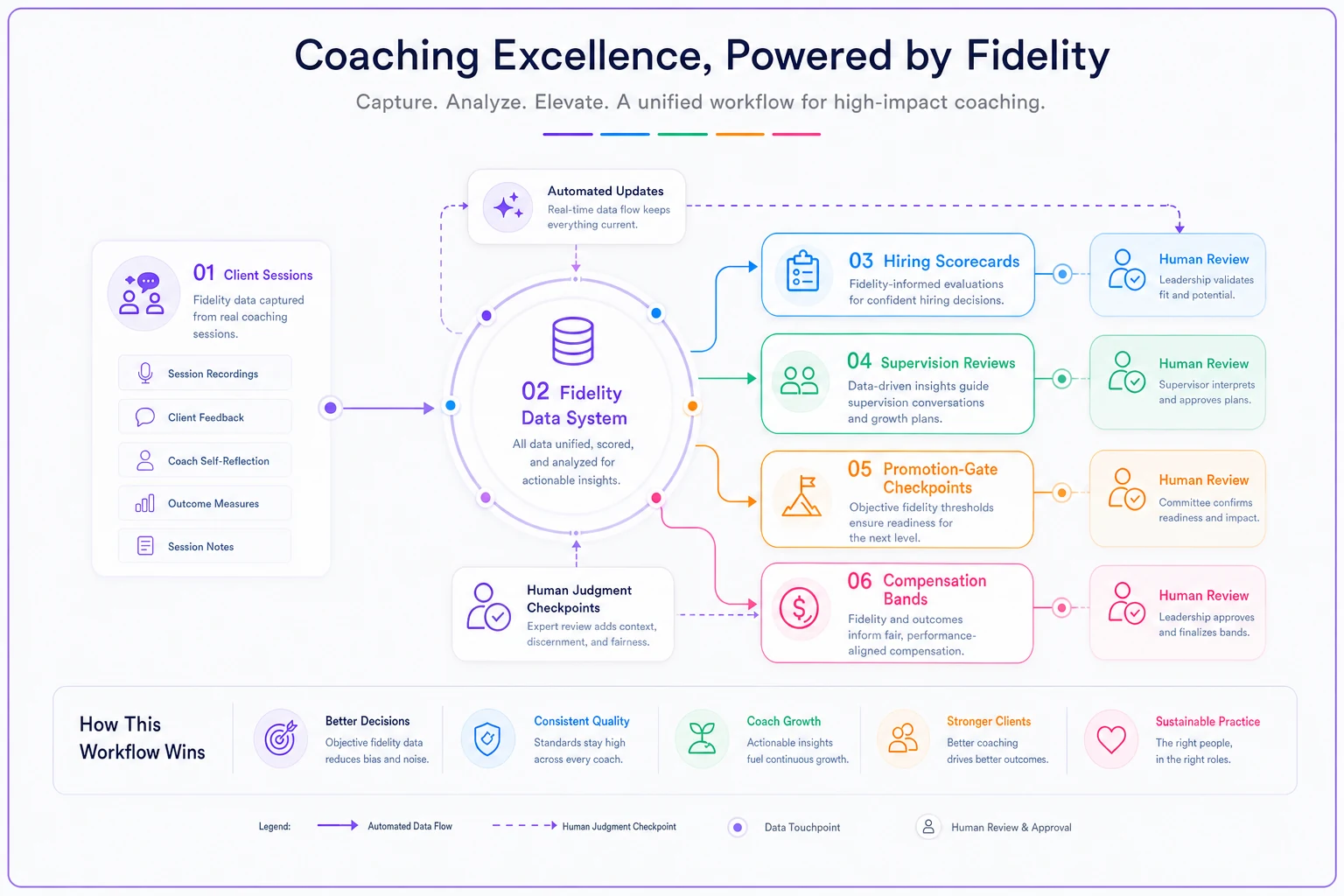
The judgment still belongs to you.
Hiring, promotion, and compensation feel like three separate jobs. They're one. The practices that stay fair and profitable as they grow are the ones that define competence once—anchored to delivery fidelity—and then let that single definition flow through who they hire, how people advance, and what everyone earns.
Get that spine in place and the hard conversations get easier, because they stop being about personalities and start being about a standard everybody can see. Skip it, and you'll spend the next few years re-negotiating the same arguments with higher stakes each time.
Ready to elevate your coaching business?
Join hundreds of coaches using Guidyly to save time, enhance client engagement, and grow their practice.