


Most coaching practices don't have a pricing problem. They have a portfolio problem that disguises itself as a pricing problem.
The difference matters. A pricing problem is "my 1:1 package is $400 and it should be $550." A portfolio problem is "I have seven offers, three of them cannibalize each other, two lose money once I account for my actual time, my best clients have nowhere to go after they finish, and I genuinely can't tell you which offer I should be pushing next quarter." The first one you fix with a number. The second one you fix with a system.
This matters more as you grow because every offer you add creates a relationship with every other offer. Two offers, one relationship. Five offers, ten relationships. Layer in associate coaches, alumni, and corporate contracts, and you're not pricing products anymore — you're managing a portfolio where each decision ripples outward. That's what a portfolio pricing operating system actually does: not set prices, but govern how the whole set of offers, segments, and margins behaves together.
This article walks through how that system works — segmentation rules, packaging ladders, margin allocation, cross-sell logic — and more importantly, where it quietly breaks when nobody's watching the connections.
Why packaging decisions compound on you
Single-offer coaches get away with a lot. You charge what you charge, deliver, move on. Pricing mistakes stay contained.
The moment you add a second tier, a group program, or a VIP day, that containment breaks. Offers get added reactively — a client asks for something, you build it, you price it based on what felt right that week. Six months later you have a menu that was never designed as a menu. Nobody sat down and asked how these pieces actually fit together.
-
Margin drift. A new offer priced on gut feel is almost never priced on actual delivery cost. You don't notice because the money comes in. The loss is invisible until you map hours against revenue.
-
Segment collision. Two offers end up competing for the same buyer. The cheaper one wins, and you've effectively discounted yourself without meaning to.
-
Ladder gaps. A client finishes your flagship and there's nowhere to go. They churn not because they're unhappy but because you built no next rung.
None of this shows up in a single month's P&L. It shows up as a slow grind — flat revenue despite more offers, more delivery hours for the same income, and a persistent sense that you're busier but not actually making more money. The pricing mistakes that quietly reduce retention are usually downstream of this structural mess, not the cause of it.
Start with segmentation, not offers
The most common sequence coaches use is backwards. Design offers first, then find people to buy them. A portfolio system reverses this: segment buyers first, then build offers that map cleanly onto those segments.
Never miss a session or detail again.
Guidyly helps you book, manage, and track every coaching session efficiently.
- Centralized session scheduling
- Automated client reminders
- Progress tracking & notes
No credit card required
Segmentation here isn't demographic fluff. It's operational. You're grouping buyers by three things that actually affect your business:
-
Willingness and ability to pay — not what they could theoretically afford, but what this type of buyer consistently pays without friction.
-
Delivery cost to serve — how much of your actual time and attention a buyer in this segment consumes.
-
Monetization horizon — how long the relationship lasts and what it opens up afterward (referrals, renewals, alumni offers).
A typical practice has something like four real segments: a self-funded individual, a career-transition individual, a corporate-sponsored individual, and a team or org buyer. These behave completely differently on all three axes. Lumping them into one price ladder is where the trouble starts.
A simple segmentation decision rule
Score each prospective buyer type on the three axes above — low to high. Then apply this logic:
-
High pay / low cost to serve → this is your margin engine. Build the premium ladder here.
-
High pay / high cost to serve → fine, but cap volume. These eat capacity fast.
-
Low pay / low cost to serve → good for scaled group offers and feeding higher rungs.
-
Low pay / high cost to serve → say no, or productize heavily so the delivery cost drops.
That last category is where practices bleed out. The client who pays the least and demands the most isn't a pricing problem — it's a segmentation failure. You accepted a buyer your portfolio was never built to serve.
Packaging ladders: designing the rungs
Once segments are clear, packaging becomes a ladder, not a list. The point of a ladder is that each rung has a reason to exist in relation to the rungs above and below it. Every offer should either feed the next one or catch someone falling from a higher one.
Here's a structure that holds up across different practice types:
| Rung | Purpose | Typical buyer | Primary job |
|---|---|---|---|
| Entry / diagnostic | Low-risk first yes | Any segment | Qualify and build trust |
| Core group program | Scaled delivery | Self-funded, career-transition | Volume + margin |
| Flagship 1:1 | Deep transformation | Corporate-sponsored, high-pay | Premium margin |
| Team / org engagement | Multi-seat contract | Org buyers | Revenue concentration |
| Alumni / continuity | Retain + monetize | Graduates of any rung | Lifetime value |
The mistakes that come up most often with ladders are worth naming directly.
Too many rungs is probably the most common one — seven offers where four would do. Each extra rung splits attention and confuses buyers. Decision paralysis kills conversion more reliably than bad pricing does. Then there's the problem of no real gap between rungs: if your group program is $900 and your 1:1 is $1,100, nobody moves up because there's no meaningful jump in value or price. Rungs need to be spaced so the climb feels deliberate. And practices with no org or continuity offer leave their most valuable relationships with nowhere to spend money. That's not modesty, that's leaving revenue on the table.
The ladder is also where capacity and pricing finally meet. You can't sell unlimited flagship 1:1 slots because you physically run out of hours. The ladder has to respect the math in your capacity and caseload model — if a rung requires more delivery hours than you have, it's not a real offer. It's an overbooking machine with a price tag.
Margin allocation: where the money actually is
This is the section most coaches skip, and it's the one that separates a portfolio that looks profitable from one that actually is.
Margin allocation means assigning the true cost of delivery to each offer, then deciding deliberately which offers should be high-margin and which you'll run thin on purpose. Not every offer needs to be maximally profitable. Some exist to bring people into the ladder. But you have to choose that — not discover it accidentally six months in.
A quick way to do it: take each offer, calculate fully loaded delivery hours (prep, sessions, async support, admin, follow-up), multiply by what your time is worth, subtract from revenue. What's left is real margin — not the illusion of revenue.
Include async support and admin time when you calculate fully loaded delivery hours.
A typical example looks like this. A coach runs a 12-week group program at $1,200 per seat, 10 seats — $12,000 in revenue. Feels great. But the actual delivery — weekly calls, prep, a Slack channel she answers most evenings, two 1:1 check-ins per person, reviewing homework — runs to roughly 90 hours across the cohort. At a target rate of $150/hour, that's around $13,500 of her time against $12,000 in revenue. The group program she thought was her cash cow was slightly underwater once delivery was honest.
Meanwhile, her flagship 1:1 at $4,000 for a 10-session engagement took about 22 loaded hours — roughly $3,300 of time against $4,000 in revenue. The "expensive" offer was the profitable one. Without doing this math, she'd have kept scaling the wrong product.
Deciding margin roles across the portfolio
-
Margin engine — your highest-margin offers. Protect and grow these.
-
Volume driver — thinner margin, but brings buyers into the ladder. Keep delivery tight.
-
Loss leader (deliberate) — the diagnostic or entry rung. You accept low or no margin because it converts upward.
-
Strategic / relationship — org work that locks in revenue concentration even at a messier margin.
The failure mode is having offers that are accidental loss leaders — thin-margin products you believe are profitable and keep pushing harder. That's not a portfolio. That's a treadmill.
Cross-sell playbooks that respect capacity
Cross-sell in coaching usually gets treated as "sell more stuff to existing clients." The portfolio version is tighter: move each client to the next right rung based on where they are, what they've completed, and what your capacity can actually absorb.
Cross-sell breaks down because it ignores capacity. You enthusiastically upsell everyone into your flagship 1:1, then realize you have 14 people in a program designed for 8 slots. Now you're either turning away committed buyers or burning yourself out. A cross-sell playbook has to be gated by available capacity, not just buyer readiness.
A healthy cross-sell motion runs something like this:
A client completes the core group program. The system flags them as a graduate and checks three things: did they hit their outcome milestones, did they engage consistently, and is there open capacity in the next rung. If all three are clear, they get offered the flagship or a continuity track. If capacity is tight, they're routed to a scaled alumni offer instead — same relationship, lower delivery cost. If engagement was weak, they don't get upsold at all; they get a re-engagement nudge first, because upselling a disengaged client just accelerates churn and refund requests.
A visual of the routing helps make the branching logic clear.
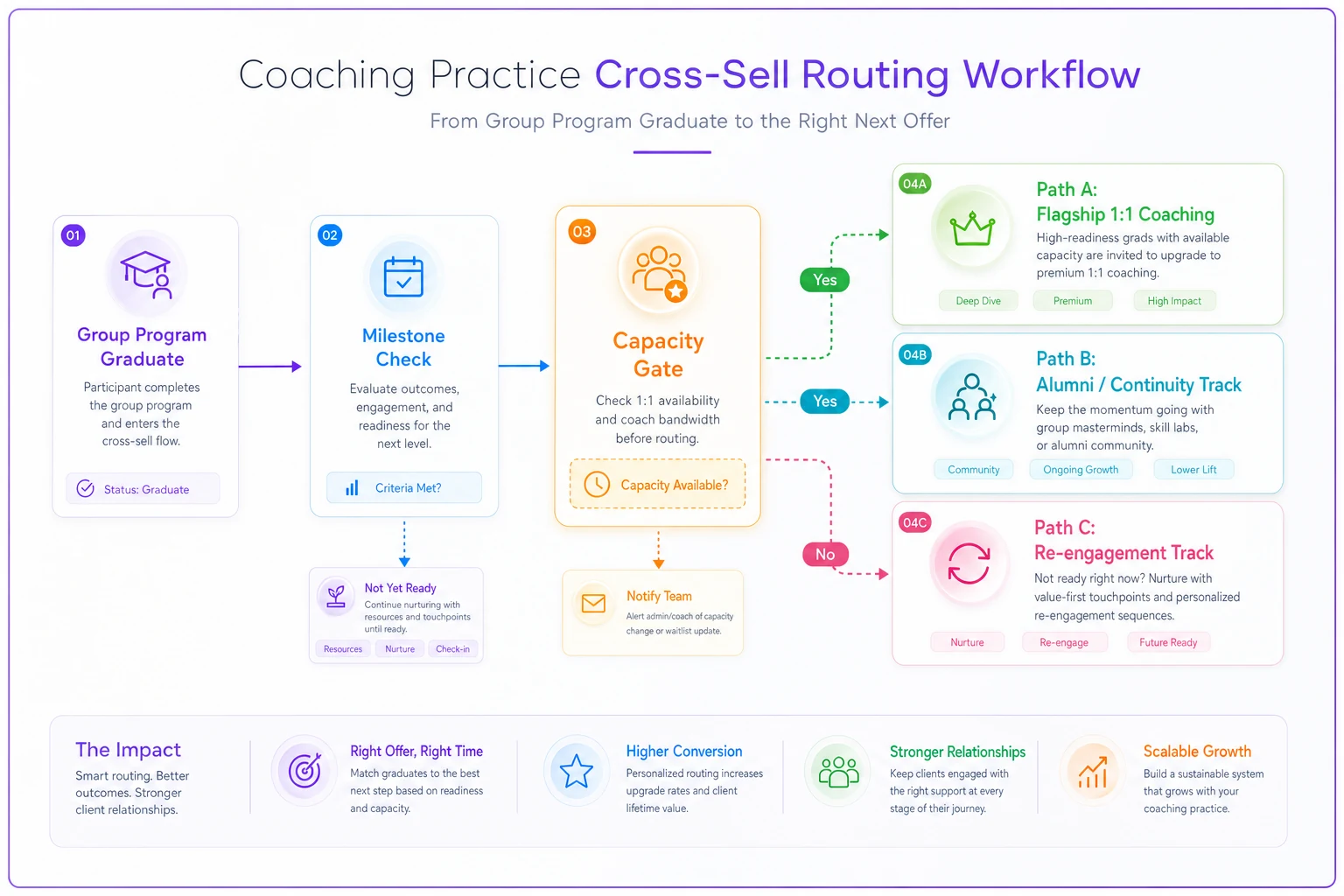
That branching logic — readiness, outcomes, and capacity all checked before an offer goes out — is what keeps cross-sell from becoming either a spam machine or an overbooking crisis.
The alumni layer is where most portfolios leak
The single most underused rung in coaching is the alumni and continuity layer. People finish, say thank you, and vanish — along with their lifetime value and referral potential. A portfolio system treats graduates as an active segment with its own offers, cadence, and monetization path, not as a clean ending. Building that out properly looks a lot like a structured alumni activation calendar with micro-offers and referral triggers — low delivery cost, high retained revenue, and the quietest margin win in the whole portfolio.
A portfolio-level pricing matrix you can actually run
Pull everything into one view. The point is to see every offer against every lever at once, so a change in one spot shows its effect everywhere else.
| Offer | Segment target | Ladder rung | True margin | Capacity cost | Cross-sell path | Role |
|---|---|---|---|---|---|---|
| Diagnostic call | All | Entry | Low (by design) | Very low | → Group or 1:1 | Loss leader |
| Group program | Self-funded | Core | Thin — fix | Medium-high | → Flagship or alumni | Volume driver |
| Flagship 1:1 | Corporate-sponsored | Premium | High | High per unit | → Org or continuity | Margin engine |
| Org engagement | Team buyers | Top | Medium | Concentrated | → Renewal | Strategic |
| Alumni track | Graduates | Continuity | Medium-high | Low | → Referral | LTV / retention |
When the matrix is filled in, the bad decisions become obvious. You can see the group program needs its margin fixed. You can see the diagnostic exists to feed the ladder, so low margin there is fine. You can see the alumni track doing quiet, cheap, profitable work. Decisions you used to make on instinct now have a frame.
This is also where lightweight tooling earns its place — not as a magic fix, but because keeping true margin, capacity load, and cross-sell eligibility updated across a dozen offers by hand is exactly where things rot. Operational software that pulls delivery hours, flags graduates automatically, and checks capacity before surfacing an upsell keeps the matrix live instead of a spreadsheet you built once and never opened again. It only matters because the connections it tracks are precisely the ones that break first when you're busy.
When this system makes sense — and when it doesn't
When it's worth building: You have three or more offers, more than one buyer segment, and you're starting to feel the busier-but-not-richer squeeze. If you're adding associate coaches or selling to organizations, you need this before the complexity gets away from you.
When it's overkill: If you run one or two offers to one clear segment, a full portfolio OS is premature. Set your prices well, deliver, and revisit when you add a third rung. Building a matrix for two offers is procrastination dressed up as strategy.
Who should hold off: Brand-new coaches still finding product-market fit. You don't have enough delivery data to allocate margin honestly, and you'll end up optimizing a portfolio that's about to change completely. Get to consistent delivery first, then systematize.
A short real scenario
A two-coach leadership practice had six offers and flat revenue for roughly three quarters despite a full calendar. When they mapped true margin, two things surfaced: their most-promoted group cohort was running close to break-even once async support was counted, and they had no offer at all for the roughly 40 graduates sitting in their email list.
They cut one redundant mid-tier offer, repriced the group program up by just under 20% while trimming the always-on Slack support that was eating margin, and launched a simple quarterly alumni continuity track at a modest price point. Nothing dramatic. Within about two quarters, overall margin improved noticeably — not from selling more, but from selling the right rungs and finally monetizing graduates who were already happy to pay for continued contact. Delivery hours actually went down.
The revenue gain was real but not the headline. The headline was that they could finally see which offer to push, and that clarity is what the whole system exists to produce.
The connective takeaway
A portfolio pricing operating system isn't about charging more. It's about making sure segmentation, packaging, margin, capacity, and cross-sell are all looking at the same picture — because in a growing practice, these stop being separate decisions. Change your flagship price and you change who climbs the ladder. Add an offer and you shift your capacity load. Ignore your graduates and you leak lifetime value that took years to earn.
The practices that get stuck aren't the ones with bad prices. They're the ones making seven separate pricing decisions that don't know the other six exist. Build the matrix, keep it honest, and let every offer earn its place in relation to the rest.
The practices that get stuck aren't the ones with bad prices. They're the ones making seven separate pricing decisions that don't know the other six exist. Build the matrix, keep it honest, and let every offer earn its place in relation to the rest.
Ready to elevate your coaching business?
Join hundreds of coaches using Guidyly to save time, enhance client engagement, and grow their practice.